](https://deep-paper.org/en/paper/2781_improving_zero_shot_adver-1685/images/cover.png)
Introduction
Vision-Language Models (VLMs) like CLIP have revolutionized how computers understand the world. By learning to associate images with natural language descriptions on a massive scale, they can classify objects they have never seen before—a capability known as zero-shot classification. You can show CLIP a picture of an “axolotl” and, even if it wasn’t explicitly trained to tag axolotls, it can figure it out by understanding the text description.
However, these powerful models have an Achilles’ heel: Adversarial Examples.
An attacker can add imperceptible noise to an image—patterns so subtle the human eye ignores them—that causes the model to completely misclassify the image. A panda becomes a gibbon; a stop sign becomes a speed limit sign. While researchers have developed methods to “fine-tune” these models to be more robust, most current techniques have a blind spot. They focus on aligning the model’s understanding of a clean image with a single, specific adversarial version of that image.
But an attack isn’t just a single point; it’s a journey. To create an adversarial image, algorithms typically take iterative steps away from the original image. This creates a trajectory of dangerous images. By ignoring the intermediate steps along this path, standard defenses leave the model vulnerable to attacks that exist in the “space between.”
In this post, we will dive deep into a research paper titled “Improving Zero-Shot Adversarial Robustness in Vision-Language Models by Closed-form Alignment of Adversarial Path Simplices.” We will explore how the authors propose a novel method, AdvSimplex, which uses sophisticated geometry and calculus (Taylor expansions and Hessians) to robustify models against infinite points along the adversarial path, all without the massive computational cost that usually comes with such a task.
The Background: Adversarial Fine-Tuning
To understand the innovation, we first need to understand the baseline. How do we currently fix fragile VLMs?
The standard approach is Adversarial Fine-Tuning. The process generally looks like this:
- Take a clean image.
- Use an attack algorithm (like PGD - Projected Gradient Descent) to generate an adversarial version of that image. This involves mathematically “pushing” the image pixels in the direction that maximizes the model’s error.
- Train the model to realize that the Clean Image and the Adversarial Image should have the same representation (embedding).
This is often done by minimizing the distance between the embedding of the clean image and the embedding of the final adversarial image.
The Problem with Point-Wise Alignment
The issue is that PGD is iterative. It takes, say, 10 small steps to turn a clean image into a highly effective adversarial image. Current methods typically only look at the starting point (clean) and the finish line (final adversary).
They ignore the trajectory. The authors of this paper argue that the intermediate samples—and the space surrounding them—capture rich information about the model’s decision boundary. If we only defend against the final point, the model might still be vulnerable to a slightly weaker attack that sits halfway along the path.
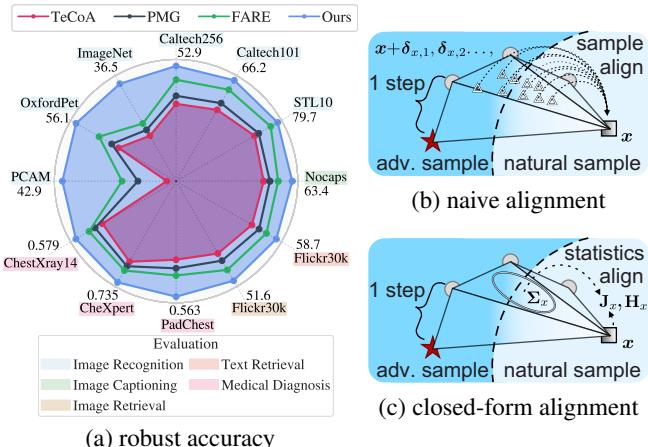
As shown in Figure 1, there is a significant difference in approach:
- Figure 1b (Naive Alignment): Shows the traditional mindset. You might try to sample a few specific points along the path and align them. But sampling is expensive.
- Figure 1c (AdvSimplex): This is the paper’s proposal. Instead of picking points, they define a geometric region (a simplex) defined by the clean image and the adversarial steps. They then use a closed-form mathematical solution to align the clean image with every possible point within that region.
The Core Method: AdvSimplex
The core idea of AdvSimplex is to robustify the VLM not just against discrete adversarial points, but against “Adversarial Simplices.”
What is a Simplex?
In geometry, a simplex is a generalization of a triangle to arbitrary dimensions.
- A 0-simplex is a point.
- A 1-simplex is a line segment.
- A 2-simplex is a triangle.
In this paper, the researchers form simplices using the clean image and two consecutive intermediate adversarial samples from the generation process. If the attack takes steps \(x \to x_1 \to x_2 \dots \to x_m\), the method looks at the triangular regions formed by \((x, x_i, x_{i+1})\).
The goal is to minimize the difference between the model’s prediction of the clean image, \(g(x)\), and the prediction of any point \(p\) inside these triangles.
The Pipeline
Let’s look at how this fits into the training pipeline.
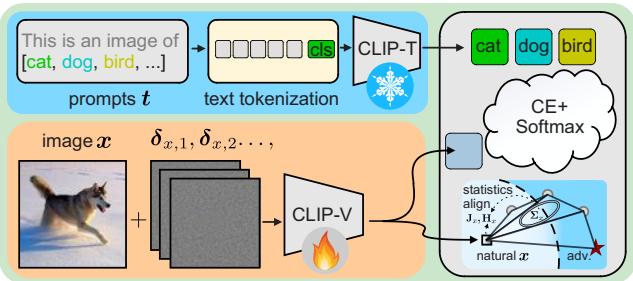
Figure 2 outlines the process:
- Text Branch (Blue Box): Class prompts are processed via the text encoder.
- Vision Branch (Orange Box): The clean image \(x\) is processed. Simultaneously, the system generates a sequence of adversarial examples (\(x + \delta_{x,1}, \dots\)) using gradient ascent.
- Simplex Formation: The system identifies the simplices formed by the clean image and the adversarial path.
- Alignment: The model minimizes the divergence between the clean representation and the representations of the simplex regions.
The Computational Barrier
Here is the catch: If you want to train a model to be robust against every point in a triangle, you theoretically need to sample thousands of points from that triangle and pass them through the model.
For a dataset with 1 million images, if you sample just 10 points per simplex, you are suddenly processing 10 million images per epoch. This is computationally prohibitive (prohibitively slow).
The Solution: Taylor Expansion and Closed-Form Statistics
To solve this, the authors employ a clever mathematical workaround. Instead of running the neural network forward pass on every sampled point, they approximate the network’s behavior using a Taylor Expansion around the clean image \(x\).
The Taylor expansion allows us to approximate the value of a function (the neural network) at a perturbed point using the function’s value at the original point, plus terms involving its derivatives (Jacobian and Hessian).
The authors derive an upper bound for the alignment loss. Instead of summing up errors for individual points, they formulate a loss that depends on the Jacobian (first-order derivatives) and Hessian (second-order derivatives) of the model, combined with the statistical properties of the simplex.
The approximation of the loss function looks like this:
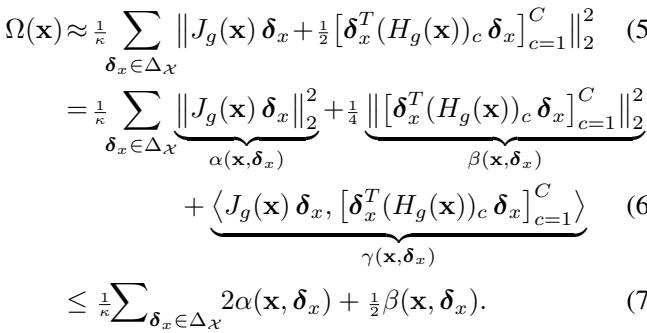
In Equation 5, \(J_g(x)\) is the Jacobian matrix and \(H_g(x)\) is the Hessian. This equation essentially says: “We can estimate the error at a perturbed point \(\delta_x\) by looking at the slope and curvature of the model at the clean point \(x\).”
Infinite Sampling via Closed-Form Matrices
The magic happens when we aggregate this over the whole simplex. Because the Taylor expansion is a polynomial with respect to the perturbation \(\delta\), we don’t need to sample \(\delta\) anymore. We just need to know the “average” behavior of \(\delta\) over the simplex.
This allows the authors to compute a closed-form covariance matrix \(\Sigma_x\). This matrix represents the statistical distribution of all points within the simplex.

Equation 12 shows this closed-form solution for a triangle (3 vertices: \(x, y, z\)). It allows the model to calculate the expected loss over the entire continuous region just by using the coordinates of the vertices.
Why is this a breakthrough? It effectively simulates infinite sampling. By minimizing this upper bound, the model is trained as if it were seeing every single point inside the adversarial triangle, but it only requires the computational cost of calculating the derivatives at the clean image.
Putting It Together: The Loss Function
The final objective function combines the standard classification loss with this new geometric alignment loss.

Here, \(\lambda\) controls the weight of the robustness term. The term \(\omega_i(x)\) allows the model to weight different simplices differently—perhaps focusing more on the parts of the adversarial path that cause the biggest drop in accuracy.

The weighting function (Equation 16) ensures that if a specific step in the attack causes a massive change in prediction, that specific simplex gets prioritized during training.
Experiments and Results
Does this mathematical heavy lifting translate to better models? The authors tested AdvSimplex on ImageNet and 14 other diverse datasets to check for zero-shot robustness.
Performance Comparison
The results indicate that AdvSimplex achieves state-of-the-art performance.
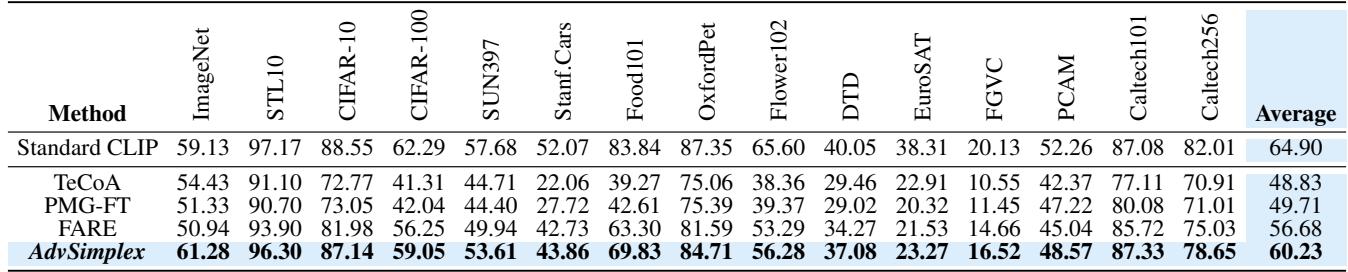
Table 2 shows the Clean Accuracy. One of the biggest risks in adversarial training is that the model becomes so paranoid about noise that it forgets how to classify clean images.
- Standard CLIP has high clean accuracy (64.90%) but zero robustness.
- Competitors like TeCoA and PMG drop significantly in clean accuracy (down to ~48-49%).
- AdvSimplex maintains a much higher clean accuracy (60.23%), bridging the gap significantly.
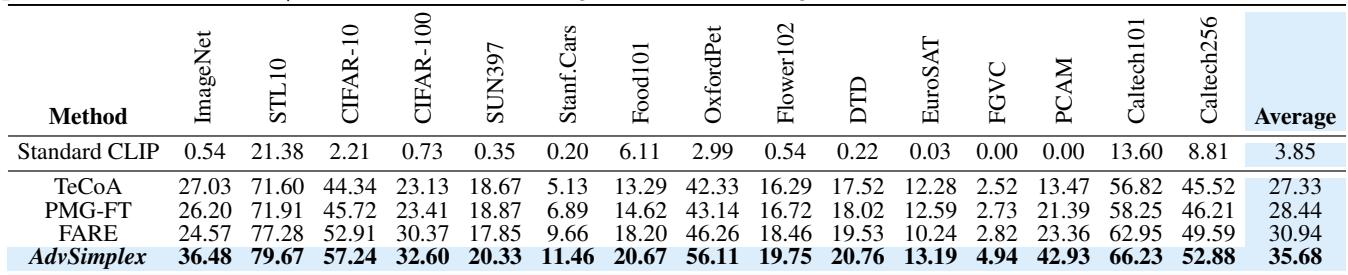
Table 3 shows the Robust Accuracy (how well it resists attacks).
- AdvSimplex achieves the highest average robustness (35.68%) across the 15 datasets, outperforming FARE, PMG, and TeCoA. It is particularly effective on complex datasets like ImageNet and OxfordPet.
Robustness Against “Worst-Case” and Transfer Attacks
The authors didn’t just test against the specific attacks used during training. They simulated a realistic scenario where an attacker tries to find the absolute worst-case perturbation within the simplex at test time.
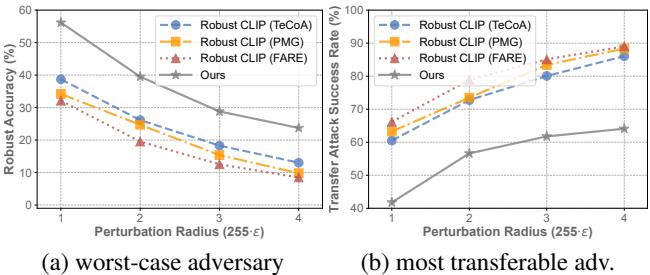
Figure 3a (left) shows robustness against “worst-case” adversaries. AdvSimplex (blue line) maintains higher accuracy as the perturbation radius increases compared to other methods. Figure 3b (right) shows transferability. Interestingly, adversaries generated against AdvSimplex are highly transferable to other models, which paradoxically indicates that AdvSimplex has learned very general, “universal” features of robustness.
Architecture Generalization
Is this specific to one model type? The authors tested across different CLIP backbones (ViT-B, ViT-L, ResNet-50).
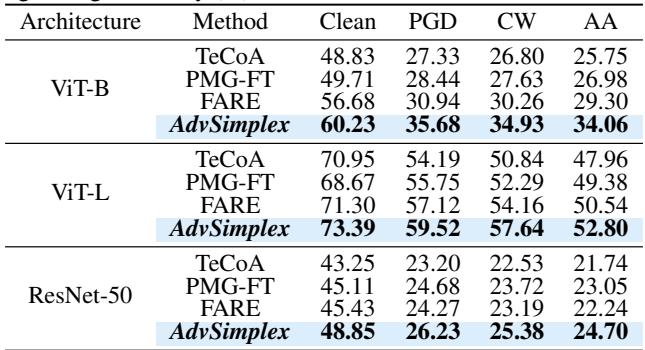
Table 4 confirms that the improvements hold true regardless of the underlying architecture. Whether using a Vision Transformer (ViT) or a ResNet, AdvSimplex consistently outperforms previous fine-tuning methods on PGD, CW (Carlini & Wagner), and Auto-Attack (AA) benchmarks.
The Efficiency Trade-off
Recall the claim that this method saves time compared to sampling. The authors visualized the trade-off between training time and robust accuracy.
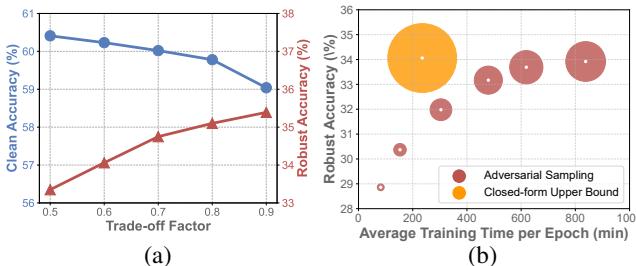
Figure 4b is crucial here.
- The Red Dots represent manual sampling. As you increase the number of samples (larger circles), robustness improves, but training time skyrockets (moving right on the X-axis).
- The Orange Dot is AdvSimplex (“Closed-form Upper Bound”). It sits high on the Y-axis (high robustness) but far to the left (low training time).
- This proves that the Taylor expansion approximation provides the benefits of heavy sampling without the computational penalty.
Conclusion and Implications
The paper “Improving Zero-Shot Adversarial Robustness in Vision-Language Models by Closed-form Alignment of Adversarial Path Simplices” introduces a sophisticated geometric approach to AI safety.
By moving from point-wise alignment (fixing specific bad images) to simplex alignment (fixing dangerous regions of images), the authors enable Vision-Language Models to learn smoother, more robust decision boundaries. The introduction of a closed-form upper bound derived via Taylor expansion turns what would be an impossibly slow training process into an efficient one.
Key Takeaways:
- Geometry Matters: Adversarial attacks are paths, not just points. Defending the path makes the model stronger.
- Math over Brute Force: Instead of computing millions of extra forward passes, calculus (Jacobians/Hessians) can approximate the same result much faster.
- No Free Lunch (But Cheaper Lunch): There is usually a trade-off between clean accuracy and robustness. AdvSimplex minimizes this trade-off better than existing state-of-the-art methods.
As we deploy VLMs in critical areas like healthcare (e.g., analyzing X-rays) and autonomous systems, robustness against invisible noise is not just a nice-to-have features; it’s a safety requirement. AdvSimplex represents a significant step toward making these “foundation models” distinctively more trustworthy.