](https://deep-paper.org/en/paper/3824_invariant_deep_uplift_mod-1740/images/cover.png)
Introduction
Imagine you run a massive online platform—perhaps a short-video app or an e-commerce giant. You have a budget to distribute coupons or high-quality video streams to keep users engaged. The central question of your marketing team is simple: “If we give User X a coupon, will they buy something they wouldn’t have bought otherwise?”
This is not a prediction of purchase; it is a prediction of influence. This field is called Uplift Modeling.
Traditionally, we train machine learning models on historical data to answer this. We look at past users, see who got a coupon, and see who bought items. However, there is a hidden trap in this approach that causes many models to fail in production: The world changes.
The users you see on a Tuesday morning might behave differently than those on a Saturday night. A model trained on data from December (holiday shoppers) might fail miserably in January. In machine learning terms, this is the Out-of-Distribution (OOD) problem. Standard models assume the future looks exactly like the past. When user preferences shift due to time, geography, or trends, standard uplift models start making bad decisions—wasting money on users who don’t need incentives or annoying users who do.
In this post, we are doing a deep dive into a research paper that tackles this exact problem: “Invariant Deep Uplift Modeling (IDUM).” This paper proposes a sophisticated method that doesn’t just look for correlations; it hunts for invariant causal features—factors that drive user behavior regardless of the environment. By leveraging a concept called the Probability of Necessity and Sufficiency (PNS), IDUM creates a model that remains robust even when the testing data looks nothing like the training data.
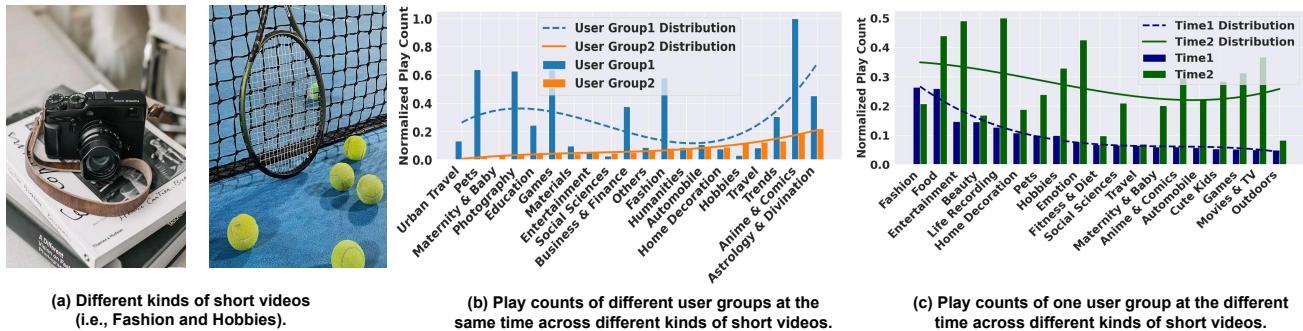
As shown in Figure 1, user behaviors (like play counts) fluctuate wildly across different user groups (b) and different times (c). A model that overfits to the “blue” distribution in Figure 1(b) will fail when deployed on the “orange” population. Let’s explore how IDUM solves this.
Background: The Uplift Modeling Landscape
Before understanding the solution, we must define the problem mathematically.
What is Uplift?
Standard machine learning predicts an outcome \(y\) (e.g., did the user buy?). Uplift modeling predicts the Individual Treatment Effect (ITE) or \(\tau\). We want to know the difference in the outcome if we treat the user (\(t=1\)) versus if we don’t (\(t=0\)).

However, we have a fundamental problem: we can never observe both outcomes for the same person at the same time. A user either gets the coupon or they don’t. This makes calculating the ground truth impossible on an individual level. Instead, we estimate the Conditional Average Treatment Effect (CATE):

This equation essentially says: “For users with features \(x\), what is the average difference in outcome between the treated and untreated groups?”
The Twin Challenges
Current methods, like S-Learners, T-Learners, or even deep learning approaches like TARNet, face two massive hurdles:
- Selection Bias: In historical data, coupons aren’t given out randomly. They are often targeted at specific groups (e.g., loyal customers). This biases the model.
- Distribution Shift (The Focus of IDUM): As mentioned, the distribution of user features \(P(X)\) changes over time. If a model relies on “spurious correlations” (features that are correlated with the outcome in training data but not causally linked), it will fail when the distribution changes.
IDUM is designed to solve the second challenge while keeping the first in check.
Core Method: Invariant Deep Uplift Modeling (IDUM)
The core philosophy of IDUM is Invariant Learning. The authors argue that while environmental features (noise) change, the underlying causal mechanism remains consistent. If a discount truly causes a purchase, that relationship should hold true regardless of whether it’s Monday or Friday, or if the user is in New York or London.
To operationalize this, IDUM introduces a complex architecture. Let’s visualize it first:
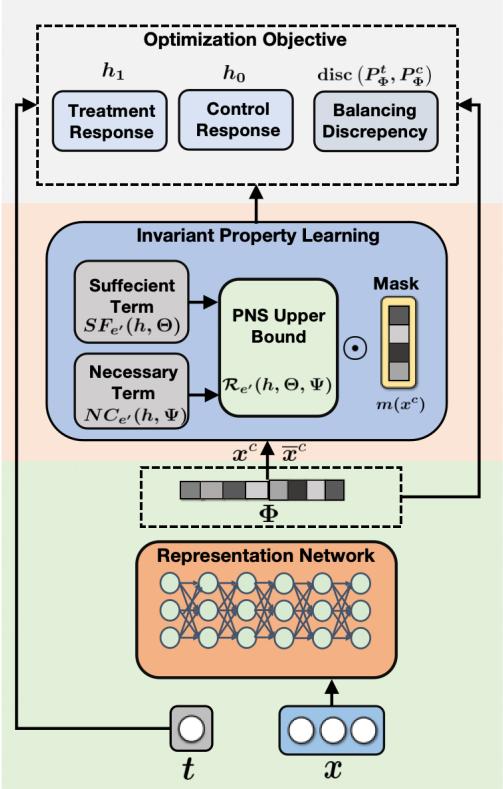
The architecture has three main engines running simultaneously:
- Invariant Property Learning (The Brain): Uses Probability of Necessity and Sufficiency (PNS) to find stable features.
- Feature Selection (The Filter): A masking mechanism to select only the most critical features.
- Balancing Discrepancy (The Stabilizer): Ensures the model handles selection bias between treatment and control groups.
Let’s break these down step-by-step.
1. Invariant Property Learning via PNS
This is the most theoretical and innovative part of the paper. To find invariant features, the authors use Pearl’s causality theory, specifically the Probability of Necessity and Sufficiency (PNS).
The goal is to find features \(X^c\) that are necessary and sufficient for the outcome \(Y\).
Necessity (PN): If the cause (\(A\)) hadn’t happened, the effect (\(B\)) wouldn’t have happened.

Sufficiency (PS): If the cause (\(A\)) happens, the effect (\(B\)) will happen.

PNS: The combined probability that the cause is both necessary and sufficient.

Why does this matter for Deep Learning?
The authors translate these abstract causal concepts into a loss function the neural network can minimize. They define a PNS Risk. The idea is to learn a representation of features that minimizes the error in identifying necessary and sufficient factors.
The PNS Risk is composed of a Sufficient Term (\(SF\)) and a Necessary Term (\(NC\)):

Here, \(\Phi(x)\) is the deep representation of the user. The model tries to minimize the cases where the prediction is wrong given the sufficient features (the \(SF\) term) and maximize the cases where prediction is correct given necessary features.
However, calculating exact PNS requires counterfactual data we don’t have. The authors derive a clever Upper Bound for the risk. Instead of calculating the impossible, they minimize this upper bound, which relies on a concept called Monotonicity.

By minimizing this upper bound (Eq. 8), the model forces the learned features to satisfy the conditions of necessity and sufficiency, making them causally robust and invariant to environment shifts.
2. Bridging the Gap: Source vs. Target Environments
The math above assumes we know the target environment (where we will deploy the model). But in OOD scenarios, we don’t! We only have our training (source) data.
How does IDUM bridge this gap? The authors provide a theoretical bridge using \(\beta\)-divergence, which measures the distance between the source environment \(e\) and the target environment \(e'\).

Using this divergence, they prove a theorem (Theorem 4.6) stating that if you minimize the risk in your source environment (weighted by this divergence), you are mathematically guaranteed to bound the risk in the unseen target environment.

This theorem is the “secret sauce” that allows IDUM to claim generalization capabilities. It tells us that by optimizing a specific objective on our training data, we are safe against future shifts in data distribution.
3. Feature Selection with Gumbel-Softmax
Deep learning models love to overfit on noise. If you feed a model 100 features, and 90 are just noise that correlates with the outcome today, the model will use them. When the noise pattern changes tomorrow, the model crashes.
IDUM employs a Masking Network to aggressively filter out these spurious features. It uses the Gumbel-Softmax trick to learn a binary mask (keep vs. drop) while remaining differentiable (so we can train it with backpropagation).

The model learns a mask \(m(x^c)\). It then multiplies the input features by this mask:

This forces the Invariant Property Learning module (described in step 1) to focus only on the subset of features that are truly invariant.
4. Handling Selection Bias (Balancing Discrepancy)
Finally, IDUM cannot ignore the classic problem of uplift modeling: selection bias in the treatment assignment. If the “treated” group in your data is fundamentally different from the “control” group (e.g., only high-spenders got the coupon), you cannot estimate the true uplift.
IDUM incorporates a Discrepancy Loss (similar to CFRNet). It measures the distance between the feature representations of the treated group (\(P_{\Phi}^t\)) and the control group (\(P_{\Phi}^c\)).

By minimizing this term \(\text{disc}(\cdot)\), the model forces the neural network to map treated and control users into a shared space where their distributions look similar. This mimics a randomized controlled trial (RCT) within the latent space.
The Final Objective
Putting it all together, the IDUM model optimizes a combined loss function:

It minimizes the PNS risk bounds (\(\tilde{M}\) and \(\tilde{SF}\)), the distribution discrepancy (\(\text{disc}\)), and ensures semantic separability between features.
Experiments & Results
The researchers tested IDUM on two datasets:
- Lazada Dataset: A large-scale production dataset from the Southeast Asian e-commerce platform.
- Production Dataset: A real-world dataset from a short-video platform (likely checking the impact of video clarity on play counts).
Crucially, they split the data to create specific Out-of-Distribution (OOD) testing sets to simulate real-world shifts.
Visualizing the Distribution Shift
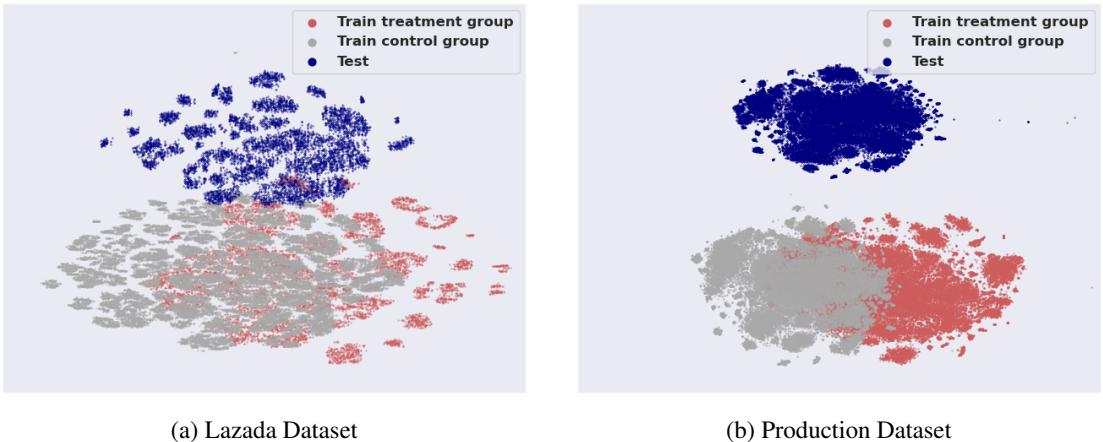
First, let’s confirm the problem exists. Look at the distribution of the Production Dataset below. The blue points (Test data) form a cluster that is distinct from the red/gray points (Training data). This visualizes exactly why standard models fail—they are asked to predict in a “blue” region they haven’t learned well.
Quantitative Results (OOD)
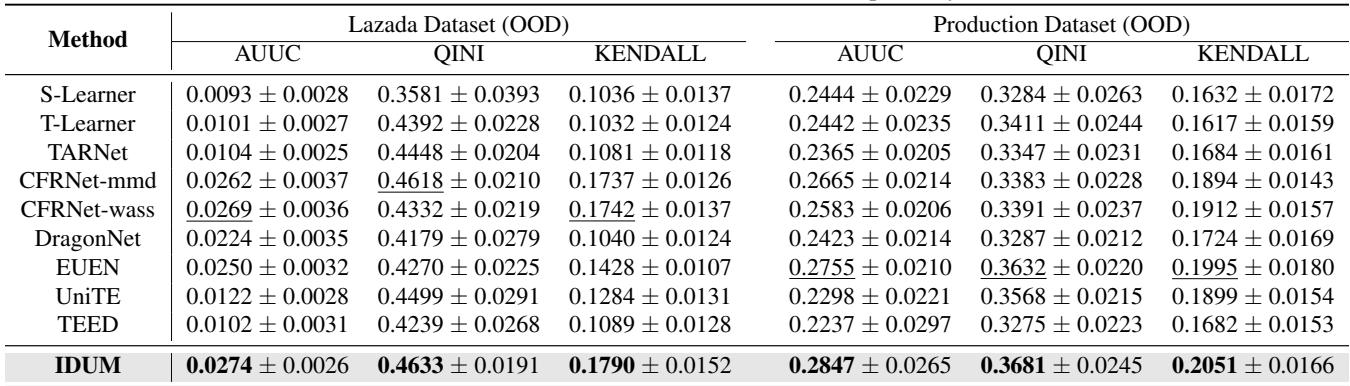
The results on the OOD datasets are the most telling. The table below compares IDUM against standard baselines (S-Learner, T-Learner) and advanced deep learning methods (TARNet, CFRNet, DragonNet).
Key Takeaways:
- Baselines Struggle: S-Learner and T-Learner perform poorly on AUUC (Area Under Uplift Curve), indicating they fail to generalize.
- IDUM Dominates: IDUM achieves the highest AUUC and QINI scores across the board. For example, on the Lazada OOD dataset, IDUM scores 0.0274 AUUC compared to TARNet’s 0.0104. This is a massive improvement in ranking capability.
- Robustness: The low standard deviation suggests IDUM is stable.
Sensitivity Analysis
You might wonder, “Is this model finicky? Do I need to tune the hyperparameters perfectly?”
The authors conducted a sensitivity analysis on the OOD Production dataset. They varied the weights of the different loss components (IPM weight, constraint weight, KL divergence, etc.).
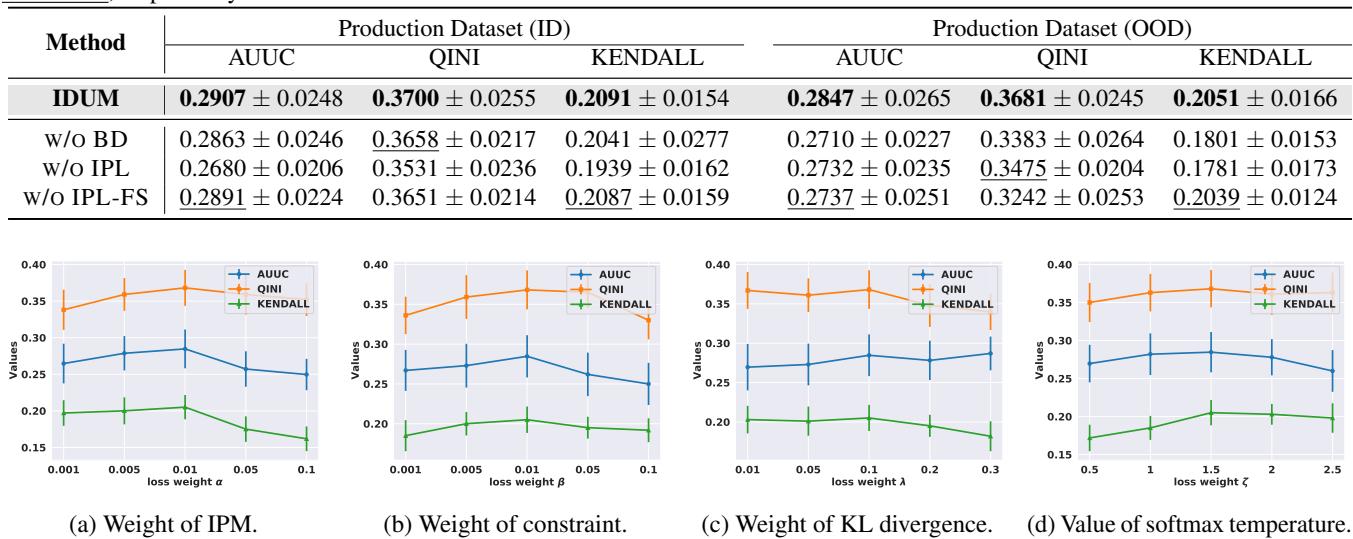
The charts show that while performance varies (as expected), the metrics (AUUC, QINI) remain relatively stable across a reasonable range of hyperparameters. Specifically, Chart (d) shows that the softmax temperature \(\zeta\) (used for feature masking) is quite robust, meaning the feature selection mechanism is reliable.
Conclusion
Uplift modeling is one of the most high-value applications of machine learning in business. It moves us from predicting “who will buy” to “who can be persuaded to buy.” But for too long, these models have been fragile, breaking down as soon as customer behavior shifts or market dynamics change.
The Invariant Deep Uplift Modeling (IDUM) paper provides a rigorous solution to this fragility. By moving beyond simple correlation and enforcing causal invariance through the probability of necessity and sufficiency, IDUM builds models that understand the why rather than just the what.
Key Takeaways for Students & Practitioners:
- OOD is Real: Never assume your training data distribution matches your deployment environment, especially in marketing.
- Causality adds Stability: Incorporating causal concepts (like invariant learning) is the best defense against distribution shifts.
- Architecture Matters: IDUM shows that a thoughtful combination of Feature Selection, Representation Balancing (for selection bias), and Invariant Risk Minimization can state-of-the-art results.
For those building the next generation of recommendation engines or incentive systems, IDUM suggests that the future isn’t just deep—it’s invariant.