](https://deep-paper.org/en/paper/439_pi_0_5_a_vision_language_a-2440/images/cover.png)
Introduction: The Generalization Gap
For decades, the “holy grail” of robotics has been a machine capable of walking into a messy, unfamiliar home and making itself useful—cleaning the kitchen, folding laundry, or tidying up a bedroom. While we have seen impressive videos of robots performing backflips or assembling cars, these feats usually occur in highly controlled environments or “labs” where the robot knows exactly where everything is.
This is the generalization gap. A robot trained to pick up a red mug in a bright lab often fails to pick up a blue mug in a dimly lit kitchen. Scaling up data collection helps, but we simply cannot physically collect robot data in every possible home configuration on Earth.
In a new paper from Physical Intelligence, researchers introduce \(\pi_{0.5}\) (Pi-zero-point-five), a Vision-Language-Action (VLA) model designed to bridge this gap. The core philosophy behind \(\pi_{0.5}\) is that a robot shouldn’t just learn from its own experience. Instead, it should act like a human apprentice: learning from other robots, reading “manuals” (web data), and following high-level semantic instructions.
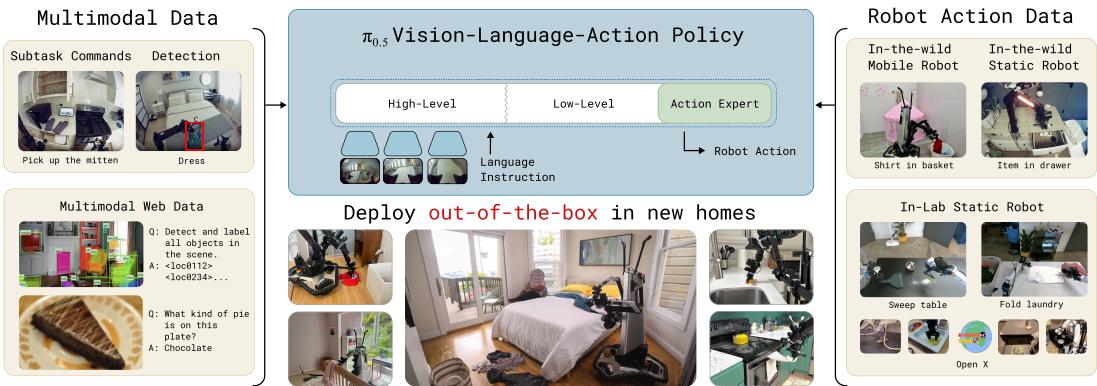
As shown in Figure 1 above, \(\pi_{0.5}\) is not just a robot policy; it is a sponge for diverse data. It demonstrates the ability to control mobile manipulators in entirely new homes—environments it has never seen before—performing complex, long-horizon chores like cleaning kitchens and making beds.
Background: VLAs and The Need for Diversity
To understand \(\pi_{0.5}\), we first need to look at its predecessor technologies. The field has recently converged on Vision-Language-Action (VLA) models. These systems take the architecture of Large Language Models (LLMs) and Vision-Language Models (VLMs) and fine-tune them to output robot actions instead of just text.
Models like \(\pi_0\) (the predecessor to this work) have shown that you can train a VLA to perform dexterous tasks. However, training a VLA solely on data collected by a specific robot in a specific lab limits how well it generalizes. If the robot encounters a drawer handle it hasn’t seen before, or a lighting condition that differs from the training set, it often freezes or fails.
The researchers hypothesize that the solution isn’t just “more data” of the same type, but heterogeneous co-training. This means training the model simultaneously on:
- Data from the specific robot you want to control.
- Data from other types of robots (different arms, different grippers).
- Internet-scale vision and language data (captions, Q&A).
- High-level reasoning tasks (breaking a big goal into sub-steps).
By mixing these sources, the model learns general concepts (what a “handle” looks like generally) from the broad data, and specific motor control from the robot data.
The \(\pi_{0.5}\) Method
The \(\pi_{0.5}\) system is built on a hierarchical architecture that separates high-level reasoning from low-level motor control, all within a unified training framework.
1. The Data Mixture
The foundation of \(\pi_{0.5}\) is its training diet. The model consumes a massive mix of datasets, categorized into five main pillars:
- Mobile Manipulator (MM): Direct data from the target robot performing chores in about 100 different homes.
- Multi-Environment (ME): Data from simpler, non-mobile robot arms bolted to tables in various homes. This provides visual diversity of home environments without the complexity of a mobile base.
- Cross-Embodiment (CE): Lab data from completely different robots performing diverse tasks. This teaches the model about physics and object interaction, even if the robot’s body is different.
- High-Level (HL) & Verbal Instructions (VI): Data where complex tasks are broken down into sub-steps (e.g., “Clean the room” \(\rightarrow\) “Pick up the shirt”).
- Web Data (WD): Standard internet data for image captioning and visual question answering (VQA).
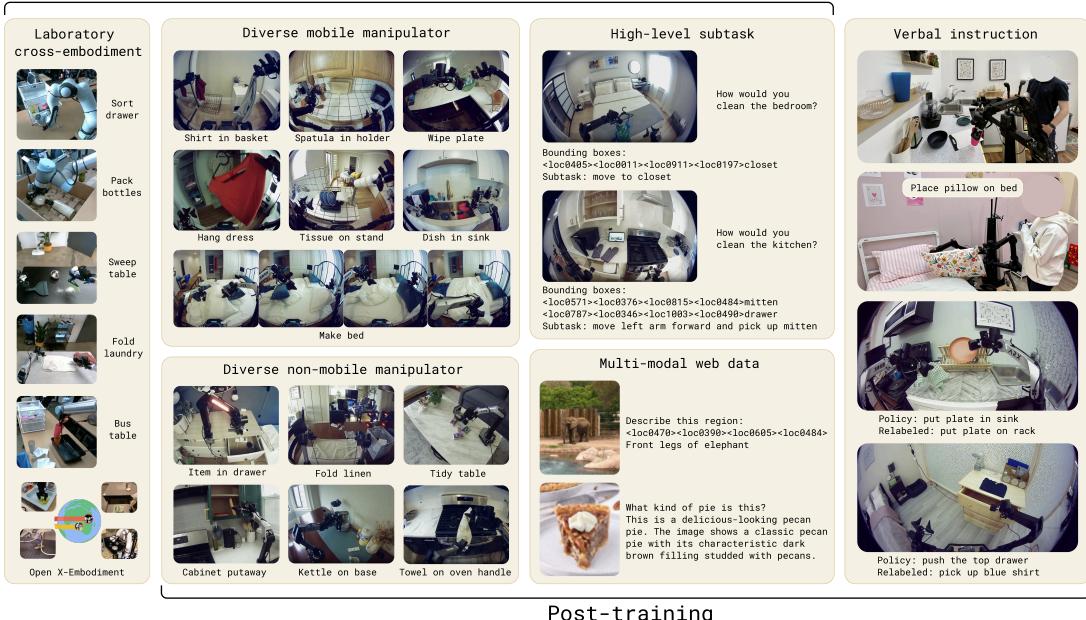
Figure 12 illustrates this variety. Notice how the model learns from everything from “cleaning a spill” (robot data) to identifying an “elephant’s legs” (web data). This breadth is essential for an “open-world” robot.
2. Architecture: From Discrete to Continuous
The architecture of \(\pi_{0.5}\) solves a specific engineering challenge: how to get the reasoning benefits of LLMs while maintaining the precision needed for robot arms.
LLMs work with discrete “tokens” (distinct chunks of information). Robot arms need continuous, smooth motion values. \(\pi_{0.5}\) handles this via a two-stage process:
- Pre-training (The “Brain”): The model is trained as a standard VLM (initialized from PaliGemma). It treats everything as tokens. It predicts text responses and “discretized” actions (turning continuous movements into token codes). This allows it to absorb the massive, diverse datasets described above efficiently.
- Post-training (The “Hands”): The model is fine-tuned to act. The researchers attach an Action Expert—a smaller module specialized for motor control.
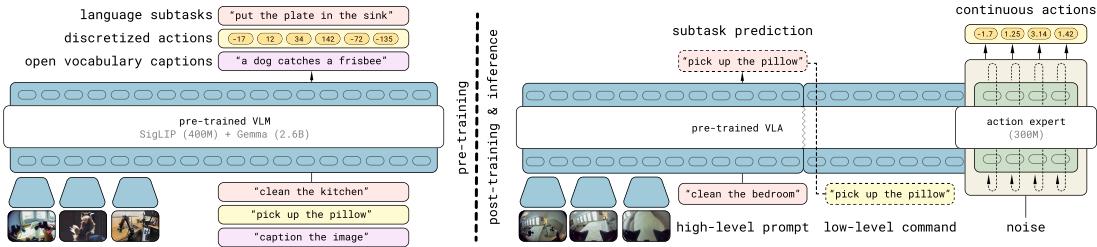
As shown in Figure 3, the post-training phase introduces Flow Matching. Instead of just picking the next token, the Action Expert predicts a vector field—essentially the “flow” of how the robot should move to get from its current position to the target. This results in smooth, high-frequency control that discrete tokens struggle to achieve alone.
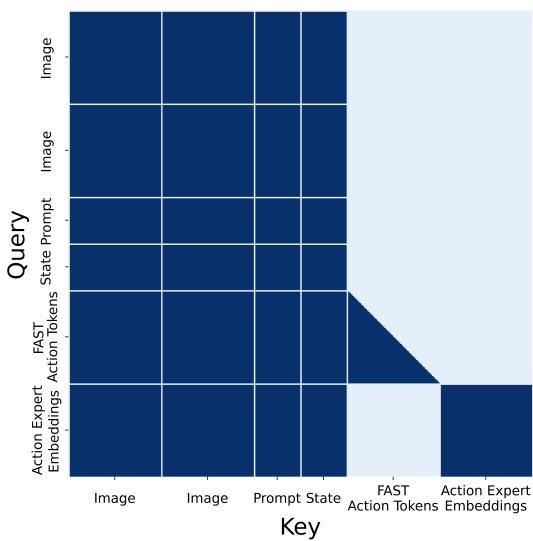
The attention masking (how different parts of the model talk to each other) is designed carefully. The vision encoder feeds the action expert, but the action expert doesn’t feed back into the vision encoder, ensuring a clean flow of information.
3. Hierarchical Inference: Think, Then Act
When the robot is placed in a new home, it doesn’t just react blindly. It uses a hierarchy:
\[ \pi_{\theta}(\mathbf{a}_{t:t+H}, \hat{\ell} | \mathbf{o}_t, \ell) = \pi_{\theta}(\mathbf{a}_{t:t+H} | \mathbf{o}_t, \hat{\ell}) \pi_{\theta}(\hat{\ell} | \mathbf{o}_t, \ell) \]
This equation simplifies to a two-step process:
- High-Level Policy (\(\pi_{\theta}(\hat{\ell} | \mathbf{o}_t, \ell)\)): The model looks at the image (\(\mathbf{o}_t\)) and the main goal (\(\ell\), e.g., “clean the kitchen”). It predicts a semantic subtask \(\hat{\ell}\) (e.g., “pick up the blue plate”).
- Low-Level Policy (\(\pi_{\theta}(\mathbf{a}_{t:t+H} | \mathbf{o}_t, \hat{\ell})\)): The Action Expert takes that specific subtask (“pick up the blue plate”) and generates the physical motor commands (\(\mathbf{a}\)) to do it.
This mimics how humans think: we decide what to do, then our motor cortex figures out how to move our muscles.
4. Mathematical Foundation
The training objective combines these discrete and continuous worlds. The loss function looks like this:

Here, the first part (\(H\)) is the standard cross-entropy loss used in LLMs—it trains the model to understand text and high-level concepts. The second part (after the \(\alpha\)) is the flow matching loss—it minimizes the difference between the predicted movement trajectory and the actual optimal trajectory. By optimizing both, \(\pi_{0.5}\) becomes a “polymath,” fluent in both language and motion.
Experiments & Results
The researchers didn’t just test this in a simulator. They deployed mobile manipulators into entirely new homes—Airbnb-style rentals that the robot had never seen during training.

As seen in Figure 2, the robot successfully navigated real kitchens, managing tasks like closing cabinets, wiping spills, and loading sinks.
Experimental Setup
The evaluation covered two main settings:
- Mock Environments: Controlled setups for rigorous, reproducible benchmarking.
- Real Homes: Three distinct real-world homes to test true “wild” generalization.

Key Finding 1: Generalization Scales with Environments
A crucial question in robotics is “scaling laws.” In LLMs, more text data equals smarter models. In robotics, does more environment data equal better generalization?
The answer is yes.
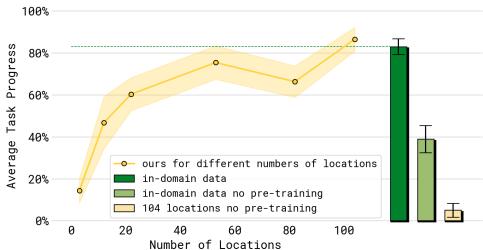
In Figure 6 (labeled here as Figure 9 from the deck), we see the performance on four test tasks as the number of training locations increases. The performance curve goes up steadily. Most impressively, the green bar represents a model trained specifically on the test home. \(\pi_{0.5}\) (the orange line) eventually matches the performance of the specialist model, despite never having seen the test home before.
Key Finding 2: The Importance of Heterogeneous Data
This is perhaps the most educational part of the paper. The researchers performed “ablations,” systematically removing parts of the training data to see what would break.
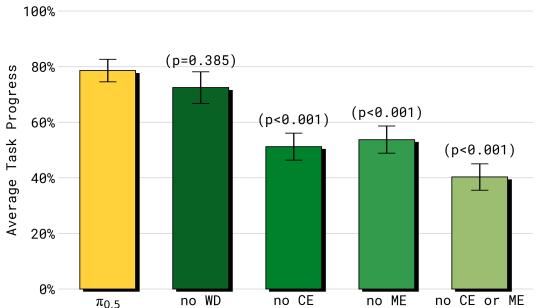
Figure 8 reveals the impact of different data sources:
- No ME (Multi-Environment) / No CE (Cross-Embodiment): Performance collapses. This proves that data from other robots and static arms is vital. Even if the embodiment is different, the physics of “picking things up” transfers.
- No WD (Web Data): At first glance (in Figure 8), removing web data doesn’t seem to hurt the average task much. However, Figure 9 (below) tells a different story.
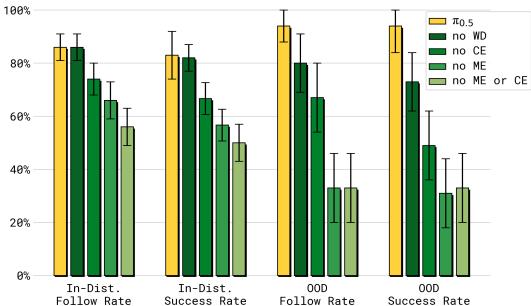
When the robot is asked to interact with Out-Of-Distribution (OOD) objects (weird items it hasn’t seen before), the model trained without Web Data (dark green bar) fails significantly more often than the full \(\pi_{0.5}\) model (yellow bar). This confirms that web data provides the semantic “common sense” needed to recognize novel objects.
Key Finding 3: Comparison to Baselines
Finally, how does it stack up against previous state-of-the-art models like \(\pi_0\)?
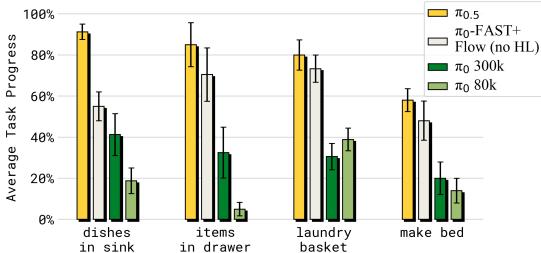
The difference is stark. \(\pi_{0.5}\) significantly outperforms \(\pi_0\) and enhanced versions of \(\pi_0\), particularly in the mock home environments which require robust generalization.
Conclusion and Implications
\(\pi_{0.5}\) represents a shift in robotic learning. It moves away from the idea that we need to collect a trillion hours of data on a specific humanoid to make it useful. Instead, it embraces a transfer learning approach where every scrap of data—from a static arm in a lab, to a caption on the internet, to a human verbally guiding a robot—contributes to a general understanding of the physical world.
The model demonstrates that:
- Architecture matters: Separating high-level semantic planning from low-level flow-matched control allows for both reasoning and dexterity.
- Diversity is key: You cannot achieve open-world generalization without a mixture of robot data (for physics) and web data (for semantics).
- Scale works: Increasing the number of unique training environments linearly improves the robot’s ability to handle a completely new house.
While limitations remain—the robot still makes mistakes, and 80-90% success rates aren’t quite enough for a consumer product yet—\(\pi_{0.5}\) provides a clear recipe for the future. By feeding robots a richer, more varied diet of experiences, we are inching closer to the day when a robot can truly walk into any home and help with the chores.