](https://deep-paper.org/en/paper/495_contrastive_forward_predic-2551/images/cover.png)
Introduction
Imagine you are hiking up a steep, rocky trail. Suddenly, you twist your ankle. It hurts, and your range of motion is limited. What do you do? You don’t stop functioning; you adapt. You shift your weight, change your gait, and favor the uninjured leg. You consciously predict that putting weight on the bad ankle will result in failure, so you adjust your control signals accordingly.
This ability to adapt to physical impairment is natural for biological beings, but it is an immense challenge for robots. In the field of legged robotics, reliability is the holy grail. We want robots to navigate disaster zones, explore planetary surfaces, and inspect industrial sites. However, hardware breaks. Motors wear out, gearboxes jam, and legs sustain damage. For a standard robot, a single locked joint often leads to immediate failure.
Today, we are diving deep into a research paper titled “Contrastive Forward Prediction Reinforcement Learning for Adaptive Fault-Tolerant Legged Robots.” This work proposes a fascinating solution to the fragility of robotic locomotion. Instead of programming specific responses for every possible break, the researchers gave the robot the ability to predict its own movement and use the error in that prediction to understand that something has gone wrong.
By combining Contrastive Learning (to organize experiences) with a Forward Prediction Model (to guess the future state), this framework allows robots to adapt to broken joints in real-time—even identifying damage types they have never seen before.
The Problem: Why is Fault Tolerance so Hard?
To understand the contribution of this paper, we first need to look at how robots usually walk.
Model-Based Control vs. Data-Driven Learning
Traditionally, Model-Based Control has been the standard. Engineers create a physics model of the robot (mass, inertia, leg length) and use mathematical solvers to calculate the exact torque needed for a step. This works beautifully—until the robot breaks. If a motor jams, the real robot no longer matches the physics model. The controller commands a motion, the leg doesn’t move, and the robot falls.
More recently, Deep Reinforcement Learning (DRL) has taken over. Here, a neural network learns to walk by trial and error in a simulation. DRL is more robust to noise, but it suffers from the “black box” problem. Standard DRL policies often struggle to generalize. If you train a robot to walk with a healthy body, it has no idea what to do when a leg drags. Even if you train it with some broken legs, it often fails when it encounters a specific type of damage it hasn’t seen (Out-of-Distribution faults).
The Missing Piece: Self-Awareness via Prediction
The researchers behind this paper identified a gap. Existing methods either rely too much on perfect models or lack the internal representation to understand what kind of damage has occurred.
Their hypothesis was simple yet powerful: A robot can adapt better if it constantly compares what it thinks should happen with what actually happens.
The Core Method: Contrastive Forward Prediction
The proposed framework is a sophisticated architecture that doesn’t just map observations to actions. It builds an internal understanding of the robot’s health. Let’s break down the architecture step-by-step.
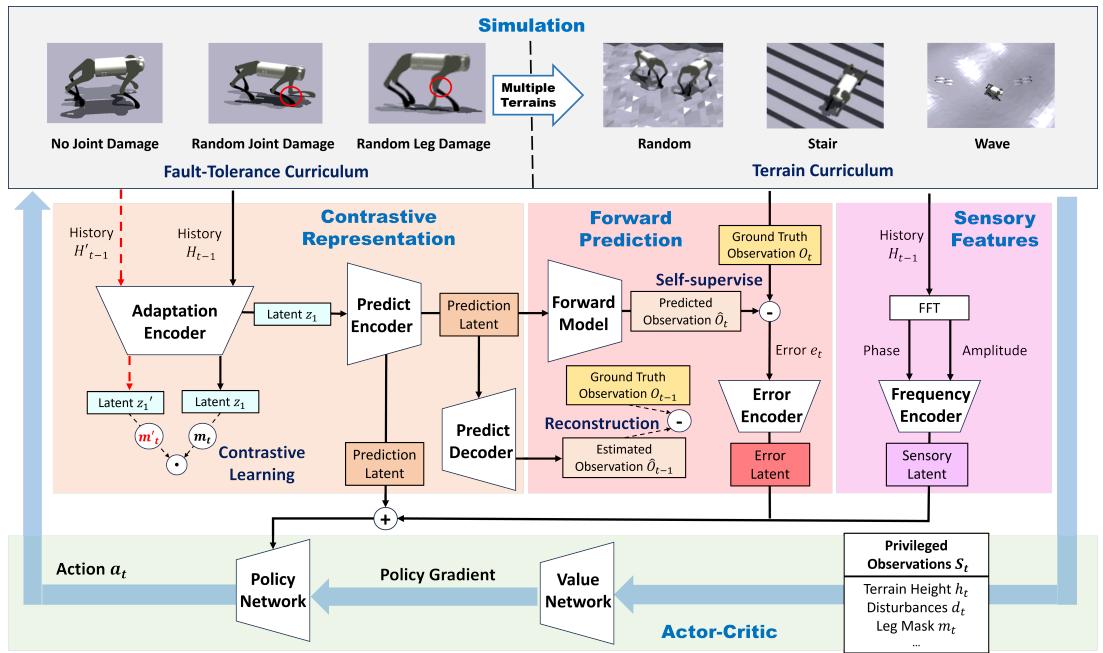
As shown in Figure 1 above, the system is composed of several specialized modules that feed into the main Policy Network. The training process uses a “Curriculum” strategy (top of the image), gradually making the simulation harder by introducing joint damage and complex terrains.
Let’s dissect the three main pillars of this network: the Contrastive Representation, the Forward Prediction Module, and the Sensory Features (FFT).
1. Contrastive Representation: Learning to Distinguish Faults
How does a robot know the difference between a “locked hip joint” and a “powerless knee”? To the raw sensors, both might just look like “bad movement.”
The authors introduce an Adaptation Encoder. This module takes a history of observations (\(H_{t-1}\)) and compresses them into a latent vector (\(z_1\)). To ensure this vector carries meaningful information about the fault type, they use Contrastive Learning.
In machine learning, contrastive learning is a technique used to pull similar things together and push different things apart. The researchers want the network to learn that all “left-leg failure” scenarios are mathematically similar, while being mathematically distinct from “right-leg failure” scenarios.
The loss function used to train this representation is shown below:

Here is what this equation achieves:
- It maximizes the similarity between samples (\(z_i\) and \(z_j\)) that share the same fault condition (the same “leg mask”).
- It minimizes the similarity between samples with different fault conditions.
This creates a structured “latent space” where specific mechanical failures form distinct clusters. This structured understanding helps the policy network quickly identify which leg is acting up.
2. The Forward Model: Predicting the Future
This is the heartbeat of the fault-tolerance mechanism. The framework includes a Forward Prediction Model.
During operation, the robot looks at its current state and its intended action. The Forward Model then makes a prediction: “If I apply this torque, my leg should move to position X.”
Simultaneously, the robot reads its actual sensors. It then uses a Comparator to calculate the difference between the Predicted State and the Actual State.
- Scenario A (Healthy): The prediction matches the reality. The error is near zero.
- Scenario B (Damaged): The robot commands the leg to move, but the joint is locked. The prediction says “leg moves,” but reality says “leg stayed still.” This generates a massive Prediction Error.
This error isn’t just discarded; it is encoded into a feature vector and fed directly into the controller. It serves as an immediate “pain signal” or “reality check,” informing the robot that the dynamics have changed.
The Forward Model is trained using Self-Supervised Learning (SSL) with a standard Mean Squared Error (MSE) loss:
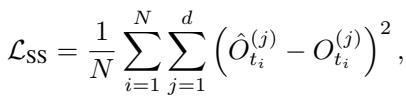
By minimizing the difference between the predicted observation (\(\hat{O}\)) and the actual observation (\(O\)), the model becomes an expert at simulating the robot’s own physics.
3. Sensory Features: The Rhythm of Walking
Locomotion is periodic; it has a rhythm. When a robot limps, that rhythm changes in the frequency domain. To capture this, the researchers use a Fast Fourier Transform (FFT).
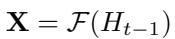
They process the history of proprioceptive data (joint angles, velocities) through an FFT to extract amplitude and phase information. This helps the robot detect subtle vibrational patterns or rhythmic disturbances caused by damage that might be invisible in a single snapshot of time.
Putting It All Together: The Training Loop
The total loss function used to train the entire system is a weighted sum of several components: surrogate loss (for the policy), value loss (for the critic), entropy (for exploration), and the specific losses for the specialized modules we just discussed (VAE, Contrastive Learning, and Self-Supervised prediction).

This composite loss function ensures that while the robot is learning to walk (maximizing reward), it is simultaneously learning to cluster fault types (Contrastive Loss) and accurately predict its own body mechanics (Self-Supervised Loss).
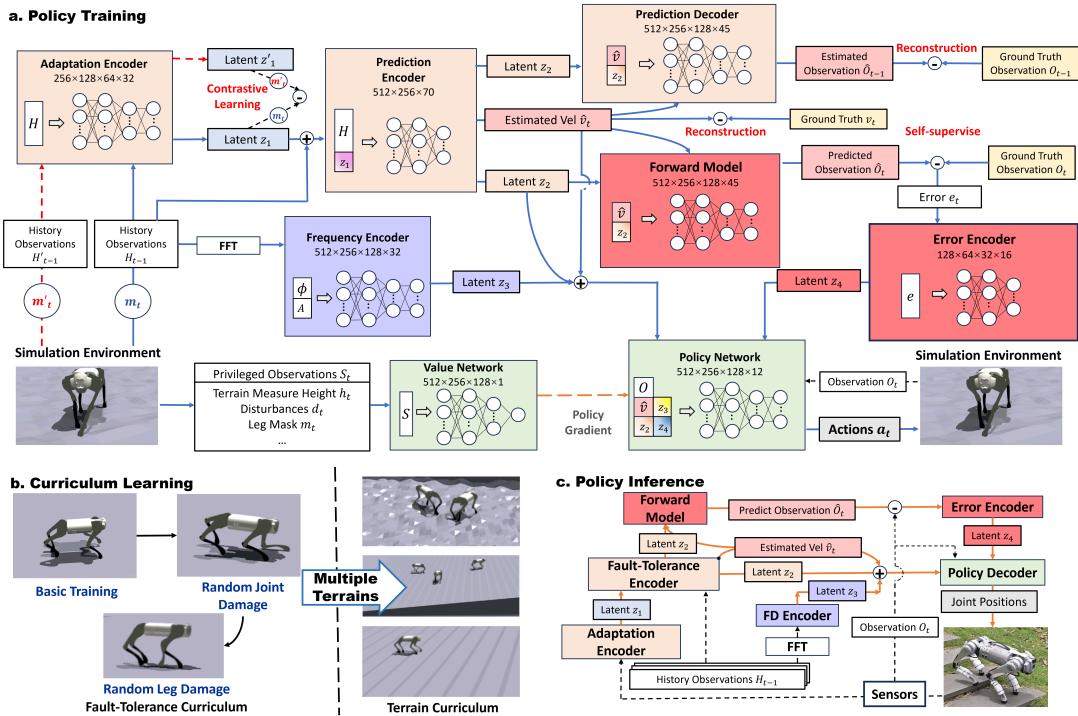
The complete training and inference pipeline is visualized in Figure 7 below. Note how the “Curriculum Learning” (part b) ramps up difficulty, and how the deployed policy (part c) runs in real-time on the robot.
Experiments and Results
Theory is good, but does it work? The researchers tested this framework on both a Unitree A1 Quadruped and a custom-built Hexapod. They utilized the Isaac Gym simulator for training and transferred the policy to real robots (Sim-to-Real).
Adaptability Across Terrains
One of the first tests was to see if the robot could handle joint damage while navigating complex terrain. A limping robot might manage a flat floor, but can it climb stairs?
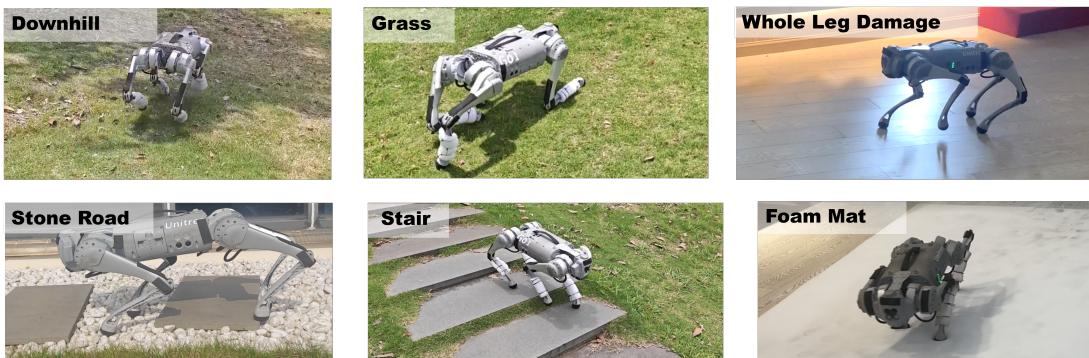
As seen in Figure 2, the robot successfully navigated stone roads, stairs, and grassy slopes even with whole-leg damage. This confirms that the fault-tolerance isn’t fragile; it works in unstructured environments.
Quantitative Performance & Ablation
The researchers compared their method against a strong baseline called DreamWaq. They also performed ablation studies—removing parts of their system to see if they were actually necessary.
Looking at Figure 3(a) (the graph on the left), we see the learning curves.
- The Red Line (Ours) consistently achieves the highest return (reward).
- The Orange Line (DreamWaq) performs significantly worse.
- Crucially, look at the Black Line (Ours w/o PE). This represents the method without the Prediction Error. The drop in performance proves that the Forward Prediction/Comparator mechanism is vital for success.
Figure 3(b) shows the prediction error itself. Notice how it spikes? That spike is the signal the robot uses to realize something is wrong.
Visualizing the “Brain”: t-SNE Analysis
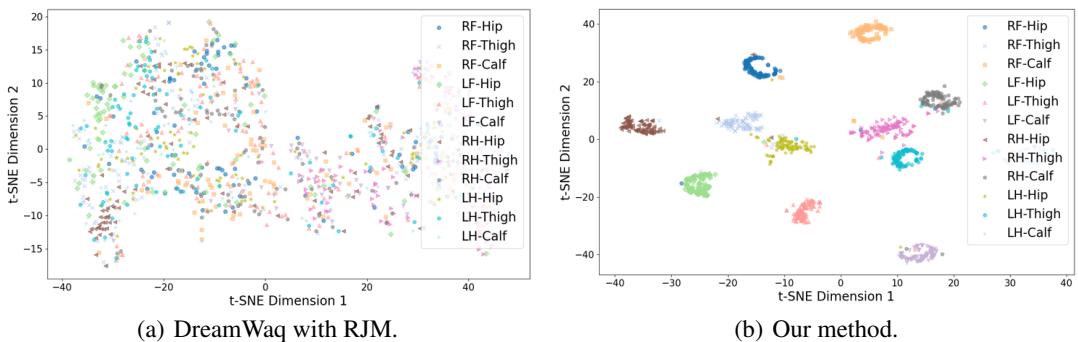
Remember the Contrastive Learning module intended to group similar faults? The researchers visualized the latent space using t-SNE (a dimensionality reduction technique).
In Figure 4 (part of the image above), compare the two clusters:
- DreamWaq (Left): The points are scattered. The robot struggles to mathematically distinguish between a hip failure and a knee failure.
- Our Method (Right): Distinct, tight clusters. The red dots (RF-Hip) are far away from the purple dots (RH-Hip). This proves the robot has learned a “semantic” understanding of its own broken parts.
Zero-Shot Transfer: The Ultimate Test
The most impressive result is the Zero-Shot Transfer.
The robot was trained primarily on “Zero Torque” faults (the motor goes limp). However, in the real world, joints often “Lock” (stuck in place). This is physically very different.
Did the robot need retraining? No.
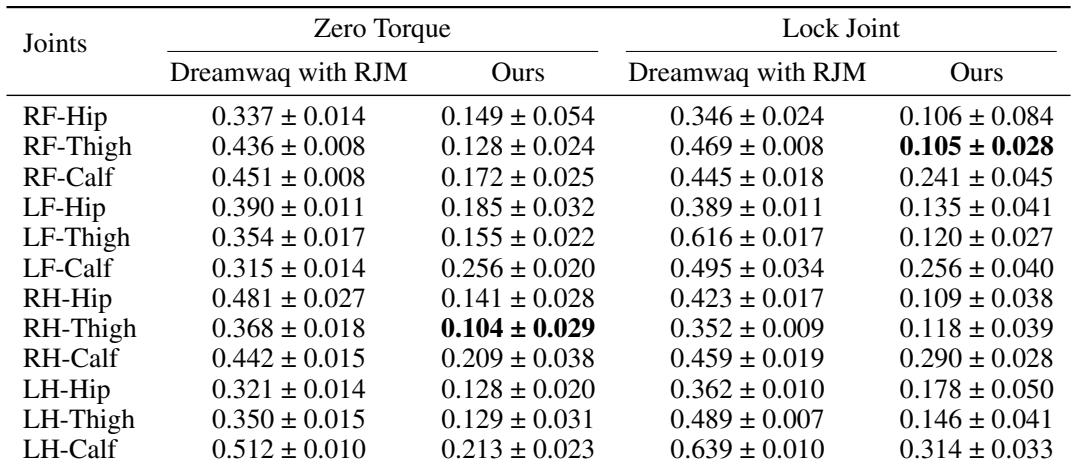
Table 1 shows the velocity tracking error. Lower is better.
- Under Lock Joint conditions (which the robot barely saw during training), the proposed method (“Ours”) maintains low error rates compared to the baseline.
- For example, with a locked Left Front Thigh (LF-Thigh), the baseline error is 0.616, while the proposed method is 0.120. That is a massive improvement in control authority.
Because the Forward Model predicts “movement” and the reality is “no movement,” the Prediction Error spikes regardless of why the leg didn’t move (limp or locked). This generic error signal allows the controller to adapt to the locked joint immediately without explicit training.
Hexapod Generalization
To prove the method isn’t just for four-legged dogs, they applied it to a six-legged robot.
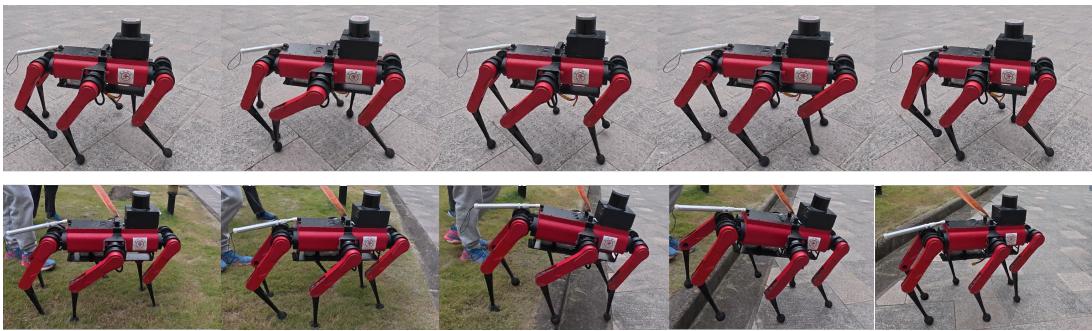
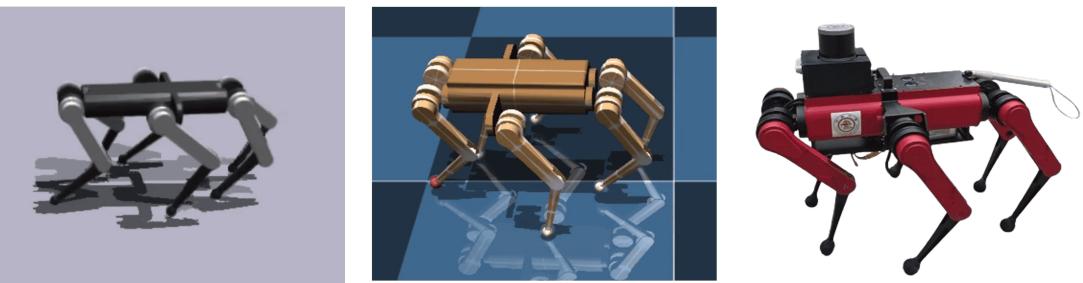
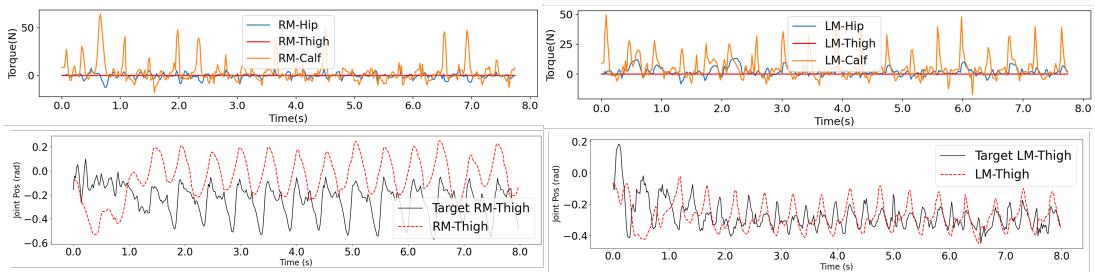
The hexapod successfully walked even with two of its middle legs damaged. Figure 6 (below) shows the torque outputs. You can see the damaged joints (dotted red lines) struggling to track targets, but the other joints adjusting to compensate.
Conclusion and Implications
The paper “Contrastive Forward Prediction Reinforcement Learning for Adaptive Fault-Tolerant Legged Robots” presents a significant step forward in robotic reliability.
By moving away from static models and purely reactive controllers, the researchers have given robots a rudimentary form of self-awareness. The integration of Contrastive Learning allows the system to categorize its health status, while the Forward Prediction Model provides a continuous reality check.
Key Takeaways:
- Prediction is Power: Using the error between predicted and actual states is a robust way to detect anomalies without knowing exactly what caused them.
- Structure Matters: Forcing the neural network to structure its latent space (via Contrastive Learning) significantly improves its ability to identify specific faults.
- Zero-Shot Potential: A system that understands “error” generally can adapt to specific faults (like locked joints) it hasn’t been explicitly trained on.
As we look toward a future where robots work alongside humans in hazardous environments, this kind of adaptive “immune system” for mechanical failure will be essential. It shifts the paradigm from “building unbreakable robots” to “building robots that can handle breaking.”