](https://deep-paper.org/en/paper/536_search_tta_a_multi_modal_t-2607/images/cover.png)
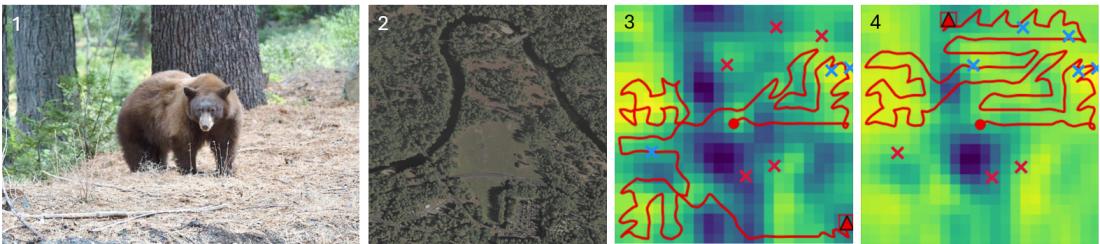
Imagine a drone deployed over a dense forest in Yosemite Valley. Its mission: locate black bears. The drone has a satellite map, but the map resolution is too low to see a bear directly. Instead, the drone must rely on visual priors—intuition derived from the map about where bears likely are (e.g., “bears like dense vegetation, not parking lots”).
But what happens if that intuition is wrong? What if the map is outdated, or the Vision-Language Model (VLM) guiding the drone hallucinates, predicting bears in an open field where none exist? In traditional systems, the drone would waste valuable battery life searching empty areas based on a bad initial guess.
This is the core problem addressed in the paper “Search-TTA: A Multimodal Test-Time Adaptation Framework for Visual Search in the Wild.” The researchers propose a system that doesn’t just stick to a pre-trained plan. Instead, it “learns” on the fly, updating its internal probability maps in real-time as it gathers data.
In this deep dive, we will explore Search-TTA, a framework that combines multimodal inputs (images, text, sound) with a novel adaptation mechanism inspired by statistical physics to make autonomous search smarter and more efficient.
The Challenge: Autonomous Visual Search (AVS)
Autonomous Visual Search (AVS) is a critical task for robotics, with applications ranging from search-and-rescue missions to ecological monitoring. The goal is simple: find targets in a large environment under a time or battery budget.
The constraints, however, are difficult:
- Limited Field of View (FOV): The robot can only see a small area at a time.
- Invisible Targets in Global Maps: The robot usually has a global map (like a satellite image), but the targets (animals, lost hikers) are too small to be seen in it.
- Static Models: Most current approaches use a static vision model to predict where targets might be. If the model is wrong at the start (due to domain shifts or lack of training data), the robot is doomed to an inefficient search path.
The Hallucination Problem
Recent advances have utilized large Vision-Language Models (VLMs) like CLIP to guess target locations based on satellite imagery. While powerful, these models often “hallucinate.” They might confidently predict that a specific texture in a satellite image represents a habitat for a species when it effectively does not. Without a mechanism to correct these errors during the mission, the robot continues to trust the bad prediction.
The Solution: Search-TTA
The researchers introduce Search-TTA, a framework that allows the robot to adapt its visual priors during the test time (the actual search mission).
The framework has two main capabilities:
- Multimodal Querying: You can tell the robot what to look for using an image, a text description, or even a sound clip.
- Online Adaptation: As the robot explores and collects “positive” (target found) or “negative” (nothing here) measurements, it performs gradient updates on its vision encoder to refine the probability map for the rest of the map.
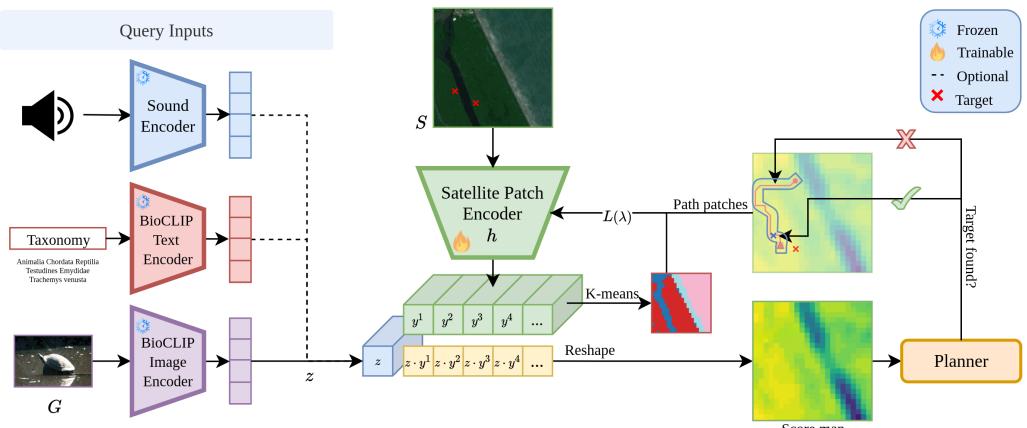
As shown in Figure 3 above, the system is modular. It takes a query (e.g., an image of a bear) and a satellite map. It generates an initial score map (heatmap of probability). A planner then directs the robot. Crucially, the feedback loop allows the system to update the Satellite Patch Encoder using a specific loss function, which we will detail later.
The Engine: How It Works
Let’s break down the technical architecture of Search-TTA.
1. Multimodal Alignment
To search for something, the robot first needs to understand what it is looking for. The researchers align a satellite image encoder with the BioCLIP embedding space. BioCLIP is a VLM pre-trained on a massive biological dataset (TreeOfLife).
By using contrastive learning, they train a satellite image encoder so that the embedding of a satellite patch (viewed from space) is close to the embedding of the ground-level image (viewed from a camera) of the animal found there.
This creates a shared representation space. Whether you feed the system a photo of a bear, the text “Ursus americanus,” or an audio recording of a bear growl, the system projects this query into the same vector space as the satellite patches. The Score Map is generated by calculating the cosine similarity between the query embedding and every patch of the satellite map.
2. The Feedback Loop: Spatial Poisson Point Processes
This is the most innovative part of the paper. How do you mathematically tell a neural network, “I looked at grid cell (X,Y) and saw nothing, so please lower the probability there, and also lower the probability for other areas that look like this one?”
The authors draw inspiration from Spatial Poisson Point Processes (SPPP). SPPP is a statistical tool used to model the intensity of scattered points (targets) in a space.
The standard SPPP loss function is designed for regression over large batches of known data. However, a robot searching in the wild has sparse data—it starts knowing nothing. If the robot searches for 5 minutes and finds nothing, a standard loss function might aggressively drive all probabilities to zero (mode collapse).
To fix this, the authors introduce a modified, uncertainty-weighted loss function:

Here is the intuition behind this equation:
- Positive Update (\(\alpha_{pos}\)): If a target is found at \(x_i\), maximize the likelihood (log \(\lambda(x_i)\)).
- Negative Update (\(\alpha_{neg}\)): If a target is not found at \(x_j\), minimize the intensity.
- The Regulator (\(\alpha_{neg, j}\)): This is the key. The negative weight is scaled based on how much of that specific region type has been explored.
The weighting term is defined as:
\[ \alpha_{neg,j} = \min(\beta(O_r / L_r)^\gamma , 1) \]Where \(O_r\) is the number of observed patches in region \(r\), and \(L_r\) is the total size of that region.
Why does this matter? Before the search starts, the system uses K-Means clustering to group satellite patches into semantic clusters (e.g., “Cluster 1” might be dense forest, “Cluster 2” might be water). If the robot visits one patch of “dense forest” and finds nothing, the system shouldn’t immediately assume all dense forests are empty. The \(\alpha_{neg}\) term ensures that the model only lowers its confidence significantly after it has explored a sufficient portion of that terrain type.
3. Visualizing Adaptation
The effect of this adaptation is dramatic. The figure below shows the search for a Marmot.

- Panel 3: The initial CLIP prediction is vague; it thinks Marmots could be anywhere.
- Panel 4: As the robot searches empty areas, the TTA mechanism lowers the probability in those specific terrain types (shown by the cooling colors).
- Panel 5: Once a Marmot is found, the system spikes the probability for that location and semantically similar locations.
- Panel 6: This creates a refined map that guides the planner to the remaining targets efficiently.
The AVS-Bench Dataset
One major hurdle in this field was the lack of appropriate data. Existing datasets either didn’t have invisible targets or lacked the ecological diversity needed for “in the wild” testing.
The authors curated AVS-Bench, a massive dataset based on internet-scale ecological data.
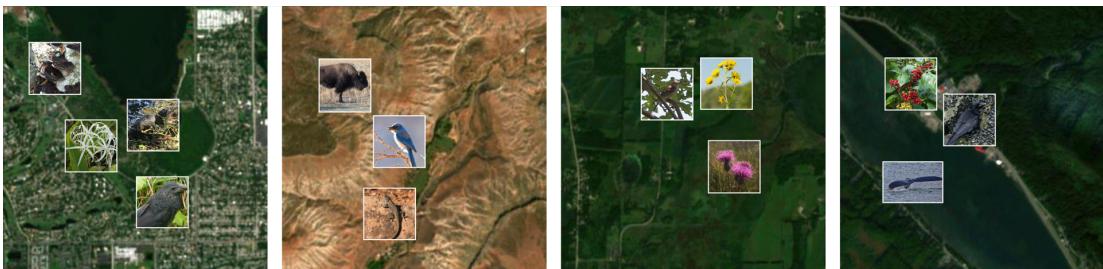
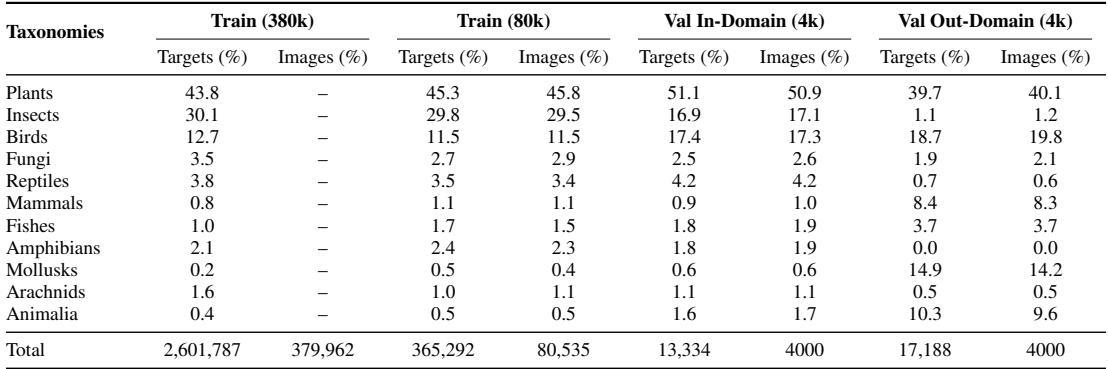
- Scale: 380,000 training images and 8,000 validation images.
- Diversity: Covers diverse geographies and taxonomies (mammals, birds, reptiles, plants).
- Data Structure: Each entry pairs a satellite image with target locations, ground-level images, and taxonomic labels.
This dataset is significant because the targets (animals) are not visible in the satellite imagery. The model must learn the correlation between the environment (habitat) and the target, rather than spotting the target directly.
Experiments and Results
The researchers validated Search-TTA extensively against various baselines, including static planners (Information Surfing) and Reinforcement Learning (RL) planners without adaptation.
1. Quantitative Performance
Does adapting on the fly actually help find more targets? Yes.
The table below shows the performance on “Out-domain” taxonomies (species the model wasn’t explicitly trained on).
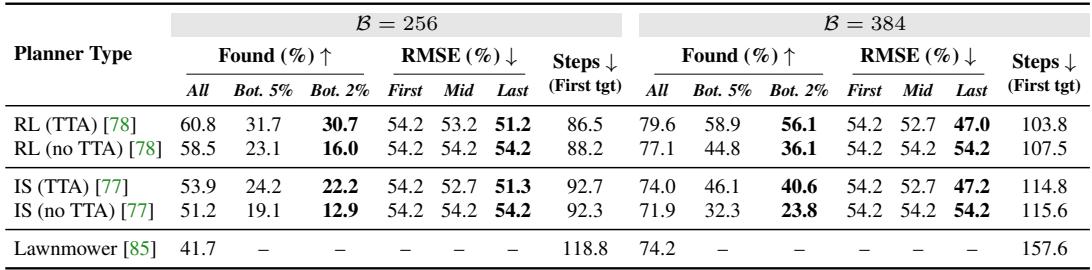
Key takeaways:
- Consistent Improvement: Adding TTA improves performance across all planner types (RL and Information Surfing).
- Rescuing Bad Maps: The “Bot. 5%” and “Bot. 2%” columns are crucial. These represent cases where the initial CLIP prediction was terrible (e.g., predicting the animal is in water when it’s on land). In the bottom 2% of cases, TTA improved the RL planner’s success rate from 16.0% to 30.7% (a nearly 2x improvement). This proves the system effectively “fixes” bad initial intuitions.
2. Dataset Scaling and Efficiency
An interesting finding emerged regarding the training data size. The authors found that Search-TTA offers the highest relative gain when the base model is weaker (trained on less data).
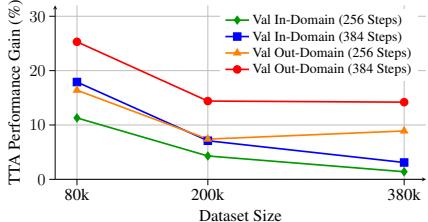
This suggests that TTA is a powerful tool for deploying models in scenarios where massive training datasets aren’t available. It compensates for the lack of pre-training by learning continuously during deployment.
3. Zero-Shot Generalization
Because the system aligns inputs to a shared embedding space, it can handle modalities it wasn’t explicitly fine-tuned for, such as sound.
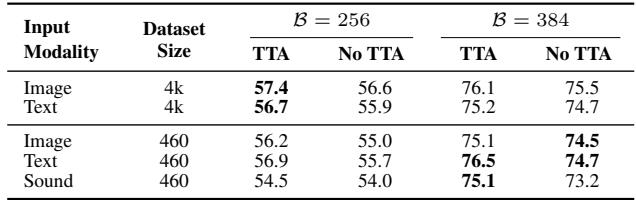
As shown in Table 4, using Text or Sound as the search query yields performance very close to using a ground-truth image. This means a search-and-rescue operator could simply type “lost hiker in red jacket” or upload a sound clip of a specific bird call, and the drone would effectively adapt its search strategy.
4. Real-World Validation
Simulations are useful, but reality is the ultimate test. The authors deployed Search-TTA on a real Crazyflie drone (with perception simulated via Gazebo for safety/consistency).
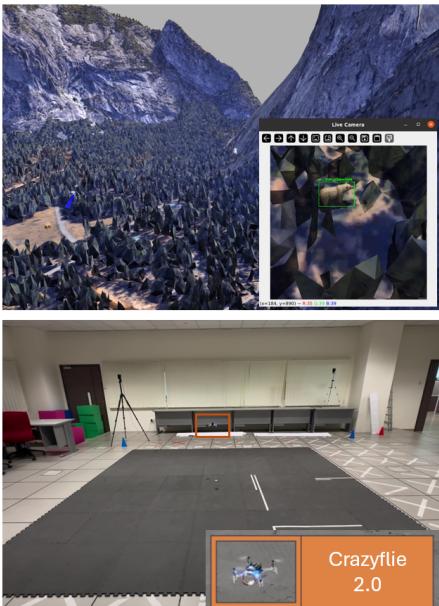
In the physical experiment searching for bear/habitat proxies, the TTA-enabled drone found 5 targets, while the static baseline found only 3. The adaptation allowed the drone to realize quickly that its initial map was slightly off and redirect its path toward the actual dense vegetation where targets were hidden.
Conclusion & Future Implications
Search-TTA represents a significant step forward in robotic autonomy. It moves away from the paradigm of “train once, deploy forever” toward “deploy and adapt.”
By treating the search process as a continuous learning opportunity, the framework:
- Mitigates Hallucinations: It corrects wrong initial guesses from VLMs.
- Improves Efficiency: It stops robots from wasting battery on empty areas.
- Generalizes: It works with images, text, and sound, making it highly flexible for different users.
For students and researchers in robotics, this paper highlights the power of combining foundation models (like CLIP) with classical statistical methods (like Poisson Processes) to solve complex, real-world exploration problems. As robots are increasingly deployed in unknown, unstructured environments, this ability to adapt in real-time will likely become a standard requirement for autonomous systems.