](https://deep-paper.org/en/paper/543_enabling_long_er_horizon_i-2601/images/cover.png)
Imagine you are teaching a robot to make a cup of coffee. This isn’t just a single motion; it is a long sequence of distinct steps: grab the mug, place it under the machine, insert the pod, press the button, and finally, pick up the hot coffee.
In robotics, we call this a Long-Horizon Task. While modern imitation learning has become quite good at short, atomic movements (like “pick up the mug”), stringing these skills together into a coherent, robust sequence remains a massive hurdle. The longer the sequence, the more likely the robot is to drift off course. A small error in step one becomes a catastrophe by step four.
To solve this, researchers often break tasks down into subgoals—checkpoints that guide the robot. But a critical question remains: How does the robot know when it has finished one subgoal and should start the next?
Today, we are diving deep into a paper titled “Enabling Long(er) Horizon Imitation for Manipulation Tasks by Modeling Subgoal Transitions.” The authors identify that the standard method of switching subgoals—using rigid, handcrafted rules—is brittle. In response, they propose two new architectures: one that learns to explicitly predict the switch, and a more powerful transformer-based model that uses “soft” attention to blur the lines between steps, resulting in significantly smoother and more robust performance.
The Problem: The “When” is as Hard as the “How”
Imitation Learning, specifically Behavior Cloning (BC), treats robot control as a supervised learning problem. You show the robot expert demonstrations (videos or teleoperation data), and it learns to map observations to actions.
However, for long tasks, BC suffers from compounding errors. If the robot drifts slightly away from the expert’s path, it enters a state it hasn’t seen before, makes a mistake, drifts further, and eventually fails.
To mitigate this, researchers use Hierarchical Imitation Learning. Instead of learning one giant policy for the whole coffee-making process, we decompose the task into a sequence of subgoals (\(G_1, G_2, \dots, G_n\)). The robot only needs to figure out how to get from its current state to the current subgoal.
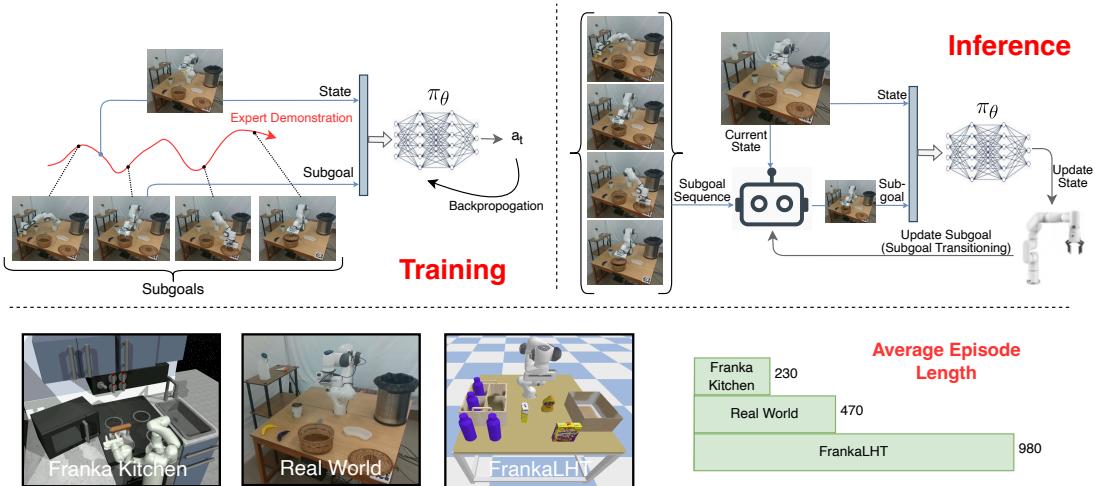
As shown in Figure 1, the inference process relies on a Subgoal Transition Mechanism. This is the brain of the operation. It decides: “Are we there yet?”
The Heuristic Trap
Historically, researchers have used a heuristic approach. They define a threshold, \(\epsilon\) (epsilon). If the robot’s current state is close enough to the subgoal (mathematically, if the Mean Squared Error is less than \(\epsilon\)), the system switches to the next subgoal.
This sounds logical, but it is deeply flawed in practice:
- Sensitivity: If \(\epsilon\) is too small, the robot effectively tries to reach the subgoal with atomic precision, gets stuck, and never transitions.
- Premature Switching: If \(\epsilon\) is too large, the robot switches too early, missing the subgoal entirely (e.g., dropping the coffee pod before it’s in the machine).
- Lack of Generalization: An \(\epsilon\) that works for “opening a drawer” might fail completely for “threading a needle.”
The authors of this paper argue that we need to stop hard-coding these transitions and start learning them.
Solution 1: ST-GPT (Explicit Subgoal Transitions)
The first solution proposed is ST-GPT (Subgoal Transition-GPT). This architecture acknowledges that transitioning is a decision that can be learned from demonstration data.
The model is based on a Causal Transformer. It takes the robot’s history of states and the current subgoal as input tokens. However, instead of just outputting the motor action (which joints to move), the model has a “dual-headed” output.
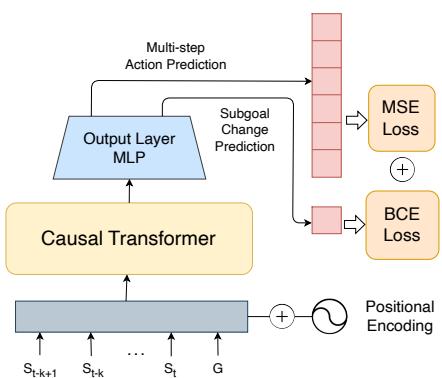
As you can see in Figure 2, the network predicts:
- Action (\(a_t\)): The physical movement.
- Transition Signal (\(\tau_t\)): A binary value (0 or 1). A
1means “Subgoal Achieved, switch to the next one.”
The loss function for this model combines the action error (MSE) and the transition classification error (Binary Cross Entropy):

Here, the model is explicitly supervised on when the expert transitioned subgoals. During deployment, the robot doesn’t rely on a distance threshold. It simply listens to its own predicted \(\tau\) signal. If the model says “move on,” it updates the subgoal condition.
The Verdict on ST-GPT: This method is a significant improvement over the \(\epsilon\) heuristic because it adapts to the specific context of the task. However, it still relies on a “hard” switch. It forces the robot to make a binary decision at a discrete timestamp. In ambiguous situations, or very long tasks, a single wrong “click” of the switch can still derail the entire operation.
Solution 2: SGPT (The “Soft” Transition)
This is where the paper introduces its most compelling contribution: SGPT (Subgoal Guided Policy Transformer).
The researchers asked a fundamental question: Why do we need to switch subgoals at a specific millisecond? Human behavior is fluid. When you are finishing pouring milk and preparing to stir the coffee, your attention gradually shifts from the bottle to the spoon. You don’t instantaneously toggle your brain state.
SGPT mimics this fluidity using the Cross-Attention mechanism found in Transformers.
The Architecture
Instead of feeding the model one subgoal at a time, SGPT provides the entire sequence of subgoals (\(G_1, \dots, G_n\)) as context. The robot’s current state (\(S_t\)) is used as a query to attend to these subgoals.
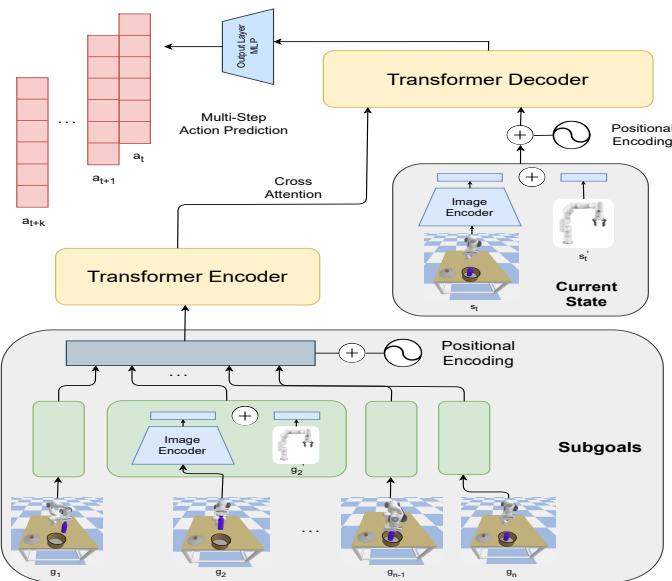
In this architecture (Figure 3):
- Encoder: Processes all subgoals into embeddings.
- Cross-Attention: The current state \(S_t\) attends to the subgoal embeddings.
- Decoder: The model calculates a weighted sum of the subgoals.
This means the robot is effectively conditioning its action on a mixture of subgoals. At the start of the task, the attention weight might be 95% on Subgoal 1 and 5% on Subgoal 2. As the robot progresses, the attention on Subgoal 1 fades while Subgoal 2 intensifies.
The loss function here is straightforward, focusing purely on the action prediction, allowing the attention mechanism to organize itself implicitly:

Visualizing the “Soft” Switch
The power of SGPT is best understood by looking at what the model actually pays attention to during a task.
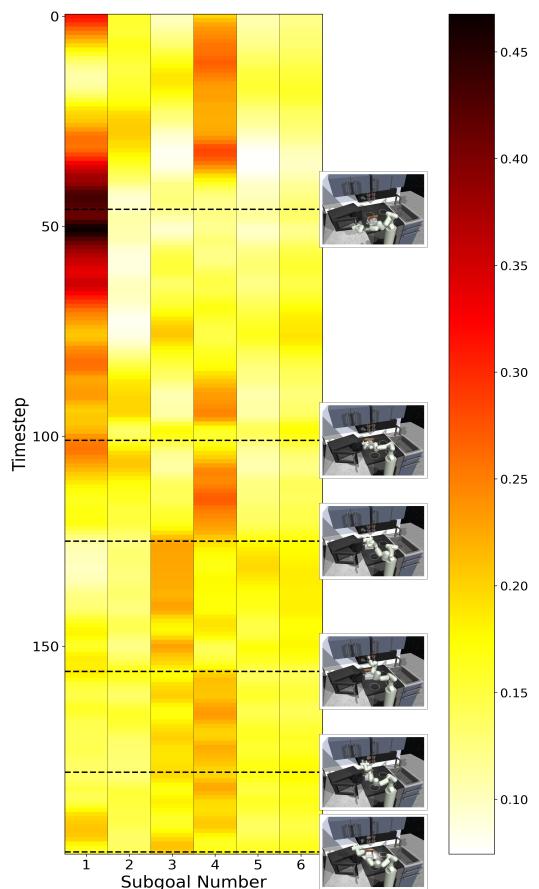
Figure 5 shows the attention weights (heatmaps) during a “Franka Kitchen” task.
- The Y-axis represents time (progressing downwards).
- The X-axis represents the different subgoals (1 through 6).
- The Colors represent attention intensity (Red = High attention).
Notice the diagonal pattern? It isn’t a staircase of sharp blocks. It is a smooth gradient.
- Panel (a): Around timestep 50, the model is peaking its focus on Subgoal 1, but it’s already starting to “look at” Subgoal 2.
- Panel (b): Look at the fascinating behavior near timestep 150. The model focuses on Subgoal 5, but it also has a strong early peak for Subgoal 4.
This implies the policy isn’t just reacting to the immediate next step; it is maintaining a global context of the plan. It transitions continuously, making it robust to slight timing errors that would break the ST-GPT or Heuristic models.
Introducing FrankaLHT: A Harder Benchmark
To truly test “long-horizon” capabilities, existing benchmarks like the standard Franka Kitchen (approx. 250 steps) weren’t enough. The authors introduced a new suite called FrankaLHT (Long Horizon Tasks).
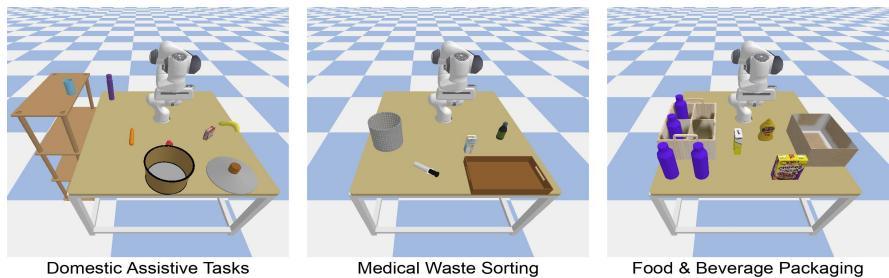
FrankaLHT includes tasks that are significantly longer (avg. 1000 steps) and semantically richer, such as:
- Domestic Assistive: Placing fruit in baskets.
- Medical Waste Sorting: precise disposal of syringes and bottles.
- Packaging: Placing bottles into compartmentalized boxes.
These tasks require not just reaching a pose, but interacting with objects in sequence (Pick A \(\rightarrow\) Place A \(\rightarrow\) Pick B \(\rightarrow\) Place B).
Experimental Results
The researchers compared their models against strong baselines:
- MLP: A simple network using the \(\epsilon\) threshold.
- GPT: A causal transformer using the \(\epsilon\) threshold (similar to ST-GPT but without the learned transition head).
- BAKU: A state-of-the-art transformer that conditions on the final goal image rather than subgoals.
Simulation Results
The results in the FrankaLHT environment were stark.
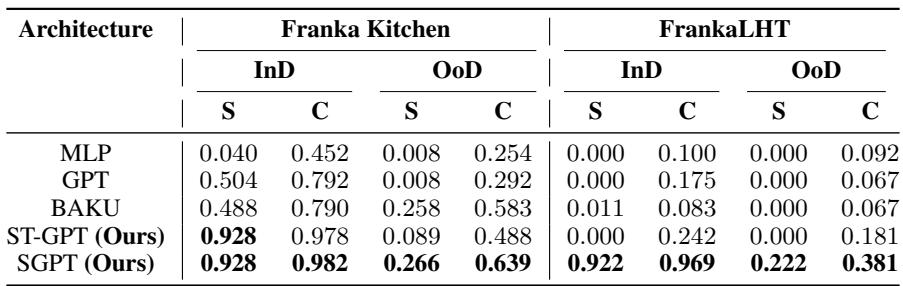
Looking at Table 2:
- Franka Kitchen (Easier): ST-GPT performs excellently (92.8% success In-Distribution), actually matching SGPT. The hard transition works fine for shorter, simpler tasks.
- FrankaLHT (Harder): This is where the baselines collapse.
- MLP & GPT score 0.00% success. The tasks are too long; the heuristics fail.
- BAKU achieves 1.1% success In-Distribution.
- SGPT (Ours) achieves 92.2% success.
The difference is massive. SGPT’s ability to smoothly transition allows it to survive the 1000-step sequences where discrete transition models fail. Even in Out-of-Distribution (OoD) settings (where initial states are randomized), SGPT holds up significantly better (22.2%) than the alternatives (0%).
Real-World Validation
Simulations are useful, but does this work on physical hardware? The team tested on a Franka Panda robot performing tabletop tasks like setting a table or managing trash.
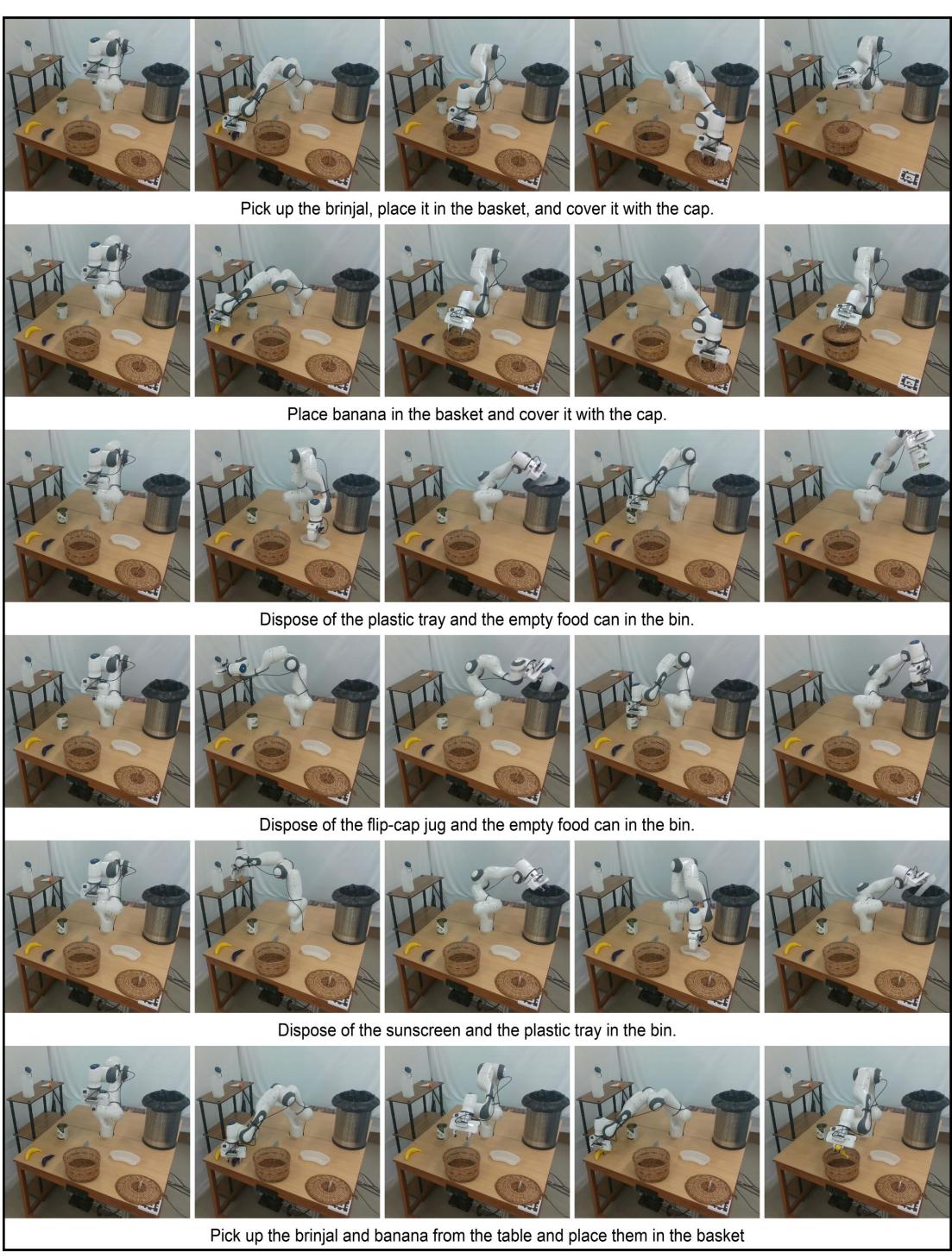
The real-world results mirrored the simulation:
- MLP, GPT, and BAKU failed to complete a single full task (0.00% success).
- SGPT achieved 52.4% success.
Why did the others fail so hard? In the real world, sensor noise and slight physical variations make the \(\epsilon\) threshold almost impossible to tune perfectly. SGPT’s soft attention absorbed these inconsistencies.
Conclusion: The Future is Soft
This paper provides a compelling lesson for robot learning: Rigidity is the enemy of reliability.
By attempting to force robotic behavior into discrete, logic-gate-style transitions (“If error < 0.005, then switch”), we introduce points of failure. The ST-GPT model improved upon this by learning the switch, but it still forced a binary choice.
The SGPT architecture demonstrates that allowing the neural network to manage the transition continuously—blurring the boundary between one step and the next—yields a policy that is remarkably more robust, especially as tasks grow longer and more complex.
For students and researchers entering the field, this highlights the power of the Transformer architecture not just for processing sequences, but for managing context. Cross-attention didn’t just help the robot “see” the subgoals; it gave the robot a temporal understanding of the task, allowing it to flow through actions rather than stepping through them robotically.
As we look toward robots that can clean entire houses or cook full meals, techniques like soft subgoal transitions will likely be standard components of the “brain” that makes it possible.