](https://deep-paper.org/en/paper/640_flower_democratizing_gener-2530/images/cover.png)
Introduction
The dream of generalist robotics is a machine that can walk into any room, look around, and perform a task simply by being asked. Whether it’s “clean up that spill” or “make me a sandwich,” the robot needs to understand the visual world, parse the language command, and translate that into precise physical movements.
To achieve this, the field has coalesced around Vision-Language-Action (VLA) models. Think of these as the robotic equivalent of Large Language Models (LLMs). But instead of outputting text, they output robot actions.
There is, however, a massive barrier to entry. Current state-of-the-art VLAs, such as OpenVLA or RDT-1B, are gigantic. They rely on multi-billion parameter backbones that require massive clusters of GPUs to train and significant hardware just to run inference. This computational cost limits research to a few well-funded labs and makes deployment on real-world robots—which often have limited onboard compute—extremely difficult.
But what if size isn’t everything? What if we are using the wrong parts of these massive brains?
In the paper “FLOWER: Democratizing Generalist Robot Policies with Efficient Vision-Language-Action Flow Policies,” researchers from the Karlsruhe Institute of Technology and Microsoft Research challenge the “bigger is better” dogma. They introduce FLOWER, a model that is under 1 billion parameters yet outperforms its gargantuan competitors.
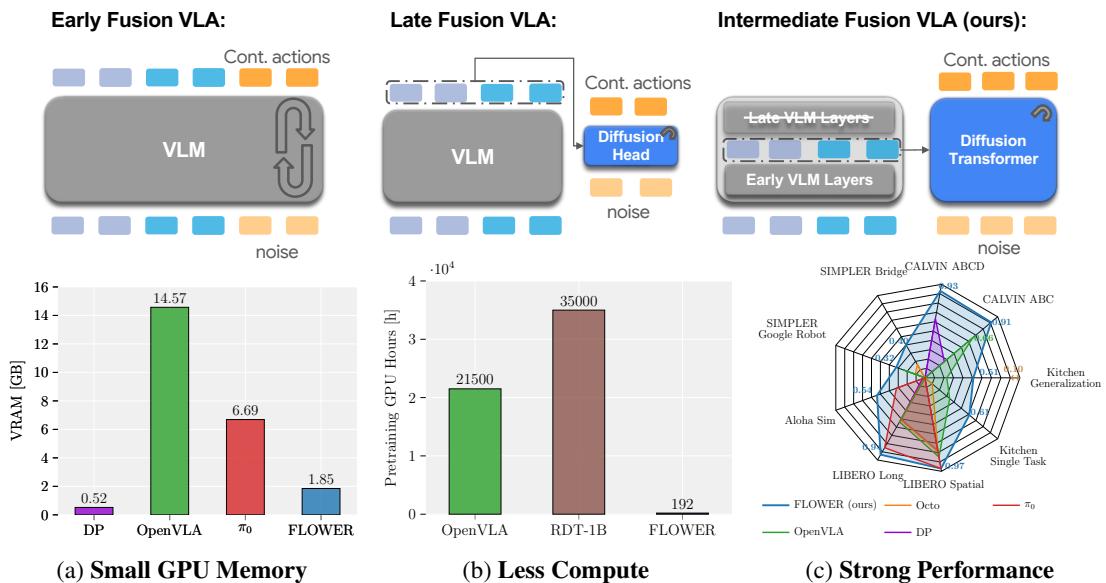
As illustrated in Figure 1, FLOWER achieves this by rethinking how vision and language are fused with action generation. By pruning the “fat” from pretrained models and introducing a novel flow-based architecture, they achieved state-of-the-art performance with only 1% of the pretraining compute required by models like OpenVLA.
In this post, we will dissect how FLOWER works, why “Intermediate Fusion” is a game-changer, and how this model manages to control diverse robots with a fraction of the usual computational budget.
Background: The VLA Bottleneck
Before diving into FLOWER, we need to understand the standard architecture of a VLA. Most generalist robot policies consist of two main parts:
- The Backbone (VLM): A pre-trained Vision-Language Model (like LLaVA or Florence) that “sees” the image and “reads” the instruction.
- The Head (Action Generator): A module that takes the features from the backbone and predicts the robot’s joint angles or gripper movements.
Traditionally, researchers use Late Fusion. They take a massive, frozen VLM (say, 7 billion parameters), pass the image and text all the way through it, and use the very last output to drive a small diffusion head.
The problem? It’s inefficient. The final layers of an LLM are specialized for predicting the next text token (e.g., determining that “cat” follows “the”). This semantic granularity is overkill for robotic control, which relies more on spatial understanding and physical affordances found in earlier layers. By keeping the whole VLM, you pay a massive latency and memory penalty for features you don’t fully use.
Conversely, Early Fusion (training a transformer from scratch or injecting actions at the start) often fails to leverage the deep semantic knowledge embedded in pre-trained models.
FLOWER aims to find the “Goldilocks” zone.
Core Method: The Architecture of FLOWER
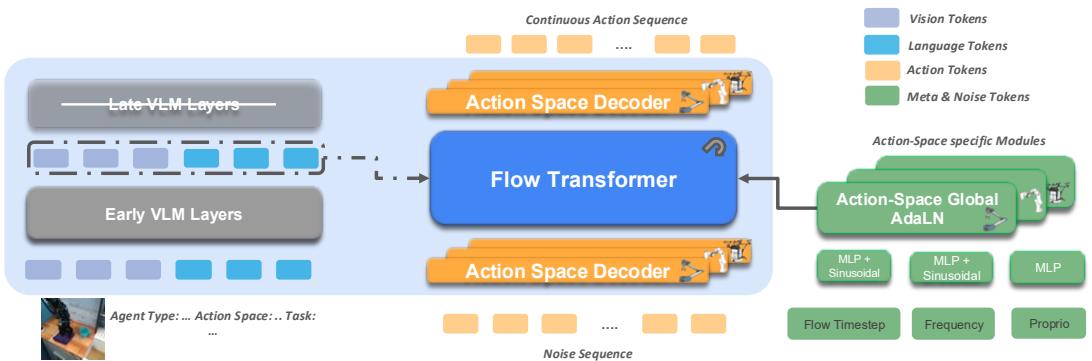
FLOWER stands for Florence With Embodied Flow. It introduces a 950-million parameter architecture designed for speed and generalization. The method relies on two major technical contributions: Intermediate-Modality Fusion and Action-Specific Global-AdaLN.
Let’s break down the architecture.
1. Intermediate-Modality Fusion
The researchers hypothesized that the most useful information for a robot isn’t at the very end of a Vision-Language Model—it’s in the middle.
In deep neural networks, early layers process edges and textures, middle layers handle object concepts and spatial relationships, and final layers refine these for specific output tasks (like text generation). For robotics, that middle layer—where the model understands “there is a cup on the table”—is crucial. The final layer—which calculates the probability of the word “cup”—is less important.
FLOWER implements Intermediate Fusion:
- The Backbone: They use Florence-2, a powerful VLM.
- The Pruning: They chop off the decoder entirely (for encoder-decoder models) or prune the last 30–50% of the layers (for decoder-only models).
- The Connection: The hidden states from these intermediate layers are projected and injected into the action generator.
This simple change reduces the parameter count drastically and speeds up inference, all while improving performance because the action head receives richer spatial features rather than over-processed text probabilities.
2. The Flow Transformer
Once the visual and language features are extracted, they need to be converted into movement. FLOWER uses Rectified Flow (a straighter, faster version of Diffusion models) implemented via a Transformer.
Standard diffusion models generate actions by gradually denoising a random signal over many steps. It’s like carving a statue from stone by slowly chipping away dust. Rectified Flow tries to draw a straight line between the noise and the target action.
The core mathematical objective of the flow matching is to minimize the difference between the predicted velocity field and the straight path to the target action:

Here, \(v_{\theta}\) is the model predicting the flow, conditioned on the state \(s\), goal \(g\), and embodiment \(e\). This allows FLOWER to generate high-quality action trajectories in very few steps (typically 4 to 8), making it fast enough for real-time control.
3. Action-Specific Global-AdaLN
A “Generalist” policy must handle different robots. A Franka Emika arm might be controlled by End-Effector positions (x, y, z coordinates), while a humanoid hand might require Joint Angles (14+ degrees of freedom).
Usually, models use separate “heads” for each robot, or they force all data into a unified format. FLOWER takes a modular approach. The core Flow Transformer is shared across all robots. To adapt to specific hardware, they use a modification of Adaptive Layer Normalization (AdaLN).
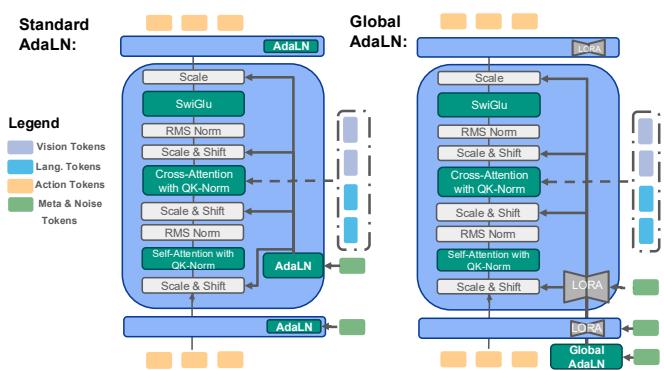
In standard Diffusion Transformers (DiT), AdaLN parameters are unique to every layer, which bloats the model. FLOWER introduces Global-AdaLN:
- It shares a single set of modulation weights across all layers.
- It generates unique modulation signals for each action type (e.g., “Delta-End-Effector” vs. “Joint-Angles”).
- It uses lightweight LoRA (Low-Rank Adaptation) adapters at each layer for fine-tuning.
This reduces the parameter count of the transformer head by 20% while allowing the model to switch “modes” instantly depending on which robot it is controlling.
Experiments & Results
To prove that a sub-1-billion parameter model can compete with the giants, the authors subjected FLOWER to a battery of tests across simulation and the real world.
The Setup
FLOWER was pretrained on an “OXE-soup”—a carefully selected subset of the Open X-Embodiment dataset containing about 250,000 trajectories. This is a tiny fraction of the data used by larger models, yet the diverse mix (including BridgeV2, Droid, and Google Robot data) proved sufficient.
Testing covered 190 tasks across 10 benchmarks, including:
- CALVIN: A standard benchmark for long-horizon language-conditioned tasks.
- LIBERO: Tests for knowledge transfer and lifelong learning.
- SIMPLER: A “Real-to-Sim” benchmark that evaluates how well policies transfer.
- Real World: A Franka Panda robot operating in a kitchen environment.

Simulation Dominance
The results in simulation were striking. Despite its small size, FLOWER consistently matched or outperformed state-of-the-art (SoTA) models like OpenVLA (7B parameters) and \(\pi_0\) (3B parameters).
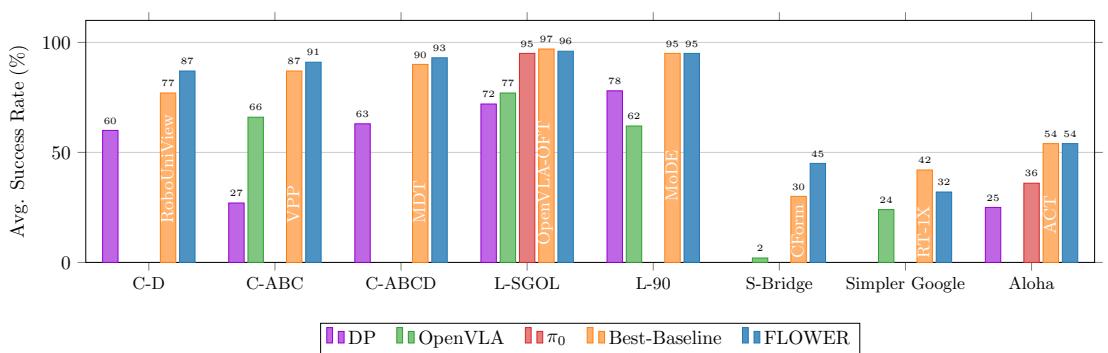
Key takeaways from the simulation benchmarks:
- CALVIN: FLOWER achieved a new SoTA on the CALVIN ABC split, demonstrating superior capabilities in following chains of diverse language instructions.
- LIBERO: On the challenging LIBERO-Long benchmark (long sequences of tasks), FLOWER achieved 94.9% success, whereas OpenVLA struggled at roughly 53%.
- Efficiency: Because of the pruned backbone and efficient Flow matching, FLOWER requires significantly less memory and compute.
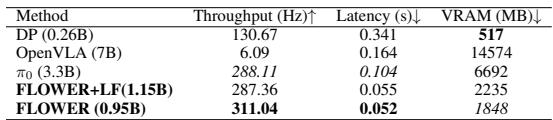
As shown in Table 4, FLOWER runs at over 300 Hz (frames per second) on an RTX 4090, while OpenVLA crawls at 6 Hz. It also uses only 1.8GB of VRAM, meaning you could theoretically run this high-performance robot policy on a gaming laptop or even edge hardware.
Real-World Kitchen Tasks
Simulations are useful, but robots live in the physical world. The authors deployed FLOWER on a Franka Panda robot in a kitchen setting involving tasks like opening microwaves, moving pots, and putting toaster levers down.
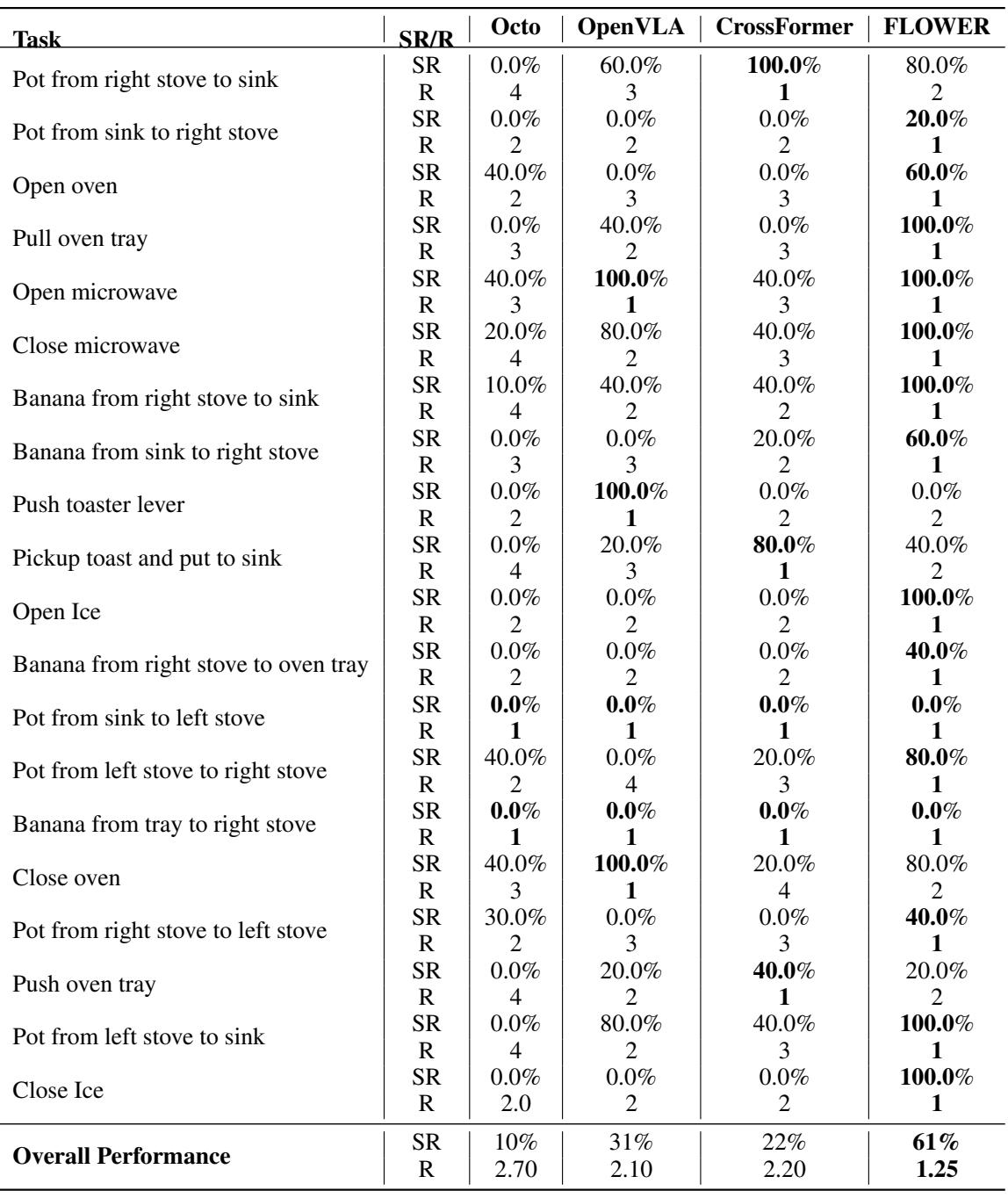
In direct head-to-head comparisons (Table 14), FLOWER achieved an overall success rate of 61%, significantly higher than OpenVLA (31%) and Octo (10%).
What is particularly impressive is FLOWER’s generalization. The researchers tested the robot with:
- Novel Objects: Items the robot had never seen before.
- Distractors: Cluttered scenes with random junk on the table.
- Poor Lighting: Running the robot with only a flashlight.
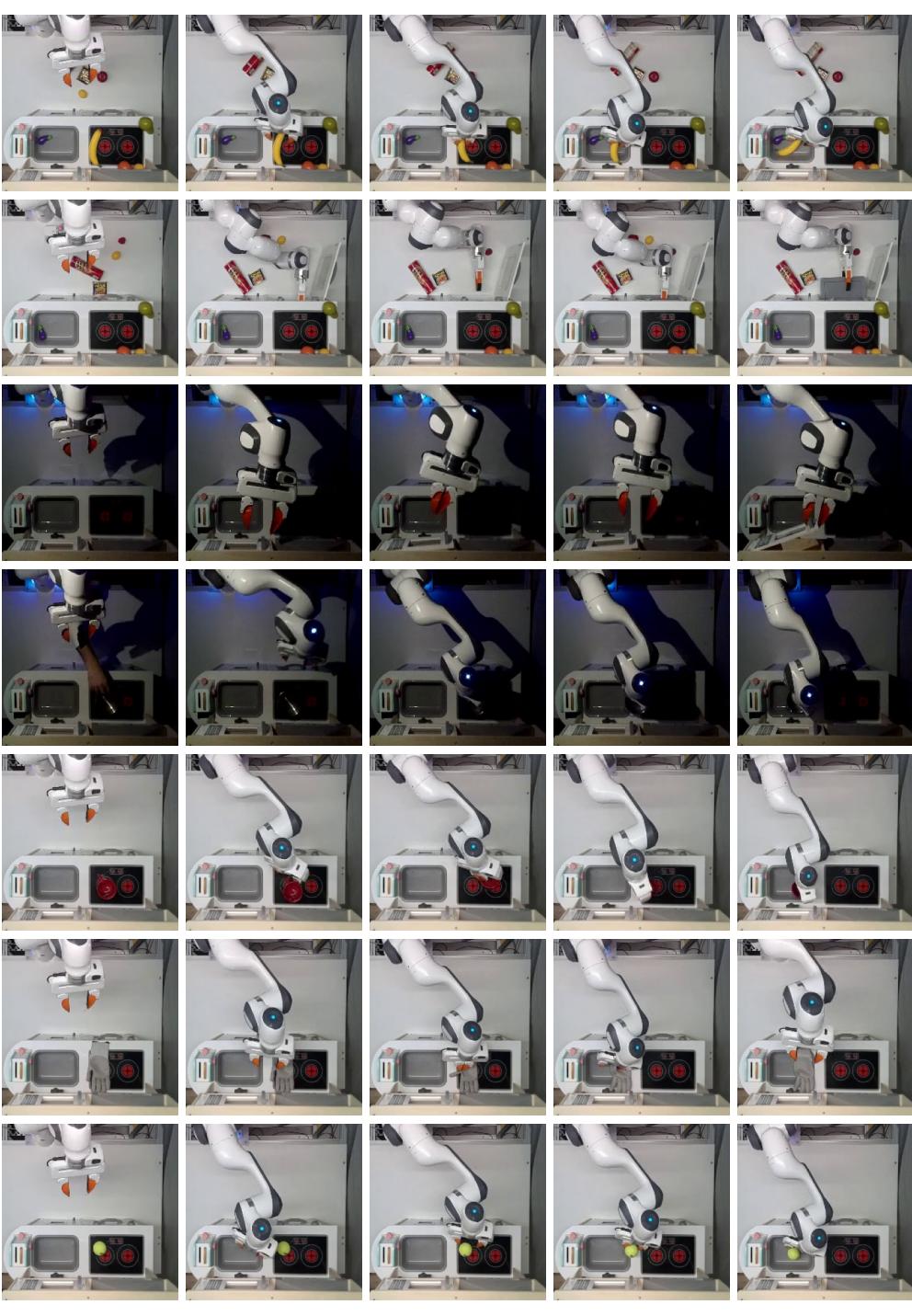
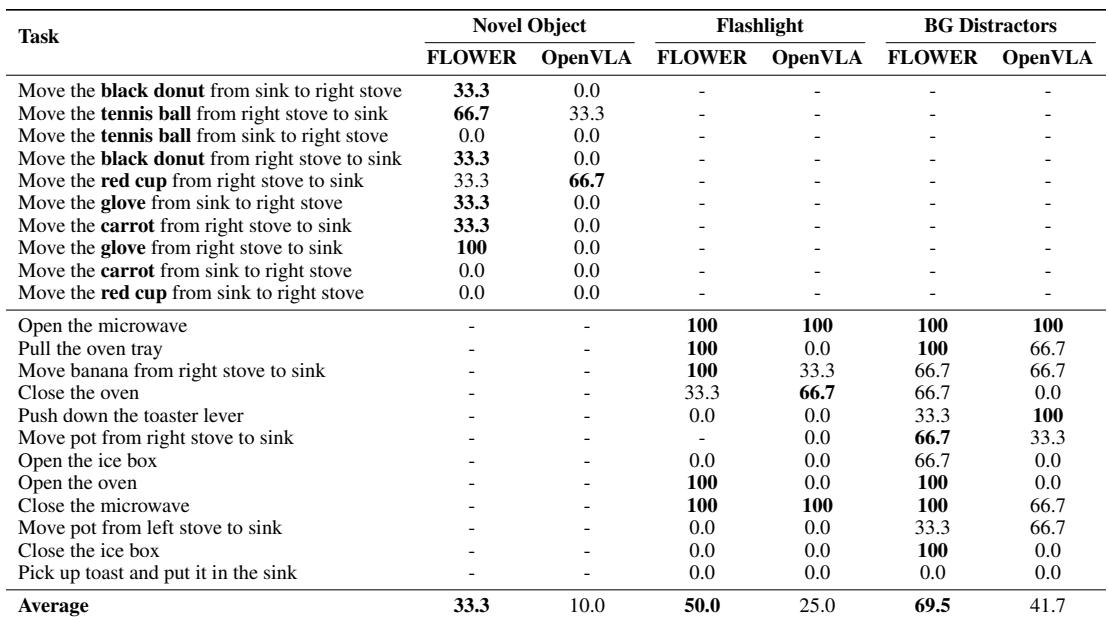
As Table 15 details, FLOWER maintained respectable performance even when the environment was adversarial. For example, with background distractors, FLOWER maintained a 69.5% success rate, while OpenVLA dropped to 41.7%.
Adaptation to High-Frequency Control
One of the hardest challenges in robotics is bimanual (two-handed) manipulation, which often requires high-frequency control (50Hz+). The Aloha benchmark tests this with tasks like transferring a cube between hands or inserting a peg.
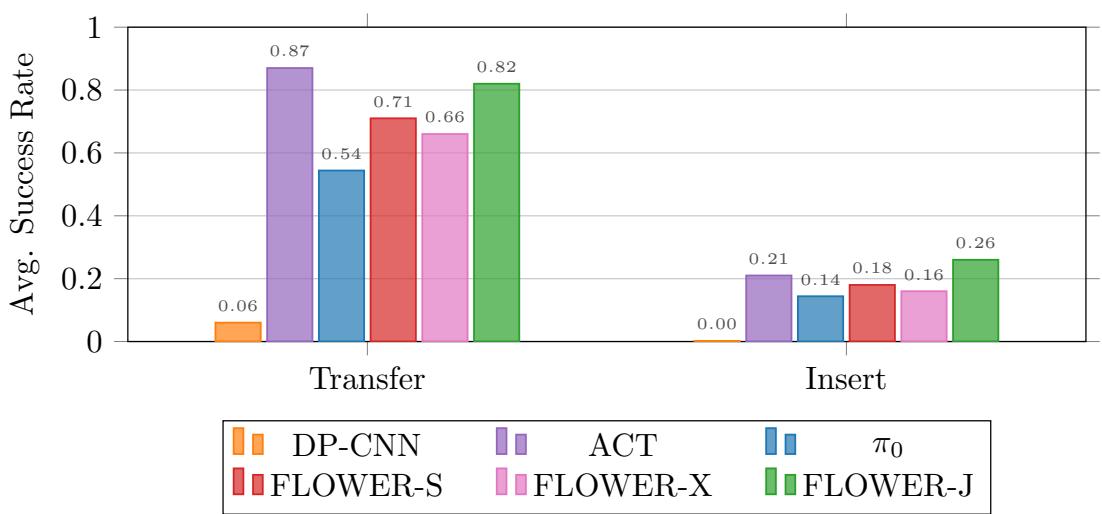
FLOWER (specifically the variant trained on joint-state data, denoted as FLOWER-J) outperformed the specialized ACT policy on the insertion task and matched it on transfer. This proves that the Global-AdaLN architecture successfully allows the model to adapt to entirely different action spaces (joint angles vs. end-effector position) without losing precision.
Conclusion & Implications
The FLOWER paper is a significant milestone because it democratizes access to advanced robot learning.
For a long time, the trend has been to scale up—more parameters, more data, more GPUs. FLOWER demonstrates that architecture matters more than raw scale. By intelligently pruning the parts of the VLM that robots don’t need (Intermediate Fusion) and designing efficient mechanisms for handling different bodies (Global-AdaLN), the authors created a model that is:
- Faster: 50x faster inference than OpenVLA.
- Cheaper: Pretrained in just 200 GPU hours (vs. tens of thousands).
- Better: State-of-the-art performance on difficult benchmarks.
For students and researchers, this is exciting news. It means that meaningful contributions to generalist robotics don’t require a supercomputer. With a standard GPU and smart architectural choices, we can build robots that are not just capable, but also efficient enough to be deployed in the real world.
The code and weights for FLOWER are open-sourced, inviting the community to build upon this efficient foundation. As we look toward the future, FLOWER suggests that the path to general-purpose robots might not be building larger brains, but building smarter, more focused ones.