](https://deep-paper.org/en/paper/6523_towards_robustness_and_ex-1635/images/cover.png)
In the world of computer science, the “No Free Lunch” theorem is a hard truth: no single algorithm performs best on every possible problem. Whether you are solving the Traveling Salesman Problem, training a neural network, or solving SAT instances, the “best” tool for the job depends entirely on the specific characteristics of the problem at hand.
This has likely led you to the field of Automatic Algorithm Selection (AS). The goal of AS is simple but ambitious: given a specific problem instance, automatically predict which algorithm from a portfolio will solve it most efficiently.
Traditionally, this has been treated as a standard supervised learning problem. You take a set of problem meta-features (like dataset size or graph density), feed them into a regressor or classifier, and hope it predicts the winner. But there is a flaw in this approach. These models rely on statistical correlations, treating the selection process as a black box. They don’t understand why an algorithm is better; they just know that historically, similar problems liked this algorithm.
This lack of understanding makes these models brittle. If the distribution of your data changes (a common occurrence in the real world), performance tanks. Furthermore, if you ask the model, “Why did you pick this solver?”, it usually can’t give you a satisfying answer.
In this post, we are diving deep into a recent paper titled “Towards Robustness and Explainability of Automatic Algorithm Selection.” The researchers propose a novel framework called DAG-AS. By moving from correlation to causality, and using Directed Acyclic Graphs (DAGs), they build a system that is not only more robust to change but also capable of explaining its own decisions.
The Problem: When Correlation Isn’t Enough
Current state-of-the-art AS techniques typically focus on the conditional probability \(P(\text{Algorithm} | \text{Problem Features})\). They act as pattern matchers.
However, the world is dynamic. Imagine a scenario where you train your selector on small-scale, uniform problems, but deployed it in an environment with high-dimensional, imbalanced data. Or perhaps new algorithms are invented, shifting the landscape of what is considered “optimal.”
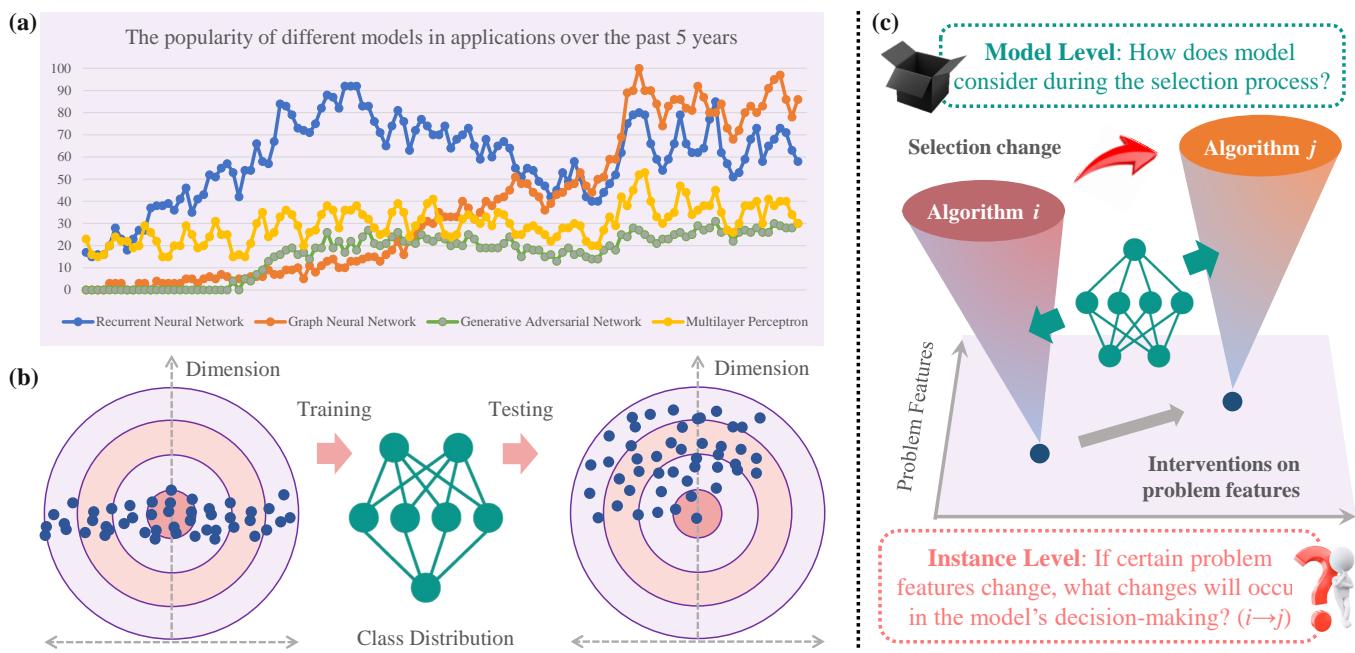
As illustrated in Figure 1 above, relying on simple correlations has three major downsides:
- Popularity Shift (Panel a): Algorithm dominance changes over time (e.g., RNNs giving way to Transformers). A correlation-based model might overfit to the “popular” algorithms of the training era.
- Distribution Shift (Panel b): Training data rarely looks exactly like test data. If the model blindly matches patterns, it fails when the geometric distribution of the problem space changes.
- Lack of Explainability (Panel c): We need to know why a decision was made (Model Level) and what would happen if the problem were slightly different (Instance Level).
The researchers argue that to fix this, we need to model the underlying mechanism of algorithm selection. We need to ask: What characteristics must an algorithm possess to effectively tackle a problem with these specific features?
The Solution: Causal Learning and DAGs
The core innovation of this paper is the introduction of a Structural Causal Model (SCM) into the algorithm selection process. Instead of just predicting a label, the model learns a Directed Acyclic Graph (DAG) that represents the causal flow from problem features to algorithm features.
The Shift in Perspective
The researchers propose a subtle but powerful shift in how we model the probability. Instead of just mapping Problem Features (PF) to a selection label, they aim to reconstruct the Algorithm Features (AF) required to solve the problem.
They model the distribution:
\[P(\mathbf{AF} | \mathbf{PF}, S=1)\]Where \(S=1\) means “Selected/Successful”. Essentially, the model asks: “Given this problem, what would the features of the successful algorithm look like?”
If the model can reconstruct the ideal algorithm features, it can then look at the available candidates, see which one matches this “ideal” profile best, and select it. Because this relies on the causal mechanism (how problem features cause the need for certain algorithm capabilities), it is invariant to shifts in the simple marginal distributions of the data.
The Core Method: DAG-AS Architecture
Let’s break down the architecture of DAG-AS. It uses a deep neural network designed to learn the causal structure (the DAG) and the functional relationships between variables simultaneously.
1. The Causal Learning Network
The heart of the system is the Causal Learning Network. It takes Problem Features (PF) and Algorithm Features (AF) as inputs.
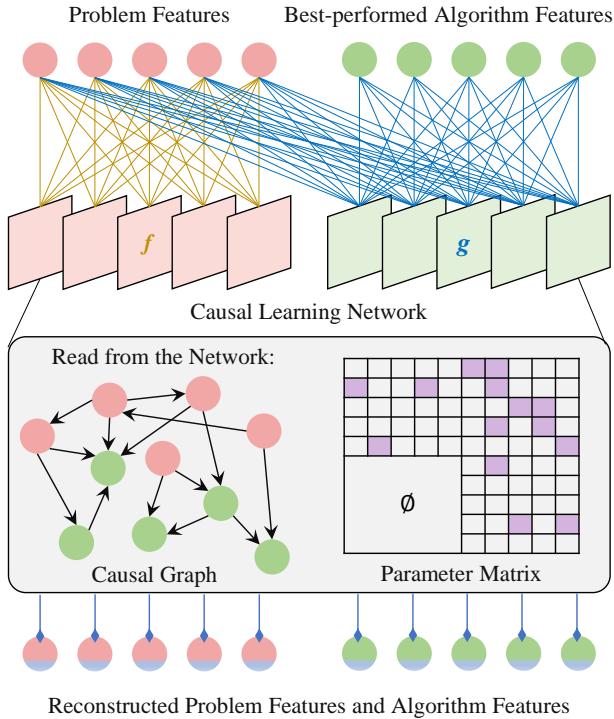
As shown in Figure 2, the system isn’t just a standard feed-forward network. It is designed to mimic structural equations. In a causal graph, a variable is determined by its parents (its causes) plus some noise (unobserved factors).
The network attempts to reconstruct the features using these equations:
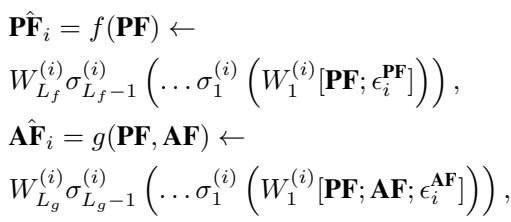
Here, \(f\) and \(g\) are neural networks that represent the non-linear causal mechanisms. The clever part is how they determine the structure of the graph. They look at the weights of the first layer of these networks. If the weight connecting node \(i\) to node \(j\) is zero, there is no causal link. If it’s non-zero, a relationship exists.
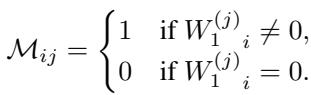
This adjacency matrix \(\mathcal{M}\) defines the learned DAG.
2. From Reconstruction to Selection
Once the model has learned to reconstruct the “ideal” algorithm features (\(\hat{\mathbf{AF}}\)) based on the problem features, how does it make a decision?
It creates a representation embedding for both the reconstructed (ideal) features and the actual features of the candidate algorithms.
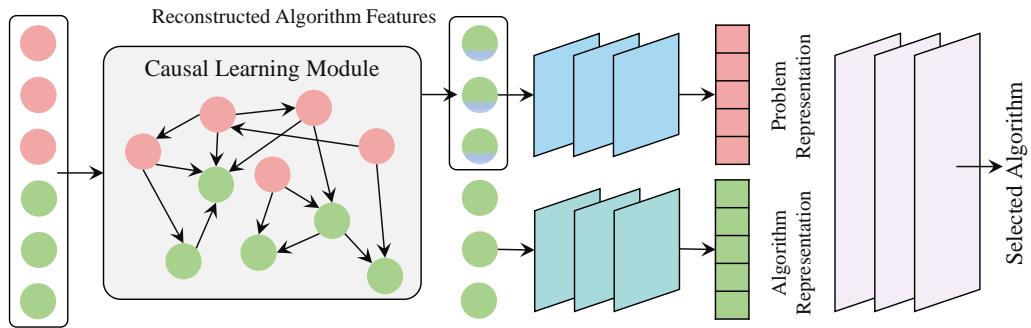
Figure 3 illustrates the full pipeline:
- Input: Problem features are fed into the Causal Learning Module.
- Reconstruction: The module outputs the “ideal” algorithm features.
- Representation: Both the ideal features and the real features of candidate algorithms are passed through representation networks.
- Matching: A similarity module compares the “Ideal” representation against the “Candidate” representations. The candidate with the highest similarity score wins.
3. The Loss Function
Training this beast is a balancing act. The researchers use a composite loss function that enforces four different goals simultaneously:

Let’s break down these four components:
- \(\mathcal{L}_{\text{reconstruction}}\): Ensures the network can accurately predict the features. If you can’t reconstruct the features, you haven’t learned the mechanism.
- \(\mathcal{L}_{\text{sparsity}}\): Causal graphs should be sparse. Everything doesn’t cause everything. This penalty forces the model to find only the most important connections.
- \(\mathcal{L}_{\text{acyclicity}}\): This is crucial. A causal graph cannot have loops (A causes B, and B causes A). This mathematical constraint ensures the learned structure is a valid DAG.
- \(\mathcal{L}_{\text{selection}}\): This is the standard ranking loss (specifically, Bayesian Personalized Ranking). It ensures that the “best” algorithm for a problem is actually ranked higher than the others.
Achieving Explainability
One of the strongest selling points of DAG-AS is that it isn’t a black box. Because it learns a graph, we can inspect it.
Model-Level Explainability
By visualizing the learned DAG (the adjacency matrix \(\mathcal{M}\)), we can see exactly which problem features influence which algorithm features. If a problem feature has no outgoing edges, it’s irrelevant. If an algorithm feature has high centrality, it’s a critical differentiator for performance.
Instance-Level Explainability: Counterfactuals
This is where the causal approach shines. We can ask “What if?” questions. Specifically, we can calculate Counterfactual Explanations.
For a specific problem instance, we can ask: “What is the smallest change I would need to make to the problem features to make the model switch its recommendation from Algorithm A to Algorithm B?”
The researchers formulate this as an optimization problem:
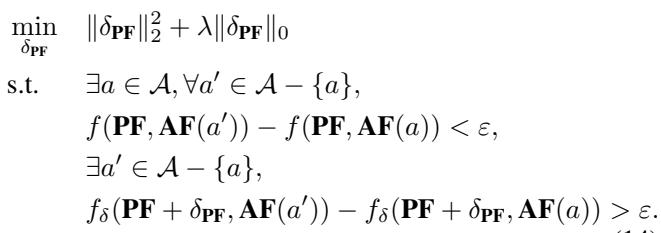
This equation seeks to find a perturbation \(\delta_{\mathbf{PF}}\) (a change to the problem features) that is:
- Minimal: We don’t want to change everything (controlled by the L2 and L0 norms).
- Effective: It must flip the decision (\(f_{\delta} > \varepsilon\)).
The result is an explanation like: “If the graph density were 5% lower, the model would have selected Solver B instead of Solver A.” This is incredibly valuable for understanding the boundaries of algorithm performance.
Experimental Results
Theory is great, but does it work? The researchers tested DAG-AS on the ASlib benchmark, a standard library for algorithm selection datasets ranging from SAT solvers to Traveling Salesman problems.
Performance Comparison
They compared DAG-AS against standard baselines (like the Single Best Solver) and state-of-the-art selection models (like ISAC, SATzilla, and simple classification). The metric used is PAR10 (Penalized Average Runtime), where lower is better.
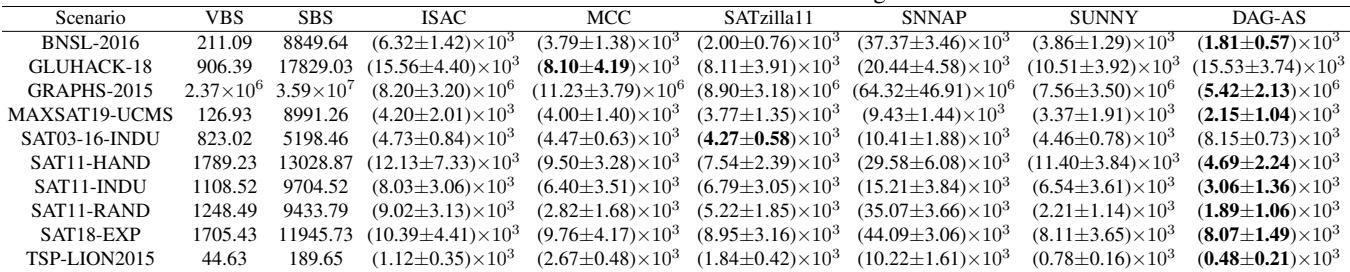
As Table 3 shows, DAG-AS achieved the lowest PAR10 score in 8 out of 10 datasets. In domains like Graph coloring (GRAPHS-2015) and Maximum Satisfiability (MAXSAT19), the improvement was significant. This confirms that modeling the causal mechanism yields better accuracy than simple correlation.
Robustness Analysis
The true test of a causal model is robustness. The researchers artificially induced distribution shifts—scenarios where the training data looks different from the test data. They tested shifts in problem distribution, optimal algorithm distribution, and even removed specific algorithms from the training set.
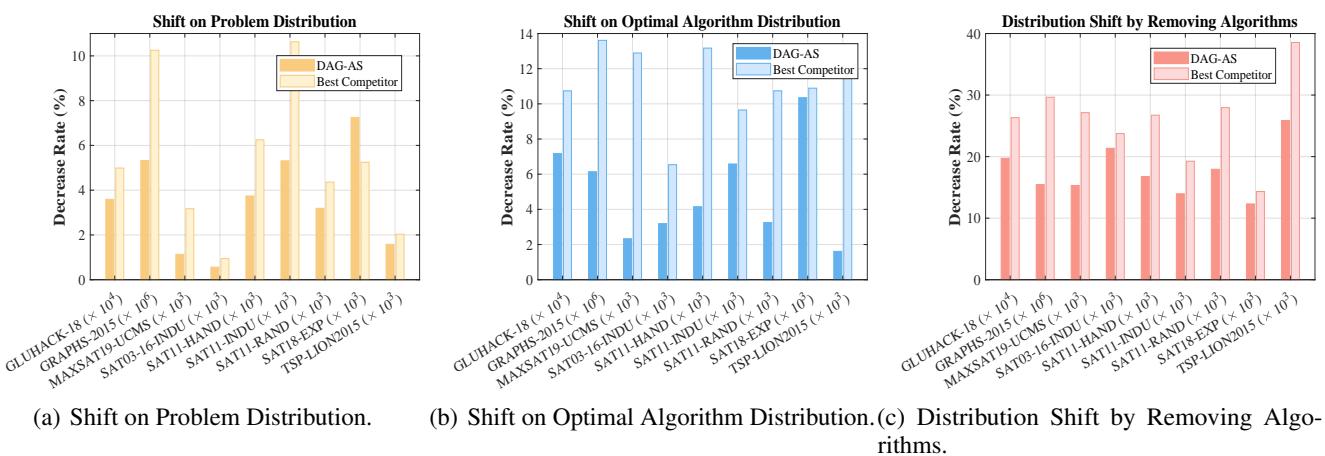
Figure 6 highlights the resilience of DAG-AS. In almost every scenario (Problem Shift, Algorithm Shift, and Removing Algorithms), DAG-AS suffered less performance degradation than the best competitor. This is particularly visible in Chart (b) (Shift on Optimal Algorithm Distribution), proving that understanding why an algorithm is good protects you when the “popular” algorithms change.
Is the “Causal” Part Necessary? (Ablation Study)
You might wonder, “Maybe it’s just the neural network, not the graph?” The researchers ran an ablation study comparing:
- No Causality: Just matching features directly.
- Cyclic Graph: Using the network but allowing loops (ignoring the causal DAG constraint).
- DAG-AS: The full model.
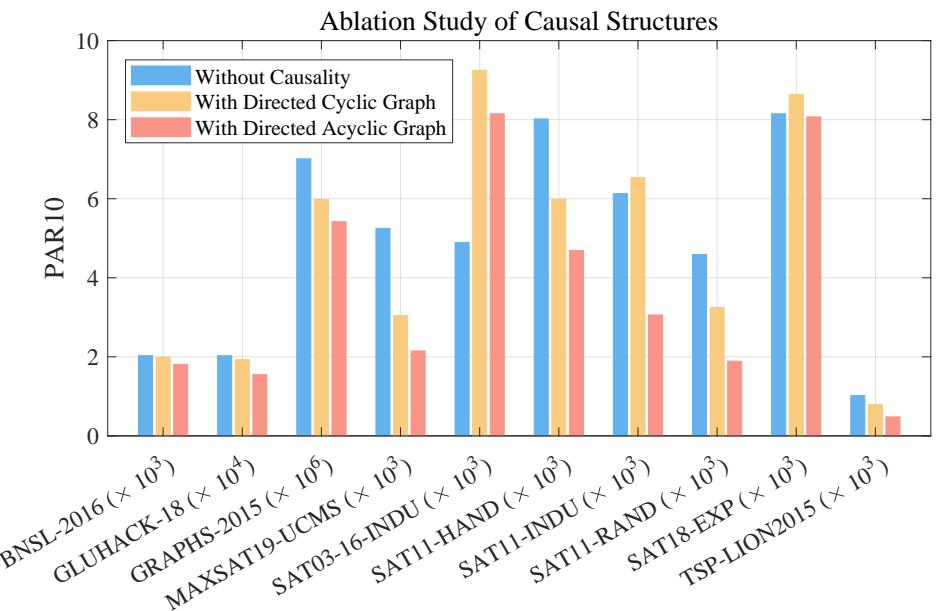
Figure 5 settles the debate. The red bars (DAG-AS) are consistently lower (better) than the alternatives. Interestingly, removing the acyclicity constraint (orange bars) often hurt performance, proving that the structural constraint of a DAG helps the model learn more meaningful, generalizable patterns.
Unveiling the Causal Graph
Finally, what did the model actually learn? The researchers visualized the causal connections between algorithm features across different datasets.
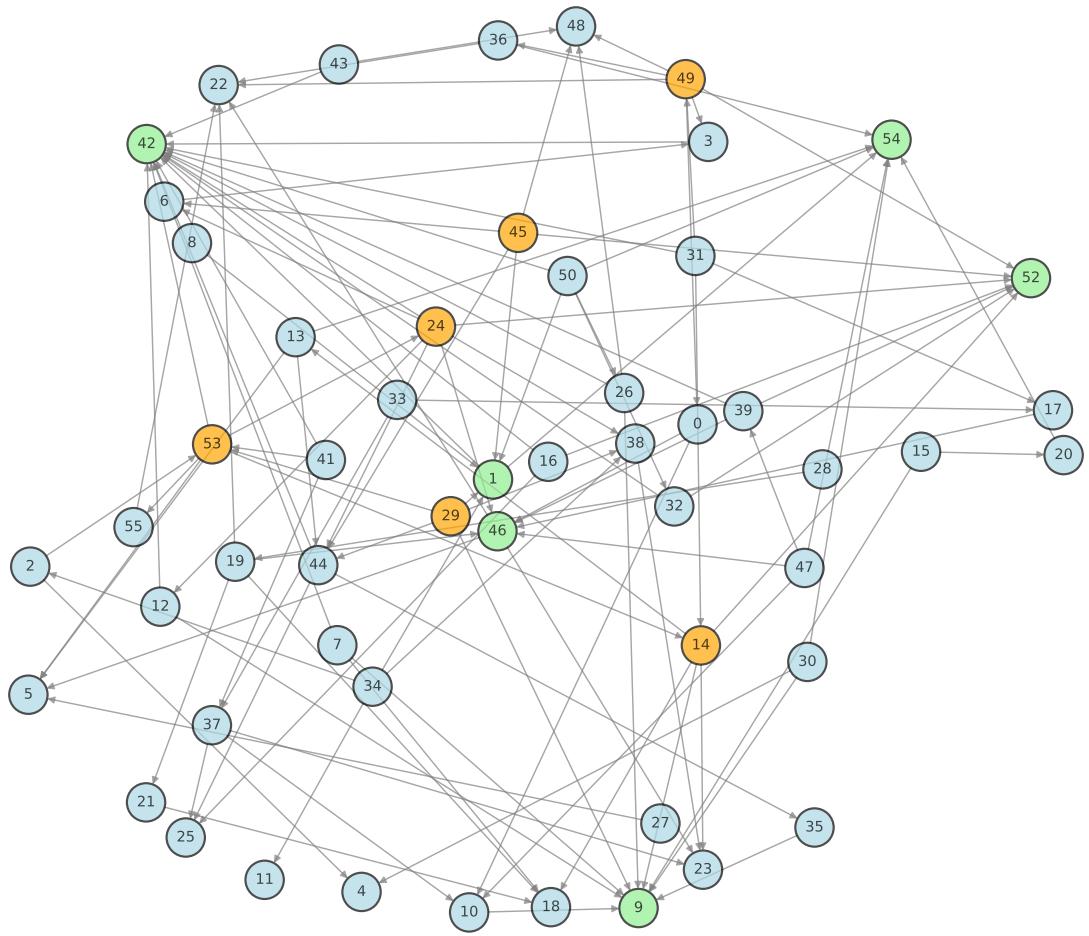
Figure 8 visualizes the learned web of dependencies. The nodes represent algorithm features (extracted from code or ASTs). The complexity here shows that algorithm performance is rarely defined by a single attribute; it is a complex interplay of code characteristics.
To demonstrate instance-level explainability, they visualized the perturbations required to change decisions in the GRAPHS-2015 dataset.
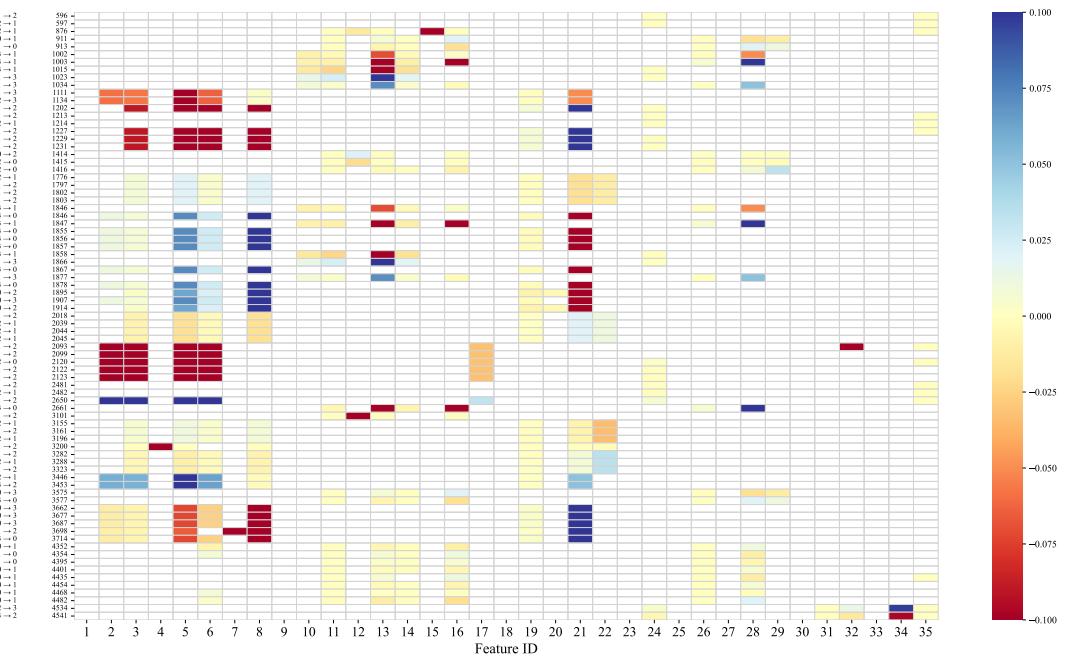
In Figure 10, the heatmap shows the intervention magnitude. The fact that the heatmap is mostly sparse (lots of white/light colors) is good—it means the model is robust. However, for specific instances (the dark spots), small changes in specific features (like feature ID 11 or 13) were enough to flip the decision. This provides a “debugging” map for algorithm developers.
Conclusion
The paper “Towards Robustness and Explainability of Automatic Algorithm Selection” represents a significant step forward for the field. By moving away from “black box” correlation and embracing Structural Causal Models, DAG-AS offers three major distinct advantages:
- Better Accuracy: It simply picks better algorithms more often.
- True Robustness: It survives distribution shifts that break traditional models.
- Explainability: It provides a window into the decision-making process via causal graphs and counterfactuals.
For students and practitioners, this work highlights a broader trend in Machine Learning: the integration of Causal Inference into deep learning. As we demand AI systems that are not just accurate but also reliable and interpretable, approaches like DAG-AS will likely become the new standard.
Note: The images used in this post are extracted directly from the research paper to illustrate the methodology and results.