](https://deep-paper.org/en/paper/6627_physpec_physically_consis-1684/images/cover.png)
Introduction: Seeing Beyond the Visible
Imagine trying to reconstruct a full symphony orchestra’s performance given only the bass, mid, and treble settings from a car radio. It seems impossible, yet that is essentially the challenge of Spectral Reconstruction.
In the world of computer vision, traditional cameras are limited. They mimic the human eye, capturing the world in three channels: Red, Green, and Blue (RGB). However, the physical world is much richer. Every material reflects light across a continuous spectrum of wavelengths. A Hyperspectral Image (HSI) captures this dense information, often containing 31 to over 100 channels. This data is invaluable for applications like remote sensing, medical diagnostics, and agricultural monitoring because it reveals intrinsic material properties that RGB cameras miss.
Recently, Deep Learning has attempted to bridge this gap, using AI to “hallucinate” the missing spectral data from simple RGB images. While impressive, these methods face a critical flaw: they often ignore the laws of physics.
In this post, we are doing a deep dive into PhySpec, a groundbreaking paper presented at ICML 2025. The authors propose a framework that doesn’t just guess the spectra but ensures the reconstruction mathematically respects the physics of how cameras work.
The Problem: The “Colorimetric Dilemma”
To understand why this paper matters, we first need to understand the failure of current methods.
Most state-of-the-art (SOTA) approaches treat spectral reconstruction as a standard “image-to-image” translation task. They train a neural network to map a 3-channel input (RGB) to a 31-channel output (HSI).
However, there is a physical relationship between HSI and RGB. An RGB image is essentially a down-sampled version of the hyperspectral scene, filtered through the camera’s sensors and lighting conditions. This is a forward process.
The problem arises when we try to reverse this. If a neural network predicts a hyperspectral cube, we should be able to simulate a camera taking a picture of that predicted cube and get back the exact RGB image we started with.
Surprisingly, most models fail this test. They predict spectra that might look statistically okay but fail to reproduce the original colors when mathematically projected back to RGB. The authors call this the Colorimetric Dilemma.
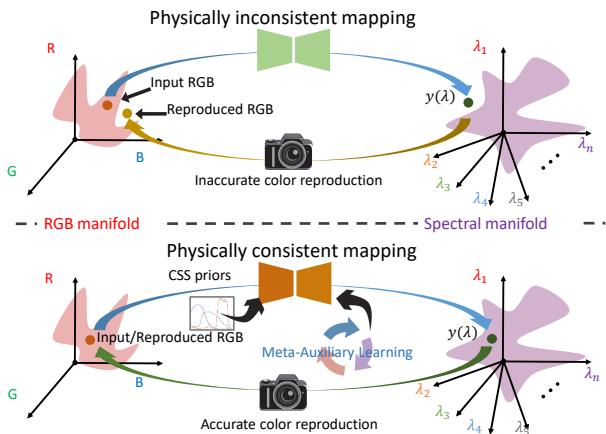
As shown in Figure 1, traditional methods (top) result in a disconnect between the input RGB and the reproduced RGB. PhySpec (bottom) bridges this gap by explicitly modeling the camera’s behavior and using a clever learning strategy called Meta-Auxiliary Learning.
The Physics of Photography
Before understanding the solution, we need a quick primer on the math of image formation. A digital camera captures an image based on three things:
- \(\mathbf{Y}\): The actual spectral radiance of the scene (the HSI).
- \(\mathbf{L}\): The illumination (lighting) spectrum.
- \(\mathbf{S}\): The Camera Spectral Sensitivity (CSS)—how sensitive the sensor is to specific wavelengths.
The mathematical equation for a single pixel in an RGB image (\(\mathbf{X}\)) is an integral (sum) over wavelengths (\(\lambda\)):

If we vectorize this (turn the matrices into flat vectors), we get a simplified linear relationship:
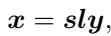
Here, \(\mathbf{x}\) is the RGB pixel, and \(\mathbf{y}\) is the spectral pixel. The combination of the camera sensitivity (\(\mathbf{s}\)) and illumination (\(\mathbf{l}\)) acts as a projection operator.
The goal of PhySpec is to find the inverse function \(\mathcal{G}\) that maps \(\mathbf{x}\) back to \(\mathbf{y}\):
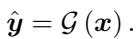
Because we are going from 3 values back to 31+, there are infinite possible solutions. We need a way to constrain the AI so it picks the solution that makes physical sense.
Core Method: Orthogonal Subspace Decomposition
The genius of PhySpec lies in how it constrains the solution using Orthogonal Subspace Decomposition.
Think of the true spectrum \(\mathbf{y}\) as having two parts.
- The Range-Space Component (\(\mathbf{y}^{\parallel}\)): This is the part of the spectrum that directly creates the RGB colors. If you know the RGB values and the camera physics, this part is mathematically fixed. You don’t need to guess it; you can calculate it.
- The Null-Space Component (\(\mathbf{y}^{\perp}\)): This consists of all the spectral details that the RGB camera is blind to. This is the “invisible” data that the AI needs to hallucinate.
Mathematically, any estimated spectrum \(\hat{\mathbf{y}}\) is the sum of these two parts:
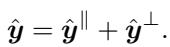
The authors define a projection matrix \(\Phi\) that represents the camera and lighting. Using this, they can mathematically enforce that the Range-Space component matches the input image perfectly.
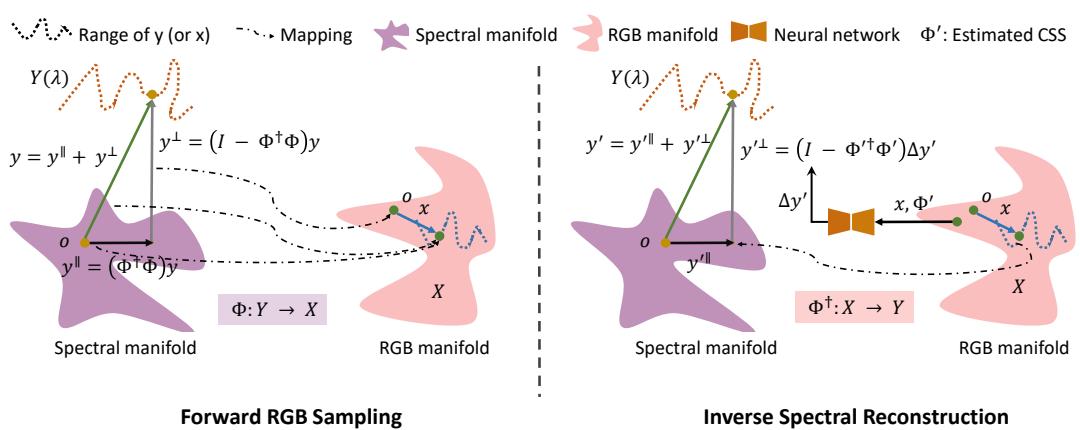
Figure 3 illustrates this concept.
- The path on the left shows the forward process: Physics turns spectra (\(\mathbf{y}\)) into RGB (\(\mathbf{x}\)).
- The path on the right shows the reconstruction: The model calculates the Range-Space component (\(\mathbf{y}'^{\parallel}\)) directly from the input using the pseudo-inverse of the camera matrix (\(\Phi^{\dagger}\)).
- The Neural Network only focuses on predicting the raw spectral signal \(\Delta\mathbf{y}'\), which is then projected into the Null-Space (\(\mathbf{y}'^{\perp}\)).
The final reconstruction formula combines these two:

This formula ensures physical consistency. No matter what the network predicts for the null space, when we project the final result back to RGB, the math guarantees it will match the input \(\mathbf{x}\).
The Architecture: Making the Math Work
To use the formula above, the model needs to know two things that are usually unknown in the real world: the Camera Spectral Sensitivity (CSS) and the Illumination.
1. Explicit CSS Estimation
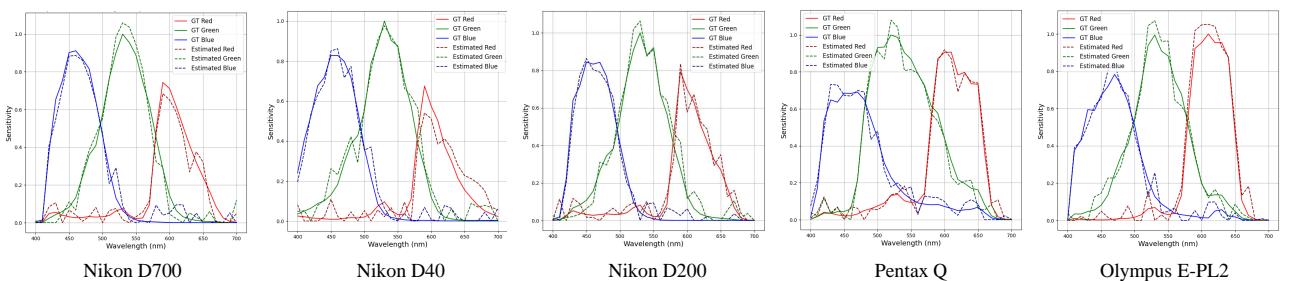
PhySpec uses a transformer-based encoder to extract features from the image and explicitly estimate the camera’s sensitivity curves.
Does it work? Look at Figure 2 below. The dashed lines (Estimated) track the solid lines (Ground Truth) remarkably well across different camera models like Nikon and Pentax.
2. Dynamic Illumination Estimation (DIEM)
Lighting varies from image to image. Using fixed parameters for lighting would cause the model to fail in new environments. The researchers designed a Dynamic Illumination Estimation Module (DIEM).
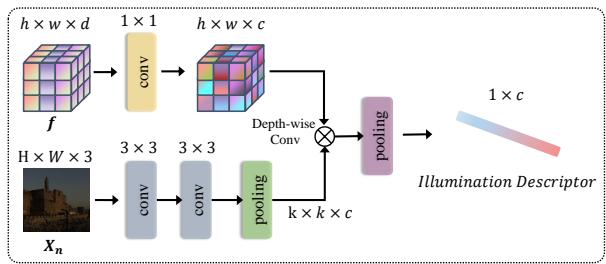
As shown in Figure 5, DIEM uses a dual-branch setup. One branch looks at the deep features, and the other looks at the raw image. They combine to generate an illumination-aware filter that adapts to the specific lighting of the input image.
Meta-Auxiliary Learning (MAXL)
Even with the physics constrained, there is a generalization problem. A model trained on sunny outdoor images might fail on indoor tungsten lighting. To solve this, the authors introduce Meta-Auxiliary Learning.
The core idea is to let the model “tune” itself at test time.
- Primary Task: Reconstruct the Spectrum.
- Auxiliary Task: Reconstruct the RGB from that spectrum (Self-Supervised).
During training, the model learns parameters that are easy to adapt. When the model sees a new test image, it runs a quick loop:
- Predict the Spectrum.
- Convert Spectrum back to RGB.
- Check the error between the reconstructed RGB and the original RGB (Auxiliary Loss).
- Update the weights slightly to minimize this error.
- Output the final Spectrum.
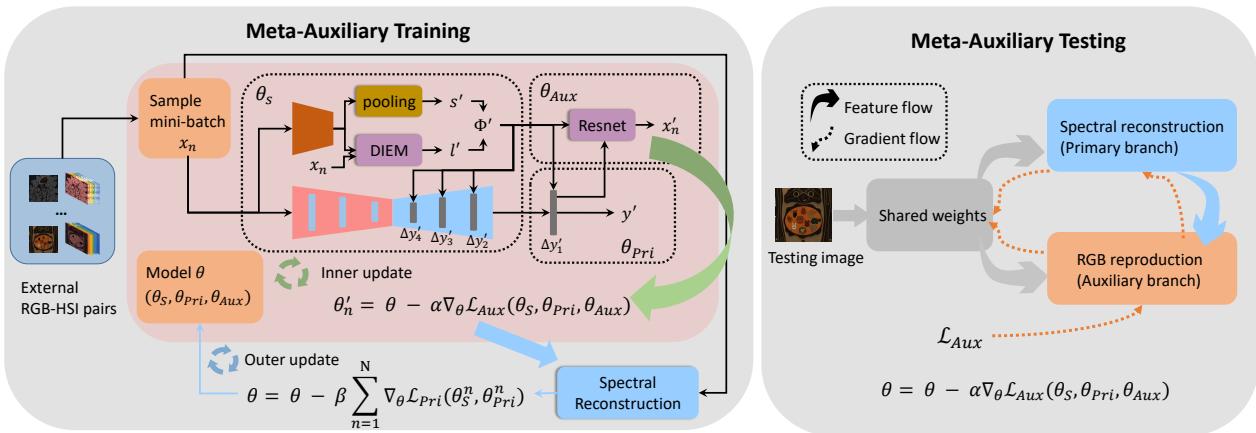
Figure 4 outlines this flow. The “Meta-Testing” phase (right side) shows how the model uses the input image itself to fine-tune its parameters via gradient descent steps before producing the final result. This allows PhySpec to adapt to unseen cameras and lighting conditions dynamically.
The auxiliary loss function is simple yet powerful—it’s just the difference between the input RGB and the reconstructed RGB:

Experiments & Results
The researchers tested PhySpec on standard datasets (ARAD-1K and ICVL). The results confirm that adding physics constraints significantly boosts performance.
Quantitative Superiority
Table 1 compares PhySpec against other leading methods (like MST++, PADUT, and AWAN).
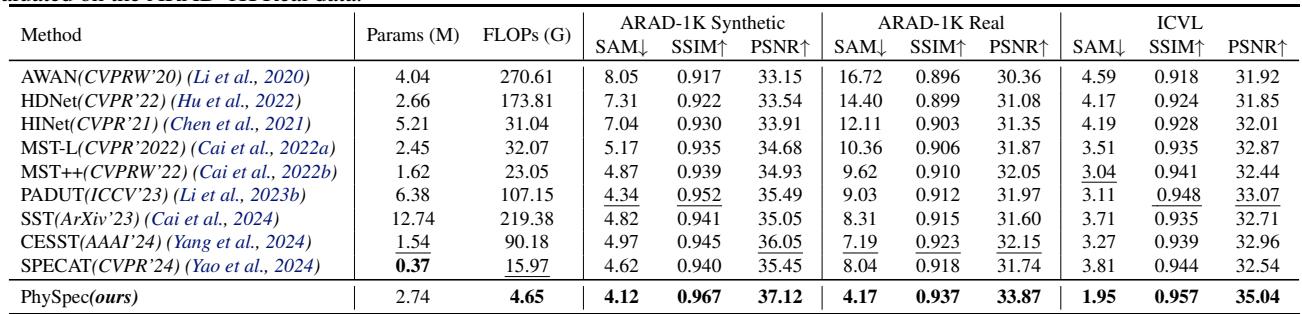
PhySpec achieves the lowest Spectral Angle Mapping (SAM) error and the highest Peak Signal-to-Noise Ratio (PSNR). Notably, it achieves this with a very low computational cost (FLOPs), making it efficient.
Visual Accuracy
Numbers are good, but visual spectral curves tell the real story. In Figure 7, we see the spectral reconstruction for a specific patch (the blue box on the owl).
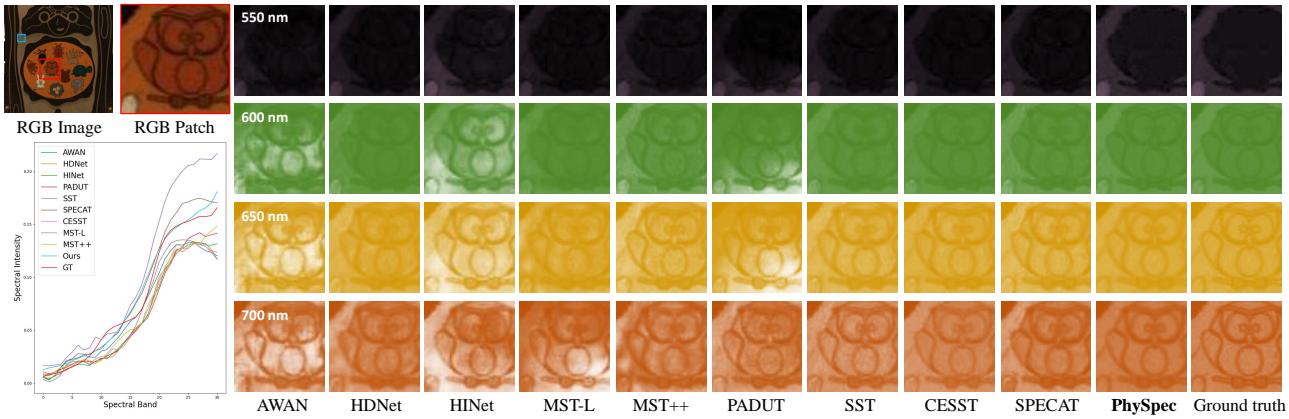
Look at the graph in the bottom left. The black line is the Ground Truth. The red line (PhySpec) hugs the ground truth tightly, capturing the peaks and valleys of the spectrum. Other methods (like the purple or green lines) often smooth out these details or miss the intensity completely.
The “Error Map” Test
To visualize where errors happen, the authors generated Mean Squared Error (MSE) heatmaps.
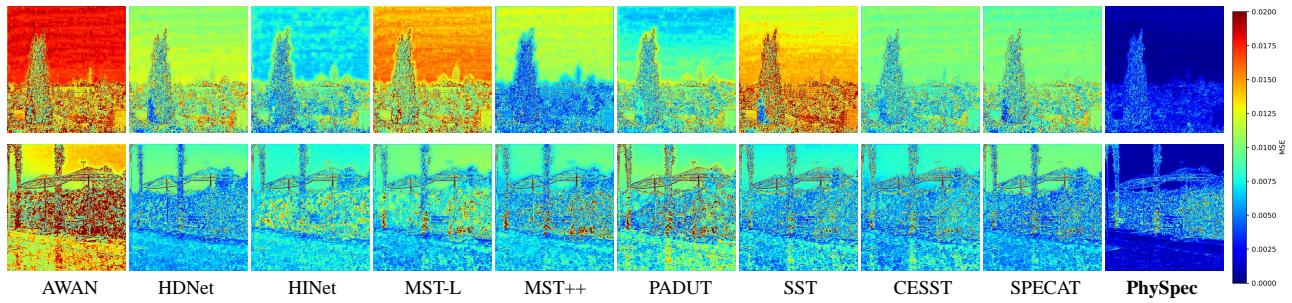
In Figure 6, blue represents low error, and red/yellow represents high error. PhySpec (far right) is almost entirely deep blue, indicating near-perfect reconstruction across the entire spatial image. Competitors like AWAN or HDNet show significant red patches, meaning they are hallucinating incorrect spectral data.
Solving the Colorimetric Dilemma
Finally, did they solve the original problem? Can the reconstructed spectra reproduce the original RGB image?
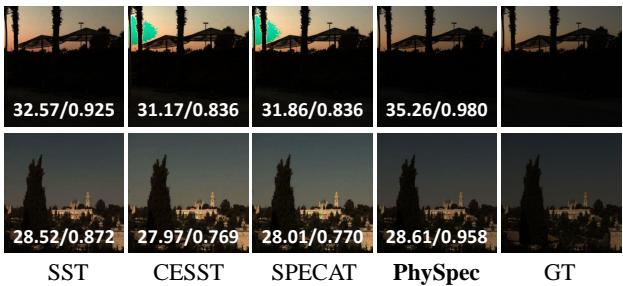
Figure 8 shows the “Reproduced RGB.”
- GT (Right): The goal.
- Competitors (SST, CESST, SPECAT): Notice the color shifts. Some images look washed out, or the sky color is slightly wrong.
- PhySpec: Visually indistinguishable from the Ground Truth, with a PSNR of 35.26 dB (compared to ~31-32 dB for others).
Conclusion and Implications
PhySpec represents a maturing of deep learning in scientific imaging. Instead of treating neural networks as black boxes that magically map inputs to outputs, this paper demonstrates the power of physics-informed deep learning.
By explicitly modeling the orthogonal subspaces of the signal—separating what we know (RGB range space) from what we need to guess (Null space)—the authors created a model that is robust, accurate, and trustworthy.
The addition of Meta-Auxiliary Learning provides a blueprint for how AI models can adapt to new environments in real-time without needing retraining labels. This is crucial for real-world applications like autonomous driving or mobile health diagnostics, where lighting and sensors are constantly changing.
Key Takeaways:
- Don’t ignore Physics: Enforcing the mathematical relationship between HSI and RGB ensures reliability.
- Divide and Conquer: Orthogonal Subspace Decomposition splits the problem into a deterministic part (physics) and a probabilistic part (AI).
- Adapt on the Fly: Self-supervised adaptation at test time solves the generalization problem.
PhySpec proves that the best AI results often come from combining modern Deep Learning with classical signal processing theory.