](https://deep-paper.org/en/paper/664_socialnav_sub_benchmarking-2652/images/cover.png)
Introduction
Imagine you are walking down a busy university hallway between classes. You see a group of students chatting on your left, a professor hurrying towards you on your right, and a janitor mopping the floor ahead. Without consciously thinking, you adjust your path. You weave slightly right to give the group space, you slow down to let the professor pass, and you avoid the wet floor. This dance of “social navigation” is second nature to humans. We effortlessly interpret intentions, social norms, and spatial dynamics.
For robots, however, this is an immense challenge.
Social robot navigation—the ability for robots to move effectively and safely within human-populated environments while adhering to social norms—remains a fundamental hurdle in robotics. While traditional algorithms can plan a path from point A to point B to avoid static obstacles, navigating around people requires a deeper level of scene understanding. The robot must ask: Is that person yielding to me? Are they distracted? Am I blocking their path?
Recently, the rise of large Vision-Language Models (VLMs), such as GPT-4o and Gemini, has offered a glimmer of hope. These models demonstrate impressive common-sense reasoning and contextual understanding. It is tempting to assume that because these models can describe an image of a party, they can also guide a robot through it.
But is that true? Can VLMs actually understand complex, dynamic social scenes accurately enough to be safe?
In the research paper “SocialNav-SUB: Benchmarking VLMs for Scene Understanding in Social Robot Navigation,” researchers from the University of Texas at Austin set out to answer this question. They introduce a rigorous benchmark designed to systematically evaluate whether state-of-the-art VLMs possess the spatial, spatiotemporal, and social reasoning capabilities required for real-world robotic navigation. The results reveal surprising insights about the gap between general-purpose AI and the specific demands of social robotics.
The Context: Why Social Navigation is Hard
Before diving into the benchmark, it is helpful to understand why this problem exists. Early approaches to robot navigation relied on the “Social Force Model,” which treated humans like particles with repulsive forces—effectively magnets pushing the robot away. While mathematically clean, humans are not magnets; we negotiate space using social cues.
Newer “learning-based” methods (like Reinforcement Learning) try to learn these behaviors from data. However, these models are often trained on small datasets or in controlled environments. They struggle to generalize to the chaotic reality of a crowded street.
This is where VLMs come in. Because they are trained on vast datasets of internet-scale images and text, they theoretically encode patterns of human behavior and social norms. The researchers behind SocialNav-SUB argue that before we slap a VLM onto a robot and let it loose, we must evaluate three critical dimensions of its “brain”:
- Spatial Reasoning: Knowing where things are (e.g., “The person is to my left”).
- Spatiotemporal Reasoning: Understanding how things move over time (e.g., “That person is walking toward me”).
- Social Reasoning: Interpreting intentions and interactions (e.g., “I should yield because they are rushing”).
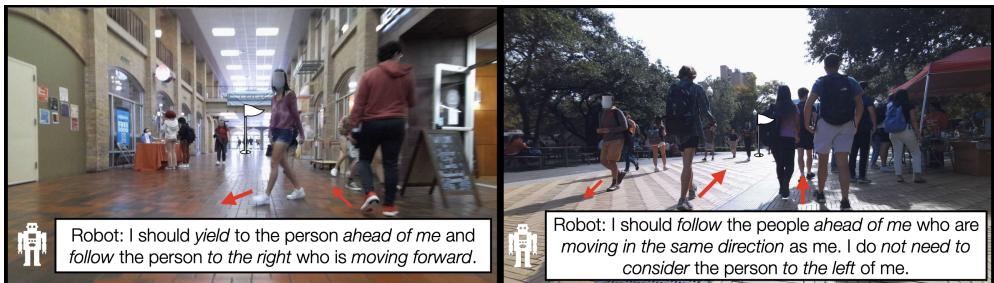
As shown in Figure 1, navigation is not just about geometry; it is about logic. In the left panel, the robot reasons, “I should yield to the person ahead of me.” In the right panel, it decides, “I should follow the people ahead of me.” These are complex decisions derived from visual input.
The Solution: SocialNav-SUB
To test these capabilities, the authors created SocialNav-SUB (Social Navigation Scene Understanding Benchmark). This is a Visual Question Answering (VQA) benchmark tailored specifically for robotics.
The core idea is to present the VLM with video clips of a robot navigating a crowd and ask it specific questions. If the VLM cannot correctly identify that a person is approaching from the left, it certainly cannot be trusted to steer the robot to avoid them.
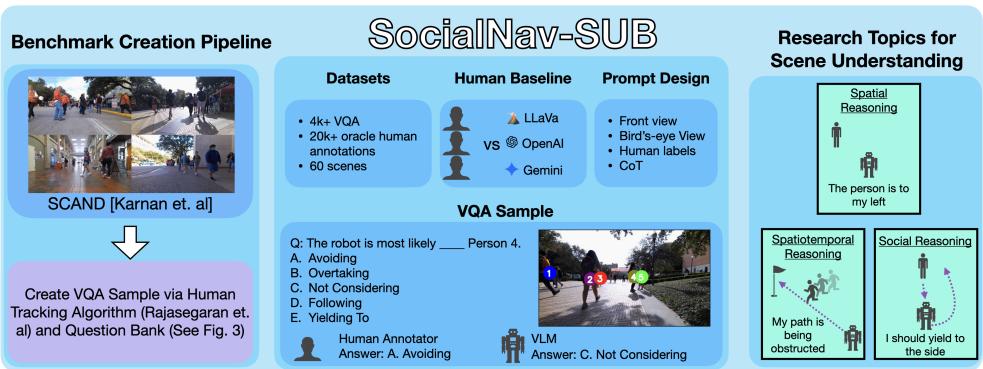
Figure 2 provides a high-level overview of the framework. It connects raw data from real-world robot deployments to a structured evaluation pipeline using human baselines and prompt engineering. Let’s break down how this benchmark was built.
1. Sourcing Challenging Scenarios
The researchers utilized the SCAND dataset, a large collection of socially compliant navigation demonstrations. The robots in this dataset were teleoperated by humans, meaning the data captures how people drive robots through crowds.
They didn’t just pick random clips. They filtered for “challenging” scenarios—scenes with high crowd density (averaging over 6 people per scene), close proximity between the robot and pedestrians, and dynamic movement. These are the “stress tests” of social navigation.
2. Rich Object-Centric Representations
One of the key insights of this paper is that giving a VLM a raw video feed isn’t enough. VLMs are notoriously bad at extracting precise 3D spatial information from 2D images.
To give the models a fair fighting chance, the authors processed the raw footage through a sophisticated pipeline.
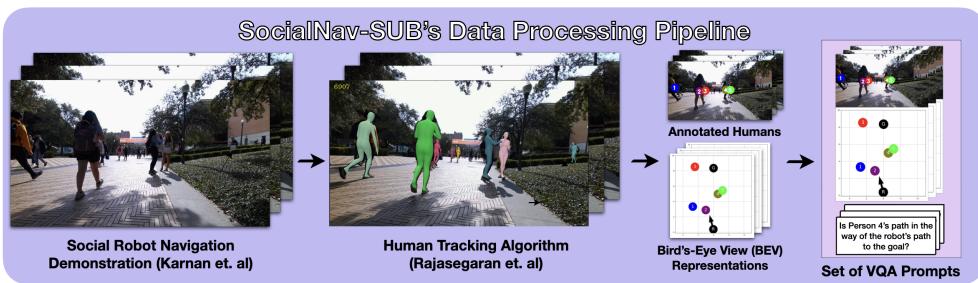
As detailed in Figure 3, the pipeline involves several steps:
- Input: A sequence of images from the robot’s front-facing camera.
- Tracking: Using the PHALP algorithm to track humans and estimate their 3D locations.
- Smoothing: Applying Kalman smoothing to ensure the trajectory data isn’t jittery.
- Projection: Creating a Bird’s-Eye View (BEV) representation.
This BEV is crucial. It translates the perspective view (what the camera sees) into a top-down map (what the navigation system needs). The VLM is then presented with both the front-view images (with people annotated by colored circles) and the BEV map. This “object-centric” approach removes some of the ambiguity of raw pixel data.

The authors validated this tracking pipeline against ground-truth data (shown in Figure 6) to ensure that the positions shown to the VLM were accurate.
3. The Question Engine
With the data prepared, the next step was asking the right questions. The benchmark consists of nearly 5,000 unique questions divided into the three reasoning categories.
- Spatial: “In the beginning, is Person 1 to the left of the robot?”
- Spatiotemporal: “Is Person 2 moving closer to the robot over time?”
- Social: “Is the robot’s movement affected by Person 3?” or “Should the robot yield to Person 4?”
Crucially, this is not just a qualitative assessment. It is a multiple-choice test.
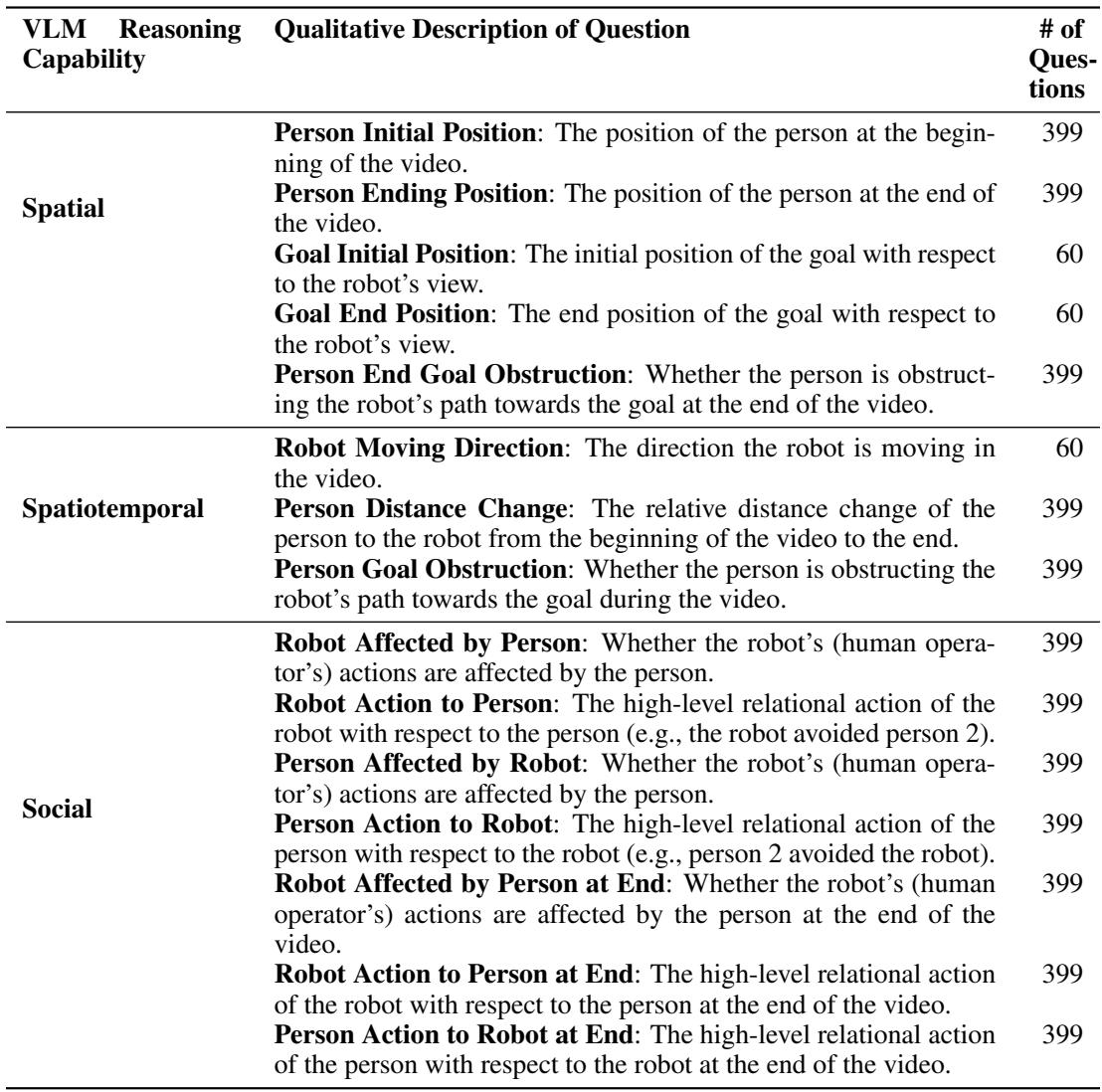
Table 6 outlines the scope of these questions. Notice the progression from simple perception (Initial Position) to complex inference (Robot Action).
4. The Human Oracle Baseline
In social navigation, there is rarely a single mathematically “correct” answer. Social interactions are subjective. If you ask five people, “Was that robot rude?”, you might get different answers.
To account for this, the researchers conducted a human-subject study. They showed the same clips and questions to humans.

This human data serves as the “Ground Truth.” However, simply taking the majority vote isn’t always enough. The authors introduced a clever metric called Consensus-Weighted Probability of Agreement (CWPA).
Here is the standard Probability of Agreement (PA):
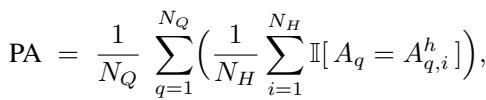
This measures how often the VLM agrees with the distribution of human answers. But CWPA takes it a step further by weighting the score based on human consensus:


Why does this matter? If humans are split 50/50 on an answer (e.g., “Is the person far away?”), the question is subjective. The model shouldn’t be penalized heavily for choosing one side. However, if 100% of humans agree (“The person is right in front of you!”), and the model gets it wrong, the penalty is severe. This metric ensures the benchmark focuses on clear errors in judgment rather than subjective ambiguity.
Experiments: Man vs. Machine vs. Rules
The researchers tested several state-of-the-art models, including GPT-4o, Gemini 2.0, Gemini 2.5, OpenAI o4-mini, and LLaVa-Next-Video. They compared these against two baselines:
- Human Oracle: The consensus of human participants.
- Rule-Based: A simple algorithm that uses the tracked coordinates of people to answer questions using hand-crafted logic (e.g., “If \(x < 0\), then person is on the Left”).
The results were eye-opening.

Table 1 presents the main scorecard. Here are the key takeaways:
1. The Rule-Based System Wins
Look at the “Rule-Based” row compared to the VLMs. In almost every category, a simple script that checks geometry outperforms massive AI models. For example, in Spatial Reasoning (CWPA), the Rule-Based system scores 0.80, while GPT-4o scores 0.73.
This indicates that while VLMs are “smart,” they lack precise geometric grounding. They might see a person, but they struggle to reliably map that person to a specific spatial relationship (left/right/ahead) compared to a simple geometric check.
2. The Spatial Reasoning Bottleneck
The VLMs performed worst on Spatial and Spatiotemporal reasoning compared to the Human Oracle. This confirms a suspicion held by many roboticists: VLMs are great at semantics (“That is a person”), but poor at spatial cognition (“That person is 2 meters away at a 45-degree angle”).
3. Social Reasoning is a Strength (Relatively)
Interestingly, the gap between VLMs and humans was smallest in Social Reasoning. For example, Gemini 2.0 achieved a PA of 0.63 in Social Reasoning, which is actually higher than the “Rule-Based” baseline (0.62).
This suggests that VLMs do capture social norms. They understand concepts like “yielding” or “following” reasonably well, perhaps better than a hard-coded rule can. However, their ability to apply this reasoning is likely hamstrung by their poor spatial perception. If you don’t know where the person is, you can’t correctly decide to yield to them.
Qualitative Analysis: Where do they fail?
To understand why the models fail, the authors provide visual examples of successes and failures.

Figure 9 shows distinct failure modes:
- Top-Left: The model fails to recognize that Person 5 is on the left. This is a basic spatial error.
- Bottom-Left: The model suggests avoiding Person 3, who is far away in the background. This is a failure of relevance—the model is “hallucinating” a threat where none exists.
- Bottom-Right: The model hallucinates an interaction with Person 7, whom humans deemed irrelevant.
However, it’s not all bad news.
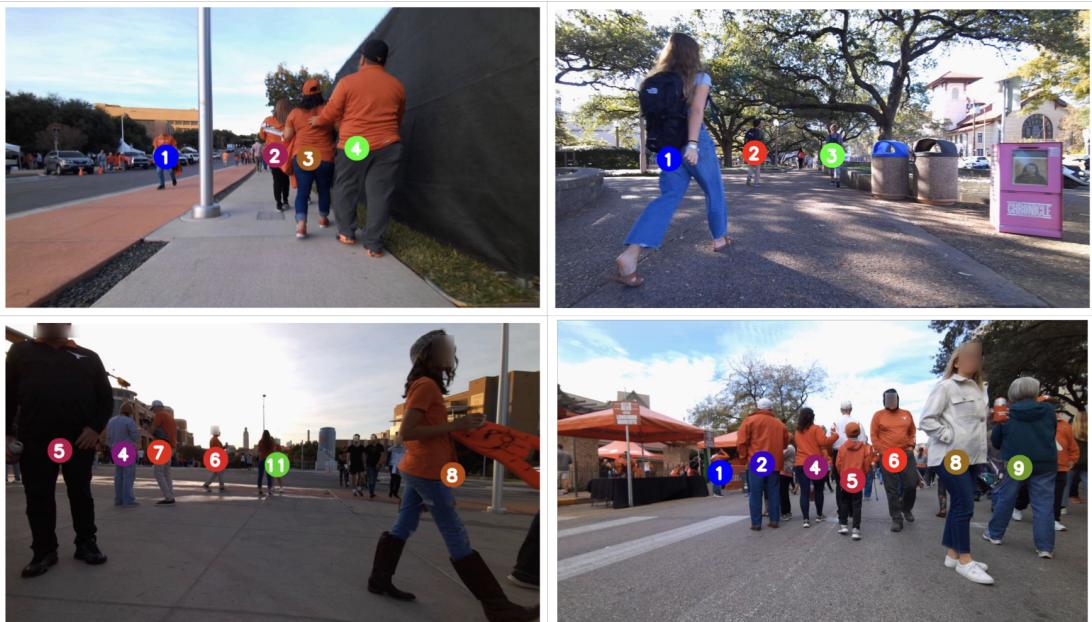
Figure 10 shows where the models shine. In the bottom-right image, most VLMs correctly predicted that the robot needs to consider Person 6 as it moves toward the goal, aligning with human intuition. This shows the potential of these models to handle dense, complex crowds when their spatial perception holds up.
Digging Deeper: Ablation Studies
The researchers didn’t stop at just testing the models; they wanted to know what helps them perform better. They conducted ablation studies (removing features to see what breaks).

Table 2 reveals two critical components for success:
- Chain-of-Thought (CoT): Asking the model to “show its work” or reason step-by-step significantly improves Social Reasoning.
- Bird’s-Eye View (BEV): Providing the top-down map helps, especially for models like Gemini 2.0. However, surprisingly, removing BEV helped LLaVa slightly in some metrics, suggesting that not all models are equally good at reading map data.
Does Scene Understanding Matter?
One valid critique of VQA benchmarks is: “So what if the model can answer questions? Can it actually navigate?”
To address this, the authors ran a “Waypoint Selection” experiment. They asked the VLMs to pick the best next point for the robot to move to, given the scene.
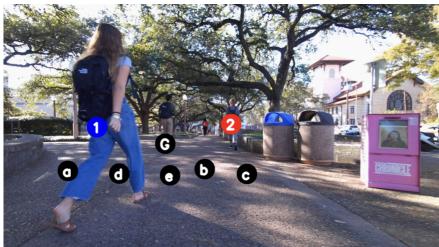
As shown in Figure 4, the VLM has to choose a subgoal (a, b, c, d, or e).

Table 3 shows the results. When the models were provided with the Human Oracle context (i.e., the correct answers to the scene understanding questions), their ability to pick the correct waypoint jumped significantly (e.g., o4-mini improved from 36% to 46%).
This proves the central hypothesis of the paper: Better scene understanding leads to better navigation. If we can fix the spatial perception issues in VLMs, their decision-making is actually quite good.
Conclusion
The SocialNav-SUB benchmark provides a reality check for the robotics community. While Vision-Language Models are powerful tools, they are not magic bullets for social navigation—yet.
The study highlights a clear hierarchy of capabilities:
- Humans (The Gold Standard)
- Rule-Based Systems (Simple, but geometrically accurate)
- VLMs (Semantically rich, but spatially confused)
The primary failure mode for current VLMs is spatial reasoning. They struggle to ground their high-level knowledge in the precise geometry of the physical world. However, the study also offers a roadmap forward. By integrating Chain-of-Thought reasoning, explicit Bird’s-Eye View representations, and hybrid systems that combine rule-based geometric tracking with VLM-based social inference, we can bridge this gap.
SocialNav-SUB sets the stage for the next generation of social robots—ones that don’t just move like magnets, but navigate with the social intelligence of a human.