](https://deep-paper.org/en/paper/670_cost_aware_discovery_of_co-2600/images/cover.png)
Introduction
Imagine you are testing a new autonomous vehicle. You run it through a simulator on a sunny day, and it stops perfectly for pedestrians. You try it in the rain, and it works fine. But then, you deploy it in the real world, and it suddenly fails to brake for a cyclist at dusk, specifically when a parked car casts a shadow on the road.
This is a contextual failure. The system didn’t fail because it was broken in a general sense; it failed because a specific combination of environmental context (lighting), task constraints (braking distance), and system state (sensor noise) conspired to trick it.
Finding these “edge cases” is the holy grail of robotics testing. However, finding them is incredibly hard. You cannot simply test every possible combination of time, weather, and traffic—it would take virtually infinite time and money. Furthermore, unlike a math problem, we often don’t have a clear equation that defines “failure.” A weird vibration in a robotic arm or a near-miss in a car is subjective and hard to code into a cost function.
In a recent paper from MIT’s LIDS titled “Cost-aware Discovery of Contextual Failures using Bayesian Active Learning,” researchers propose a sophisticated new framework to solve this. They combine human expertise (or LLMs acting as experts) with Bayesian Active Learning to efficiently hunt down these rare, dangerous scenarios without breaking the bank.
In this deep dive, we will unpack how this method works, why “coverage” is the secret sauce to testing, and how they used this technique to break—and fix—robotic arms and self-driving algorithms.
The Core Problem: Why Traditional Falsification Fails
In engineering, “falsification” is the process of trying to break your system to prove it isn’t safe. Traditional methods usually fall into three buckets:
- Model-based methods: These assume you have a perfect mathematical model of your robot. (Spoiler: In the real world, you rarely do).
- Optimization-based methods: These try to minimize a specific cost function. If the cost drops below zero, you found a failure. But this requires you to write a mathematical function that perfectly describes “failure,” which is often impossible for nuanced behaviors.
- Random Sampling: You just roll the dice and hope you find a bug. This is inefficient and rarely finds the complex, “deep in the corners” failures.
The authors of this paper tackle a more realistic, “black-box” scenario where:
- We don’t know the internal workings of the system.
- Evaluating the system is expensive (running a real robot takes time and risks damage).
- We need an expert (human or AI) to judge if a failure occurred.
The Solution Overview
The researchers propose a loop that integrates experiments, expert feedback, and probabilistic modeling.
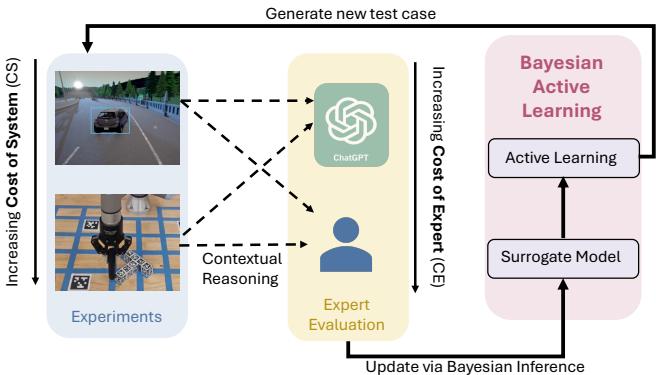
As shown in Figure 1, the process works in a cycle:
- Experiments: The system runs a test scenario (e.g., a specific road condition).
- Contextual Reasoning: An expert (human or ChatGPT) watches the result and evaluates it.
- Surrogate Model: A probabilistic model (Gaussian Process) updates its understanding of where failures are likely to hide.
- Active Learning: The algorithm calculates the next best scenario to test to maximize discovery and diversity.
Methodology: How to Hunt for Failures
Let’s break down the machinery inside this framework. The goal is to find a set of scenario parameters \(z\) (like weather, speed, obstacle position) that cause the system to fail.
1. Defining the Target
First, we need to define what we are looking for. The researchers define a “Target Set” \(\Omega\). This set contains all the scenarios where the severity of the failure (\(\gamma\)) is higher than a certain threshold (\(\delta\)).

In plain English: We are hunting for the regions in the parameter space where things go wrong.
2. The Expert in the Loop
Since we can’t write a math equation for “the car drove awkwardly,” the framework relies on an expert evaluation function, \(g\). This expert assigns scores to different “failure modes.”
For example, in a robotic arm task, Mode 1 might be “hitting a joint limit,” while Mode 2 might be “missing the target object.” The expert provides a score for each mode. Interestingly, the paper demonstrates that you don’t always need a human for this. They successfully used Large Language Models (LLMs) like GPT-3.5 to analyze simulation logs and act as the “expert” judge.
3. The Surrogate Model (The Brain)
Because running the real robot is expensive (high “evaluation cost”), we can’t test everything. We need a model that can guess the outcome of a test without actually running it. This is called a Surrogate Model.
The authors use Gaussian Processes (GPs). A GP is a powerful probabilistic tool that doesn’t just predict the outcome; it predicts the outcome and tells you how unsure it is.
- If the GP is confident that a region is safe, the system won’t waste time testing there.
- If the GP is uncertain, or predicts a high chance of failure, the system marks that region for investigation.
4. Active Learning via “Coverage”
This is the most innovative part of the paper. Most testing algorithms just want to find one failure. Once they find it, they stop, or they keep finding the exact same failure over and over.
But knowing that a car crashes at 50mph is useless if you don’t know it also crashes at 10mph in the rain. We want Diversity.
The researchers introduce a metric called Expected Coverage Improvement (ECI). They want to cover the search space in two ways:
- Parameter Space Coverage (\(C_p\)): Explore diverse inputs. Don’t just test sunny days; test rain, snow, and fog.
- Metric Space Coverage (\(C_m\)): Explore diverse severities. Find catastrophic failures, but also find mild glitches.
The acquisition function (the logic that picks the next test) looks like this:

Here, the algorithm balances exploring the physical parameters (\(\mathbb{N}_p\)) and the failure outcomes (\(\mathbb{N}_m\)). By maximizing this function, the system consistently picks the next test case that adds the most new information to our understanding of the system’s weaknesses.
Experimental Validation
To prove this actually works better than just guessing, the researchers ran extensive experiments across three different domains.
Case Study 1: The “Push-T” Robot Task
In this task, a robotic arm must push a T-shaped block to a target location. It’s a classic control problem that is deceptively tricky.
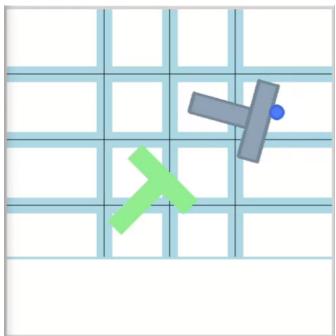
The researchers compared their method (ECI) against Random Sampling and Upper Confidence Bound (UCB), a standard optimization technique.
The Result: Standard optimization (UCB) gets “stuck.” It finds one spot where the robot fails and keeps drilling there. Random sampling is too scattered. The proposed ECI method, however, maps out the entire failure landscape.
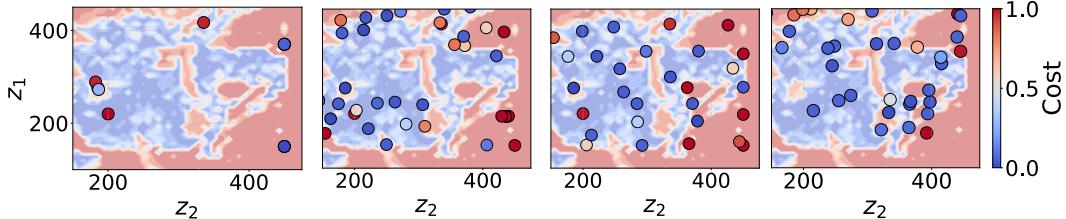
Look at Figure 2 above.
- UCB (Left): Clumps all its tests in one tiny red spot. It found a failure, but it missed the big picture.
- ECI (Center): Spreads its samples along the “boundary” of failure. It effectively traces the coastline of the danger zone.
- Random (Right): Just noise.
Sim-to-Real Gap
They didn’t just run this in code; they put it on a real UR3E robot. They found that the real robot had failure modes that didn’t exist in the simulator, specifically related to joint limits and cable tension.
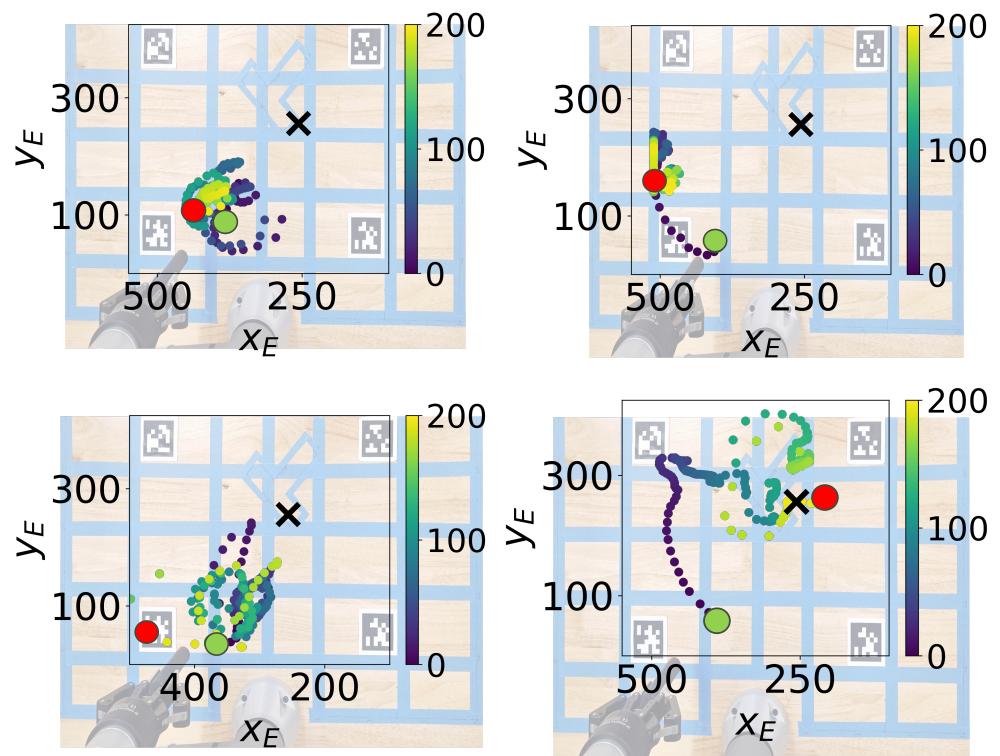
Figure 9 shows the actual trajectories of these failures. The framework was able to identify Mode 1 (joint limits) and Mode 2 (poor training data) distinctively. Later, it even discovered a surprise Mode 3 (workspace limits) that the researchers hadn’t initially accounted for, proving the system’s ability to adapt to new, unexpected failure types.
Case Study 2: Self-Driving Perception (CARLA)
Next, they tackled a high-fidelity self-driving simulator (CARLA). The goal: test a YOLO object detector. The scenario involved a pedestrian crossing the street while two cars (ego and lead) maneuvered.
The parameters (\(z\)) included the braking distances of the cars and the sun’s position (brightness).
The Challenge: Can we find scenarios where YOLO fails to see the car or the person? The “Expert”: Instead of a human watching hours of footage, they used an LLM. They fed the simulation data (object lists and captions) into GPT-3.5 and asked, “Did the perception system fail due to bad lighting?”
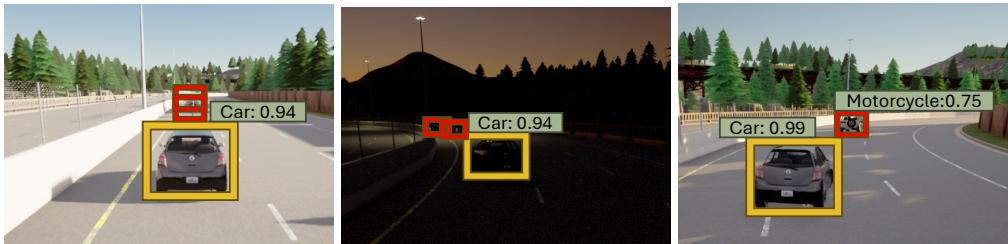
Figure 4 visualizes the failures discovered. The system successfully found specific “Contextual Failures”:
- Mode 1: Misdetection due to large distance.
- Mode 2: Misdetection due to poor lighting (glare/shadows).
The active learning agent realized that simply making it “dark” wasn’t enough; it had to find the specific combination of distance and lighting that broke the neural network.
Case Study 3: Autonomous Emergency Braking (AEB)
The final experiment tested an Autonomous Emergency Braking system in a Simulink environment involving a cyclist, a pedestrian, and a parked car.
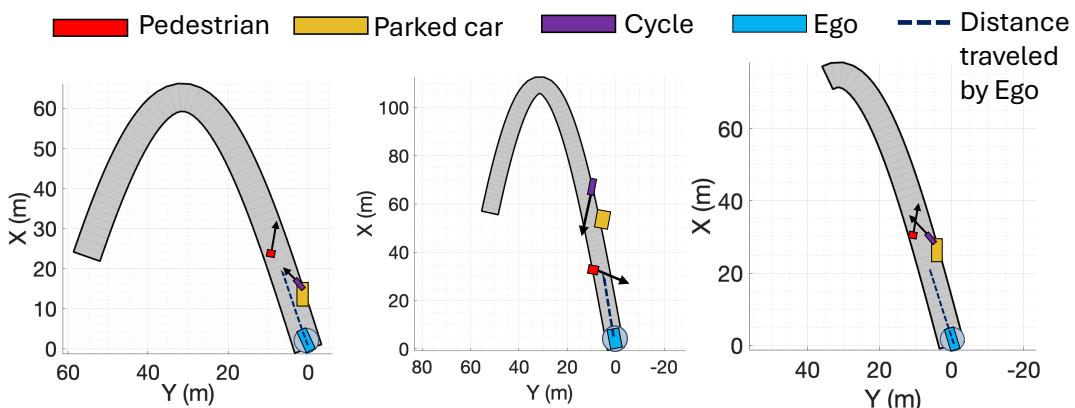
This scenario is high-dimensional (many variables: speeds, positions, start times).
- Mode 1: The cyclist is occluded (hidden) by the parked car, causing late braking.
- Mode 2: The pedestrian enters the scene late, causing a panic stop.
Table 6 highlights the performance metrics. The proposed ECI method significantly outperformed random sampling in finding “Positive Samples” (actual failures).
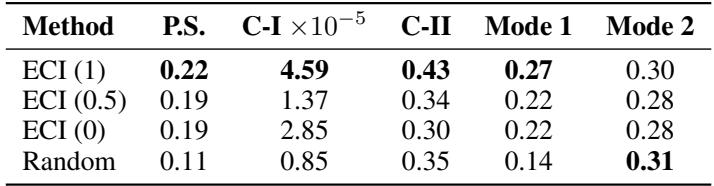
Because the search space is so huge, random sampling is like looking for a needle in a haystack. The Bayesian approach acts like a metal detector, guiding the search toward areas of high uncertainty and high failure probability.
Why This Matters: Closing the Loop
Discovering failures is only half the battle. The ultimate goal is to fix them.
In the Push-T robot experiment, the researchers took the failures discovered by their algorithm—specifically “Mode 3” failures where the robot left its workspace—and used them to generate new training data.
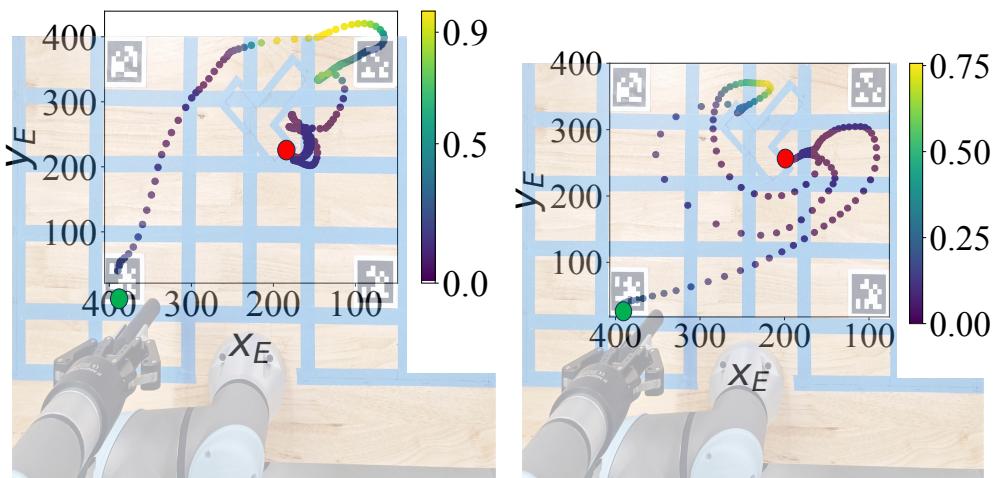
Figure 15 shows the “Before and After.”
- Left: The original policy drives the robot arm out of bounds (failure).
- Right: After retraining the policy using the specific “edge cases” found by the algorithm, the robot learns a corrected trajectory that stays within safety limits.
This demonstrates the complete pipeline: Discovery \(\rightarrow\) Analysis \(\rightarrow\) Repair.
Conclusion
The safety of autonomous systems relies on our ability to find the “unknown unknowns”—the weird, contextual failures that don’t show up in standard tests.
This research paper makes three major contributions to the field:
- Cost-Awareness: It acknowledges that testing is expensive and treats every sample as precious.
- Contextual Reasoning: It moves beyond simple math costs, allowing experts (or AI proxies) to define failure based on context.
- Diversity First: By using Bayesian Active Learning with a coverage metric, it ensures we don’t just find a bug, but that we map out the entire landscape of bugs.
As we move toward a world populated by robots and self-driving cars, tools like this—which can efficiently root out failures before they happen on the road—will be essential for deployment safety. The move to incorporate LLMs as evaluators also opens up exciting possibilities for automating the testing of subjective, human-like behaviors in machines.