](https://deep-paper.org/en/paper/733_steerable_scene_generation-2627/images/cover.png)
Introduction
In the rapidly evolving world of robotics, data is the new gold. We are witnessing a shift where robots, much like Large Language Models (LLMs), are increasingly trained on massive datasets. However, unlike chatbots that feed on text scraped from the internet, robots need to understand physical space. They need 3D environments to practice navigation, manipulation, and interaction.
This creates a bottleneck: Where do we get millions of diverse, physically realistic 3D scenes?
Manual creation by 3D artists is too slow and expensive. Collecting real-world 3D scans is difficult and lacks interactivity. Traditionally, researchers have relied on “procedural generation”—writing complex sets of code-based rules to randomly place objects (think of how Minecraft generates terrain). While scalable, these systems are rigid. If you want to change the distribution of objects—for example, to train a robot specifically on “messy tables”—you often have to rewrite the code.
A new research paper, Steerable Scene Generation with Post Training and Inference-Time Search, proposes a powerful alternative. The researchers introduce a method to train a Generative Diffusion Model on scenes. Instead of relying on hand-coded rules at runtime, the model learns the concept of a scene from data.
But the real innovation isn’t just generating scenes; it is steering them. The authors demonstrate how to force the generative model to create scenes that meet specific, difficult criteria—like high clutter or specific object stacks—using Reinforcement Learning (RL) and a novel Tree Search algorithm.
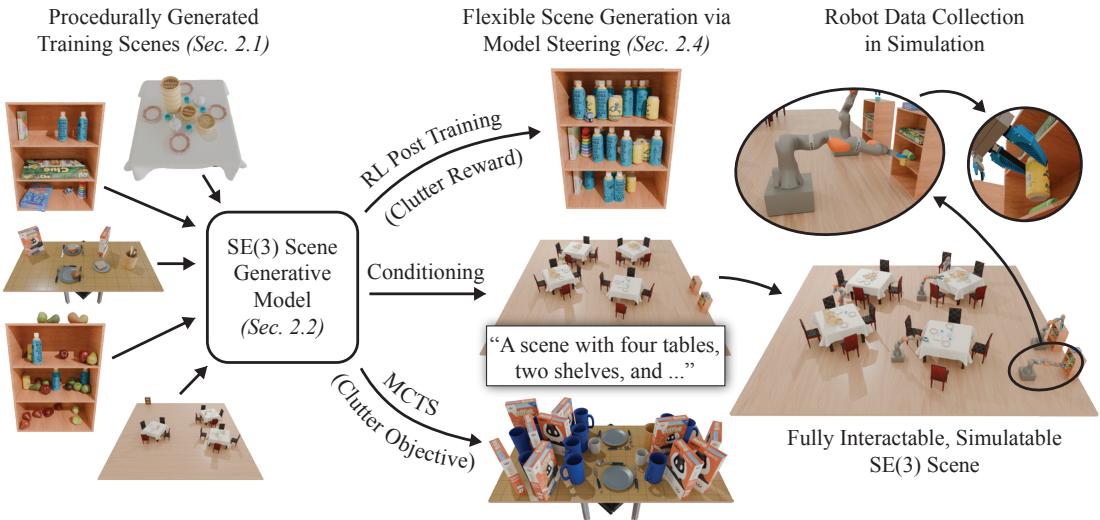
As shown in Figure 1, this pipeline transforms static procedural data into a flexible, adaptable “scene prior” that can be molded to fit the exact needs of a robot’s training regimen.
Background: From 2D Layouts to SE(3) Reality
Before diving into the method, we need to understand the gap this paper fills.
The Limitation of SE(2)
Many previous attempts at scene generation focused on SE(2)—the Special Euclidean group in 2 dimensions. In plain English, these models viewed scenes like floor plans. They could place a couch or a bed on the floor (x, y coordinates) and rotate it around the vertical axis (yaw). This is fine for navigating a room, but useless for a robot arm that needs to pick up a mug from a shelf.
The Necessity of SE(3)
Robotic manipulation happens in SE(3)—full 3D space. Objects have 3D positions (x, y, z) and 3D orientations (roll, pitch, yaw). A robot needs to understand that a plate can be on top of a table, a bowl can be on top of the plate, and a spoon can be inside the bowl at an angle.
The paper tackles this harder problem. They treat a “scene” not as an image, but as a collection of objects, where each object has:
- Category: What is it? (e.g., Apple, Can, Plate).
- Pose: Where is it exactly in 3D space?
Core Method: The Steerable Scene Pipeline
The authors’ approach can be broken down into three phases: Data Distillation, Diffusion Training, and the novel “Steering” mechanisms.
1. Distilling Procedural Data
The team started by generating a massive dataset of over 44 million scenes using existing procedural tools. These scenes ranged from breakfast tables to pantry shelves. While procedural generation is rigid, it provides a “ground truth” of valid object placements.
They used this data to train their model. By doing so, they “distilled” the complex, hard-coded rules of the procedural generator into a neural network. Once the network learns the distribution, it becomes differentiable—meaning we can use gradients and math to tweak the output, which is impossible with standard code-based procedural generators.
2. The Diffusion Architecture
The generative model is based on Diffusion, the same technology behind image generators like Stable Diffusion or DALLE-3.
- Continuous & Discrete: A scene contains continuous data (positions/rotations) and discrete data (object categories). The authors use a “mixed diffusion” framework. They add noise to the object positions and randomly mask object categories, then train a neural network (based on the Flux transformer architecture) to reverse this process and reconstruct the clean scene.
- Physics Post-Processing: Diffusion models are dreamers—they don’t inherently know physics. A raw output might have a fork clipping through a plate or a can floating 1mm above a table. To fix this, the authors apply a two-step correction:
- Projection: A mathematical optimization moves objects to the nearest point where they don’t collide.
- Simulation: The scene is loaded into the Drake physics simulator. Gravity is turned on, allowing unstable objects to settle naturally.
3. Steering the Model
This is the heart of the paper. A standard generative model just mimics its training data. If the training data has mostly clean tables, the model will generate clean tables. But what if a robot needs to practice in a messy, cluttered environment to become robust?
The authors propose three ways to “steer” the model away from the average and toward specific goals.
Strategy A: Conditional Generation
The most direct way to control the output is through conditioning, similar to prompting an image generator.
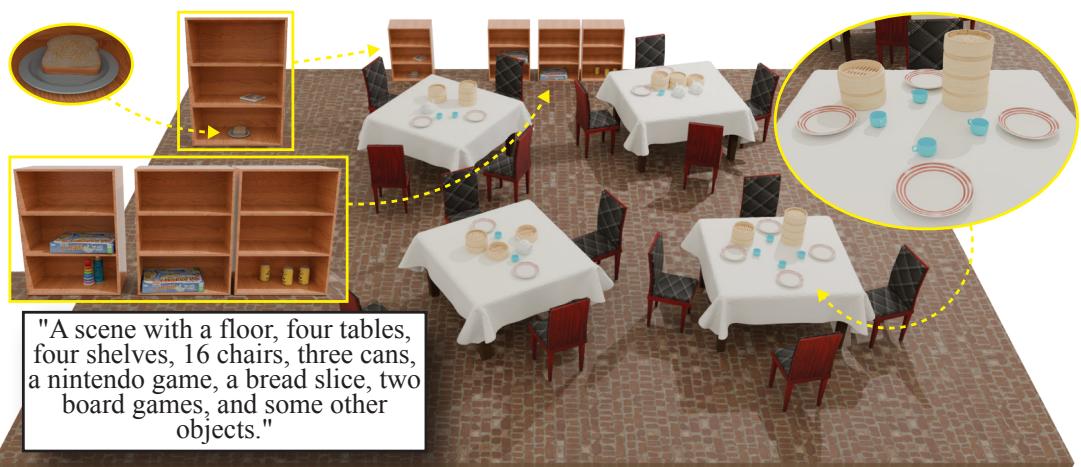
Text-Conditioning: By integrating a BERT text encoder, the model can accept natural language prompts. As seen in Figure 3 below, a user can specify exact counts and types of objects. The model respects the large-scale layout (four tables) while handling fine-grained placement (cans, games, bread slices).
Inpainting and Rearrangement: The model can also take a partial scene and fill in the blanks. This allows for “scene rearrangement.” You can mask out the positions of specific objects (like cutlery) while keeping their identity fixed, and ask the model to generate new positions.

In Figure 5, the model successfully moves cutlery from a crock (vertical orientation) to the table surface (horizontal orientation), demonstrating it understands SE(3) rotations, not just 2D sliding.
Strategy B: Reinforcement Learning (RL) Post-Training
Sometimes, you want to change the behavior of the model globally without prompting it every time. For example, you might want a model that always generates scenes with maximum clutter to stress-test a robot’s path planner.
The authors apply Reinforcement Learning to the diffusion model (similar to how ChatGPT is fine-tuned with RLHF). They define a reward function—in this case, “number of objects.”
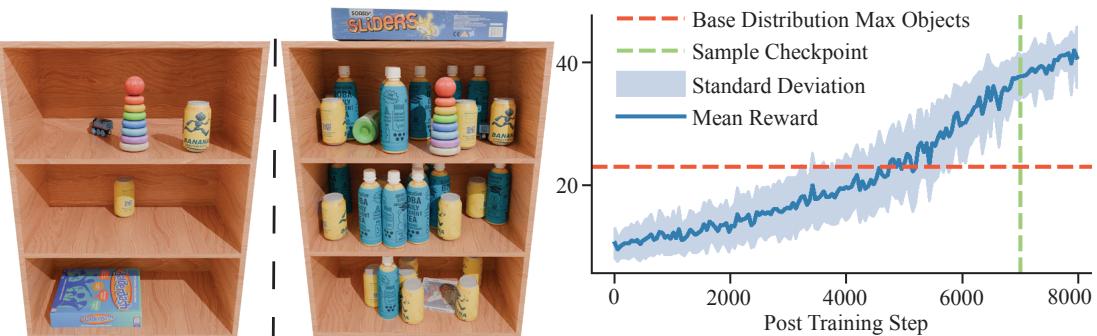
Figure 4 illustrates the power of this approach. The original training data had a maximum of roughly 23 objects. After RL post-training (blue line in the graph), the model learns to pack shelves with far more objects (image Middle), effectively extrapolating beyond the data it was trained on.
Strategy C: Inference-Time Search (MCTS)
The most sophisticated steering method presented is Monte Carlo Tree Search (MCTS) applied at inference time.
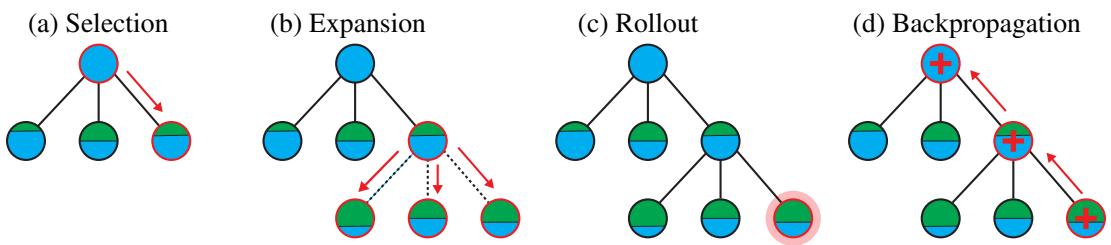
RL adapts the model weights permanently. MCTS, on the other hand, optimizes a specific single generation on the fly. It iteratively builds a scene, checking at each step if it is maximizing a specific reward (e.g., “physical feasibility” or “stack height”).
How it works: The process treats scene generation as a game tree.
- Root: An empty scene.
- Expansion: The model proposes several possible objects or placements (inpainting).
- Rollout: The system evaluates how good those placements are using a reward function.
- Backpropagation: The score updates the tree, guiding the model to explore the most promising branches.
This method is particularly useful for difficult physical arrangements. In the example below (Figure 7), the goal is to maximize the number of physically feasible objects in a Dimsum stacking scenario.
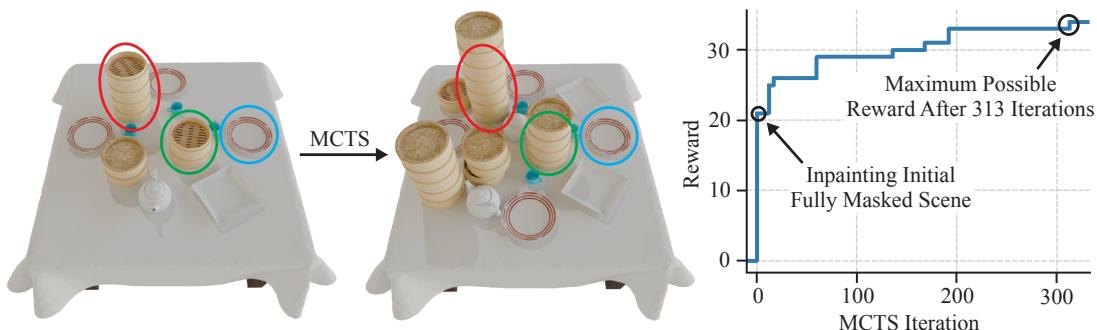
Standard generation might accidentally create unstable stacks that topple over. MCTS (Right graph) drastically improves the success rate, finding configurations with 34 feasible objects where standard sampling only found 21. It effectively “searches” for a stable way to stack the bamboo steamers.
Experiments and Results
The authors evaluated their models across five diverse environments: Breakfast Table, Living Room Shelf, Pantry Shelf, Restaurant, and Dimsum Table.
Quantitative Quality
To measure realism, they used the Fréchet Inception Distance (FID)—a standard metric for generative quality—and Median Total Penetration (MTP) to measure physical violations (collisions).

As shown in Table 1, the proposed method (“Ours”) achieves comparable or better FID scores than baselines like DiffuScene and MiDiffusion. More importantly, looking at the MTP (cm) column, the proposed method has significantly lower penetration errors (e.g., 6.31 vs 18.11 in the Restaurant scene). This indicates that the model has learned a much tighter, more physically plausible distribution of objects.
Interpolation Capabilities
One of the fascinating properties of learning a distribution is the ability to mix concepts. The authors trained a joint model on both Living Room shelves (books, toys) and Pantry shelves (food, cans).
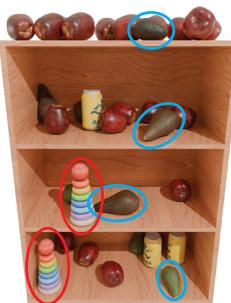
Figure 6 shows that the model can smoothly interpolate between these domains. When prompted, it creates hybrid scenes—placing food items on living room furniture or games on pantry shelves—while maintaining plausible physics.
Conclusion & Implications
This research bridges a critical gap in robotic simulation. By moving from rigid procedural generation to Steerable Generative Models, the authors have created a way to synthesize infinite, diverse, and task-specific training data.
The key takeaways are:
- Unified Prior: A single diffusion model can learn to generate valid 3D scenes from massive procedural datasets.
- Physics Matters: Generating poses in SE(3) requires careful handling of physics (projection and simulation) to be useful for robots.
- Steerability is Key: The ability to force the model to create high-clutter scenes (via RL) or physically stable stacks (via MCTS) allows researchers to target the “long tail” of distribution—the rare, difficult scenarios where robots often fail.
This work suggests a future where robot training environments are not hand-designed or randomly generated, but curated by AI. A robot struggling to grasp plates could automatically trigger a generative model to “imagine” thousands of difficult plate-stacking scenarios, training itself on the fly.