](https://deep-paper.org/en/paper/7375_outlier_gradient_analysis-1880/images/cover.png)
Introduction: The Data-Centric Shift
In the world of machine learning, we often obsess over the “model.” We tweak architectures, adjust learning rates, and experiment with novel optimizers. This is the model-centric approach. However, there is a growing realization that the biggest bottleneck isn’t usually the algorithm—it’s the data. This has given rise to data-centric AI, a paradigm where the focus shifts to improving the quality of the training data itself.
The premise is simple: “Garbage In, Garbage Out.” If your training dataset contains mislabeled samples, outliers, or irrelevant data, your model’s performance will suffer, no matter how sophisticated your architecture is.
But here lies the challenge: in a dataset of millions of images or text snippets, how do you find the “garbage”? You can’t manually inspect every sample. We need automated ways to identify detrimental training samples—data points that actively hurt your model’s ability to generalize.
For years, Influence Functions have been the gold standard for this task. They mathematically estimate how much a model would change if a specific data point were removed. While theoretically beautiful, they have a major flaw: they are computationally excruciating for deep learning models because they require calculating the inverse of the Hessian matrix (a massive matrix of second-order derivatives).
In this post, we are diving deep into a paper that proposes a clever, efficient alternative: Outlier Gradient Analysis. The researchers argue that we don’t need the heavy machinery of the Hessian. Instead, simply looking for outliers in the gradient space is faster, often more accurate for deep models, and mathematically sound.
Let’s explore how we can bridge the gap between complex influence functions and efficient outlier detection to build better models, faster.
Background: The Problem with Influence Functions
To understand the solution, we first need to understand the tool we are trying to replace. Influence functions mimic the “Leave-One-Out” retraining method. Ideally, to check if a data point is bad, you would:
- Train the model with the full dataset.
- Remove the data point.
- Retrain the model from scratch.
- Compare the performance.
If performance improves after removal, the data point was detrimental. Obviously, retraining a deep neural network thousands of times is impossible. Influence functions approximate this process using a Taylor expansion. The classic formula for the influence of a training sample \(z_j\) looks like this:

Let’s break this down simply:
- \(\nabla_{\hat{\theta}} \ell(z_j; \hat{\theta})\) is the gradient of the loss for the specific training sample. It tells us the direction the parameters want to move to satisfy this sample.
- \(\mathbf{H}_{\hat{\theta}}^{-1}\) is the Inverse Hessian. The Hessian represents the curvature of the loss landscape (how “steep” the valley is).
- The first term is the gradient of the validation/test loss.
By combining these, we get an Influence Score (\(\mathcal{I}\)).

If the score is negative, the sample is detrimental (removing it helps). If positive, it is beneficial.
The “Deep” Problem
While this formula works perfectly for convex models (like Logistic Regression), it breaks down for Deep Neural Networks (DNNs) for two reasons:
- Non-Convexity: DNN loss landscapes are not simple bowls; they are complex terrains with hills and valleys. The Hessian might not even be invertible.
- Computational Cost: For a model with \(P\) parameters, the Hessian is a \(P \times P\) matrix. If you have a model with just 1 million parameters, the Hessian has 1 trillion entries. Inverting this is computationally intractable.
Researchers have tried approximations (like LiSSA or Hessian-free approaches), but they remain slow and often inaccurate for deep models.
The Core Method: Outlier Gradient Analysis
The authors of this paper propose a brilliant simplification. They asked: Do we really need the Hessian to find bad data?
Let’s look at the influence equation again. It has three parts, but only one part is specific to the training sample \(z_j\) we are analyzing: the gradient vector \(\nabla_{\hat{\theta}} \ell(z_j; \hat{\theta})\). The Hessian and the test set gradients are global or aggregate terms.
This leads to the core hypothesis of the paper: The gradient vector alone contains enough information to identify detrimental samples.
The Conceptual Bridge
The researchers bridge influence functions with Outlier Analysis.
- Observation: In a converged model, most training data points are “beneficial” or neutral. They fit the pattern.
- Detrimental Samples are Outliers: Data points that are mislabeled or confusing are, by definition, anomalous relative to the majority.
- Hypothesis: Therefore, detrimental samples should appear as outliers in the gradient space.
Instead of solving a complex calculus problem (Influence Functions), we can solve a statistical geometry problem (Outlier Detection).
The Algorithm
The proposed method, Outlier Gradient Analysis, is surprisingly elegant and simple. Here is the process, visualized in the algorithm below:
- Collect Gradients: For every sample in your training set, compute the gradient of the loss with respect to the last layer’s parameters. (Using the last layer reduces dimensionality and is standard practice).
- Detect Outliers: Feed these gradient vectors into an outlier detection algorithm. The authors recommend Isolation Forest (iForest) because it is efficient (\(O(n)\) complexity) and handles high-dimensional data well. Simple methods like L1 or L2 norm thresholding can also work.
- Trim: Remove the identified outliers (the “detrimental” samples).
- Retrain: Train the final model on the cleaned dataset.
Visualizing the Hypothesis: Linear vs. Non-Linear
To prove this works, the authors created synthetic datasets. This visualization is crucial for understanding why traditional influence functions fail in deep learning while this new method succeeds.
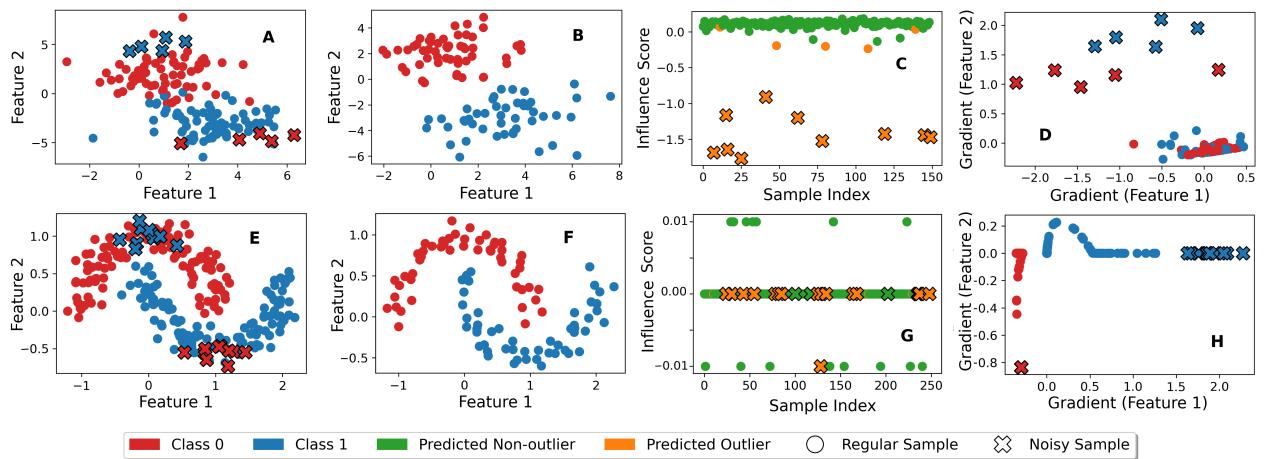
Let’s dissect this figure:
- Top Row (Linear Model): In a simple logistic regression (A-D), traditional influence scores (C) clearly separate bad data (negative spikes) from good data. The gradient space (D) also shows clear separation. Both methods work.
- Bottom Row (Deep/Non-Linear Model): This is where it gets interesting. In a non-convex Neural Network (E-H), the traditional Influence Scores (G) are a mess. The “bad” samples (marked with X) are mixed in with the good ones. The Hessian confuses the signal. However, look at Plot H (Gradient Space). The bad samples are still clearly clustered away from the main group.
Takeaway: In deep learning, the gradient space preserves the “outlier-ness” of bad data better than the full influence function approximation.
Experiments & Results
The theory is sound, but does it work on real data? The authors tested this across Vision, NLP, and Large Language Models.
1. Fixing Noisy Labels in Computer Vision
Real-world datasets are messy. The researchers used CIFAR-10N and CIFAR-100N, versions of the famous image datasets where labels were crowdsourced and contain human errors (noise).
They compared their Outlier Gradient method against state-of-the-art label correction methods and other influence-based methods.
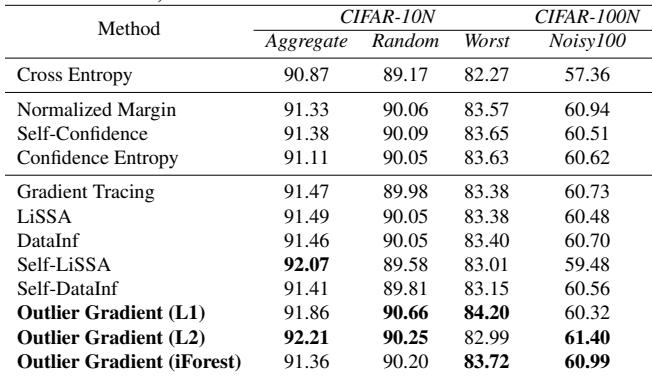
The Results:
- Consistency: The Outlier Gradient Analysis (specifically L1, L2, and iForest variants) consistently outperforms or matches the best baselines.
- Worst Case: In the “Worst” noise setting (40% noise!), the L1-norm approach boosted accuracy from 82.27% (standard training) to 84.20%, beating complex methods like DataInf and LiSSA.
- Efficiency: Crucially, it achieves this high accuracy while being significantly faster to compute (more on this later).
But what exactly is it removing? Is it just deleting random hard examples? The authors visualized the detected outliers:
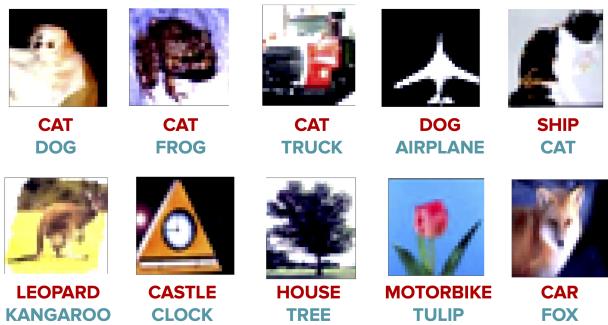
As you can see, the method correctly identified images that were blatantly mislabeled—a “Cat” labeled as a “Frog,” or a “Dog” labeled as an “Airplane.” Removing these confusing signals allows the model to learn the actual features of cats and dogs.
2. Fine-Tuning NLP Models
The method isn’t limited to images. The authors applied it to RoBERTa, a transformer model, on the GLUE benchmark. They introduced noise into the datasets and used the method to select the best subset of data for fine-tuning.

In Figure 3, the Red line (Outlier Gradient Trimming) consistently sits at the top or near the top of the accuracy curves across different datasets (QNLI, SST2, QQP). This indicates that the method identifies the high-value data (by removing the bad data) much faster and more accurately than methods like Gradient Tracing or LiSSA.
3. Interpreting Large Language Models (LLMs)
One of the most exciting applications is in LLMs (Llama-2-13B). Here, the goal was “Influential Data Identification”—finding which training samples were most responsible for the model’s ability to solve a specific test prompt.
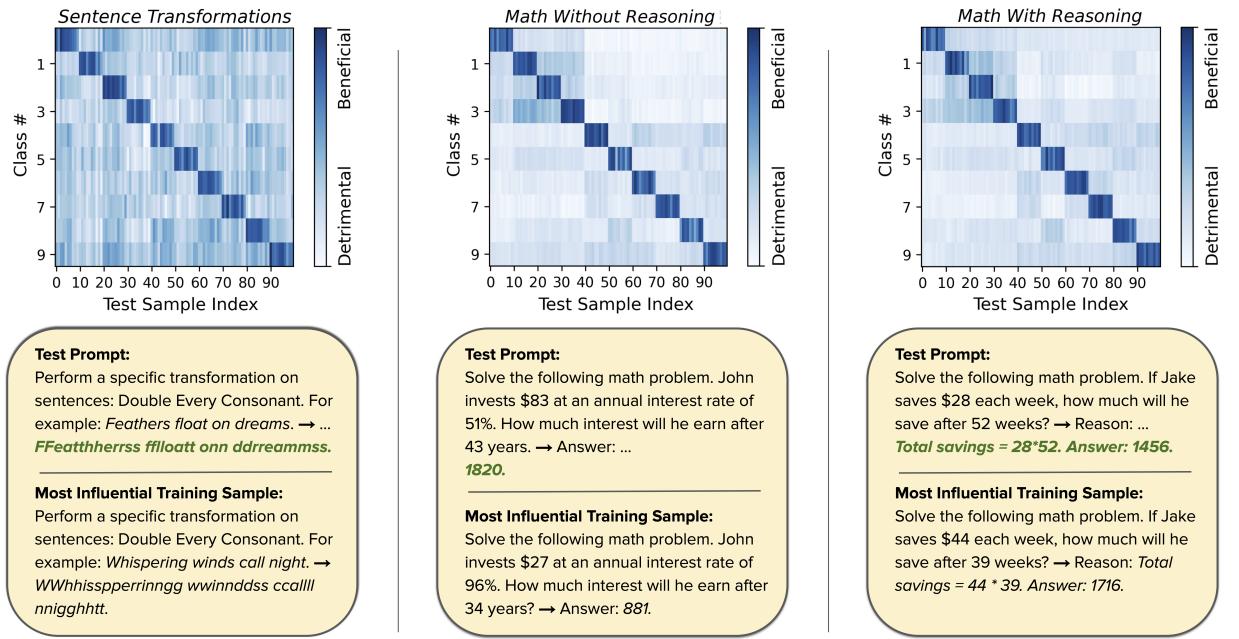
In this experiment, the method tries to match a test prompt (e.g., a math problem) with the most similar/influential training prompts. The heatmaps in Figure 4 show a strong diagonal, meaning the method correctly identifies that training samples from the same task category are the most influential.
The quantitative results for the LLM experiment are staggering:
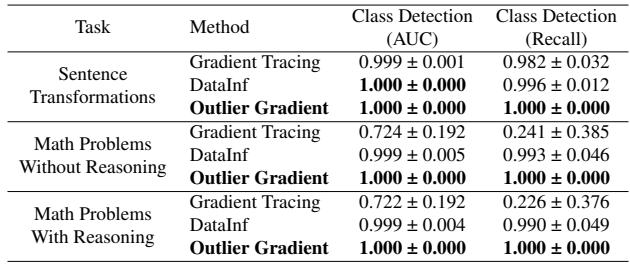
For tasks like “Sentence Transformations” and “Math Problems,” the Outlier Gradient method achieved perfect scores (1.000) in detecting the relevant class, significantly outperforming Gradient Tracing.
Discussion: The Need for Speed
We mentioned earlier that the inverse Hessian is a computational bottleneck. Just how much time does avoiding it save?
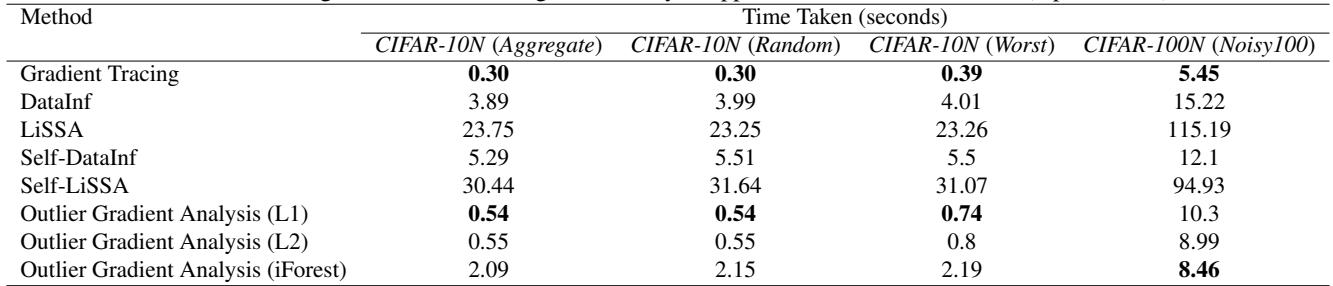
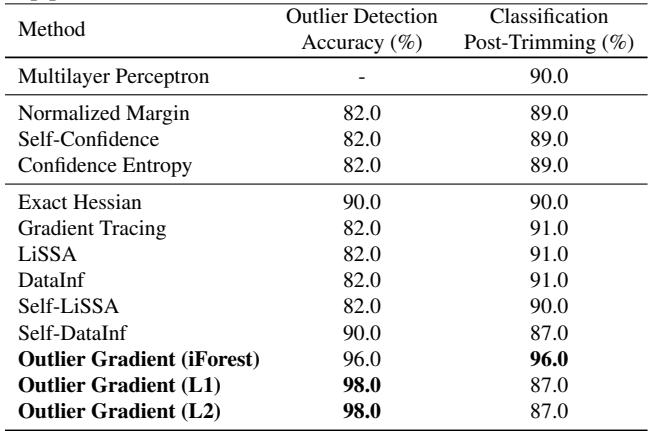
This table is arguably the most impactful part of the paper for practitioners.
- LiSSA (Hessian-based): Took 115 seconds on CIFAR-100N.
- Outlier Gradient (iForest): Took 8.46 seconds.
That is an order-of-magnitude improvement. When you consider scaling this to datasets with billions of tokens or images, the difference is between a job taking days versus minutes.
Computational Complexity
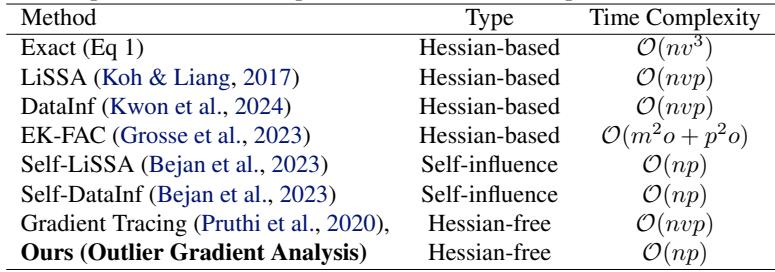
Mathematically, the complexity drops from \(O(nvp)\) (where \(p\) is parameters and \(v\) is validation size) in methods like DataInf, down to just \(O(np)\) for Outlier Gradient Analysis. It removes the dependency on the validation set size and the costly inverse operations.
Conclusion and Implications
The paper “Outlier Gradient Analysis” presents a compelling argument for simplicity in data-centric AI. For years, the field has relied on the assumption that we need second-order information (the Hessian) to accurately judge the value of a data point.
This research demonstrates that in the complex, non-convex world of Deep Learning, the Hessian might actually be introducing more noise than signal for this specific task. By treating detrimental samples as outliers in the gradient space, we can identify mislabeled and harmful data:
- More Accurately (better separation in non-convex landscapes).
- Much Faster (no matrix inversion).
- Scalably (linear time complexity).
For students and practitioners, this offers a practical toolkit. If you are training a model and suspect your data is noisy, you don’t need to implement complex influence pipelines. You can simply extract the gradients from your final epoch, run an Isolation Forest (available in standard libraries like scikit-learn), and trim the outliers.
As models continue to grow in size, “efficient” methods aren’t just a luxury—they are a necessity. This work suggests that sometimes, the most effective path forward is to simplify the math and trust the geometry of the data.