](https://deep-paper.org/en/paper/7693_mgd_3_mode_guided_dataset-1826/images/cover.png)
Scaling Down to Scale Up: How MGD³ Distills Datasets Without Fine-Tuning
In the modern era of deep learning, the mantra has largely been “bigger is better.” We build massive models and feed them even more massive datasets. However, this trajectory hits a wall when it comes to computational resources and storage. Not every researcher or student has access to a cluster of H100 GPUs. This bottleneck has given rise to a fascinating field of study: Dataset Distillation.
Imagine taking a dataset like ImageNet, which contains over a million images, and compressing it down to just 10 or 50 images per class. The goal? To train a neural network on this tiny, synthetic dataset and achieve accuracy comparable to training on the full million images.
Today, we are diving deep into a new paper, “MGD³: Mode-Guided Dataset Distillation using Diffusion Models.” This research proposes a clever way to generate these distilled datasets using pre-trained diffusion models—without the expensive fine-tuning required by previous methods. If you are interested in generative AI, data efficiency, or just want to know how we can make deep learning more accessible, this post is for you.
The Problem: Why Distillation is Hard
Dataset distillation isn’t just about selecting the “best” images; it’s about synthesizing new images that pack the most information density.
Traditionally, there have been two main approaches to this:
- Optimization-based Distillation: These methods treat the pixels of the synthetic images as learnable parameters. They try to minimize the gap between the gradients or features of a model trained on real data versus one trained on synthetic data. While effective for tiny datasets, this is computationally exhausted and struggles to scale to high-resolution images.
- Generative Dataset Distillation: This newer approach uses generative models (like GANs or Diffusion Models) to synthesize the data. Instead of storing pixels, you store the “knowledge” in the generative model parameters.
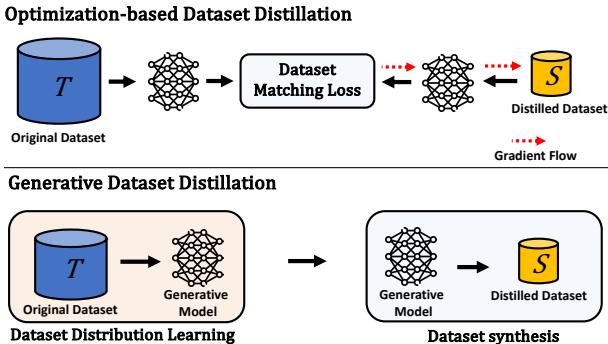
As shown in Figure 1, optimization methods (top) constantly loop back to update the synthetic dataset based on matching losses. Generative methods (bottom) learn the distribution once and then synthesize the dataset.
The “Diversity” Trap in Diffusion
Diffusion models are the current kings of image generation. However, when used for dataset distillation, they have a flaw: Mode Collapse.
Diffusion models are trained to maximize likelihood, which means they prefer generating images from the dense regions of the data distribution (the “average” look). If you ask a standard diffusion model to generate a “dog,” it will likely give you the most common breed in the most common pose. It might ignore the rare breeds or unusual angles.
For dataset distillation, this is a disaster. To train a robust classifier, you need diversity. You need the model to see the dog from the front, the side, close up, and far away. If your distilled dataset only contains the “average” view, the student model will fail to generalize.
Previous solutions, like MinMax Diffusion, attempted to fix this by fine-tuning the diffusion model explicitly to force diversity. But fine-tuning is expensive, slow, and defeats the purpose of using off-the-shelf pre-trained models.
Enter MGD³: Mode-Guided Diffusion
The authors of MGD³ propose a solution that requires zero fine-tuning. Instead of retraining the model, they manipulate the sampling process to ensure diversity.
The core idea relies on three stages:
- Mode Discovery: Figure out where the different “clusters” (modes) of data are.
- Mode Guidance: Force the diffusion model to generate images belonging to those specific clusters.
- Stop Guidance: Know when to stop forcing it, so the image remains high-quality.
Let’s visualize the difference in trajectory between standard diffusion and this new approach.
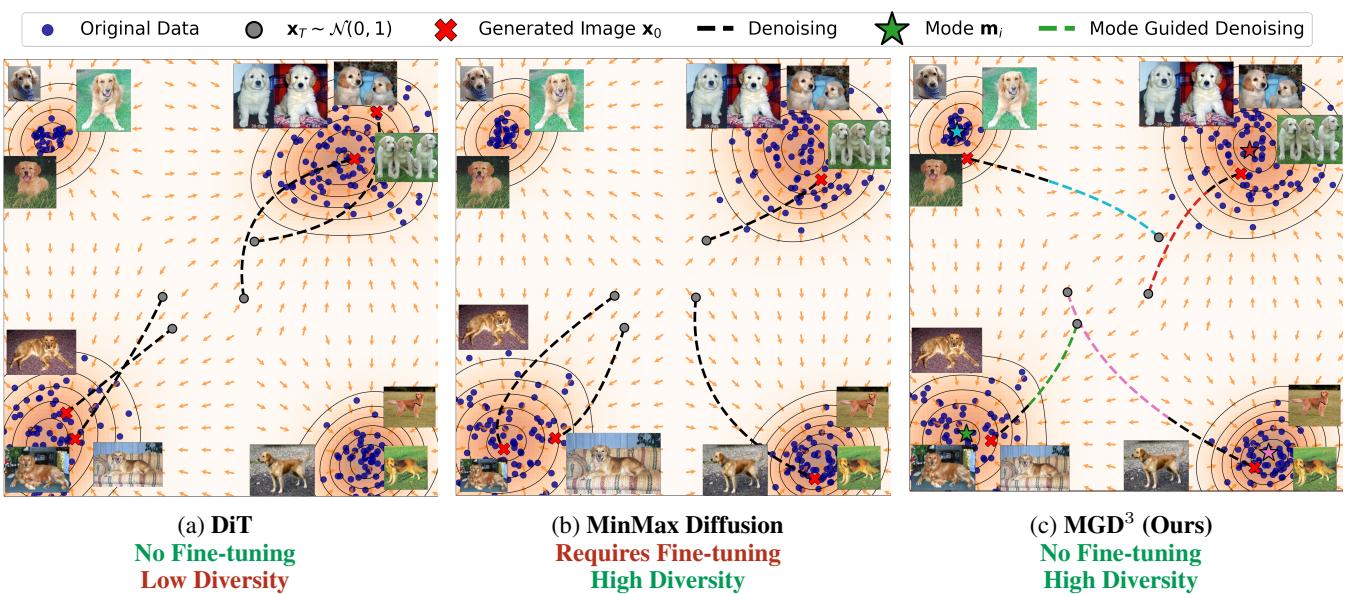
In Figure 2:
- (a) Standard Diffusion (DiT): All generated samples (red Xs) cluster in the dense orange region. Low diversity.
- (b) Fine-Tuned (MinMax): Better diversity, but requires expensive training.
- (c) MGD³ (Ours): The method identifies distinct targets (green stars) and guides the denoising process (green lines) toward them before letting the model finish naturally (black lines).
Let’s break down the three stages of the MGD³ pipeline.
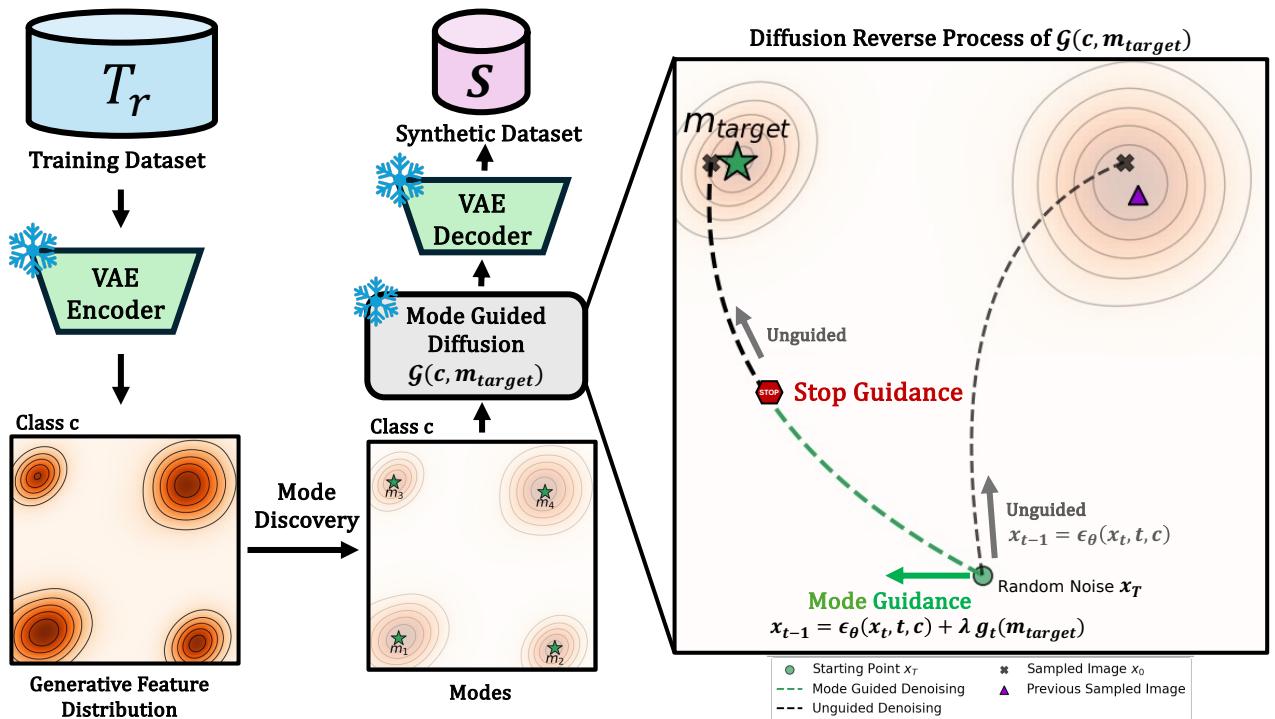
Stage 1: Mode Discovery
Before we can generate diverse data, we need to know what “diverse” looks like for a specific class. The researchers use a pre-trained Variational Autoencoder (VAE) to encode the original dataset into a latent space.
Why latent space? Because pixel space is too noisy. Latent space captures the semantic content (shape, object type) rather than high-frequency details.
Once the data is mapped to latent space, they apply K-Means clustering to find \(N\) centroids (modes) for each class. If the budget is 10 images per class (IPC = 10), they find 10 distinct modes. Each mode (\(m_i\)) represents a different “archetype” of that class—for example, one mode might be “Golden Retriever sitting,” another might be “Pug running.”
Stage 2: Mode Guidance
Now that we have the target modes, we need to generate images that land near them. Standard diffusion involves starting with random noise and gradually denoising it.
MGD³ intervenes in this process. At each timestep \(t\), the model predicts the denoised image \(\hat{x}_0\). The authors calculate a guidance signal based on the difference between where the image is currently heading and where the target mode \(m_i\) is.
The guidance signal vector is calculated as:

This vector points the generation process toward the target mode. This signal is then injected into the noise prediction step of the diffusion model. The modified noise prediction looks like this:

Here, \(\lambda\) is a scalar that controls how hard we push the model toward the mode. By applying this guidance, the random noise is steered specifically to become an image that resembles the cluster centroid found in Stage 1.
Stage 3: Stop Guidance
This is perhaps the most intuitive contribution of the paper.
The diffusion generation process generally has three phases:
- Chaotic: The early steps where the global structure is determined.
- Semantic: The middle steps where objects and shapes form.
- Refinement: The final steps where textures and fine details are polished.
The authors found that if you apply Mode Guidance all the way to the end, the images look weird. The guidance forces the pixel values to strictly adhere to the centroid, which ruins the natural texture and high-frequency details that the diffusion model is good at generating.
The solution? Stop Guidance. They only apply the guidance signal for the first part of the generation (the chaotic and semantic phases). Once the general structure is locked in (e.g., at timestep 25 out of 50), they turn off the guidance (\(\lambda = 0\)) and let the standard diffusion process finish the job.
This ensures the image has the structure of the diverse mode but the quality of a natural image.
Visualizing the Process
To really understand the impact of Stop Guidance, let’s look at the generation process over time.
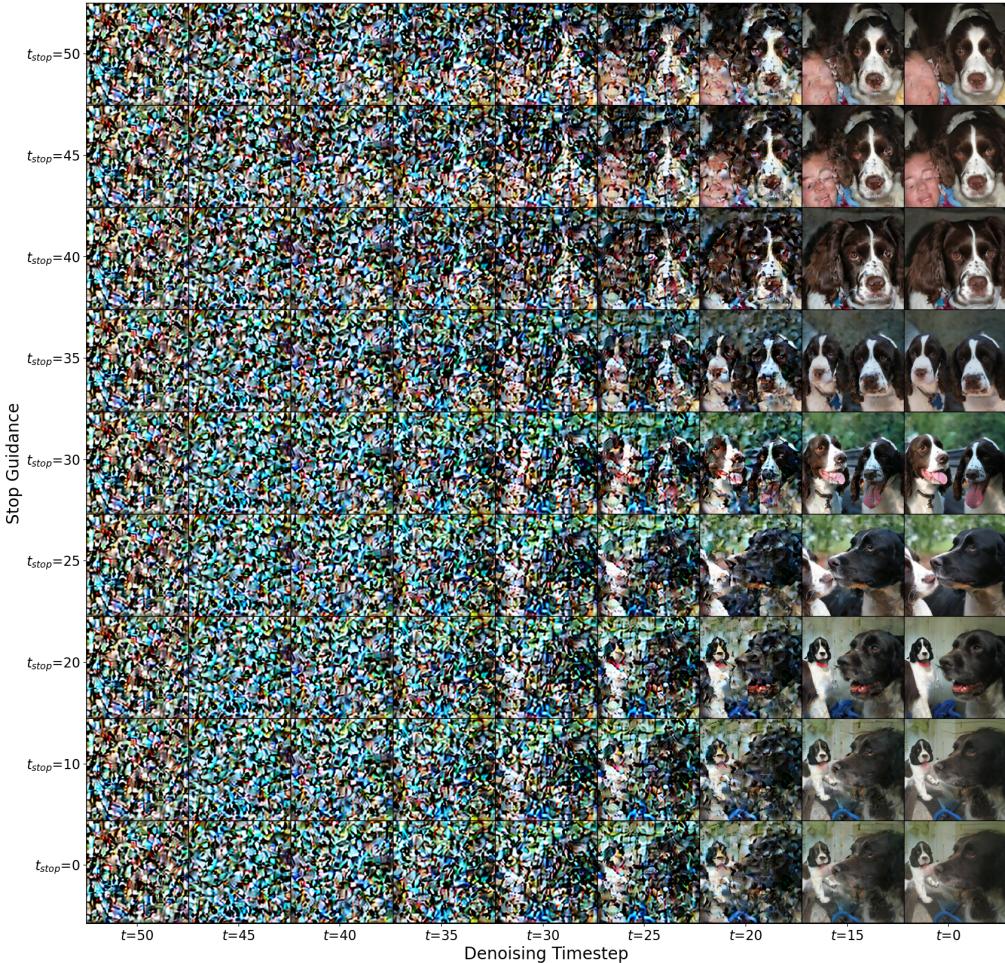
In Figure 11, the x-axis represents the denoising timesteps (from noise at \(t=50\) to image at \(t=0\)). The y-axis represents when the guidance was stopped (\(t_{stop}\)).
- Top Row (\(t_{stop}=50\)): This effectively means no guidance. The model generates a generic dog.
- Bottom Row (\(t_{stop}=0\)): Full guidance until the very end. The images often have artifacts or look “over-constrained.”
- Middle Rows: By stopping halfway, the model directs the noise into a specific pose/breed (distinct from the top row) but refines it into a clean image.
The authors found that a \(t_{stop}\) around 20-30 (in a 50-step process) offers the perfect balance.
Experiments and Results
So, does this method actually work? The authors tested MGD³ on several benchmarks, including ImageNette, ImageNet-100, and the massive ImageNet-1K.
Performance vs. SOTA
The primary metric is validation accuracy: if we train a fresh ResNet-18 on only the synthetic images generated by MGD³, how well does it perform on real test data?
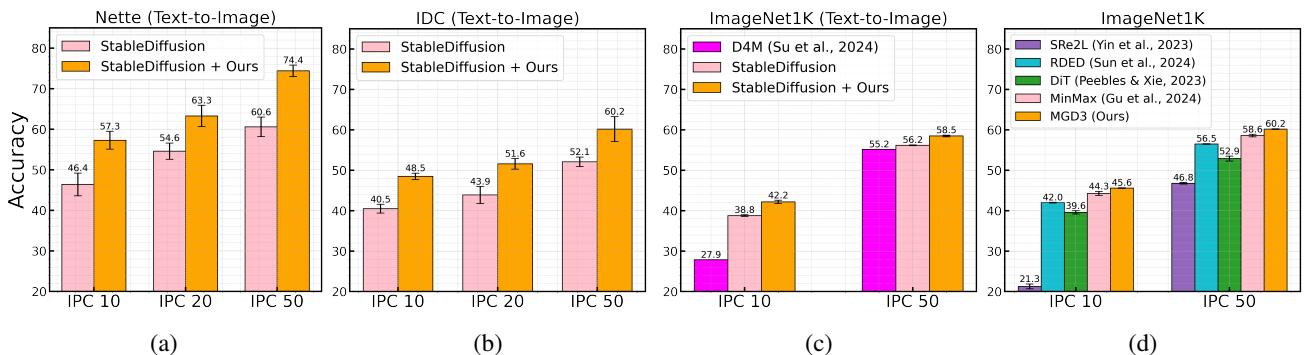
As seen in Figure 4, MGD³ (Ours) consistently outperforms previous state-of-the-art methods.
- Chart (c): On ImageNet-1K using text-to-image models, MGD³ beats standard Stable Diffusion significantly.
- Chart (d): Compared to methods like DiT, SRe²L, and MinMax, MGD³ holds the lead, particularly as the number of images per class (IPC) increases.
For a more granular look at the numbers, we can examine Table 1.
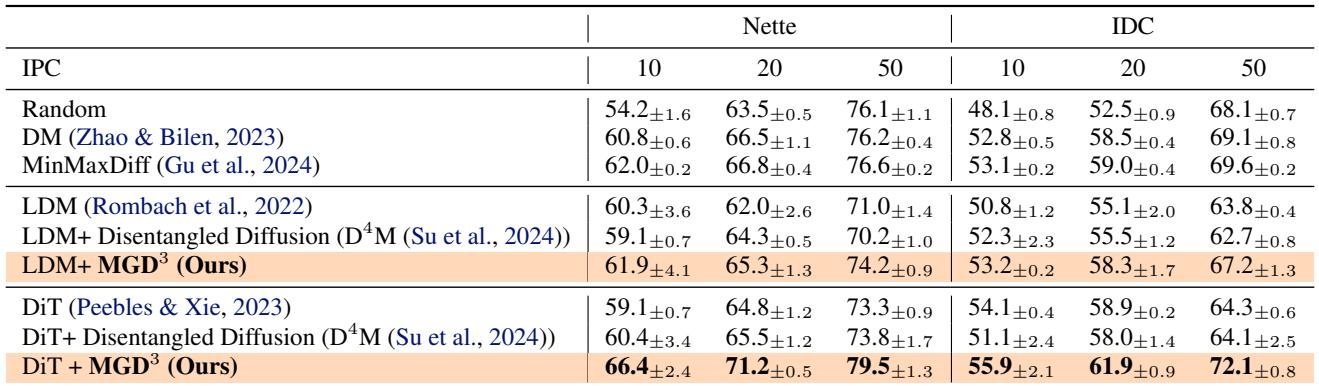
On ImageNette with 10 images per class (IPC 10), MGD³ achieves 66.4% accuracy, a substantial jump over the standard pre-trained DiT (59.1%) and even the fine-tuned MinMaxDiff (62.0%). This confirms that the guidance mechanism is extracting more useful training signal than simply sampling the model randomly.
The Diversity Analysis
The hypothesis was that MGD³ works because it creates more diverse datasets. To prove this, the authors visualized the distilled datasets using t-SNE (a technique for visualizing high-dimensional data in 2D).
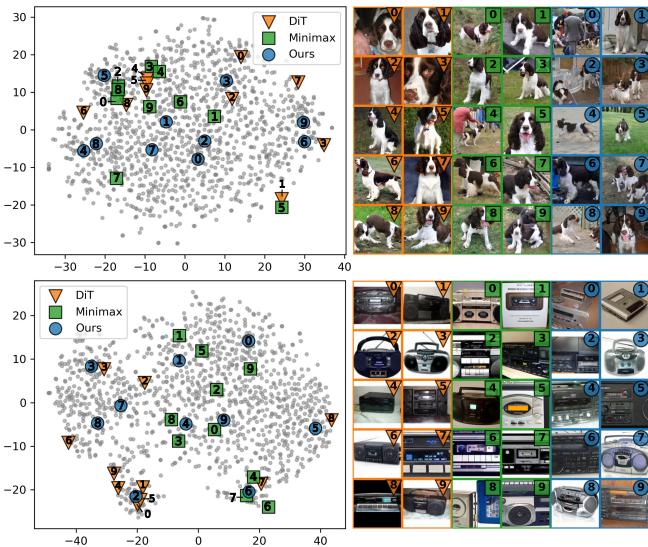
Look at Figure 5:
- Orange Triangles (DiT): The standard model’s samples are clumped together. It keeps generating the same “type” of cassette player or dog.
- Blue Circles (MGD³ - Ours): The samples are spread widely across the data distribution, covering different clusters.
This visual proof confirms that Mode Discovery + Guidance successfully forces the model to explore the latent space.
Diversity vs. Representativeness
There is often a trade-off in generative modeling. You can have high diversity (random noise is very diverse!) but low representativeness (it doesn’t look like the class). Or you can have high representativeness (perfect looking dogs) but low diversity (all look identical).
Ideally, you want both.
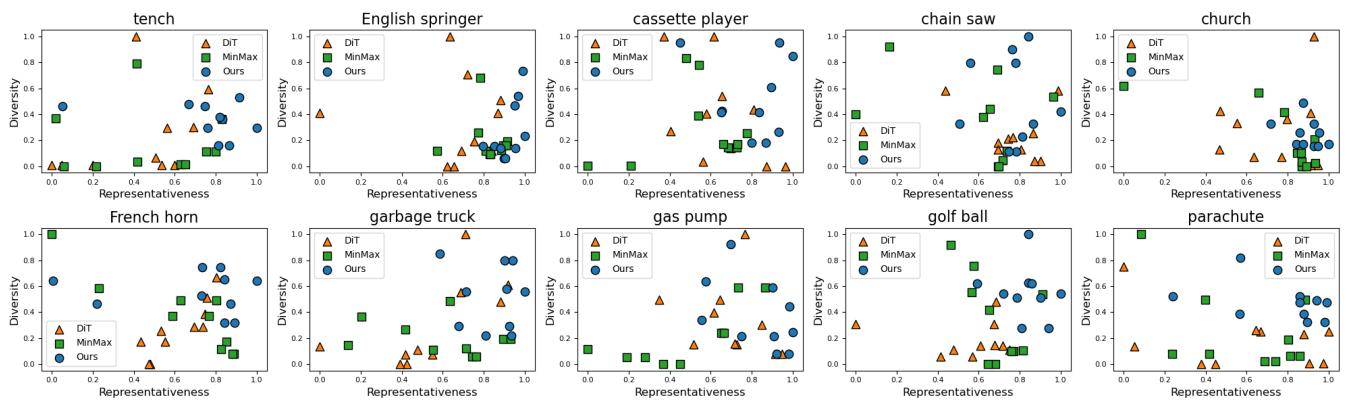
Figure 8 plots this trade-off for various classes. The goal is to be in the top-right corner (High Diversity, High Representativeness).
- DiT (Orange): Often high representativeness, but lower diversity.
- MinMax (Green): Higher diversity, but often loses representativeness (images might look weird).
- MGD³ (Blue): Consistently occupies the upper-right region, balancing the two metrics better than the alternatives.
Why This Matters
The implications of MGD³ extend beyond just getting a slightly higher accuracy score on a leaderboard.
- Computational Efficiency: Previous SOTA methods like MinMax Diffusion took 10 hours to generate a distilled dataset for ImageNet-100 because of the fine-tuning requirement. MGD³ does it in 0.42 hours. That is a massive speedup.
- Accessibility: Because it uses pre-trained models without modification, anyone can run this. You don’t need to know how to train a diffusion model from scratch; you just need to know how to sample from one.
- Scalability: The method scales gracefully to larger datasets (like ImageNet-1K) and larger architectures (ResNet-101), proving that generative dataset distillation is a viable path for the future of efficient AI.
Conclusion
MGD³ presents a compelling argument: we don’t always need to retrain generative models to make them do what we want. Sometimes, we just need to guide them better.
By splitting the problem into identifying modes (Discovery), pushing the generation toward them (Guidance), and knowing when to let the model take over (Stop Guidance), the researchers achieved state-of-the-art results in dataset distillation. They managed to compress the knowledge of massive datasets into tiny synthetic sets that capture the full diverse spectrum of the original data.
For students and researchers, this paper serves as an excellent example of how to leverage the latent space of pre-trained models to control generation output—a technique that will likely see applications far beyond just dataset distillation.