](https://deep-paper.org/en/paper/791_multimodal_fused_learning_-2634/images/cover.png)
Introduction
Imagine you are a robot in a massive fulfillment center. Your job is to collect five specific items to fulfill an order. It sounds simple, right? But here is the catch: “Item A” isn’t just in one place. It is stocked on Shelf 1, Shelf 5, and Shelf 12. “Item B” is available in two other locations. To be efficient, you don’t need to visit every location; you just need to pick one location for Item A, one for Item B, and so on, while keeping your total travel distance as short as possible.
This isn’t the classic Traveling Salesman Problem (TSP) where you must visit every city. This is the Generalized Traveling Salesman Problem (GTSP). In GTSP, targets are grouped into “clusters,” and the solver must find the optimal path that visits exactly one node from each cluster.

As shown in Figure 1 above, this problem is fundamental to modern logistics. While humans are naturally good at glancing at a map and spotting the most efficient cluster of stops, computational algorithms struggle. Exact mathematical solvers are too slow for real-time robotics, and heuristic methods often get stuck in suboptimal loops.
Recently, researchers from Central South University and the National University of Singapore proposed a fascinating new approach. In their paper, “Multimodal Fused Learning for Solving the Generalized Traveling Salesman Problem in Robotic Task Planning,” they argue that to solve spatial problems effectively, algorithms shouldn’t just look at data as a graph—they should also “look” at it as an image.
In this deep dive, we will explore their Multimodal Fused Learning (MMFL) framework, dissecting how combining graph topology with visual geometry creates a smarter, faster path-planning robot.
Background: Why is GTSP So Hard?
To understand the innovation here, we need to understand the limitations of current tech.
The GTSP is an NP-hard combinatorial optimization problem. This means as you add more items (clusters) and more potential locations (nodes), the number of possible routes explodes exponentially.
- Exact Algorithms: Methods like Branch-and-Cut can find the mathematically perfect route, but they might take minutes or hours to do so. A robot in a warehouse needs a decision in milliseconds.
- Metaheuristics: Algorithms like Ant Colony Optimization or Genetic Algorithms are faster but require extensive “tuning.” They are often fragile—optimized for one warehouse layout, they might fail in another.
- Neural Combinatorial Optimization (NCO): This is the modern AI approach. We train a neural network to predict the path. Most NCO methods treat the problem purely as a graph—a list of nodes connected by edges.
The authors of this paper identified a critical gap in NCO methods: Graph neural networks (GNNs) often miss the forest for the trees. They are excellent at understanding local connections between specific nodes, but they struggle to grasp the global, spatial context—the “shape” of the problem—that is immediately obvious to a human looking at a 2D map.
The Core Method: Multimodal Fused Learning (MMFL)
The researchers propose a solution that mimics human intuition: why not use both the graph data (precise coordinates and connections) and a visual representation (an image of the map)?
The MMFL framework processes the problem through two parallel streams—a Graph Encoder and an Image Encoder—and then fuses them together to make a decision.

As illustrated in Figure 2, the architecture has four main stages:
- Image Builder: Converting the problem into a visual format.
- Dual Encoders: Extracting features from both the graph and the image.
- Multimodal Fusion: Mixing these features intelligently.
- Decoder: Constructing the final path step-by-step.
Let’s break these down.
1. The Adaptive Image Builder
The first challenge is translating a mathematical problem instance into a picture. The system takes the normalized 2D coordinates of every node and maps them onto a grid.
The pixel value at any specific point on the grid corresponds to the cluster ID. If a node belongs to Cluster 5, the pixel at that node’s location gets a value associated with 5.

The Challenge of Scale: A fixed-size image is problematic. If you have a small problem with 20 nodes, a large image is a waste of memory. If you have 1,000 nodes, a small image will cause points to overlap, losing critical detail.
To solve this, the authors introduce Adaptive Resolution Scaling (ARS). They dynamically adjust the image resolution (\(W \times H\)) based on the number of nodes (\(n\)) and the patch size (\(w\)) used by the vision network. This ensures that the density of information remains consistent, regardless of whether the problem is small or massive.
Once the grid is built, the model needs to understand where each pixel is relative to the others. They use a Multi-Layer Perceptron (MLP) to embed the normalized coordinates:

2. The Dual Encoders
Now that the data is prepared, it is fed into two separate neural networks.
The Image Encoder (Seeing the Geometry)
The image stream uses a Vision Transformer (ViT). The image is chopped into small squares called “patches.” These patches are flattened and processed through layers of Self-Attention and Feed-Forward Networks (FFN).
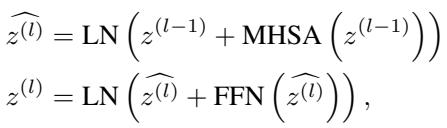
This part of the network is responsible for understanding the spatial distribution. It sees “clumps” of nodes and empty spaces, providing a macro-view of the map layout.
The Graph Encoder (Understanding the Topology)
Simultaneously, the original coordinate data is processed as a graph. Each node is turned into an initial embedding vector combining its location and cluster ID:

These embeddings pass through a Graph Attention Network. This network allows every node to “talk” to every other node, refining its understanding of its neighbors and potential connections.
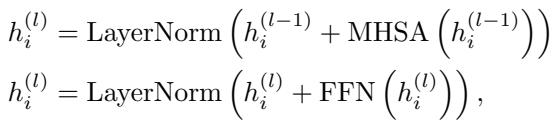
3. The Multimodal Fusion Module
This is the most innovative part of the MMFL framework. We have “visual” features (patches) and “graph” features (nodes). How do we combine them?
Simply concatenating them doesn’t work well because they represent different abstractions. Instead, the authors use a Bottleneck Attention Mechanism.
They introduce learnable “Bottleneck Tokens” (\(b_{graph}\) and \(b_{image}\)). Think of these tokens as translators or diplomats. Instead of forcing every pixel to talk to every graph node (which would be computationally incredibly heavy), the image data compresses its info into the image bottleneck tokens, and the graph data compresses its info into the graph bottleneck tokens.
First, the inputs are prepared by appending these tokens to the feature lists:
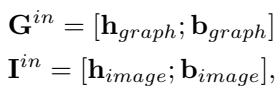
Then, a cross-attention mechanism is applied. The graph stream “queries” the image stream, and vice versa. This allows the graph topology to be enriched by the visual spatial context.
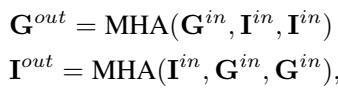
Following the cross-attention, the features go through normalization and feed-forward layers to stabilize the learning:
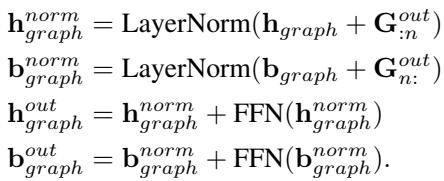
Finally, the two streams are merged into a single fused representation (\(h_{fused}\)). The model takes the refined graph features and adds a weighted average of the image features (controlled by \(\alpha\), usually set to 0.5).

This fused representation now holds the best of both worlds: the precise connectivity of the graph and the global spatial awareness of the image.
4. The Multi-Start Decoder
With a rich understanding of the environment, the robot needs to plan the actual tour. The decoder works auto-regressively, meaning it picks one node at a time to build the sequence.
At each step \(t\), the decoder looks at the previously visited node (\(\pi_{t-1}\)) and the context of the whole graph.

It generates a “Query” vector (\(q\)) that asks: “Given where I am and what the map looks like, where should I go next?”

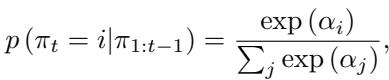
The Compatibility Check: The decoder assigns a score (\(\alpha_i\)) to every possible next node. Crucially, it employs a masking mechanism. In GTSP, once you visit a node in Cluster A, you are done with Cluster A. The mask sets the score of all other nodes in Cluster A to negative infinity, ensuring the robot never wastes time visiting a cluster twice.

Finally, these scores are converted into probabilities using a Softmax function. The robot selects the node with the highest probability (or samples from the distribution during training).
To make the system even more robust, they use a multi-start strategy. During inference, they run the solver multiple times starting from different “neighbor” nodes of the depot and pick the best resulting tour.
Experiments & Results
The theory sounds solid, but does it work? The researchers pitted MMFL against industry-standard solvers like Google OR-Tools, heuristic masters like LKH (Lin-Kernighan-Helsgaun), and purely graph-based neural models like POMO.
Performance Comparison
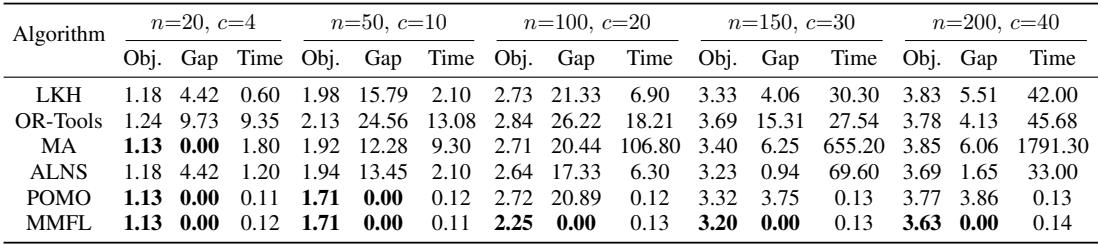
Table 1 summarizes the results across varying problem sizes (\(n=20\) to \(n=200\)).
The results are striking:
- Vs. Heuristics: MMFL consistently outperforms Google OR-Tools and LKH. On larger problems (\(n=200\)), MMFL achieves a shorter path (Obj 3.63 vs 3.83 for LKH) while being orders of magnitude faster (0.14 seconds vs 42 seconds).
- Vs. Neural Baselines: MMFL matches or beats POMO (the state-of-the-art graph learner) in almost every category. The gap widens as the problems get harder, proving that the added visual context becomes more valuable as complexity increases.
Generalization Capabilities
Real warehouses aren’t random mathematical distributions. They have aisles, zones, and clusters of varying densities. The researchers tested MMFL on “Hybrid,” “Proximity,” and “Density” based cluster shapes.
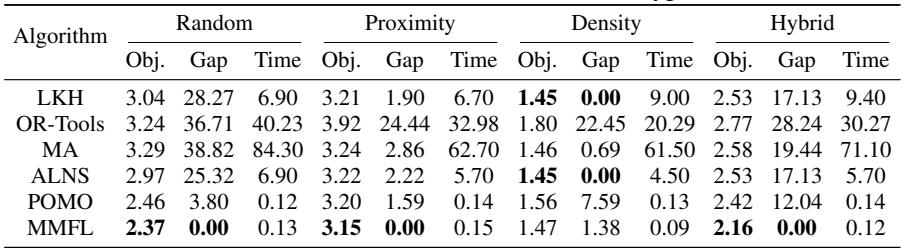
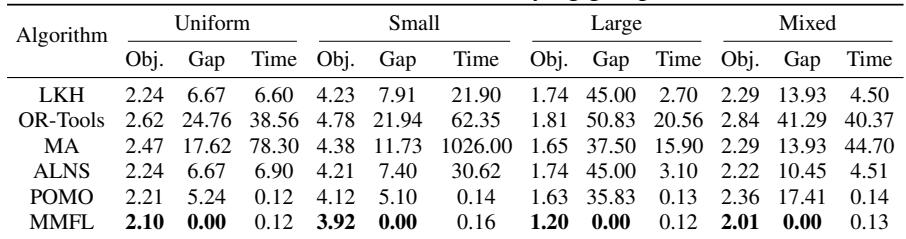
As shown in Tables 2 and 3, MMFL demonstrates superior generalization. Whether the clusters are tightly packed or spread out, the visual component helps the model adapt. Notably, in “Large” group settings (where clusters have many nodes), MMFL drastically outperforms competitors, likely because the visual encoder can better identify the optimal “entry and exit” points of large spatial clusters.
Does the “Image” Part Actually Help?
To prove that the complex architecture is worth it, the authors performed an ablation study, removing the image encoder and the fusion module to see what would happen.
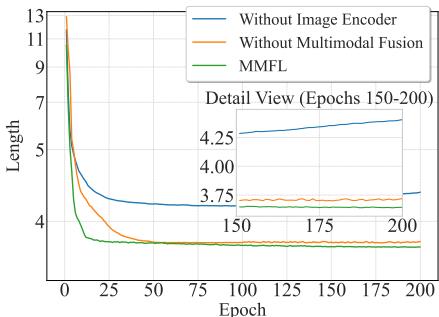
The convergence curves in Figure 4 tell the story clearly. The Green line (Complete MMFL) converges faster and to a lower (better) tour length than the Blue line (No Image Encoder) or Orange line (No Fusion). This empirically proves that “seeing” the map helps the agent learn faster and plan better.
Visualizing the Solution
Finally, what do these solutions look like?
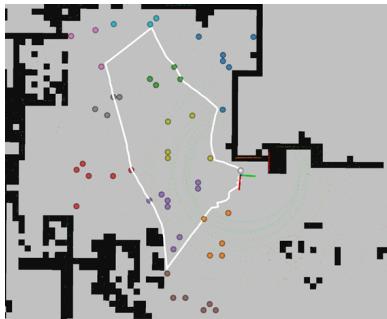
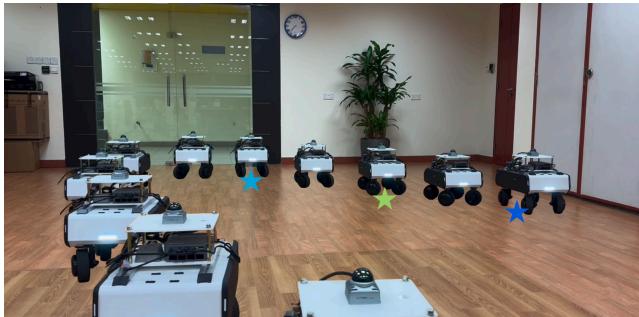
Figure 5 shows the path generated by MMFL. The white line represents the robot’s trajectory. Notice how efficiently it cuts through the environment, visiting exactly one node from each required zone without unnecessary backtracking. The researchers even validated this on physical mobile robots (Figure 6, shown below), confirming that the computed paths translate effectively to real-world navigation.
Conclusion
The Multimodal Fused Learning (MMFL) framework represents a significant step forward in robotic task planning. By acknowledging that spatial problems are both mathematical graphs and visual geometries, the researchers have built a system that outperforms traditional solvers in both speed and quality.
Key Takeaways:
- Dual Representation: Combining coordinates (Graph) and pixel grids (Image) provides a holistic view of the problem.
- Adaptive Scaling: The ARS strategy ensures the vision model handles problems of any size effectively.
- Intelligent Fusion: Bottleneck tokens allow for efficient information exchange between the graph and image modalities without overwhelming the system.
- Real-Time Speed: The model generates near-optimal solutions in a fraction of a second, making it viable for dynamic, real-world robotics.
For the future of warehouse automation, disaster response robots, and autonomous monitoring, approaches like MMFL suggest that the best way for a robot to think might be to help it see.