](https://deep-paper.org/en/paper/823_mirrorduo_reflection_consi-2593/images/cover.png)
Double Your Robot’s Skills: How MirrorDuo Uses Reflection for Efficient Learning
Imagine you are teaching a child to catch a ball. You demonstrate the motion with your right hand. Intuitively, the child understands that they can perform a similar motion with their left hand, just mirrored. They don’t need to relearn the physics of the ball or the concept of catching from scratch; they simply apply a reflection symmetry to what they already know.
In the world of robotics, however, this intuition is missing. If you train a robot to pick up a cup on the right side of a table, standard learning algorithms treat the left side of the table as a completely alien environment. To teach the robot to use the left side, you usually have to collect a whole new dataset of “left-sided” demonstrations. This process is expensive, time-consuming, and inefficient.
In this post, we’ll dive into MirrorDuo, a research paper that aims to solve this problem. The researchers introduce a method to mathematically and visually “mirror” robot demonstrations, effectively allowing a robot to “collect one demonstration, and get one for free.”
The Problem: The High Cost of Data
Visuomotor learning—teaching robots to move based on what they see—often relies on Behavior Cloning (BC). You show the robot thousands of examples of a task, and it learns to mimic the policy. The bottleneck is the data.
If your workspace changes slightly, or if you want the robot to perform the same task in a mirrored configuration (e.g., picking from a left bin instead of a right bin), you typically need to collect new data covering those specific scenarios.
While researchers have successfully used 3D data (like point clouds) to handle rotation symmetries (SE(3) equivariance), doing this with standard 2D images is much harder. 3D transformations don’t map perfectly onto 2D grids of pixels, especially when perspective and camera angles are involved.
Enter MirrorDuo
MirrorDuo is a framework that leverages reflection symmetry. It takes a demonstration (images, robot states, and actions) and mathematically flips it to generate a valid, mirrored counterpart.
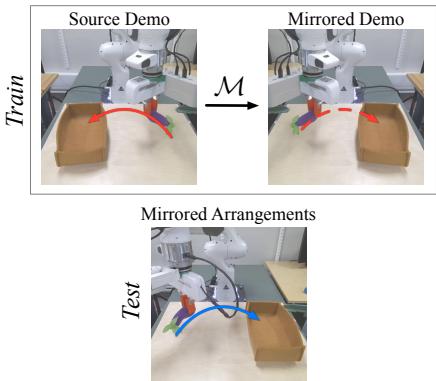
As shown in Figure 1, the concept is straightforward:
- Source Demo: The robot performs a task on the right side.
- Mirroring Transformation (\(\mathcal{M}\)): The system flips the image horizontally and transforms the robot’s physical actions to match.
- Mirrored Demo: The result looks and acts like a valid demonstration performed on the left side.
This allows the robot to generalize to unseen mirrored arrangements or simply learn faster by doubling its training data.
The Core Method: How to Mirror a Robot
Mirroring isn’t as simple as just flipping an image in Photoshop. A robot demonstration consists of three tightly coupled streams of data:
- Visual Observations: What the camera sees (RGB images).
- Proprioception: The robot’s internal sense of its position (joint angles, end-effector pose).
- Actions: The commands sent to the robot (move to coordinates \(x, y, z\), rotate, open gripper).
If you only flip the image, the robot’s internal coordinate system won’t match what it sees. MirrorDuo proposes a mathematical formulation to ensure consistency across all three.
1. Mirroring the Pose (The Math)
The robot’s hand position (end-effector) is usually defined by a pose matrix \(\mathbf{X}\) in 3D space (SE(3)). To mirror this pose across a vertical plane, we can’t just negate the x-coordinate; we have to transform the rotation matrix as well.
The researchers define a reflection matrix \(\mathbf{E} = \text{diag}([-1, 1, 1, 1])\). This matrix flips the x-axis while keeping y, z, and scale constant. The formula to get a mirrored pose \(\mathbf{X}^*\) from an original pose \(\mathbf{X}\) is:

Here, \(\mathbf{X}_C\) is the camera’s position. This equation effectively converts the pose into the camera’s frame, reflects it, and converts it back.
2. Removing Camera Dependency
The equation above requires knowing exactly where the camera is (\(\mathbf{X}_C\)). In many datasets, we don’t have perfect camera calibration. To solve this, MirrorDuo uses Delta Poses or Relative Poses. Instead of saying “move to coordinate (10, 5, 3),” the robot learns “move 1 unit right and 0.5 units up from where you are now.”
When using relative poses, the camera position cancels out, simplifying the math significantly:

This means the mirroring logic becomes dataset-agnostic. You don’t need to know where the camera is to flip the robot’s intended movement.
3. The Unified Mirroring Operator
Now, we can define a single operator, \(\mathcal{M}\), that acts on the entire tuple of observations and actions.
- Images: We apply a horizontal flip (\(\mathcal{M}_I\)).
- Vectors (State & Action): We multiply the state vectors by a sign-flipping vector \(\rho\).

Here, \(\rho\) is a simple vector like \([-1, 1, 1, -1, 1, 1]\) that flips the signs of the x-axis components (position and rotation) while leaving y and z touched.
Two Ways to Use MirrorDuo
The researchers propose two distinct ways to apply this math:
A. Data Augmentation (MirrorAug)
This is the simplest approach. During training, you take a batch of data, flip half of it using the math above, and feed it into a standard learning algorithm (like Diffusion Policy or BC-RNN). This effectively doubles your dataset size and diversity without changing the neural network architecture.
B. Reflection-Equivariant Policy (MirrorDiffusion)
This is the more rigorous approach. Instead of just adding data, the researchers designed a neural network architecture that enforces mathematical symmetry.
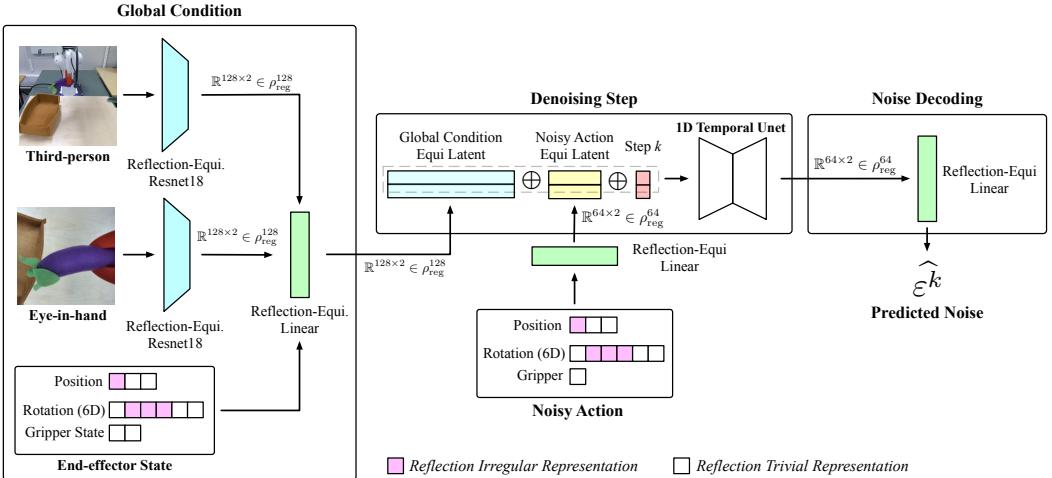
As shown in Figure 8, MirrorDiffusion uses specialized “Equivariant ResNets.” If you feed an image into this network, and then feed the mirrored version of that image, the network guarantees that the internal features (and the output action) will also be perfectly mirrored counterparts. This hard-codes the “left hand equals right hand” logic directly into the robot’s brain.
The Challenge: The Real World Isn’t Perfectly Symmetric
In a perfect simulation, a mirrored image looks exactly like the real world viewed from the opposite side. In reality, things are messy.
- Robot Asymmetry: A robot arm might have a cable or a logo on one side. When you flip the image, the logo reads backwards, or the cable jumps to the wrong side.
- Lighting & Backgrounds: Shadows fall in a specific direction. A mirrored shadow might look physically impossible.
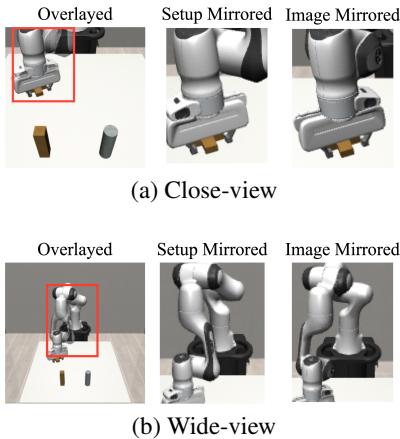
The image above illustrates this issue. Notice how the robot’s wrist and elbow joints might look slightly “off” in the mirrored version compared to reality. This is a visual domain gap.
The Solution: To handle this, the authors combine MirrorDuo with Visual Generalization techniques:
- Random Overlay: They replace the table/background with random images during training. This forces the robot to ignore the background and focus on the objects and the arm.
- Pretrained Backbones: Using standard vision networks (like ResNet-18 trained on ImageNet) makes the model more robust to weird visual artifacts caused by mirroring.
Experiments and Results
The researchers tested MirrorDuo in both simulation and on a real Franka Emika robot. They looked at two main scenarios: One-Sided demos (can we generalize to the other side?) and Two-Sided demos (does this make learning faster?).
1. Zero-Shot Transfer to Mirrored Setup
They trained a robot using only demonstrations from the right side of the workspace and tested it on the left side.
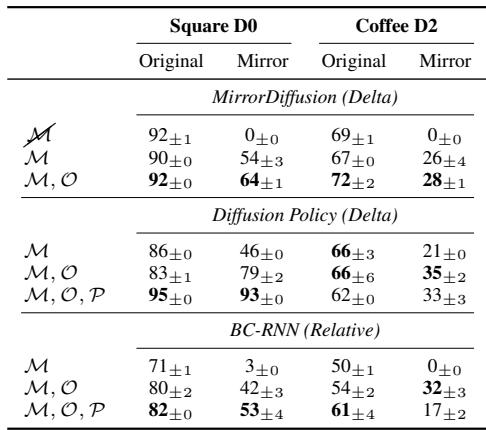
The results in Table 1 are striking:
- Standard policies (Diffusion Policy, BC-RNN) failed almost completely (0-3% success) on the mirrored setup because they had never seen it.
- MirrorDuo (labeled \(\mathcal{M}\)) significantly boosted performance.
- When combined with Random Overlay (\(\mathcal{O}\)) and Pretrained weights (\(\mathcal{P}\)), the Diffusion Policy reached 93% success on the mirrored task—effectively the same as its performance on the original side!
2. Data Efficiency
Does MirrorDuo help even if we have data from both sides? Yes. It allows the robot to learn much faster.
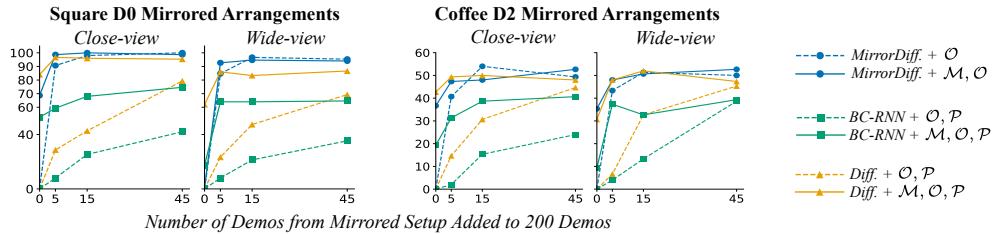
Figure 4 shows the success rate as we add more demonstrations. The solid lines (MirrorDuo enabled) shoot up much faster than the dashed lines (baseline). In some cases, MirrorDuo achieves with 5 demonstrations what the baseline takes 50+ demonstrations to learn.
3. Real-World Validation
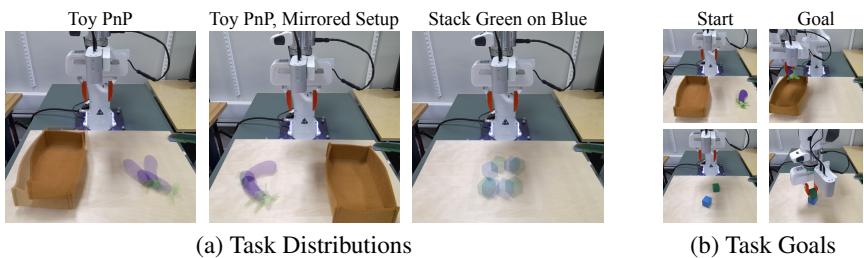
The system worked on physical hardware, too. In a “Toy Pick-and-Place” task, the robot trained with MirrorDuo could handle a mirrored setup with just 5 real-world demonstrations, whereas the baseline failed completely.
Limitations and Conflicting Cues
While powerful, mirroring isn’t a magic bullet for every single scenario. The researchers found an interesting edge case involving conflicting visual cues.
Sometimes, a mirrored view creates a scenario that looks geometrically valid but suggests the wrong action compared to what a human would do.
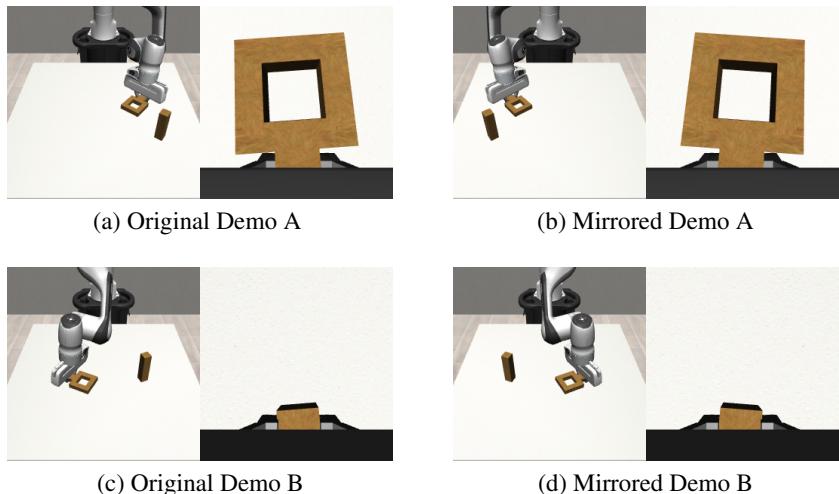
In Figure 9, the researchers explain that a mirrored demonstration might look similar to a different original demonstration but require an opposite rotation. If the dataset is dense, these “phantom” decision boundaries can confuse the network, leading to a slight performance drop in highly specific, data-rich scenarios. However, for the vast majority of cases—especially where data is scarce—the benefits vastly outweigh this risk.
Conclusion
MirrorDuo presents a compelling argument for integrating geometric priors into modern deep learning. By treating reflection symmetry as a fundamental property of the world, rather than just learning it from scratch, we can make robots:
- More Generalizable: Transferring skills from left to right instantly.
- More Data Efficient: achieving high performance with a fraction of the data.
Whether implemented as a simple data augmentation step or a sophisticated equivariant network, MirrorDuo offers a practical “free lunch” for roboticists struggling with the high cost of data collection. As we move toward general-purpose robots, leveraging these kinds of physical symmetries will be key to scaling up their capabilities.