](https://deep-paper.org/en/paper/858_lucid_xr_an_extended_reali-2460/images/cover.png)
Introduction: The Data Bottleneck in Robotics
If you look at the history of filmmaking, there is a clear trajectory from practical effects—building physical sets and animatronics—to digital effects (CGI). Filmmakers made this switch because the digital world offers infinite control and scalability. Robotics is currently facing a similar transition, but the stakes are higher than just box office numbers.
To train a general-purpose robot, we need data—massive amounts of it. Specifically, we need data showing robots successfully manipulating objects in the real world. The traditional way to get this is through teleoperation, where a human controls a robot to perform a task while recording the data. However, this is slow, expensive, and hard to scale. You need a physical robot, a physical set, and a human operator in the same room.
Simulations offer a solution, allowing us to generate data digitally. But simulations have historically suffered from two major problems:
- The Sim-to-Real Gap: Simulators rarely look or act exactly like the real world, causing policies trained in sim to fail in reality.
- Latency and Accessibility: High-fidelity physics simulations often require powerful servers, making them difficult to crowd-source to users on standard consumer hardware.
Enter Lucid-XR, a new system developed by researchers at MIT CSAIL and UC San Diego. Lucid-XR creates a “data engine” that allows users to generate high-quality robotic training data using consumer Virtual Reality (VR) headsets, without the need for a physical robot or a powerful external server.
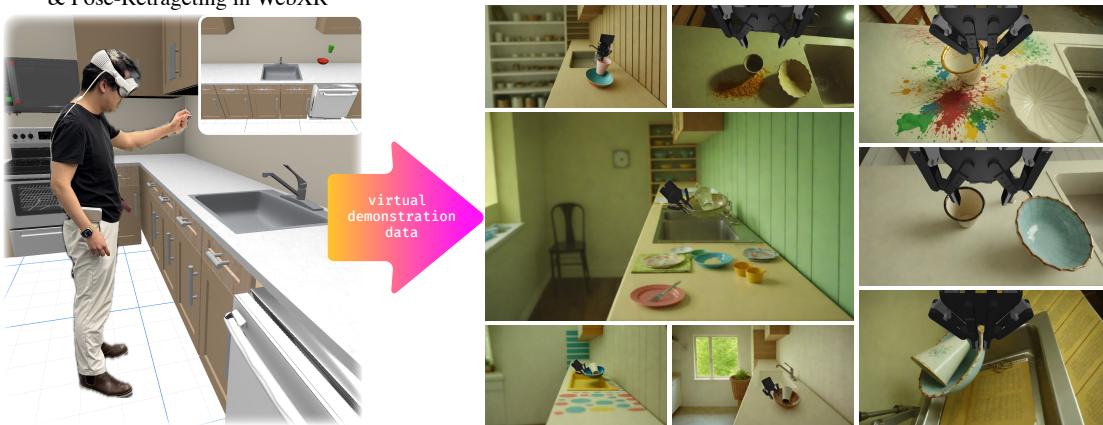
As shown in Figure 1, the system bridges the gap between human demonstration and robot learning. It combines on-device physics simulation with a Generative AI pipeline to create diverse, realistic training data that allows robots to function in the real world—even in environments they have never seen before.
The Architecture of a Data Engine
The core philosophy of Lucid-XR is “Internet-scale.” If we want to solve robotic manipulation, we need to enable anyone, anywhere, to contribute training data. To achieve this, the researchers built a pipeline that removes the heavy computational barriers usually associated with robotics simulators.
The workflow, illustrated below, consists of three main stages:
- Vuer (On-Device Simulation): A web-based physics simulator that runs entirely inside a VR headset’s browser.
- Human-to-Robot Retargeting: A system that translates human hand movements into robot movements in real-time.
- Generative AI Data Amplification: A pipeline that takes the “cartoonish” simulation data and hallucinates photorealistic visuals for training.
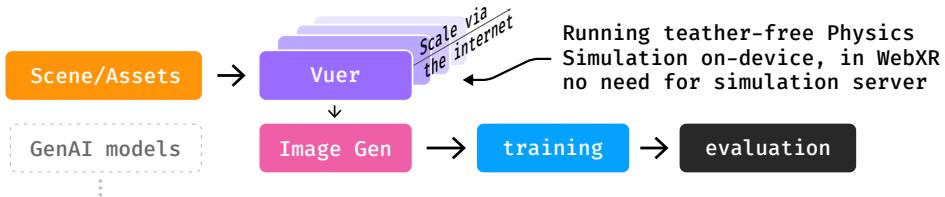
Let’s break down each of these components to understand why this approach is so effective.
Part 1: Physics in the Browser
The most significant technical hurdle Lucid-XR clears is running complex physics simulations directly on a standalone VR device (like the Apple Vision Pro or Meta Quest) without lagging.
Traditionally, VR teleoperation relies on a “tethered” approach. The VR headset captures the user’s hand movements, sends that data to a powerful desktop or cloud server running the physics engine, waits for the server to calculate the result, and receives the rendered frame back.
This round-trip introduces latency. In robotic teleoperation, even a delay of 50-100 milliseconds can ruin the user’s ability to perform delicate tasks like stacking blocks or pouring liquids.
eliminating the Server
Lucid-XR moves the physics engine inside the headset. The researchers utilized MuJoCo, a standard physics engine in robotics, and compiled it to WebAssembly (WASM). This allows the physics code to run at near-native speeds directly within the web browser of the XR device.

As Figure 3 illustrates, the traditional off-device method incurs latency from WiFi transmission and network overhead. By moving the simulation on-device (specifically into a “vuer client”), Lucid-XR eliminates network delays entirely. The simulation step takes under 12ms, allowing the system to maintain the high frame rates (90fps) required to prevent motion sickness in VR.
Multi-Physics Capabilities
You might assume that running a physics engine in a web browser limits complexity, but Lucid-XR proves otherwise. The system supports complex interactions including:
- Deformable Objects: Such as cloth or sponges.
- Fluid Dynamics: Simulating wind or liquids.
- Complex Collisions: Using Signed Distance Functions (SDF) to handle non-convex shapes (shapes with indentations or holes) without simplifying them.

This fidelity is crucial because real-world manipulation often involves messy, squishy, or flowing objects—not just rigid boxes.
Part 2: Hitchhiking Controllers and Retargeting
Once the physics is running smoothly, the next challenge is control. Humans have dexterous hands with five fingers; most robots have parallel jaw grippers or distinct kinematic structures. How do you map one to the other intuitively?
Lucid-XR introduces a concept called the Hitchhiking Controller.
In standard VR, if you try to control a virtual robot hand that is far away from your physical body, small errors in your hand tracking get amplified over that distance, making precise control impossible. The Hitchhiking Controller solves this by detaching the robot’s coordinate frame from the user’s absolute position.
Instead of directly mapping the user’s hand position to the robot, the system applies the user’s motion relative to a “Motion Capture (MoCap) site” on the robot. This allows the user to operate the robot from a comfortable distance—essentially “hitchhiking” on the robot’s end-effector—while maintaining the precision needed for fine motor tasks.
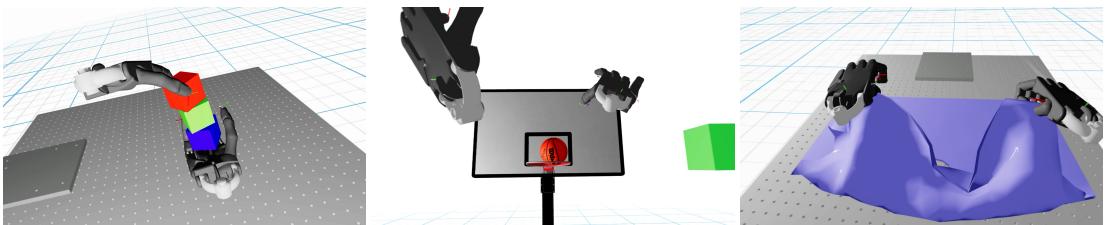
Furthermore, the system uses an on-device Inverse Kinematics (IK) solver. This algorithm calculates the necessary joint angles for the robot arm to reach the position dictated by the user’s hand. Because this runs locally in the browser, users can perform dynamic tasks, like throwing a ball or folding cloth, without the lag that usually makes these actions impossible in teleoperation.
Part 3: From Simulation to Photorealism
We now have a user collecting data in a smooth, low-latency virtual world. However, the visual data collected looks like a video game—clean geometries, flat textures, and perfect lighting. If you train a robot vision system on this data, it will fail immediately in the messy, shadowy real world.
This is where the Generative AI component comes in.
Lucid-XR employs a technique known as Sim-to-Real via Image Generation. Instead of trying to build a perfect 3D replica of the real world (which is artistically expensive), the system uses the low-fidelity simulation frames as a “guide” for a text-to-image diffusion model.
The Generation Pipeline
The pipeline works as follows:
- Input: The simulation provides a semantic mask (which pixels are the robot, which are the object) and a depth map (how far away things are).
- Prompting: The system uses Large Language Models (like ChatGPT) to generate thousands of diverse text descriptions of scenes (e.g., “a rustic wooden kitchen table with harsh sunlight,” “a messy granite countertop with scattered flour”).
- Synthesis: A model like Stable Diffusion, guided by ControlNet (using the masks and depth), paints a new image that matches the geometry of the simulation but looks like a photograph described by the text prompt.
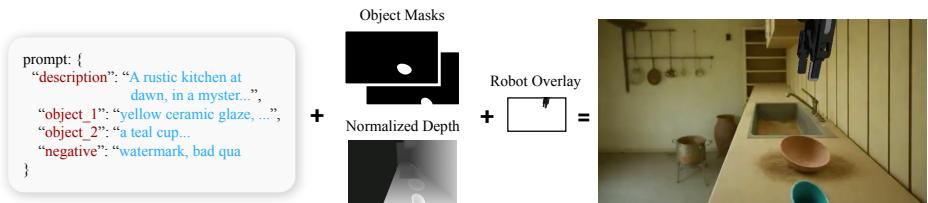
This process, shown in Figure 8, transforms a single virtual demonstration into hundreds of visually distinct training examples. A robot trained on this data learns to recognize the concepts (cup, handle, pour) rather than memorizing specific textures or lighting conditions.
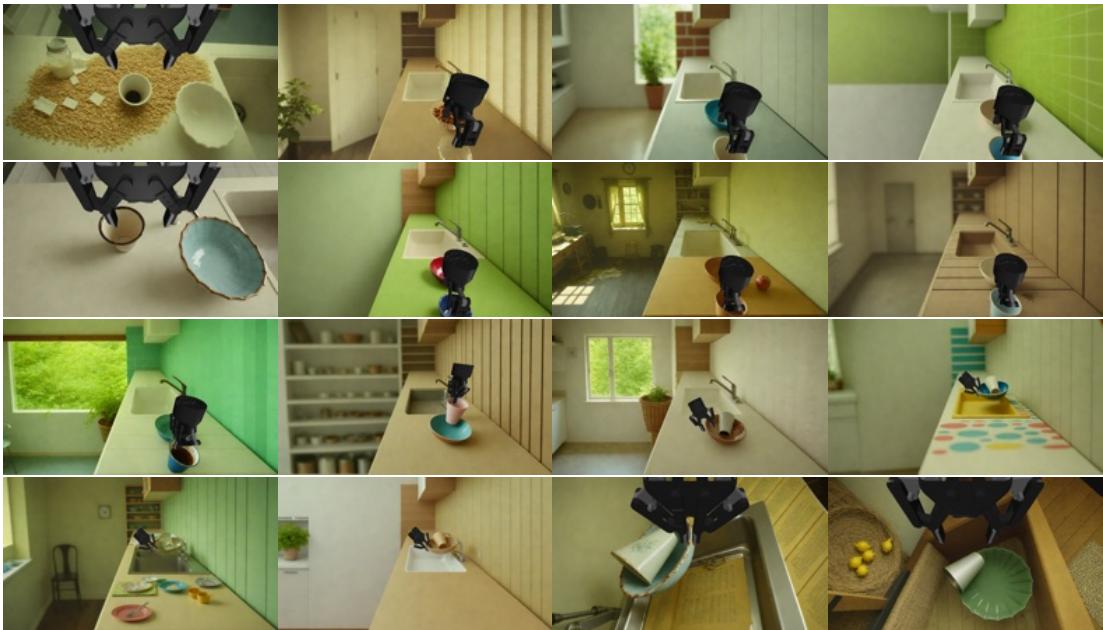
As seen in Figure 16, the system can generate a wide variety of “messy” environments, effectively training the robot to handle visual noise that would otherwise confuse it.
Experiments and Results
The researchers validated Lucid-XR by answering two main questions: Is it faster than real-world data collection? And does the data actually work on real robots?
1. Speed of Data Collection
Collecting data on a real robot is tedious. You have to reset the scene manually after every attempt—picking up the block, drying the spill, or untying the knot. In Lucid-XR, a scene reset is just a button press.
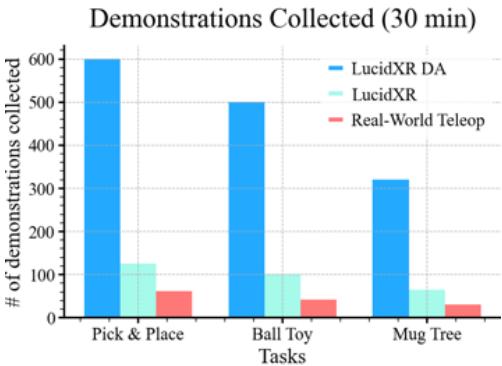
The results were dramatic. As shown in Figure 10, participants using Lucid-XR collected roughly 2x more demonstrations in the same 30-minute window compared to real-world teleoperation. When the generative augmentation pipeline was applied (creating multiple visual variations of each demo), the effective dataset size grew to 5x the real-world baseline.
2. Real-World Success
The ultimate test is deploying the policy on a physical robot. The researchers tested the system on several tasks, including contact-rich activities like “Mug Tree” (hanging a mug on a rack) and “Ball Sorting.”
Crucially, the policies trained entirely on Lucid-XR data (with no real-world images) performed comparably to policies trained on real-world data.
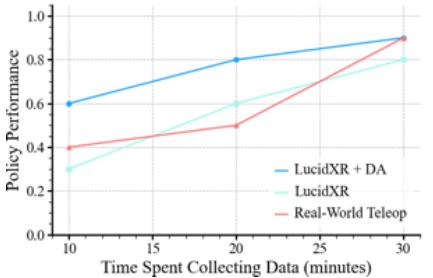
Even more impressive was the system’s robustness to environmental changes. When the researchers changed the lighting or the tablecloth color in the real world:
- The policy trained on real-world data failed (it had overfit to the original environment).
- The policy trained on Lucid-XR data succeeded, because it had seen thousands of variations of lighting and textures during training.
Conclusion: The Future of Crowd-Sourced Robotics
Lucid-XR represents a significant shift in how we approach robot learning. By decoupling data collection from physical hardware and expensive servers, it opens the door to crowd-sourcing.
Imagine a future where thousands of people earn money by playing “games” in VR—stacking blocks, folding laundry, or assembling kits. In the background, Lucid-XR could be capturing these motions, running the physics on their headsets, and using Generative AI to turn that gameplay into millions of hours of training data for real-world service robots.
This “From Atoms to Bits” approach—moving the hard work of robotics into software—might be exactly what is needed to finally solve the data bottleneck and bring capable, generalist robots into our daily lives.