](https://deep-paper.org/en/paper/870_agreement_volatility_a_sec-2533/images/cover.png)
Introduction
Imagine a future where a surgical robot operates autonomously on a patient. It’s stitching soft tissue with precision, relieving an overworked surgeon who oversees the process. Suddenly, the robot encounters a piece of tissue that is slightly more slippery or deformed than what it was trained on.
In a standard automation scenario, the robot might plow ahead, confident in a wrong decision, potentially causing harm. Ideally, however, the robot would “realize” it is confused, pause, and ask the human surgeon to take over for a moment. Once the tricky part is navigated, the robot resumes control.
This collaborative dance between human and machine is the holy grail of surgical robotics. But to make it work, the robot needs a sense of self-awareness. It needs to quantify its own uncertainty.
In this post, we are diving deep into a fascinating research paper titled “Agreement Volatility: A Second-Order Metric for Uncertainty Quantification in Surgical Robot Learning.” The researchers propose a novel way for robots to measure their own confusion—not just by looking at whether their internal models disagree (variance), but by measuring how sensitive that disagreement is to small changes in the environment. They call this metric Agreement Volatility.
The Challenge of Soft Tissue
Why is this so hard? In industrial robotics, a factory arm picks up a rigid car part. The part doesn’t squish, bend, or change shape when you touch it. In surgery, everything is deformable.
Soft tissue manipulation is notoriously difficult for robots because the state of the environment (the shape of the tissue) is partially observable and highly variable. A robot might be trained on thousands of simulations, but real-world biological tissue introduces “Out-of-Distribution” (OOD) scenarios—situations the robot hasn’t seen before, such as unusual tissue geometries or suboptimal grasping points.
The researchers build upon a state-of-the-art framework called DeformerNet, which learns to manipulate soft objects. While DeformerNet is powerful, it is a “black box.” It gives an answer, but it doesn’t tell you if it’s confident. When it encounters OOD data, it often fails silently.
To fix this, the authors introduce Volatility-Aware DeformerNet (VAD-Net).
Volatility-Aware DeformerNet (VAD-Net)
VAD-Net is not just a robot controller; it is a system designed to decide who should be in control: the robot or the human.
At its core, VAD-Net uses an ensemble approach. Instead of training one neural network, the researchers train five copies of the same network, each initialized differently. When the robot looks at the tissue, all five networks propose a movement.
- If all 5 models agree: The robot is likely correct and safe to proceed.
- If the 5 models disagree: The robot is uncertain and should perhaps yield control.
However, the researchers found that simply measuring the disagreement (variance) wasn’t enough. They introduced a deeper, “second-order” metric called Agreement Volatility.
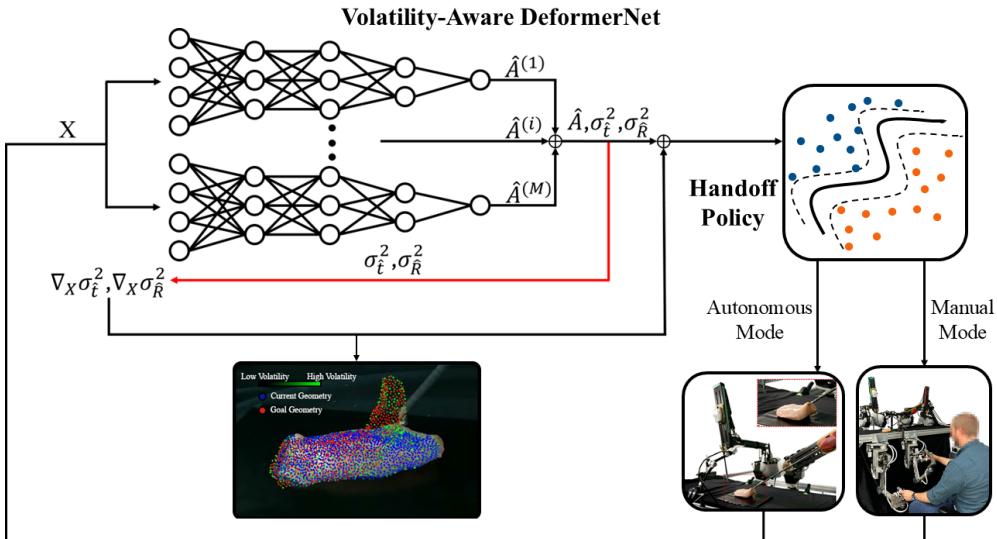
As shown in the architecture diagram above, the system takes point clouds of the current tissue and the goal shape. It processes these through the ensemble to produce motion predictions (\(\hat{A}\)). Crucially, it calculates two gradients (the mathematical symbols with the triangles), which represent the volatility. These features are fed into a Support Vector Machine (SVM) “Handoff Policy” that acts as the switch between the robot and the human.
The Ensemble Architecture
The backbone of this system is the DeformerNet architecture. It takes point cloud data—essentially a 3D scan of the tissue—and processes it through layers of “PointConv” (convolutions for 3D points) to understand the geometry.
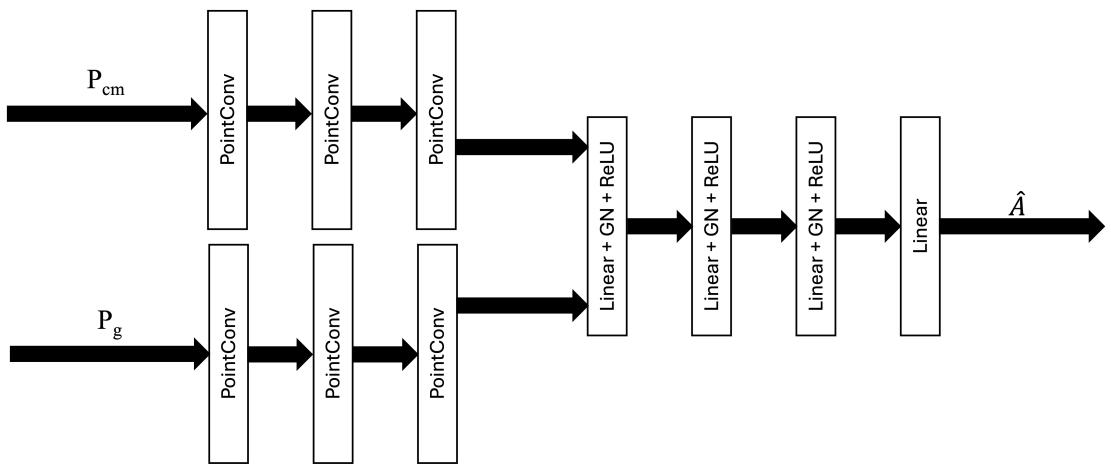
In VAD-Net, five of these networks run in parallel. Each outputs a transformation matrix containing two key pieces of information:
- Translation (\(\hat{t}\)): How much to move the tool in 3D space.
- Rotation (\(\hat{R}\)): How to rotate the tool. \[ f ^ { ( i ) } ( \mathrm { X } ) = \left[ \hat { \mathrm { R } } ^ { ( i ) } ( \mathrm { X } ) \hat { \textbf { \textit { t } } } _ { 1 } ^ { ( i ) } ( \mathrm { X } ) \right] \]
The Core Math: Defining Uncertainty
This section is the heart of the paper’s contribution. How do we turn five different opinions into a reliable “risk score”?
1. First-Order Metric: Predictive Variance
The standard way to measure uncertainty in deep learning is Variance. This asks: How spread out are the predictions?
If Model A says “move left 1cm” and Model B says “move right 5cm,” the variance is high. For the positional component (translation), the variance is calculated as the mean squared deviation of each model’s prediction from the average prediction.
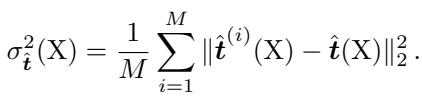
Here, \(X\) is the input (the tissue shape), and \(M\) is the number of models (5). While variance is useful, it is a “first-order” metric. It tells you the magnitude of disagreement, but it doesn’t tell you how stable that disagreement is.
2. Second-Order Metric: Agreement Volatility
This is where the paper innovates. The authors argue that variance alone can be misleading. Sometimes models might agree by chance, or they might disagree in a way that is easily fixed by a tiny movement.
Agreement Volatility measures the sensitivity of the ensemble’s variance to changes in the input.
Think of it this way: Imagine you are balancing a ball on a hill.
- Variance is how far the ball is from the center.
- Volatility is how steep the slope is. If the slope is steep, a tiny nudge (perturbation) will cause the ball to roll away wildly.
In mathematical terms, Agreement Volatility is the gradient of the variance with respect to the input. It asks: If the tissue shape changes by a microscopic amount, does our consensus fall apart?
The researchers derive this by taking the derivative of the variance equation with respect to the input \(X\).

This equation looks complex, but it essentially checks how the individual model predictions change relative to the average prediction when the input changes.
To get a single score for “volatility” at a specific point \(p\) on the tissue, they take the norm (magnitude) of this gradient vector:

Handling Rotation
Rotation is trickier because you can’t just average angles like numbers (due to the complex geometry of 3D rotations). The authors use “geodesic distance”—the shortest path along the curve of possible rotations—to measure variance.

Similarly, they compute the gradient of this rotational variance to find the Rotational Agreement Volatility.

And finally, the score for rotational volatility:

The Handoff Policy
Now the system has a set of features: the raw variance and the agreement volatility for both position and rotation. How does it decide to wake up the surgeon?
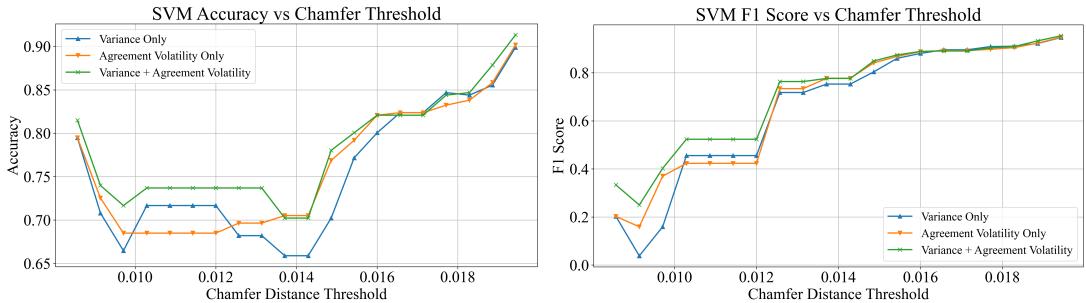
The authors train a Support Vector Machine (SVM) to act as a gatekeeper. This isn’t just about accuracy; it’s about being risk-sensitive.
They define a “Meta-Policy” that minimizes a specific cost function:

- FN (False Negative): The robot thought it was safe, but it failed. This is dangerous.
- FP (False Positive): The robot got scared and asked for help, but it could have handled it. This is annoying and inefficient.
- \(c_f\) and \(c_h\): The costs associated with failure vs. asking for help.
The goal is to find the sweet spot where the robot is humble enough to avoid failure but confident enough to be useful.
The researchers found that adding Agreement Volatility to the SVM inputs significantly improved the decision-making capability compared to using Variance alone.
Uncertainty Attribution: Seeing the Confusion
One of the coolest features of using gradients for uncertainty is that it creates a map. Because the volatility is calculated with respect to the input points, we can visualize exactly which part of the tissue is confusing the robot.
This is called Uncertainty Attribution.
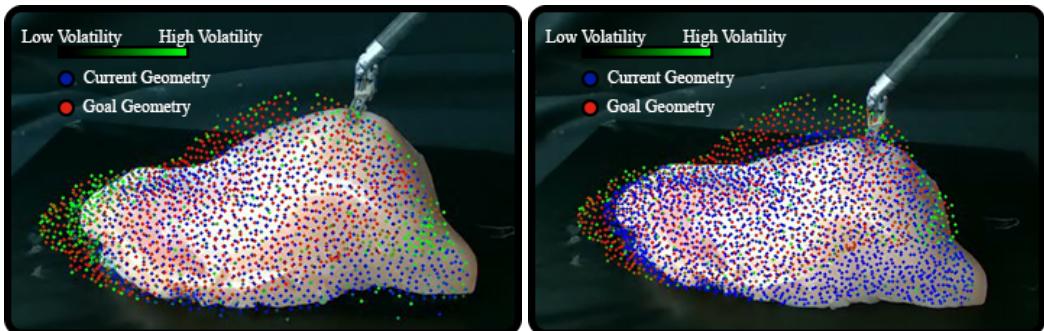
In the image above:
- Blue points: Current tissue shape.
- Red points: Goal shape.
- Green intensity: High volatility.
This tells the human operator why the robot is pausing. Is it the grasp point? Is it a weird fold in the tissue? This transparency builds trust between the surgeon and the autonomous system.
Experimental Results
The theory sounds great, but does it work on actual meat? The researchers moved away from simulation and tested VAD-Net on a daVinci Research Kit (dVRK) robot manipulating ex vivo chicken tissue.
They ran three types of trials:
- Fully Autonomous: No human help allowed.
- Variance Only: The robot asks for help based only on variance.
- VAD-Net: The robot asks for help based on variance AND agreement volatility.
Success Rates and Efficiency
The results were stark. The fully autonomous system failed frequently when faced with tricky, out-of-distribution geometries.
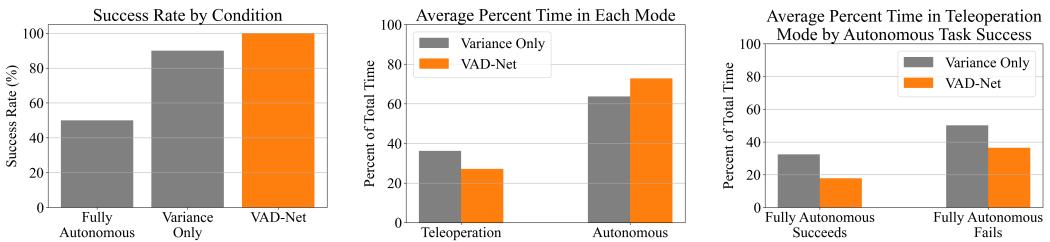
- Success Rate (Left Graph): The Fully Autonomous mode (gray) succeeded less than 50% of the time. Both the Variance-Only and VAD-Net approaches achieved near-perfect success rates because they could ask for help.
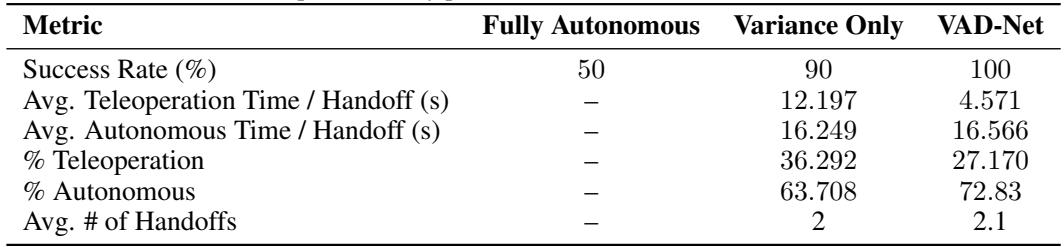
- Efficiency (Middle Graph): This is the key differentiator. VAD-Net (orange) spent less time in teleoperation mode than the Variance-Only baseline. This means VAD-Net was smarter about when to ask for help. It didn’t panic unnecessarily.
- Strategic Handoffs: The researchers noted that VAD-Net reduced reliance on human intervention by roughly 10% compared to the baseline.
A Real-World Handoff Scenario
Let’s look at what a trial looks like over time.
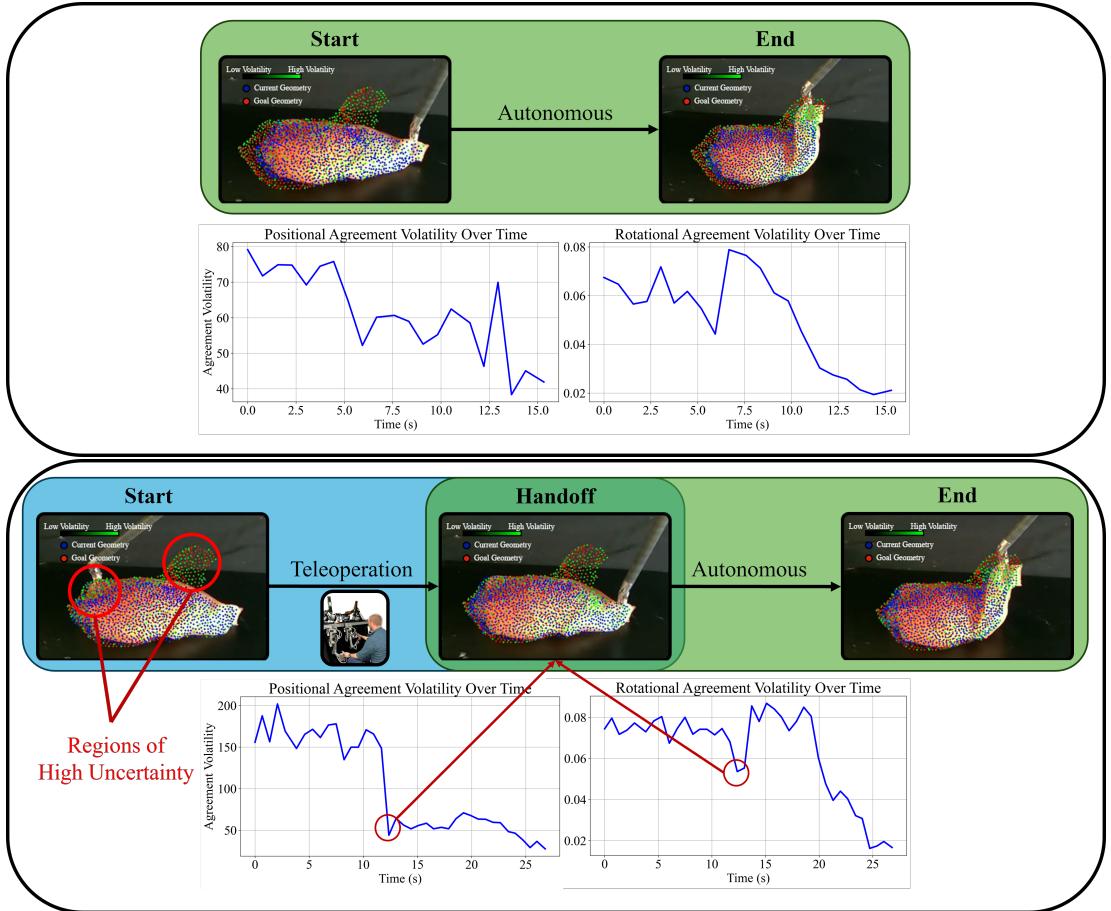
In the bottom scenario of Figure 9:
- Start: The robot sees the tissue. The volatility (blue line in the graphs) spikes. The system detects “High Uncertainty.”
- Handoff: The robot hands control to the human. The human adjusts the tissue or the grasp.
- Resume: Once the human fixes the tricky state, the volatility drops. The robot detects it is back in a “safe” zone and resumes autonomous control to finish the job.
Speed Comparison
Finally, we look at pure speed. Did the new metric slow things down?
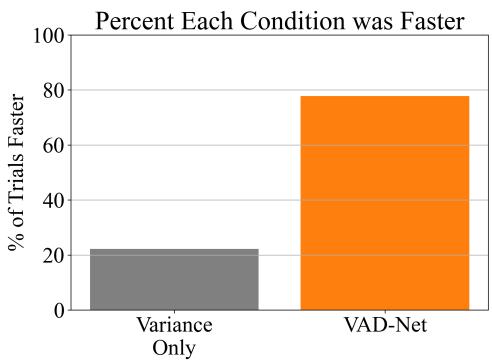
Because VAD-Net is more discerning, it avoids the “boy who cried wolf” scenario. It only pauses for legitimate risks, leading to faster overall procedure times in nearly 80% of the trials compared to the variance-only approach.
The quantitative breakdown is summarized in Table 1:
Conclusion
The integration of robots into surgery is not about replacing surgeons; it’s about augmenting them. However, for a robot to be a good teammate, it needs to know its limits.
This research paper makes a compelling case that Agreement Volatility is a superior metric for this self-awareness compared to standard variance. By calculating the second-order sensitivity of the model’s predictions:
- The robot becomes safer (100% success rate in trials).
- The robot becomes more efficient (bothering the human less often).
- The robot becomes transparent (visualizing exactly where the confusion lies).
As we move toward more autonomous medical systems, metrics like Agreement Volatility will likely become standard safety features, ensuring that when a robot operates on you, it knows exactly when to stop and ask for a second opinion.