](https://deep-paper.org/en/paper/8764_counterfactual_graphical_-1694/images/cover.png)
Human reasoning is fundamentally built on our ability to imagine worlds that never existed. We look back at a decision and ask, “What if I had taken the job in London?” or “Would the patient have survived if we started treatment a week earlier?”
These are counterfactuals. They represent the highest rung on the ladder of causation. Unlike standard statistics, which deal with correlations in observed data, or even basic causal inference, which deals with interventions (“What happens if I do X?”), counterfactuals require us to compare the observed reality against a hypothetical alternative.
For researchers and students in causal inference, handling these “what if” queries mathematically has always been challenging. How do you compute the probability of an event in a world that doesn’t exist, given evidence from a world that does?
In this post, we are doing a deep dive into the research paper “Counterfactual Graphical Models: Constraints and Inference.” This work introduces a powerful new graphical tool—the Ancestral Multi-World Network (AMWN)—and a formalized logic system called ctf-calculus. Together, they provide a sound and complete method for reasoning about counterfactuals, generalizing Pearl’s celebrated do-calculus.
The Problem with Parallel Worlds
To understand why this paper is significant, we first need to define the landscape. Causal reasoning is often visualized using Causal Diagrams (Directed Acyclic Graphs, or DAGs).
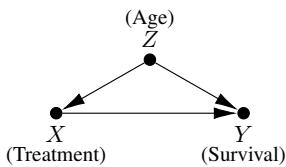
In Figure 1, we see a simple system: Age (\(Z\)) affects both Treatment (\(X\)) and Survival (\(Y\)), and Treatment (\(X\)) also affects Survival (\(Y\)).
We can easily ask probabilistic questions like \(P(Y|X)\) (observation) or causal questions like \(P(Y|do(X))\) (intervention). But counterfactuals are different. A typical counterfactual query looks like this: \(P(Y_{x} = 1 | X = x')\).
Translated to English: “What is the probability that the patient would have survived (\(Y=1\)) had they received treatment (\(x\)), given that we observed they actually did not receive treatment (\(X=x'\))?”
This is a cross-world query. We are conditioning on evidence in the “real” world (where \(X=x'\)) but asking about a “counterfactual” world (where \(X=x\)). Standard causal graphs struggle here because they usually represent just one world at a time. This paper provides the bridge between these worlds.
The Structural Causal Model (SCM)
The foundation of this reasoning is the Structural Causal Model. An SCM is defined by a set of variables and functions. Every observable variable is determined by its parents in the graph and some unobserved noise (exogenous variables), denoted as \(U\).
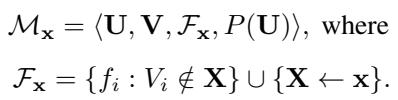
When we talk about “intervention” (the \(do\) operator), we are essentially breaking the natural function of a variable and replacing it with a constant. This creates a submodel (\(\mathcal{M}_x\)), as shown above.
The beauty of the SCM framework is that it unifies three layers of reasoning, often called the Pearl Causal Hierarchy (PCH).
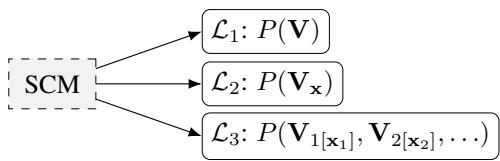
As Figure 2 illustrates:
- \(\mathcal{L}_1\): Association (Seeing) - \(P(y|x)\)
- \(\mathcal{L}_2\): Intervention (Doing) - \(P(y_{x})\)
- \(\mathcal{L}_3\): Counterfactuals (Imagining) - \(P(y_{x}|x')\)
The paper’s main contribution is providing efficient algorithms and rules to navigate \(\mathcal{L}_3\).
The Three Pillars of Counterfactual Constraints
To perform algebra across different worlds, we need rules. The authors identify three fundamental types of constraints that govern how counterfactual variables relate to each other: Consistency, Exclusion, and Independence.
1. Consistency Constraints
Consistency is the anchor that connects the hypothetical to the real. It states that if a variable naturally takes on a value \(x\), then intervening to set that variable to \(x\) will not change the outcome. The world “where we force X to be x” and the world “where X happened to be x” look identical for those specific units.
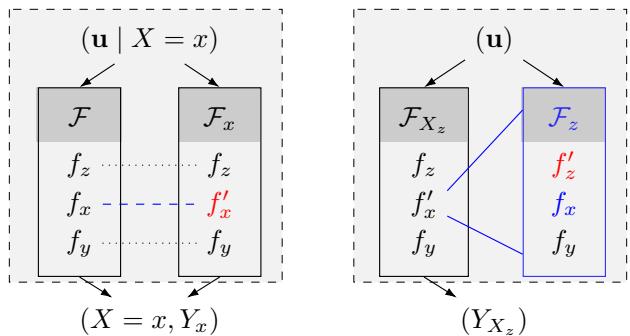
Figure 3(a) visualizes this. The gray box represents the mechanism of the world. If \(X(\mathbf{u}) = x\) naturally, then the potential outcome \(Y_x\) is exactly the same as the observed \(Y\).
Mathematically, this leads to a crucial identity:
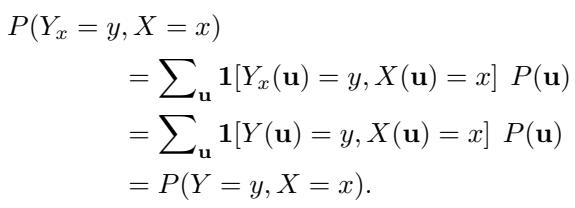
This rule allows us to switch between observational probabilities and counterfactual ones, provided the observation matches the intervention.
2. Exclusion Constraints
Exclusion is about irrelevance. If we intervene on a variable \(X\), it should only change outcomes that lie on a causal path from \(X\).
Consider the chain structure in Figure 4(a) below. \(X \to Z \to Y\). If we intervene on \(Z\), we cut the link from \(X\). Therefore, an additional intervention on \(X\) becomes irrelevant to \(Y\).
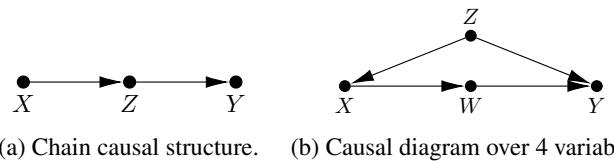
In the context of the chain in Figure 4(a), \(Y_{zx} = Y_z\). The intervention on \(x\) is “excluded” from the subscript because \(Z\) effectively blocks \(X\)’s influence on \(Y\). This simplifies complex counterfactual expressions by removing redundant interventions.
3. Independence Constraints
This is the most complex and powerful constraint. It tells us when variables in one world are independent of variables in another world.
In standard causal diagrams, we use d-separation to read independences. But d-separation works on a single graph. How do we test independence between \(Y_{xw}\) (a variable in a world where we intervened on X and W) and \(X\) (a variable in the observed world)?
Historically, researchers used “Twin Networks”—basically duplicating the graph for every world involved and connecting them via shared error terms (\(U\)). However, Twin Networks scale poorly. If you have complex queries involving 3 or 4 different hypothetical worlds, the graph becomes massive and hard to read.
Core Method: Ancestral Multi-World Networks (AMWN)
The authors introduce the Ancestral Multi-World Network (AMWN). This is a streamlined graphical construction that is sound and complete for reading counterfactual independences using d-separation.
The key insight is the concept of Ancestors. When evaluating a specific counterfactual query, we don’t need the entire Twin Network. We only need the relevant ancestors of the variables in our query.
Constructing the AMWN
Let’s look at a concrete example. Suppose we have the graph in Figure 4(b) (shown above in the Exclusion section) and we want to check if \(Y_{xw}\) is independent of \(X\) given \(Z\) and \(W\).
The algorithm works as follows:
- Identify Ancestors: We look at the variables in our query (\(Y_{xw}, X, Z, W\)) and trace back their ancestors in the respective submodels.
- Merge Nodes: If variables are deterministically the same due to Consistency or Exclusion, we merge them.
- Add Latent Variables: We explicitly add the unobserved parents (\(U\)) that are shared across worlds.
Let’s compare the approaches visually.
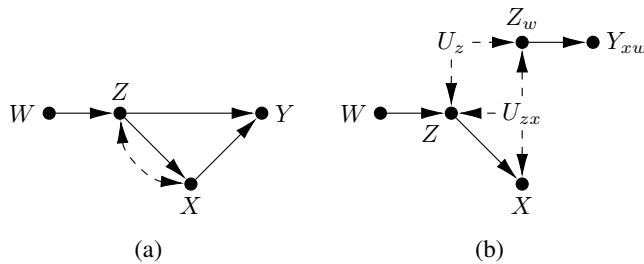
In Figure 6, we see the transformation.
- Left (a): The original causal diagram.
- Right (b): The AMWN.
Notice how compact Figure 6(b) is. It explicitly includes the shared latent variables (\(U_z, U_{zx}\)) which connect the different versions of the variables.
- We can see that \(U_{zx}\) connects \(X\) and \(Z\).
- We see \(Z_w\) affecting \(Y_{xw}\).
Using standard d-separation on Figure 6(b), we can check the path between \(Y_{xw}\) and \(X\). There is an active path \(X \leftarrow U_{zx} \to Z \to Z_w \to Y_{xw}\). Because this path is open, we conclude that independence does not hold.
Efficiency
The AMWN is significantly more efficient than previous methods like Twin Networks or Multi-Networks.
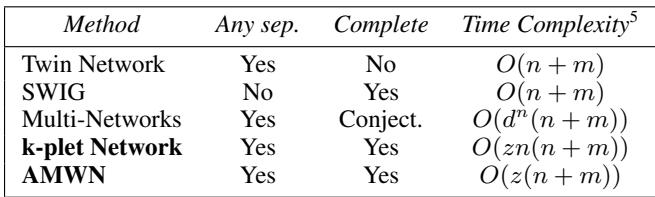
As the table shows, AMWN supports any separation query and is complete (meaning if the graph says they are independent, they really are; and if the graph says they aren’t, there is a counterexample). Crucially, the time complexity is polynomial, scaling linearly with the number of worlds (\(z\)), rather than exponentially.
The Counterfactual Calculus (ctf-calculus)
Having a graph to check for independence is great, but we also need to perform algebraic transformations to solve for specific values. This is where the ctf-calculus comes in.
Just as Pearl’s do-calculus provides three rules for transforming interventional expressions (\(P(y|do(x))\)), the ctf-calculus provides three analogous rules for counterfactuals.
Rule 1: Consistency (Observation/Intervention Exchange)
This rule allows us to treat a counterfactual intervention as an observation if the values match.

If we observe \(X=x\), then the counterfactual “what if \(X=x\)?” is just the reality we are seeing. This anchors our hypothetical math in real data.
Rule 2: Independence (Adding/Removing Evidence)
This rule allows us to add or remove conditions in our probability expression.

We can remove the observation \(X_t\) from the conditioning set if the AMWN shows that \(Y_r\) is d-separated from \(X_t\). This is the “engine” of the calculus, allowing us to simplify complex conditional probabilities.
Rule 3: Exclusion (Adding/Removing Interventions)
This rule allows us to modify the subscript of the counterfactual.
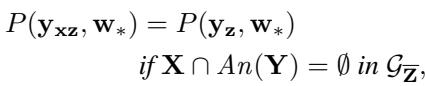
We can remove an intervention \(x\) from \(Y_{xz}\) if \(X\) is not an ancestor of \(Y\) in the graph where \(Z\) is cut. Essentially, if doing \(x\) doesn’t causally reach \(Y\), we can drop it from the expression.
Putting it Together: Determining Causality
The true power of this framework is revealed when we use it to identify causal effects. Identification means expressing a theoretical counterfactual quantity purely in terms of data we can actually collect (observational or experimental).
The paper proves that the ctf-calculus is complete. If a counterfactual quantity is identifiable, it can be derived using these three rules.
Let’s walk through two examples provided in the paper.
Example 1: Effect of Treatment on the Treated (ETT)
We return to the “Backdoor” diagram (Figure 1). We want to find \(P(y_x | x')\). This is the probability of outcome \(y\) if we had treated (\(x\)), given that we observed no treatment (\(x'\)).
We construct the AMWN for this query:
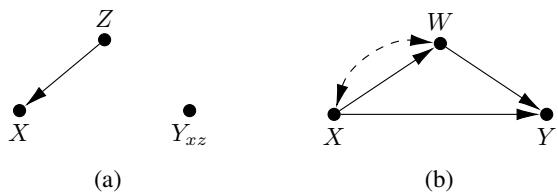
Using the AMWN in Figure 7(a) and the ctf-calculus, the derivation proceeds step-by-step:
- Conditioning: We introduce \(Z\) using standard probability theory. \[= \sum_{z} P(y_{x} | z, x')P(z|x')\]
- Rule 3 (Exclusion): In the graph, treating \(X\) does not change \(Z\). So \(Z_x = Z\). \[= \sum_{z} P(y_{x} | z_x, x')P(z|x')\]
- Rule 1 (Consistency): Since we are conditioning on \(Z_x = z\), we can rewrite \(Y_x\) as \(Y_{xz}\).

- Rule 2 (Independence): The AMWN shows \(Y_{xz}\) is independent of \(X\) given \(Z\).
- Final Result: We reduce the counterfactual query entirely to observational terms: \[= \sum_z P(y|z,x)P(z|x')\] We have successfully turned a “what if” question into a calculation we can perform on a standard dataset!
Example 2: Natural Direct Effect (NDE)
Consider Figure 7(b) (above). Suppose \(X\) is exercise, \(W\) is cholesterol, and \(Y\) is heart disease. We want to know the Natural Direct Effect of exercise on heart disease—the benefit that doesn’t come from lowering cholesterol.
This requires calculating a nested counterfactual: \(P(y_{x', W_x})\). This asks: “What is the probability of \(Y\) if we set \(X\) to \(x'\) (no exercise), but we keep \(W\) (cholesterol) at the level it would have been if we did exercise (\(W_x\))?”
This seems incredibly abstract, but the ctf-calculus breaks it down.
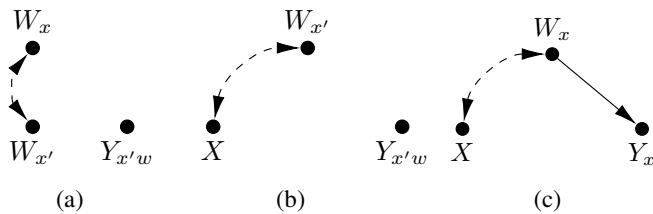
Using the AMWNs shown in Figure 8, the authors use the calculus to decompose the problem.
- They unnest the counterfactual using the law of total probability.
- They use Rule 2 (Independence) to remove the conflicting intervention \(X\).
- They use Rule 1 (Consistency) to turn counterfactuals back into observations.
The derivation leads to this elegant formula:

This formula allows researchers to disentangle direct and indirect mechanisms using only observed data probabilities (\(P(y|w, x')\) and \(P(w_x)\)), provided the graph structure holds.
Conclusion: A Complete Toolkit for the Causal Hierarchy
The research presented in “Counterfactual Graphical Models” marks a significant maturity in the field of Causal AI. For a long time, Layer 3 (Counterfactuals) was a difficult territory, often requiring restrictive assumptions or inefficient computational methods.
By introducing the Ancestral Multi-World Network, the authors provided a scalable way to visualize and test relationships across parallel worlds. By formalizing the ctf-calculus, they gave us a rigorous language to manipulate these relationships algebraically.
The most important takeaway for students and practitioners is the property of completeness. We no longer have to wonder if a specific “what if” question is solvable. If the ctf-calculus cannot reduce a query to data, then that query is mathematically impossible to answer without stronger assumptions. This certainty is invaluable.
As AI moves from simple prediction to complex reasoning and decision-making, tools like AMWN and ctf-calculus will be the bedrock upon which we build systems that can understand not just what happened, but what could have happened.