](https://deep-paper.org/en/paper/8999_fedssi_rehearsal_free_con-1601/images/cover.png)
Imagine you are trying to learn a new language, say Spanish. You study hard for a month. Then, you switch gears to learn Python programming. A month later, you try to speak Spanish, but you find yourself struggling to recall basic vocabulary. Your brain has overwritten the old neural pathways to make room for the new syntax. In cognitive science and AI, this phenomenon is known as Catastrophic Forgetting.
Now, imagine this problem at a massive scale involving thousands of smartphones or hospital servers. This is the challenge of Continual Federated Learning (CFL). Devices need to learn from new streams of data continuously without sharing that private data, all while remembering what they learned months ago.
Most current solutions rely on “rehearsal”—keeping a buffer of old data to re-train the model occasionally. But storing old data eats up memory on edge devices and, more critically, creates a privacy nightmare.
In this post, we are diving deep into a paper titled “FedSSI: Rehearsal-Free Continual Federated Learning with Synergistic Synaptic Intelligence.” This research proposes a clever way to prevent models from forgetting, without ever needing to store or revisit old data.
The Twin Challenges: Privacy and Memory
To understand why FedSSI is significant, we need to set the stage with two conflicting concepts: Federated Learning (FL) and Continual Learning (CL).
Federated Learning: Privacy First
In traditional machine learning, you gather all data into a central server. In Federated Learning, the data stays on the device (the “client”). The client trains a model locally and sends only the updates (gradients or weights) to the server. The server aggregates these updates to create a global model. This is great for privacy (think hospital records or text history).
Continual Learning: The Stream of Time
Real-world data isn’t static. It arrives in streams. A self-driving car learns to drive in summer, then autumn, then winter. If the model optimizes purely for winter driving, it might “forget” how to handle safe, dry summer roads. Continual Learning aims to update models with new tasks without erasing the knowledge of previous tasks.
The Problem: Rehearsal is Expensive
When you combine these two fields into Continual Federated Learning (CFL), things get messy. To stop catastrophic forgetting, most algorithms use Rehearsal. They force the client to cache (store) a subset of old data samples to mix in with new data.
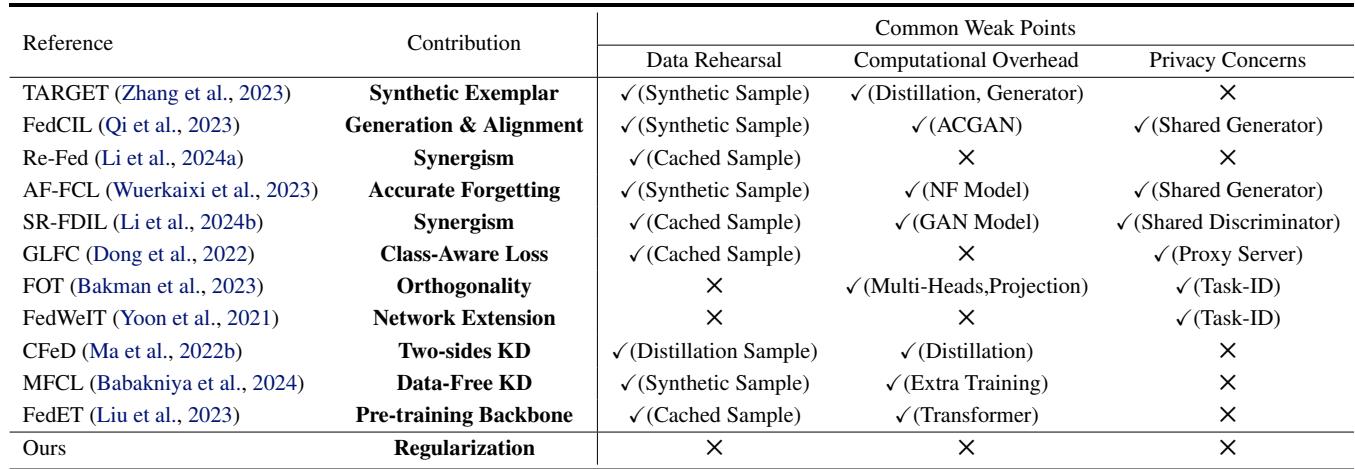
As shown in Table 1 above, most leading methods (like FedCIL or GLFC) rely on “Cached Samples” or “Synthetic Samples.” This leads to three major issues:
- Memory Costs: Edge devices (IoT sensors, phones) have limited storage.
- Privacy Concerns: If a user deletes their data, the model might still be holding onto a cached copy for rehearsal. This violates the right to be forgotten (e.g., GDPR).
- Computational Overhead: Generating synthetic data or managing buffers requires heavy processing power.
The researchers behind FedSSI asked: Can we solve catastrophic forgetting without storing any data?
The Regularization Approach: A Good Idea with a Flaw
If we can’t store data, we must use Regularization. In the context of neural networks, regularization usually means adding a penalty term to the loss function.
The most famous method for this in centralized learning is Synaptic Intelligence (SI). The intuition is beautiful: imagine the neural network weights are synapses. Some synapses are crucial for Task A, while others are less important. When we move to Task B, we should “freeze” or heavily penalize changes to the important synapses, while allowing the unimportant ones to change freely.
The researchers first tried applying standard regularization techniques (like LwF, EWC, and SI) directly to Federated Learning.
Observation 1: It works when data is uniform (IID)
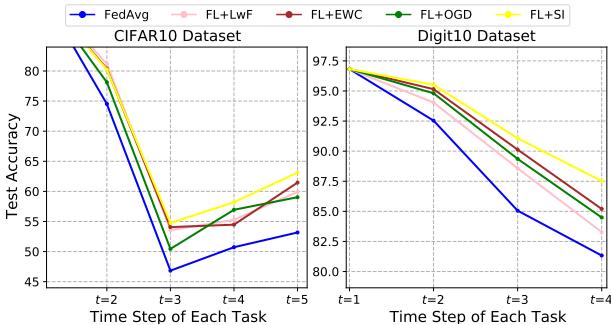
As you can see in Figure 1, when the data is IID (Independent and Identically Distributed—meaning every client has a similar mix of data), standard regularization methods work well. The yellow line (FL+SI) performs admirably, preventing the sharp drop in accuracy that standard FedAvg (blue line) suffers from.
Observation 2: It crashes when data is diverse (Non-IID)
However, the real world is Non-IID. One hospital might handle mostly elderly patients; another might handle pediatrics. One phone user types in English; another in French.
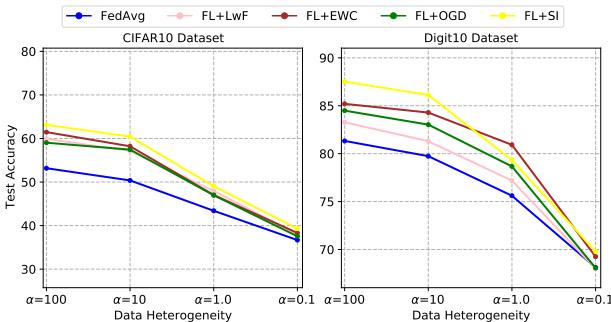
Figure 2 reveals the failure. As data heterogeneity increases (represented by \(\alpha\), where lower \(\alpha\) means more diverse/heterogeneous data), the performance of standard SI (yellow line) collapses. In the graph on the left, looking at \(\alpha=0.1\) (highly heterogeneous), SI performs no better than the baseline.
Why does this happen? Standard Synaptic Intelligence calculates the “importance” of weights based on the local data available to the client. But if a client only sees a tiny slice of the global reality, its estimation of which weights are “important” will be biased. It might freeze weights that are useless globally, or overwrite weights that are crucial for another client.
The Solution: FedSSI
To fix this, the authors propose FedSSI (Synergistic Synaptic Intelligence). The core idea is to calculate the “importance” of weights by looking at both the local data and the global model simultaneously.
The Personalized Surrogate Model (PSM)
The secret sauce of FedSSI is the introduction of a Personalized Surrogate Model (PSM).
Usually, a client takes the global model and immediately starts training on its new local task. In FedSSI, there is an intermediate step. The client creates a temporary model (the PSM) denoted as \(v_k\).
This PSM is updated using a special rule that acts like a tug-of-war.
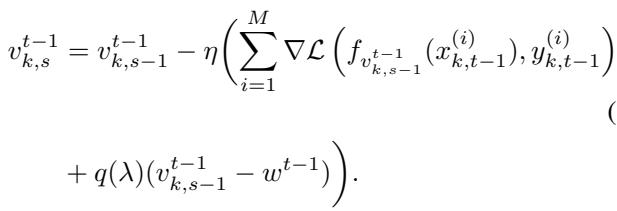
Let’s break down this update rule (Equation 5 in the paper):
- \(v_{k, s-1}^{t-1}\): The current state of the personalized model.
- \(\nabla \mathcal{L}(\dots)\): This is the gradient derived from the local data. It pulls the model toward solving the local task.
- \(q(\lambda)(v_{k,s-1}^{t-1} - w^{t-1})\): This is a regularization term involving the global model (\(w^{t-1}\)). It acts like an anchor or a spring, pulling the personalized model back toward the global knowledge.
The parameter \(\lambda\) controls the balance. If the data is very heterogeneous (Non-IID), we need to rely more on the global model to understand what is truly important.
Calculating Synergistic Importance
Once the PSM is trained (which is very fast), the client monitors how the loss changes with respect to the parameters. This allows the client to calculate the importance (\(s_{k,i}\)) of every single parameter (weight) in the network.
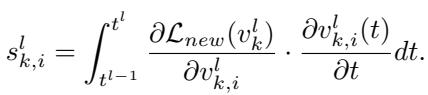
This integral (Equation 6) essentially asks: How much did the loss decrease when we changed this specific weight? If the loss dropped significantly, the weight is “important.”
Because this calculation uses the PSM (which balances local and global views), the resulting importance scores are synergistic. They reflect weights that are important not just for the client’s specific data, but for the global federation.
The Final Training Step
Finally, the client trains the actual local model for the new task. The loss function used for this training includes the standard error (Cross-Entropy) plus the Surrogate Loss:

Here, \(\mathcal{L}_{sur}\) is the penalty. It looks at the difference between the current weight (\(w_{k,i}^t\)) and the old weight (\(w_i^{t-1}\)). It multiplies that difference by the importance score (\(\Omega\)) we calculated earlier.
If a weight was deemed important (high \(\Omega\)), changing it will result in a huge penalty, forcing the model to keep it as is. If a weight is unimportant (low \(\Omega\)), the model is free to change it to learn the new task.
The calculation of \(\Omega\) accumulates importance over time:
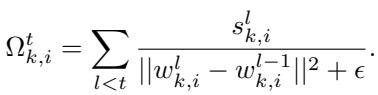
This accumulation ensures that the model respects the history of all previous tasks, not just the most recent one.
Experimental Results
The authors tested FedSSI against a wide range of baselines, including rehearsal-based methods (like Re-Fed and FedCIL) and architecture-based methods (like FOT). They used challenging datasets like CIFAR100 (Class-Incremental Learning) and DomainNet (Domain-Incremental Learning).
Accuracy Comparison
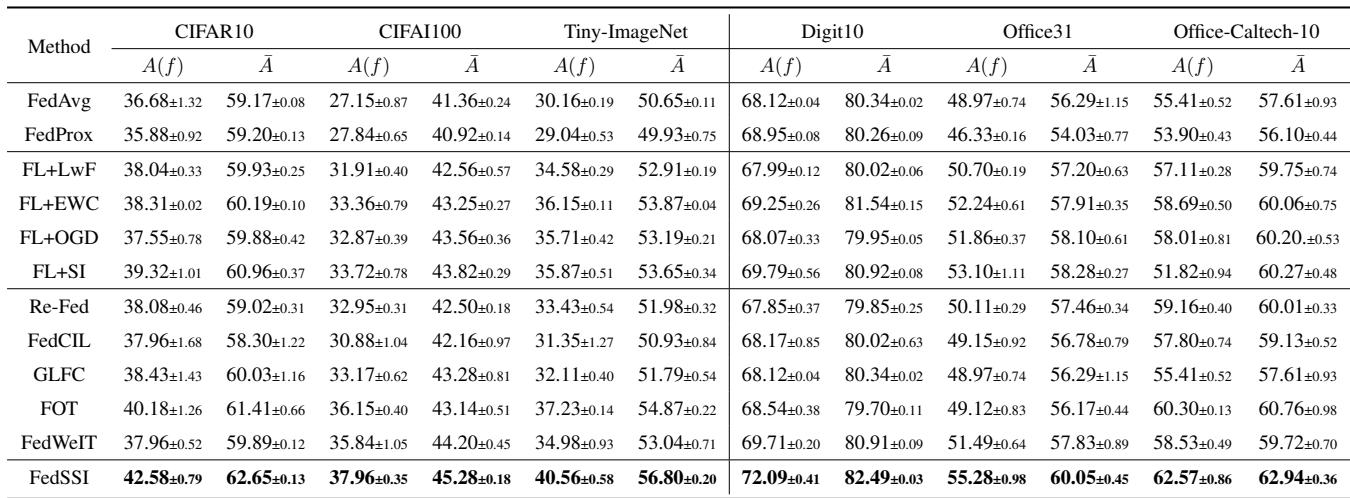
Table 2 shows the final accuracy (\(A(f)\)) and average accuracy (\(\bar{A}\)).
- FedSSI consistently outperforms the competition. For example, on CIFAR10, it achieves 42.58% final accuracy, compared to 39.32% for standard SI and 38.08% for Re-Fed.
- It shines particularly well in complex scenarios like CIFAR100 and Tiny-ImageNet.
Robustness to Heterogeneity
The true test of Federated Learning is how it handles messy, Non-IID data.
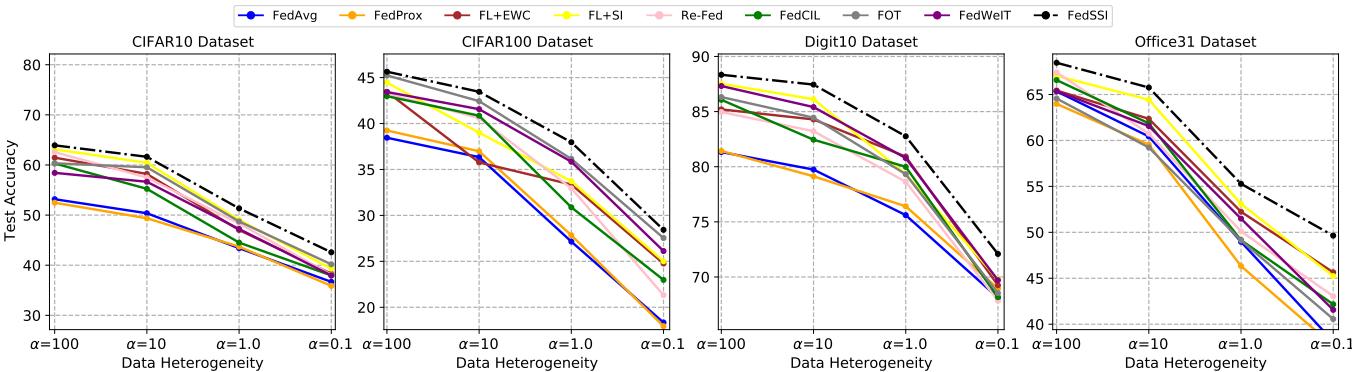
In Figure 3, the x-axis represents data heterogeneity (\(\alpha\)). Remember, a lower number (like 0.1) means more heterogeneous (harder).
- Look at the black dashed line (FedSSI).
- On the far right of the charts (highly heterogeneous data), FedSSI maintains a significant gap above the other colored lines.
- This proves that the “Synergistic” approach—mixing local and global views to determine parameter importance—successfully mitigates the bias that usually kills regularization methods in FL.
Communication Efficiency
One trade-off in Federated Learning is communication cost. Does FedSSI require sending massive files back and forth?
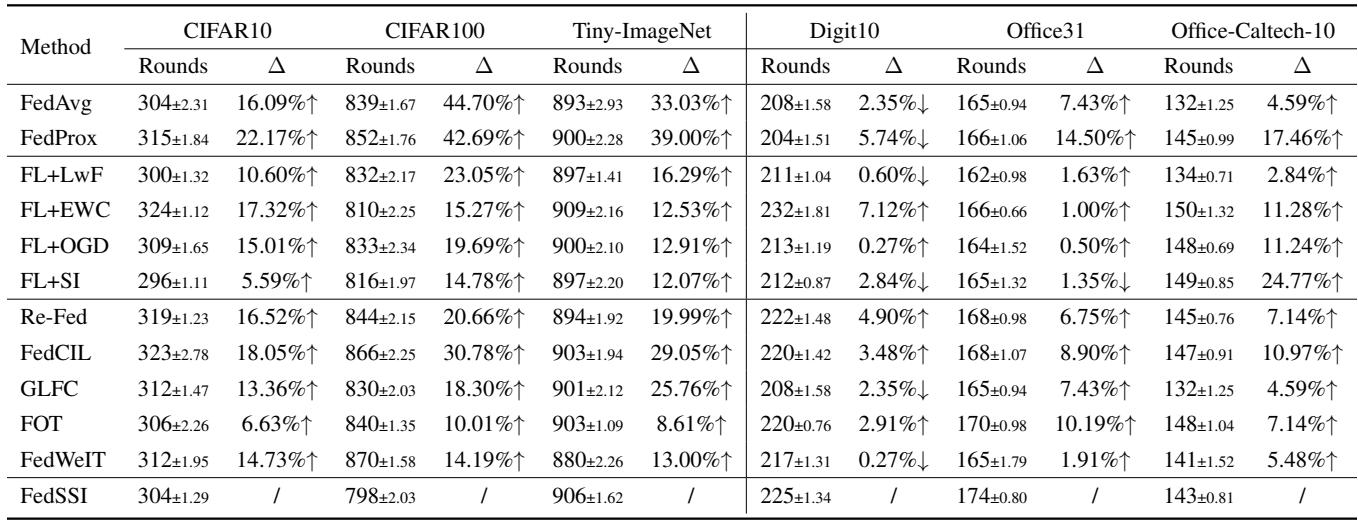
Table 4 analyzes the “communication rounds” required to reach peak accuracy.
- While FedSSI might sometimes require a similar number of rounds to other methods, the \(\Delta\) column is key. It shows the trade-off between accuracy gain and communication cost.
- FedSSI often achieves significantly higher accuracy without a proportional explosion in communication overhead. It is a highly efficient protocol relative to the performance gains it delivers.
Scalability
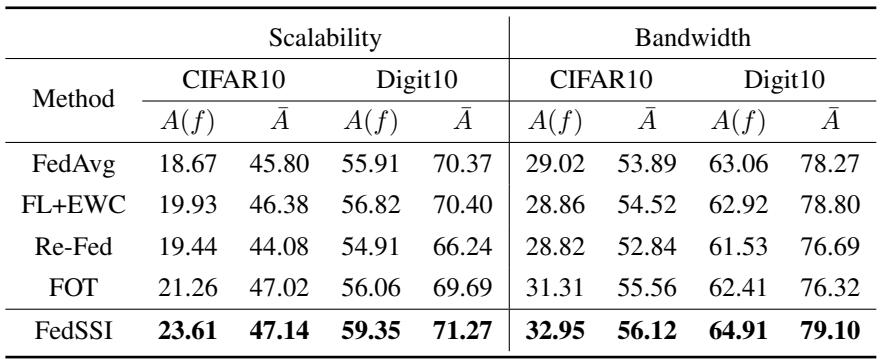
The authors also tested scalability (Table 7 in the paper, visualized in supplemental data). Even when scaling up to 100 clients, or when bandwidth is constrained, FedSSI maintained its lead over methods like FedAvg and FOT.
Why This Matters
FedSSI represents a significant step forward for deploying AI in the real world.
- Privacy Preserved: By eliminating the need for rehearsal buffers, FedSSI ensures that raw user data is never stored longer than necessary for immediate training.
- Hardware Friendly: It avoids the memory overhead of caching data and the computational overhead of generating synthetic images (like GAN-based methods use).
- Real-World Ready: It specifically targets the Non-IID data distribution problem, which is the default state of data in the wild.
By intelligently calculating which “synapses” in the artificial brain are important using both a local and global perspective, FedSSI allows distributed devices to learn continuously without forgetting the past. It turns the weakness of Federated Learning—isolated data—into a manageable constraint through synergistic regularization.