](https://deep-paper.org/en/paper/96_robust_dexterous_grasping_o-2562/images/cover.png)
Imagine you are trying to pick up a wet bar of soap. As your fingers close around it, the soap slips slightly. Instantly, without looking or thinking consciously, your fingers adjust their pressure and position to secure the grip. This micro-adjustment is a hallmark of human dexterity.
Now, imagine a robot trying to do the same. Most robotic systems plan a grasp based on a static snapshot, close their “eyes” (sensors), and execute the motion blindly. If the object moves, or if the robot bumps into something, the grasp fails.
Achieving human-level dexterity in robots—specifically with multi-fingered hands—is one of the grand challenges in robotics. It requires not just planning where to put fingers, but adaptively reacting to physical disturbances in real-time.
In this post, we are deep-diving into the paper “Robust Dexterous Grasping of General Objects,” which presents a novel framework for “zero-shot” dynamic grasping. This method allows a robot to grasp thousands of unseen objects using only a single camera view, maintaining a firm grip even when faced with unexpected collisions or external forces.
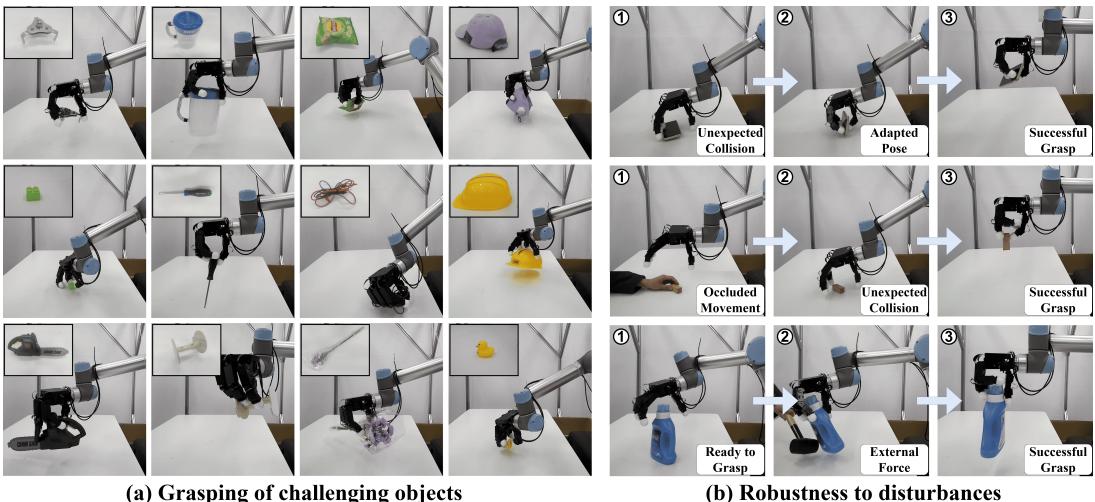
As shown in Figure 1, this system handles everything from rubber ducks to chainsaws, adapting to collisions (Scenario ①) and resisting external forces (Scenario ③). Let’s explore how the researchers achieved this level of robustness.
The Problem: Why is Dexterous Grasping So Hard?
Before dissecting the solution, we must understand the friction points in current robotics.
- High Dimensionality: Unlike a simple parallel-jaw gripper (which works like tongs), a dexterous hand (like the Allegro hand used in this paper) has 16 degrees of freedom. Controlling 16 joints simultaneously to coordinate a grasp is computationally heavy.
- Occlusion: When a robot hand reaches for an object, the hand itself blocks the camera’s view. The robot essentially becomes blind to the object’s exact position right at the most critical moment—contact.
- Lack of Tactile Feedback: While humans rely heavily on touch, high-fidelity tactile sensors are expensive and fragile. Most scalable robot solutions need to work with just vision and joint positioning (proprioception).
- Static vs. Dynamic: Traditional methods scan an object, calculate a perfect grasp pose, and try to move the hand there. This is “open-loop” execution. It cannot handle an object slipping or a table bumping the arm.
The researchers argue that to solve these problems, we need a system that is dynamic (reacts in real-time) and robust (handles noise and uncertainty), trained without requiring expensive human demonstrations.
The Framework: Teacher-Student Learning
The core philosophy of this paper is a Teacher-Student training paradigm. This is a common technique in Reinforcement Learning (RL) where we first train an “omniscient” agent (the Teacher) in a simulation where it has access to perfect data, and then use it to teach a “realistic” agent (the Student) that operates under real-world constraints.
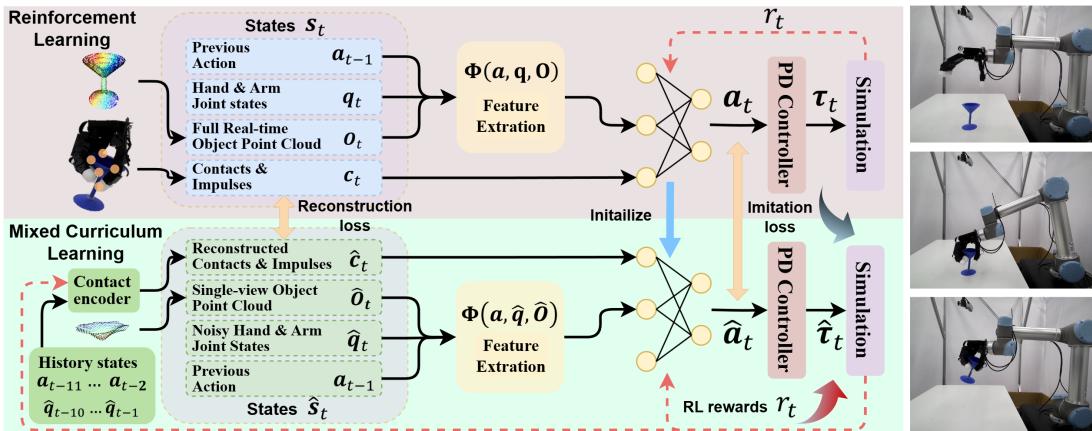
As illustrated in Figure 2, the pipeline consists of two distinct phases:
- The Visual-Tactile Teacher Policy: Trained via Reinforcement Learning (RL). It cheats. It sees the full 3D point cloud of the object in real-time (even through the hand) and knows exact contact forces.
- The Student Policy: This is what runs on the real robot. It only sees a single camera view (with occlusions) and has no tactile sensors—only “noisy” proprioception (knowledge of its own joint angles).
The goal is to transfer the Teacher’s “muscle memory” to the Student, allowing the Student to hallucinate the missing information and act robustly.
Core Method: How the Magic Happens
The success of this framework relies on three technical pillars: a unique shape representation, a specific observation strategy, and a mixed curriculum learning approach.
1. Hand-Centric Object Shape Representation
In typical robotic learning, the robot looks at the global shape of an object (e.g., “This is a mug”). However, for grasping, the global shape matters less than the local geometry where the fingers will touch.
The authors propose a sparse hand-centric object representation. Instead of processing a heavy 3D mesh, the system calculates a set of vectors.
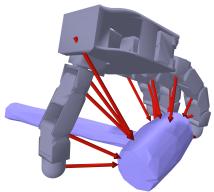
As shown in Figure 3, the system computes 51 vectors. Each vector represents the distance from a specific joint on the robot hand to the nearest point on the object surface.
Why is this brilliant?
- Efficiency: It condenses complex 3D data into a small vector, which is fast for the neural network to process.
- Generalization: It focuses on interaction. Whether the object is a mug or a toy car, the “distance to surface” metric means the same thing to the finger. This helps the robot grasp objects it has never seen before.
- Robustness: By ignoring the object’s geometry far away from the hand (which doesn’t affect the grasp), the system is less confused by visual noise.
2. Dealing with Blindness: Estimating Contacts
The Student policy lacks tactile sensors. To compensate, the researchers implemented a contact estimator.
The robot knows what torque (force) it is applying to its motors. It also knows how much its joints are actually moving. If the robot applies torque to close a finger but the finger doesn’t move, it can infer that it has hit something.
The Student policy uses a Long Short-Term Memory (LSTM) network—a type of neural network with memory—to analyze the history of joint movements and torques. It effectively “imagines” where the contacts are occurring, reconstructing the tactile data that the Teacher had access to.
3. Mixed Curriculum Learning
This is arguably the most critical contribution of the paper. How do you train the Student?
If you use pure Imitation Learning (IL) (telling the Student “do exactly what the Teacher did”), the Student becomes brittle. If it makes a tiny error and ends up in a state the Teacher never visited, it panics and fails.
If you use pure Reinforcement Learning (RL) (telling the Student “figure it out by trial and error”), the training takes forever because the task is too hard given the limited sensors.
The authors propose Mixed Curriculum Learning.
- Start with Imitation: At the beginning of training, the Student is heavily penalized for deviating from the Teacher’s actions. This quickly bootstraps the policy, teaching it the basics of how to approach an object.
- Transition to Exploration: As training progresses, the system gradually lowers the weight of imitation and increases the weight of RL rewards (success/failure).
- Introduce Noise: Crucially, during the Student’s training, the simulation introduces “noise”—random friction, jittery sensor readings, and imperfect motor responses.
Because the Student is now being rewarded for success (RL) rather than just copying (IL), it learns to adapt to this noise. It learns that if its finger slips (due to noise), it must squeeze harder or reposition. The Teacher never had to learn this because the Teacher lived in a perfect, noise-free simulation.
Experimental Setup
The researchers validated their method on a massive scale.
- Simulation: Using Raisim, they tested on 247,786 unique objects from the Objaverse dataset.
- Real World: They used a UR5 robot arm with an Allegro Hand and a RealSense camera.
- Objects: They collected 512 real-world objects, ranging from heavy tools to deformable plush toys.

Figure 4 details the physical setup. Note the single top-down camera. This is a very “sparse” sensor setup compared to labs that use multi-camera arrays, making this method highly practical for real-world deployment.
Results and Analysis
The results are statistically impressive, demonstrating that the method generalizes exceptionally well to objects it has never seen (zero-shot generalization).
1. Large-Scale Success

In simulation (Table 2), the system achieved a 97.0% success rate across nearly a quarter-million objects. It performed consistently well across small, medium, and large objects.

In the real world (Table 3), the success rate remained incredibly high at 94.6%. Look at the categories in the table above. The robot successfully grasped:
- Deformable objects (sponge, cloth) – 95.7% success.
- Heavy tools – 89.3% success.
- Tiny items (building blocks) – 96.3% success.
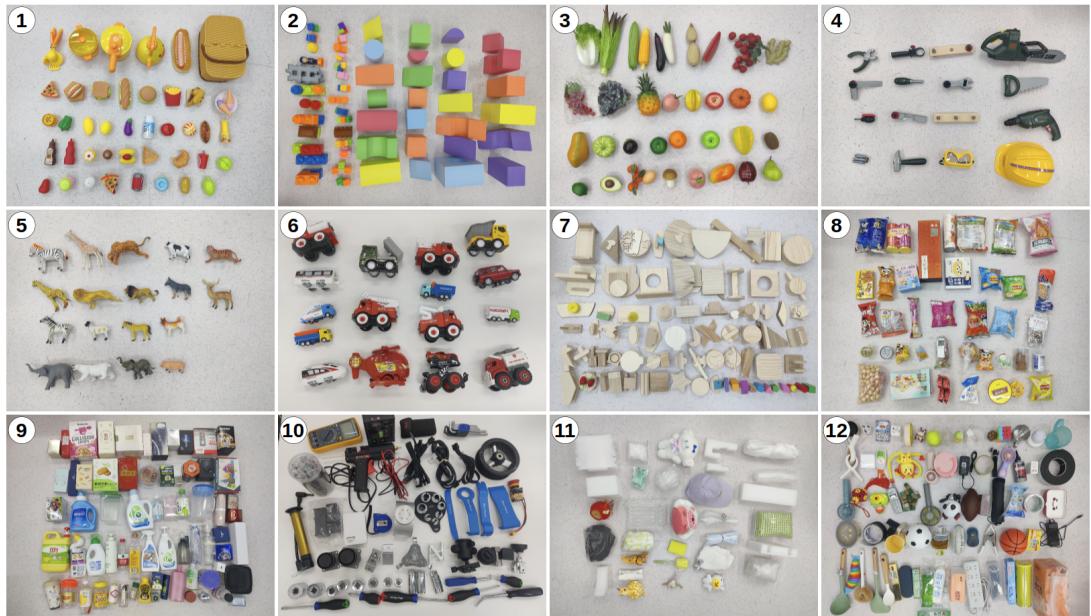
This variety is visualized in Figure 5 below. The fact that a policy trained on rigid simulation objects works on deformable real-world objects confirms that the “closed-loop” control is working—the fingers feel the give of the sponge and keep squeezing until the grip is secure.
2. Comparison with State-of-the-Art
The authors compared their work against several leading baselines, including DexGraspNet (a state-of-the-art pose generation method).

As shown in Table 4, the proposed method (Ours) achieves 92.0% success on a specific test set, while DexGraspNet only achieves 60.7%.
Why the huge gap? DexGraspNet generates a static pose. It calculates where the fingers should go and sends them there. If the object is slightly misaligned or slippery, the fingers might knock the object over. The proposed method, however, adjusts 5 times per second (5Hz policy frequency, 100Hz control frequency). If it feels a collision, it reacts.
3. Robustness to External Forces
This is the ultimate test of dynamic grasping. The researchers poked and prodded objects while the robot was holding them, or applied forces during the approach.

Table 5 shows that even with a 2.5N external force applied (significant for these small objects), the success rate only dropped slightly to 84.0%, whereas the baseline plummeted to 48.0%. This proves the robot is actively fighting to keep the object stable.
Why It Works: The Ablation Study
To prove that their specific design choices (like the mixed curriculum) were necessary, the authors performed an ablation study (removing parts of the system to see what breaks).
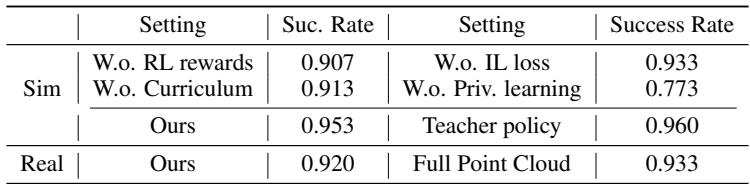
Table 6 reveals key insights:
- W.o. RL rewards: If you remove the RL phase and just do Imitation Learning, success drops to 90.7% (Sim). The student copies the teacher but doesn’t learn to correct itself.
- W.o. Curriculum: If you don’t fade from Imitation to RL gradually, training is unstable.
- W.o. Privileged Learning: If you try to learn from scratch without a Teacher, success drops massively to 77.3%. The task is simply too hard to learn without a mentor.
Conclusion
The paper “Robust Dexterous Grasping of General Objects” represents a significant step forward in robotic manipulation. By moving away from static planning and embracing dynamic, closed-loop control, the researchers created a system that handles the messiness of the real world.
Key Takeaways for Students:
- Representation Matters: Simplifying the world into hand-centric vectors (Figure 3) is often better than trying to process high-fidelity 3D scans.
- Privileged Teachers: You can use “cheating” AI (teachers with perfect data) to train “realistic” AI (students with limited data).
- Curriculum is Key: Don’t just throw a robot into the deep end. Start by having it imitate a pro, then let it experiment to learn robustness.
While limitations exist—the large Allegro hand struggles with tiny sub-1.5cm objects, and catching flying objects is still out of reach—this framework lays the groundwork for robots that can operate in our homes, handling our coffee mugs and remote controls as naturally as we do.