](https://deep-paper.org/en/paper/file-1920/images/cover.png)
In the rapidly evolving world of 3D computer vision, self-supervised pre-training has become the golden standard. Whether you are building perception systems for autonomous vehicles or analyzing 3D medical scans, the recipe for success usually involves taking a massive, unlabeled dataset, pre-training a Deep Neural Network (DNN) on it, and then fine-tuning it for your specific task.
We know that it works. Pre-training consistently boosts performance. But why does it work?
For a long time, this has been a bit of alchemy. We attribute the success to “better feature learning” or “robust representations,” but these are vague terms. What exactly changes inside the mathematical “brain” of a neural network when it undergoes pre-training compared to when it is trained from scratch?
A fascinating paper titled “A Unified Approach to Interpreting Self-supervised Pre-training Methods for 3D Point Clouds via Interactions” offers a groundbreaking answer. By applying concepts from game theory, the researchers have managed to open the black box. They discovered a universal mechanism: pre-training fundamentally shifts the network’s focus from simple, local details to complex, global structures.
Even more impressively, they used this insight to design a new training method that achieves pre-training-level performance without needing the massive pre-training phase.
In this post, we will deconstruct this paper, explain the game-theoretic math behind “interactions,” and look at how we can guide neural networks to learn better 3D representations.
1. The Mystery of the Point Cloud
To understand the solution, we first need to appreciate the problem. 3D point clouds—sets of data points in space representing a 3D shape—are notoriously difficult for neural networks to process compared to 2D images. They are unstructured, unordered, and often sparse.
Researchers have developed various self-supervised learning (SSL) methods to handle this. For example:
- OcCo (Occlusion Completion): The network tries to reconstruct missing parts of an object.
- Jigsaw: The network reassembles a scrambled 3D object.
- CrossPoint: The network aligns 3D point clouds with corresponding 2D images.
Despite their differences in design, these methods all tend to improve the final accuracy of the model. This suggests there is a common mechanism underlying their effectiveness. The authors of this paper set out to identify that mechanism using a metric called Interaction.
2. Viewing Neural Networks Through Game Theory
How do we measure what a neural network is “thinking”? The authors propose using Game-Theoretic Interactions.
Imagine a neural network as a team of workers. The input (the 3D object) is broken down into different regions (the team members). The output score (e.g., the confidence that this object is an “airplane”) is the result of their collaboration.
Step 1: Breaking Down the Object
First, the researchers take an input point cloud and divide it into \(n\) distinct regions. They use a technique involving Farthest Point Sampling (FPS) and K-Dimensional Trees (KDTree) to cluster points into local neighborhoods.
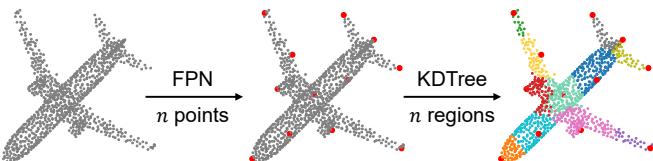
As shown in Figure 2, an airplane is segmented into colored regions. Each region contains a subset of points representing a part of the object, like a wing tip, an engine, or a piece of the fuselage.
Step 2: Defining Interaction
In game theory, the Shapley value is often used to attribute a “score” to each player based on their contribution. However, simple attribution isn’t enough. We need to know how regions interact.
Does the “wing tip” imply “airplane” on its own? Probably not. But the “wing tip” combined with the “wing root” and “fuselage” creates a strong signal for “airplane.” This collaboration is an Interaction.
The paper mathematically decomposes the network’s output score, \(v(x)\), into the sum of interactions between all possible subsets of regions.
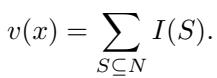
Here, \(I(S)\) represents the numerical effect of the interaction among the regions in set \(S\). The summation covers all possible subsets of regions.
But how do we calculate the interaction \(I(S)\) for a specific set of regions? It involves an “AND” relationship. An interaction \(S\) is activated only when all regions in \(S\) are present.
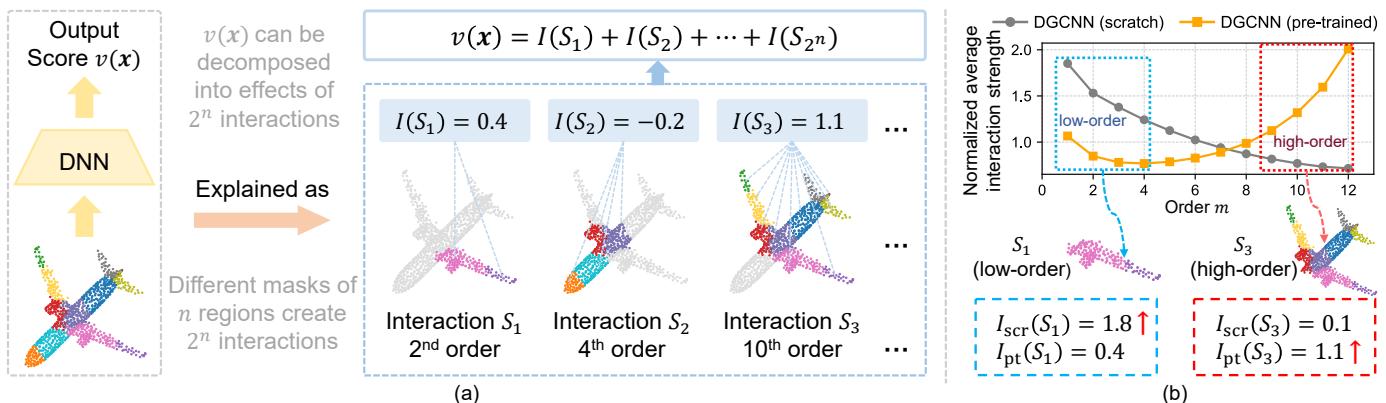
Figure 1(a) illustrates this beautifully.
- \(S_1\) (Low-order): A collaboration between just the wing tip and wing root. This is a local feature.
- \(S_3\) (High-order): A collaboration between many regions covering the fuselage, wings, and tail. This is a global structural feature.
The magnitude of \(I(S)\) tells us how much that specific combination of parts pushes the network toward a decision. A positive value pushes toward the target class; a negative value pushes away.
Step 3: High-Order vs. Low-Order Interactions
This is the crux of the paper’s theory. The “Order” of an interaction, denoted as \(m\), is simply the number of regions involved in that interaction (\(|S|\)).
- Low-Order Interactions: Involve few regions. They represent simple, local 3D structures (e.g., a sharp corner, a flat surface).
- High-Order Interactions: Involve many regions. They represent complex, global 3D structures (e.g., the overall skeleton of a chair, the aerodynamic shape of a jet).
The researchers introduced a metric, \(\kappa^{(m)}\), to measure the average strength of interactions at each order \(m\).

By plotting \(\kappa^{(m)}\) against the order \(m\), we can see “where” the network is focusing its attention—on the local details or the big picture.
3. The Common Mechanism: From Local to Global
The researchers compared networks trained from scratch against networks that used pre-training methods (like IAE, OcCo, Jigsaw, etc.). The results were striking and consistent across different architectures and datasets.
The Findings
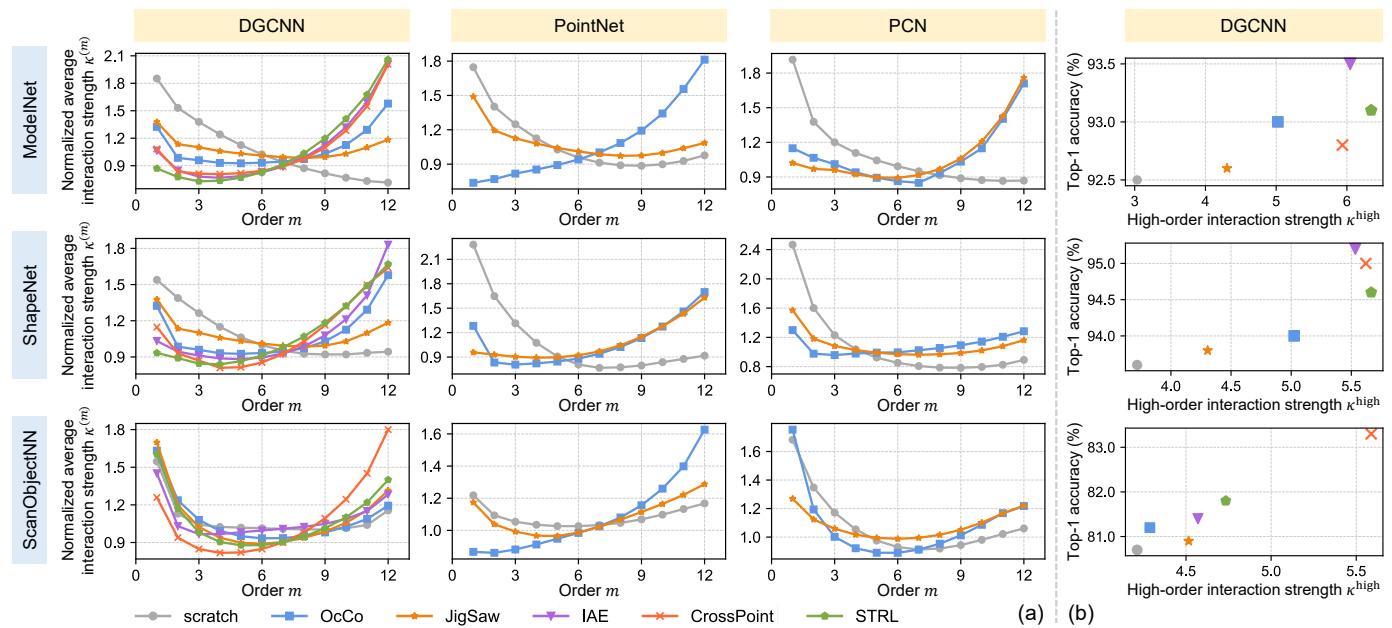
Look at the graph in Figure 3(a).
- The Gray Lines (Scratch): The models trained from scratch show high strength in low-order interactions (the left side of the x-axis) but drop off significantly as the order increases.
- The Colored Lines (Pre-trained): The pre-trained models show the opposite. They have lower strength in low-order interactions but significantly higher strength in high-order interactions (the right side of the x-axis).
Conclusion 1: The common mechanism of pre-training is that it suppresses reliance on simple, local features and enhances the encoding of complex, global structures.
Why Does This Matter?
You might ask, “Why is global better than local?”
Local structures are ambiguous. A vertical cylinder could be the leg of a chair, the stem of a plant, or the handle of a mug. If a network relies too heavily on these local cues (low-order interactions), it gets confused easily.
Global structures are distinct. The specific geometric relationship between four legs, a seat, and a backrest is unique to a chair.
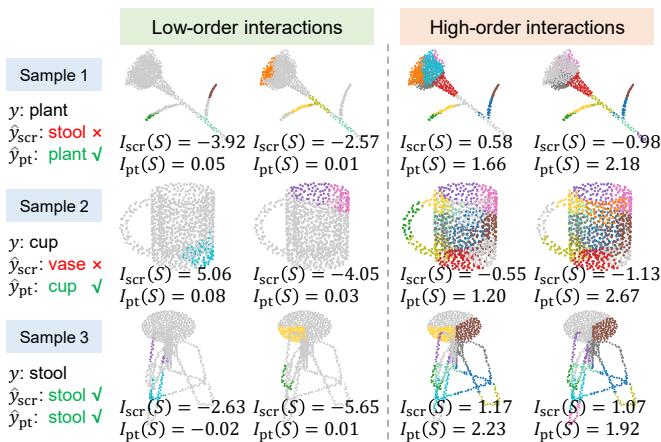
Figure 4 provides a concrete example of this.
- Sample 1 (The Plant): The model trained from scratch (Scratch) incorrectly classifies the plant as a “stool.” Why? Because it focused on local parts (likely the stem) that resemble a stool’s leg.
- The Fix: The pre-trained model (PT) correctly identifies it as a plant because it utilizes high-order interactions—it looks at the arrangement of leaves relative to the stem, capturing the global shape.
Universality Across Architectures
Is this just a quirk of standard Convolutional Neural Networks (CNNs)? Apparently not. The researchers also tested modern Transformer-based architectures (like PointBERT and PointMAE).
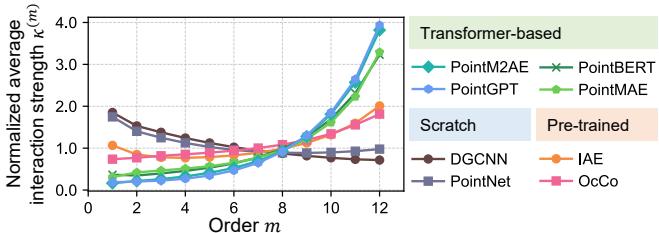
As shown in Figure 5, Transformers naturally behave like pre-trained networks, heavily favoring high-order interactions. This suggests that the “secret sauce” of advanced 3D deep learning is almost always the ability to capture global context.
4. What Strengthens the Mechanism?
The researchers dug deeper to understand what factors control this shift from local to global.
Factor A: The Extent of Pre-training
Does training longer matter?
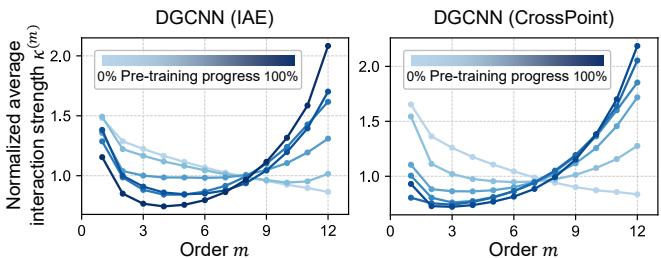
Figure 6 shows the evolution of interaction strength during the pre-training phase. The darker lines represent later stages of training. We see a clear trend: as pre-training progresses, the “U-shape” becomes more pronounced. The network actively discards low-order dependencies and builds up high-order ones. This confirms that the learning of global structures is a gradual process accumulated over time.
Factor B: Amount of Fine-Tuning Data
After pre-training, the model is fine-tuned on a specific task. How does the amount of labeled data affect the mechanism?
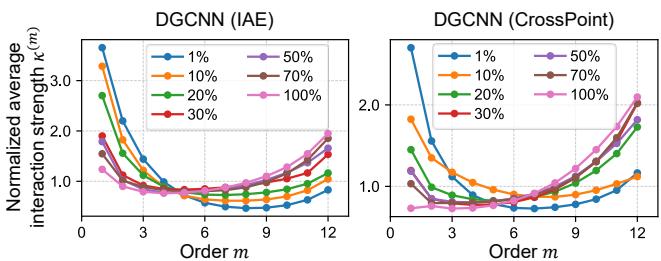
Figure 7 reveals that data quantity reinforces the mechanism. With only 1% of data (the orange lines), the high-order strength is lower. As data increases to 100% (the pink lines), the high-order interactions skyrocket. This explains why “big data” is so effective—it provides enough variety for the network to confirm and solidify global patterns.
5. The Hidden Risk: The Transferability Paradox
However, the paper uncovers a fascinating nuance. Is “more global” always better? Not necessarily.
There is a concept in machine learning called Transferability—how well features learned on one dataset (e.g., ModelNet) work on a different, unseen dataset (e.g., ShapeNet).
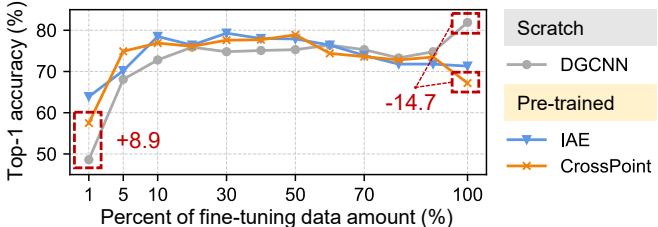
Figure 9 presents a “Transferability Paradox”:
- Low Data Regime: When fine-tuning data is scarce (left side of the graph), pre-training is a lifesaver. It boosts accuracy significantly (+8.9%).
- High Data Regime: When fine-tuning data is abundant (right side), pre-training actually hurts transferability (-14.7%).
Conclusion 3: Pre-training can make the network too obsessed with the specific global structures of the training set. If the network encodes high-order interactions with excessively high strength, it essentially overfits to the “global shape style” of the source dataset, making it harder to adapt to new datasets with slightly different geometries.
6. The Solution: Guiding Training Without Pre-training
Here is the most actionable part of the paper. The researchers posed a question:
If we know that the benefit of pre-training comes from boosting high-order interactions, can we just force the network to do that directly?
If successful, this would eliminate the need for expensive pre-training on massive datasets.
The New Loss Function
They proposed a new regularization term, \(\mathcal{L}_{interaction}\), to be added to the standard classification loss.

Conceptually, this equation does two things:
- Minimize the strength of interactions in the Low-Order set (\(\Omega^{low}\)).
- Maximize (via the negative sign) the strength of interactions in the High-Order set (\(\Omega^{high}\)).
However, calculating interactions for all subsets is computationally impossible (NP-hard). To solve this, they created an approximate version using sampling.

They sample three disjoint small subsets (\(S_1, S_2, S_3\)) to represent low-order interactions and treat their union (\(S_{union}\)) as a high-order interaction. The loss function tries to ensure the whole (\(S_{union}\)) is greater than the sum of its parts.
The Total Loss
The final training objective becomes:

Here, \(\alpha\) is a hyper-parameter that controls how much we want to force this “global thinking.”
Does It Work?
The results are impressive. They tested this method on standard benchmarks like ModelNet40 and ScanObjectNN.
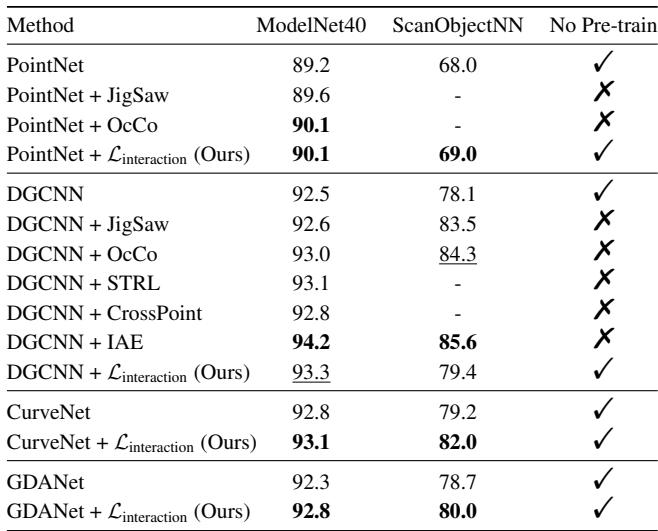
In Table 2, look at the rows for DGCNN + \(\mathcal{L}_{interaction}\) (Ours).
- On ModelNet40, it achieves 93.3%, beating the standard DGCNN (92.5%) and matching complex pre-training methods like JigSaw and STRL.
- On ScanObjectNN (real-world data), it reaches 79.4%, again outperforming the baseline and competitive with pre-training.
Crucially, “Ours” requires NO pre-training data. It achieves these results purely by changing how the network learns from the labeled data.
They also validated this on Semantic Segmentation tasks (S3DIS dataset), where the method continued to shine.
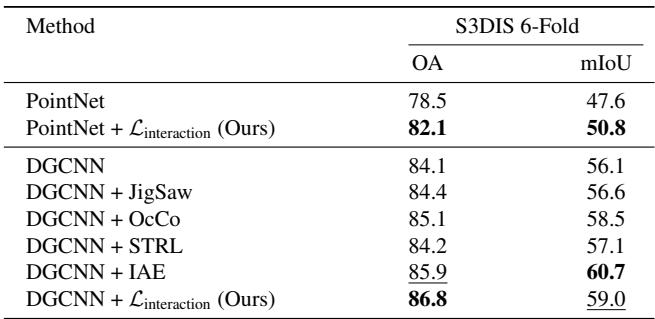
As seen in Table 3, the method outperforms nearly all pre-training baselines in Mean IoU (Intersection over Union).
Tuning the Hyper-parameter
The researchers also verified that the improvement wasn’t a fluke. They showed that as you increase \(\alpha\) (the weight of the interaction loss), the network indeed shifts its focus to high-order interactions.
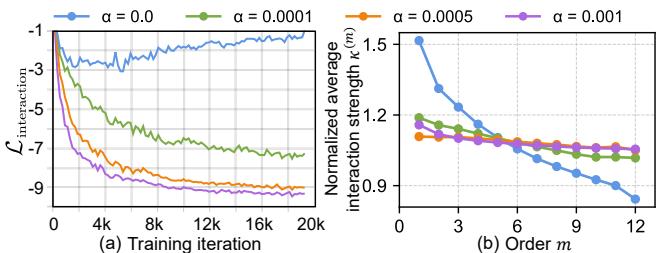
Figure 10(b) shows that increasing \(\alpha\) (from blue to purple lines) successfully pushes the curve toward that desired “pre-trained” shape, with higher values on the right side of the graph.
Conclusion: Opening the Black Box
This paper represents a significant step forward in Interpretable AI. Instead of treating Deep Learning as a mysterious black box where we just pour in data and hope for the best, the authors provided a clear, game-theoretic explanation for why performance improves.
Key Takeaways:
- Mechanism: Success in 3D point cloud processing comes from shifting reliance from local, ambiguous features (low-order) to global, structural contexts (high-order).
- Verification: Pre-training, large datasets, and Transformer architectures all naturally encourage this shift.
- Application: We don’t always need massive pre-training. By mathematically defining what “good” learning looks like (high-order interactions) and adding it to our loss function, we can train smarter, more efficient networks from scratch.
For students and practitioners, this offers a valuable lesson: understanding the fundamental dynamics of your model can be just as powerful—if not more so—than simply throwing more data at it.