](https://deep-paper.org/en/paper/file-1924/images/cover.png)
Introduction: The Invisible World and the Iron Triangle
Human vision is trichromatic; we perceive the world through a mix of red, green, and blue. However, the physical world is far richer. Every material interacts with light across a continuous spectrum of wavelengths, creating a unique “fingerprint” invisible to the naked eye. Hyperspectral Imaging (HSI) is the technology that allows us to see these fingerprints. By capturing hundreds of spectral bands instead of just three, HSI can distinguish between real and fake plants, detect diseases in tissue, or classify minerals in real-time.
However, traditional HSI faces a fundamental bottleneck, often described as an “Iron Triangle” of trade-offs:
- Spectral Resolution: How detailed are the color bands?
- Temporal Resolution: How fast can we capture an image?
- Data Bandwidth: How much data do we need to process and store?
Classically, you could pick two, but rarely all three. Scanning systems give high detail but are slow (bad for moving objects). Snapshot systems are fast but have low resolution. Both generate massive amounts of redundant data.
A new paper, “Active Hyperspectral Imaging Using an Event Camera,” proposes a radical solution to break this deadlock. By combining active illumination (a controlled light source) with an event camera (a sensor inspired by biology), the researchers have developed a system that captures high-quality hyperspectral data at video rates (up to 30 FPS) with a fraction of the bandwidth required by traditional methods.
In this deep dive, we will explore how this system works, the mathematics behind turning “events” into “spectra,” and the impressive results it achieves.
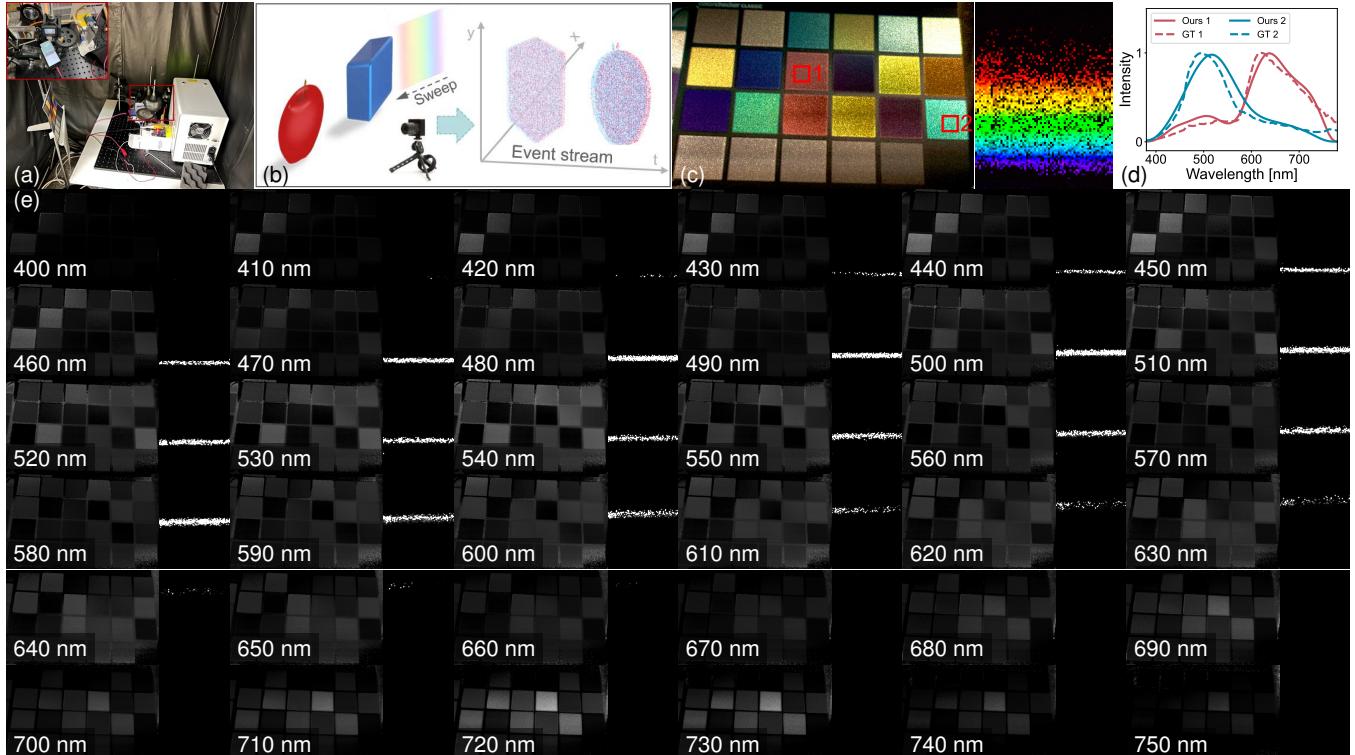
Background: The Shift from Frames to Events
To understand why this paper is significant, we first need to understand the sensor at its heart: the Event Camera.
The Problem with Frames
Traditional cameras are “frame-based.” They open a shutter and record the intensity of every single pixel on the sensor, usually 30 or 60 times a second. If you are filming a static scene, the camera wastefully records the exact same data over and over again. This redundancy is the enemy of efficiency, especially in hyperspectral imaging where the data volume is already massive (3D cubes of data: \(Height \times Width \times Wavelength\)).
The Event Camera Solution
Event cameras (also known as Dynamic Vision Sensors) work differently. Each pixel operates independently and asynchronously. A pixel only sends data (an “event”) when it detects a significant change in brightness (logarithmic intensity). If nothing changes, the pixel stays silent.
This results in:
- Microsecond temporal resolution: Changes are reported the instant they happen.
- Low bandwidth: Static backgrounds generate zero data.
- High Dynamic Range: They can handle very dark and very bright scenes simultaneously.
The challenge, however, is that event cameras only report changes in brightness, not absolute color (wavelength). The researchers had to figure out a way to encode color information into brightness changes.
The Core Method: The “Sweeping Rainbow”
The researchers’ key insight is ingenious: If we control the light hitting the scene, we can force colors to manifest as changes in brightness over time.
The Optical Architecture
Instead of using a passive camera to look at a static scene, this system uses active illumination. They built a custom optical setup that acts as a “spectral scanner.”
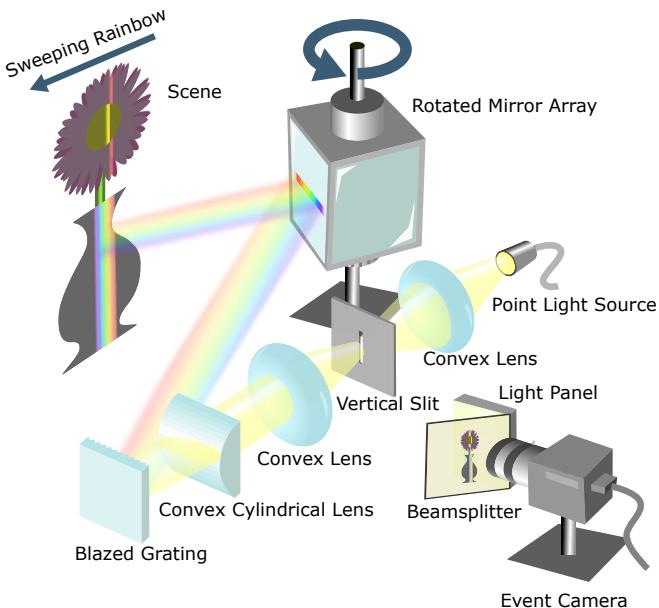
Here is the step-by-step light path shown in Figure 2:
- Light Source: A white point light source is collimated (made parallel) by a lens.
- Dispersion: The light passes through a slit and a blazed grating. This acts like a prism, splitting the white light into its constituent wavelengths (a rainbow).
- Scanning: This dispersed light hits a Rotating Mirror Array. As the mirrors spin, they direct the “rainbow” beam to sweep across the scene.
- Capture: The light reflects off the object and is captured by the Event Camera.
Temporal-Spectral Encoding
Imagine a single pixel on the camera looking at a specific point on a flower. As the mirror rotates, the “rainbow” sweeps over that point.
- First, the pixel is illuminated by 400nm (violet) light.
- Milliseconds later, it is illuminated by 500nm (green) light.
- Then 600nm (red), and so on.
Because different materials reflect different wavelengths effectively, the intensity of the light reflecting back to the camera changes as the color of the illumination changes.
- If the flower is red, it will reflect very little light when the violet part of the rainbow hits it (low intensity).
- When the red part of the rainbow hits it, it reflects a lot of light (high intensity).
This rapid change from dark to bright triggers the event camera. The timestamp of the event tells us which wavelength was illuminating the pixel at that moment. By knowing the speed of the mirror, the system maps Time directly to Wavelength.
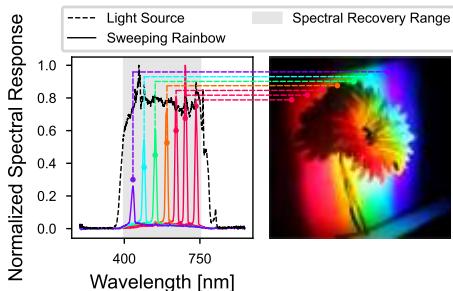
As shown in Figure 4, the “sweeping rainbow” creates a deterministic relationship between time (\(\tau\)) and wavelength (\(\lambda\)).
Mathematical Framework: Solving the Spectral Puzzle
The hardware provides a stream of events. The goal is to turn those events into a Hyperspectral Image (HSI). This requires a robust mathematical model.
1. The Imaging Model
First, we define the intensity \(I\) at a specific pixel \((x, y)\) at time \(\tau\). This intensity depends on three things:
- The spectral response of the camera sensor, \(D(\lambda)\).
- The unknown reflectance of the object (what we want to find), \(R(\lambda)\).
- The illumination pattern, \(L(\lambda, \tau)\).
The relationship is expressed as an integral over all wavelengths:
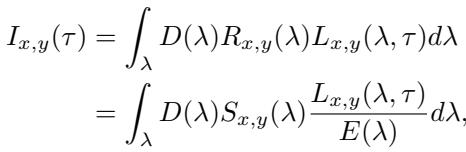
Here, \(S(\lambda)\) represents the true hyperspectral image we want to reconstruct. To make this solvable by a computer, we discretize the continuous spectrum into \(M\) distinct bands (e.g., 72 channels from 400nm to 760nm). This turns the integral into a sum:

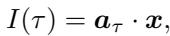
We can simplify this by grouping the knowns (illumination and sensor response) into a coefficient vector \(\boldsymbol{a}_\tau\) and the unknown spectral values into a vector \(\boldsymbol{x}\).
2. The Event Constraint
Now we bring in the event camera physics. An event is triggered when the logarithmic intensity changes by a threshold \(C\). If an event occurs at time \(\tau_k\), it relates to the previous event at \(\tau_{k-1}\) as follows:

This equation states that the new intensity is equal to the old intensity multiplied by a factor determined by the threshold \(C\) and polarity \(\sigma\) (whether brightness went up or down).
3. The Null Spectrum Vector
By rearranging the terms in the event equation, the researchers derive a powerful concept called the Null Spectrum Vector, denoted as \(\boldsymbol{n}_k\).

Since the dot product of \(\boldsymbol{n}_k\) and the unknown spectrum \(\boldsymbol{x}\) must equal zero:
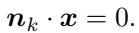
This equation is the core engine of the reconstruction. Every single event generated by the camera provides a new vector \(\boldsymbol{n}_k\) that is perpendicular to the true spectrum. If we collect enough events (enough vectors), we can mathematically narrow down exactly what \(\boldsymbol{x}\) (the spectrum) must be.
4. Overcoming Ambiguity and Noise
Solving for \(\boldsymbol{x}\) using just the Null Spectrum Vectors has a problem: it only gives relative intensity, not absolute values. To fix this, the researchers add a constant “bias” light \(c\) to the setup. This augments the vectors and anchors the solution.
They formulate the reconstruction as a Least Squares Minimization problem:

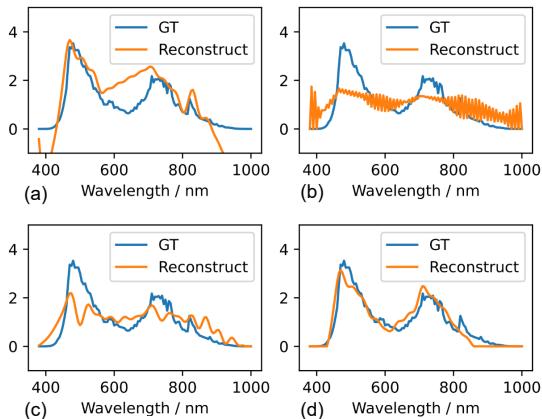
However, raw data is noisy. Directly solving this using techniques like Singular Value Decomposition (SVD) can lead to physically impossible results (like negative light intensity) or “hallucinations” where the algorithm guesses wildly during gaps between events.
To ensure high-quality reconstruction, the authors introduce three critical constraints:
- Non-negative Constraint: Light intensity cannot be less than zero.

- Anti-Drift Regularization (\(R_{int}\)): Ensures that intensity changes smoothly between events and doesn’t drift aimlessly.

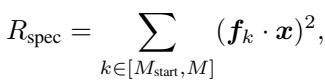
- Spectral Smoothness (\(R_{spec}\)): Natural spectra (like colors on a flower) tend to change smoothly across wavelengths, rather than spiking erratically. This term penalizes high-frequency noise in the spectral domain.
The final algorithm solves a constrained optimization problem that balances the data from the events with these physical realities.

The importance of these constraints is vividly illustrated in the ablation study below. Without them, the reconstruction suffers from artifacts, noise, or instability.
Experiments and Results
The researchers built a prototype and tested it against several state-of-the-art methods, including frame-based systems and “snapshot” compressive imaging systems (CASSI).
1. High-Frequency Spectral Accuracy
One of the hardest things to capture is a spectrum with sharp peaks (high frequency). The researchers projected a rainbow pattern to test this.
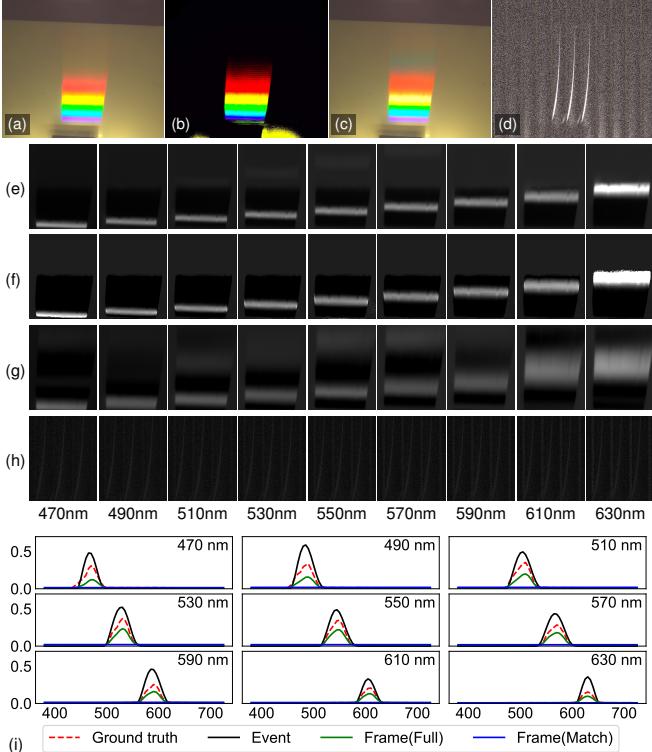
As seen in Figure 5, traditional basis-based methods (c) tend to blur the sharp lines of the rainbow because they assume spectra are always smooth. The proposed event-based method (b) captures the sharp transitions almost as well as a full-bandwidth frame camera, but with significantly less data.
2. Color Fidelity (ColorChecker)
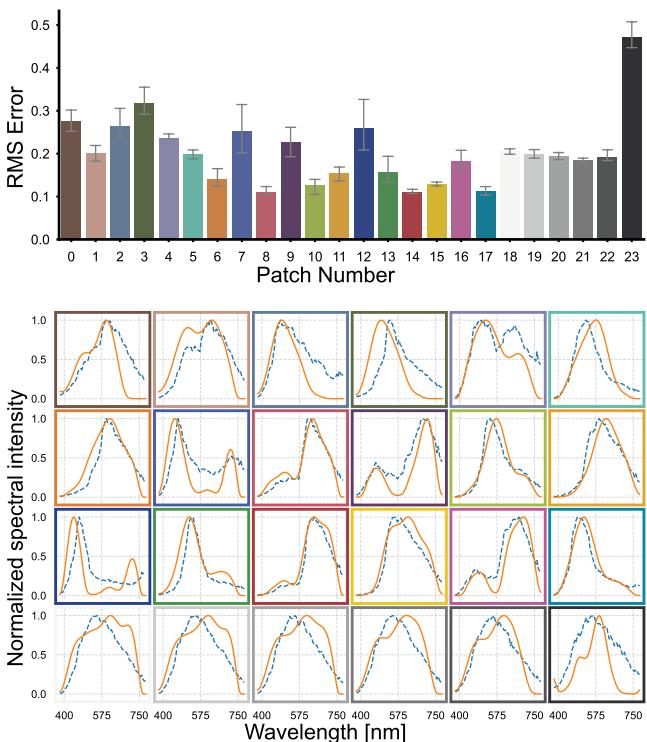
Using a standard X-Rite ColorChecker, the system demonstrated high quantitative accuracy. The RMS (Root Mean Square) error was low across various color patches, proving that the “sweeping rainbow” technique correctly identifies standard colors.
3. Metamerism: The Daisy Test
Metamerism occurs when two colors look identical to the human eye (or an RGB camera) but have completely different spectral makeups. The researchers placed a real daisy next to a fake one. To the naked eye, they look similar.
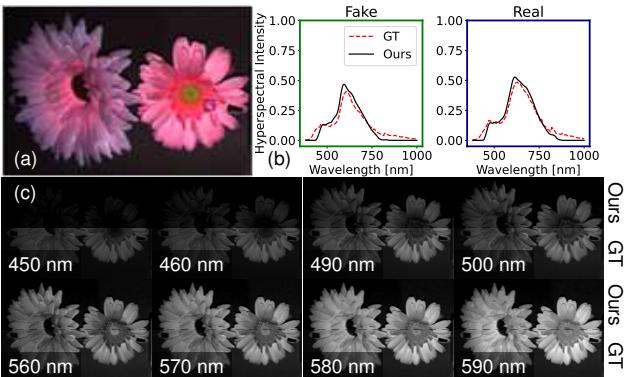
In Figure 7, the system successfully distinguishes the two. The “Ours” line (solid black) tracks the Ground Truth (red dashed) for both the real and fake flowers, revealing the subtle biological differences in reflectance that a standard camera would miss.
4. The “Killer Feature”: Dynamic Scenes
The primary motivation for using an event camera is speed. Traditional HSI scanning takes seconds, making it impossible to capture moving objects.
This system captures hyperspectral data at 10-30 FPS. Figure 8 shows a moving piece of iridescent paper. The colors on the paper shift depending on the viewing angle. As the paper moves, the spectral properties change rapidly.
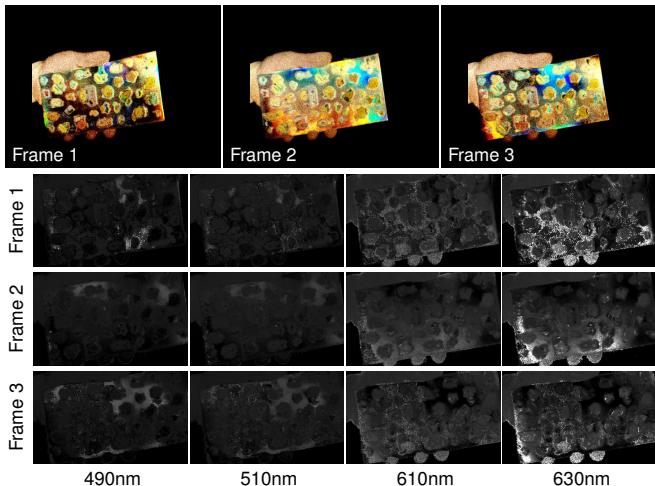
The system reconstructs the changing spectrum in real-time without the motion blur or “jelly effect” (skewing) that would plague a traditional scanning slit camera.
Conclusion and Future Implications
This research marks a significant step forward in computational imaging. By rethinking the data acquisition pipeline—moving from varying the sensor (scanning) to varying the light (active illumination) and using a sensor that detects change rather than absolute value—the authors have broken the “Iron Triangle.”
Key Takeaways:
- Efficiency: The system achieves a 59.53% bandwidth reduction compared to frame-based methods.
- Speed: It enables real-time HSI capture (up to 30 FPS), opening the door for HSI in robotics, autonomous driving, and industrial sorting.
- Flexibility: The spectral resolution is defined by the math and optics, not the sensor pixel layout, allowing for high-resolution spectral reconstruction.
While the system currently requires a dark environment (to control the active light) and doesn’t yet account for complex light interactions like inter-reflection, it proves that Event Cameras are not just for motion tracking—they are powerful tools for multidimensional scientific imaging. This fusion of active photonics and neuromorphic sensing is likely to inspire a new generation of cameras that see the world not just faster, but in “colors” we can only imagine.