](https://deep-paper.org/en/paper/file-1929/images/cover.png)
Introduction
In the world of computer vision and signal processing, noise is the enemy. Whether it’s grainy low-light photographs, medical imaging artifacts, or signal degradation in fiber optic cables, “denoising” is a fundamental step in making data usable.
Traditionally, we rely on electronic chips (CPUs and GPUs) to clean up these images. We run heavy algorithms—from classical Weiner filtering to modern Convolutional Neural Networks (CNNs)—to guess what the clean image should look like. While effective, this approach hits a hard wall: latency and power consumption. Electronic computing involves moving electrons through transistors, which generates heat and takes time. When you need to process data in real-time, such as in high-speed fiber optic communications, electronic chips often become the bottleneck.
But what if we could process the image while it is traveling as light, before it even hits a digital sensor?
This represents the frontier of Optical Computing. In a recent CVPR paper, researchers from Peking University and Tianjin University introduced the All-Optical Nonlinear Diffractive Denoising Deep Network (N3DNet). This architecture performs image denoising at the speed of light, achieving processing speeds nearly 3,800 times faster than electronic chips with negligible energy consumption.
In this post, we will break down how N3DNet works, why its “nonlinear” nature is a game-changer for optical neural networks, and how the researchers used Reinforcement Learning to build it.
Background: The Need for Speed (and Linearity Issues)
To understand N3DNet, we first need to understand the concept of a Diffractive Deep Neural Network (\(D^2NN\)).
Imagine a series of semi-transparent screens (layers) placed one after another. When you shine a light beam (carrying an image) through them, the light bends and scatters (diffracts). If you carefully engineer the thickness and transparency of every point on those screens, you can control exactly how the light interferes with itself. You can design these screens so that a noisy image enters one side, and through the physics of diffraction alone, a clean image projects onto the other side.
This is a \(D^2NN\). It uses photons instead of electrons, meaning the “computation” happens instantly as light propagates.
However, traditional \(D^2NN\)s have a major flaw: Linearity. Standard optical diffraction is a linear process. In Deep Learning, we know that complex tasks require nonlinearity (like ReLU or Sigmoid activation functions) to model sophisticated features. Without nonlinearity, a neural network is just a limited linear transformation. This has historically made optical networks much worse at denoising than their electronic cousins.
N3DNet solves this by introducing optical nonlinearity and a robust training mechanism.
The Core Method: Inside N3DNet
The N3DNet architecture is a hybrid system that combines optical physics with advanced machine learning training. Let’s look at the high-level structure.
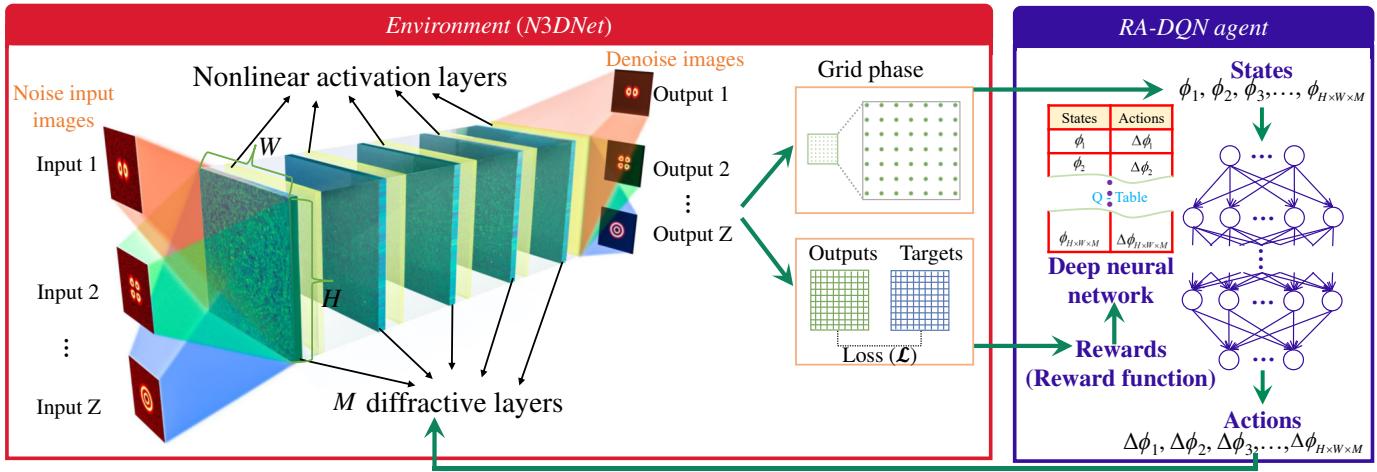
As shown in Figure 1 above, the system consists of an “Environment” (the physical optical layers) and an “Agent” (the Reinforcement Learning algorithm used to design those layers).
The optical forward propagation is broken down into two main modules, illustrated in the diagram below:
- Image Encoding and Pre-Denoising (I)
- All-Optical Diffractive Propagation (II)
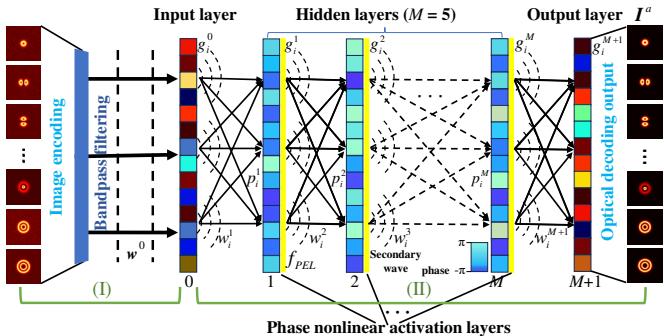
Let’s dissect these stages.
1. Encoding and Pre-Denoising
Before the deep network can do its work, the image must be converted into an optical signal. The input image is encoded onto a light wave carrier. The electric field of this signal is described as:

Here, \(A_s\) is the image signal and \(A_0\) is the carrier light amplitude.
The researchers added a clever preprocessing step here. Before the light hits the neural network layers, it passes through a 4f optical system (a standard optical setup using lenses) that performs a Fourier Transform. By placing a bandpass filter in the frequency domain, they can strip away some noise frequencies immediately.

This filtered signal \(h\) serves as the input to the diffractive network.
2. The Nonlinear Diffractive Layers
This is the heart of the innovation. The light now propagates through \(M\) diffractive layers. Each layer is composed of “neurons”—tiny physical units that modulate the phase of the light passing through them.
Propagation via Diffraction
According to the Huygens-Fresnel principle, every point on a wavefront acts as a source of secondary spherical wavelets. The researchers modeled this propagation mathematically to calculate how light moves from one neuron to the next layer.
The propagation from layer to layer is governed by the relative distance and wavelength:

This equation calculates the optical mode \(w\) based on the distance \(d\) between neurons. The signal arriving at the first hidden layer \(g^0\) is the result of the input image diffracting through free space:

The Nonlinear Activation (PEL)
As mentioned earlier, purely linear diffraction isn’t enough for high-quality denoising. To fix this, the authors introduce a Phase Exponential Linear (PEL) activation function.
In the physical device, this nonlinearity is achieved using specific meta-surfaces (composed of \(Si_3N_4\) and Er-doped \(TiO_2\)) that react to light intensity. Mathematically, the output of a neuron \(g_i^l\) in layer \(l\) is calculated by summing the inputs from the previous layer, applying the transmission coefficient \(p\), and then passing it through the PEL function:

The PEL function itself is defined as:

By setting \(\alpha=0.5\) and \(\beta=0.2\), this function introduces the necessary nonlinearity, allowing the network to “decide” which features to keep and which (like noise) to suppress.
The transmission coefficient \(p\) (the “weights” of this neural network) controls the amplitude and phase modulation at each specific point on the layer:

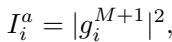
Finally, the denoised image is captured at the output plane by measuring the light intensity:
3. Training with Regularization-Assisted DQN
How do we determine the correct phase values (\(\phi\)) for the thousands of neurons in the physical layers? The researchers framed this as a Reinforcement Learning (RL) problem.
They developed an algorithm called Regularization-Assisted Deep Q-Network (RA-DQN).
- State (\(S\)): The current phase values of the diffractive layers.
- Action (\(A\)): The change applied to the phase values (\(\Delta \phi\)).
- Reward: Improvement in image quality (negative loss).
The network uses a composite loss function that looks at pixel accuracy (Charbonnier loss), frequency restoration (Fourier loss), and structural similarity (FSIM loss):

The RA-DQN agent updates its policy using the Q-learning update rule:

To make training more stable (a common challenge in RL), they added a regularization term \(\kappa\) that penalizes drastic changes between steps, smoothing the optimization path:

4. Physical Implementation
Once the model is trained on a computer, the parameters (the phase values for the layers) are exported to a 3D printer.
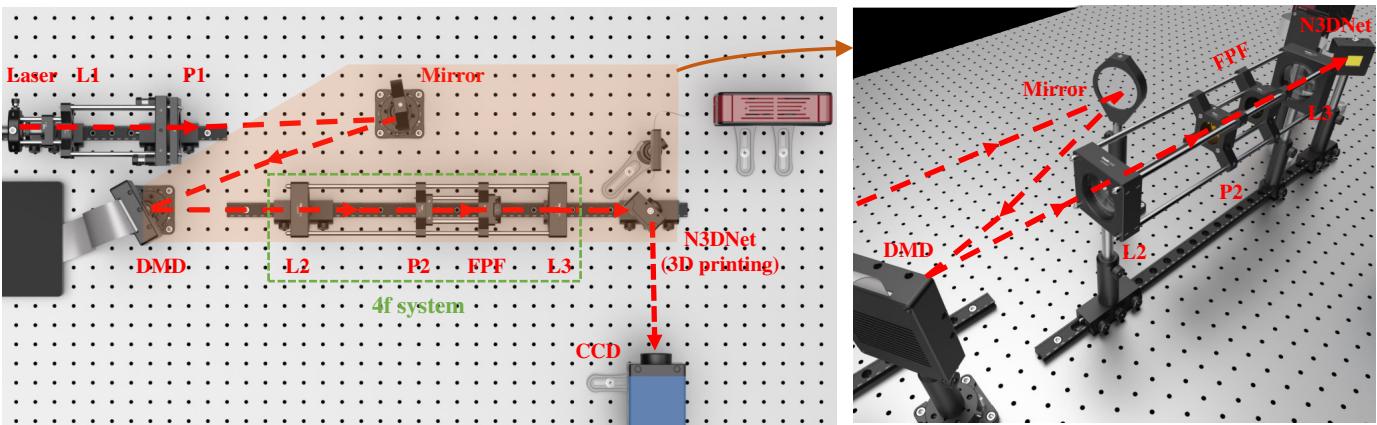
Figure 3 shows the actual lab setup.
- Laser: Provides the carrier light.
- DMD (Digital Micromirror Device): Encodes the digital image onto the light beam.
- 4f System: Performs the pre-denoising bandpass filtering.
- N3DNet: The 3D-printed blocks that perform the deep learning inference.
- CCD: Captures the final cleaned image.
Experiments and Results
To test N3DNet, the researchers needed data. Since there was no standard dataset for optical mode denoising in fiber communications, they built their own.
The MIDD Dataset
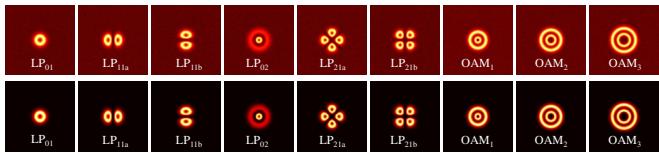
They introduced the Mode Image Denoising Dataset (MIDD), comprising 120,000 pairs of noisy and clean images captured from real fiber communication systems. These include various polarized modes (LP) and orbital angular momentum (OAM) modes.
Simulation Performance
The authors compared N3DNet against state-of-the-art electronic denoising methods, including BM3D (traditional) and deep learning models like DnCNN, RIDNet, and Masked Training (MT).
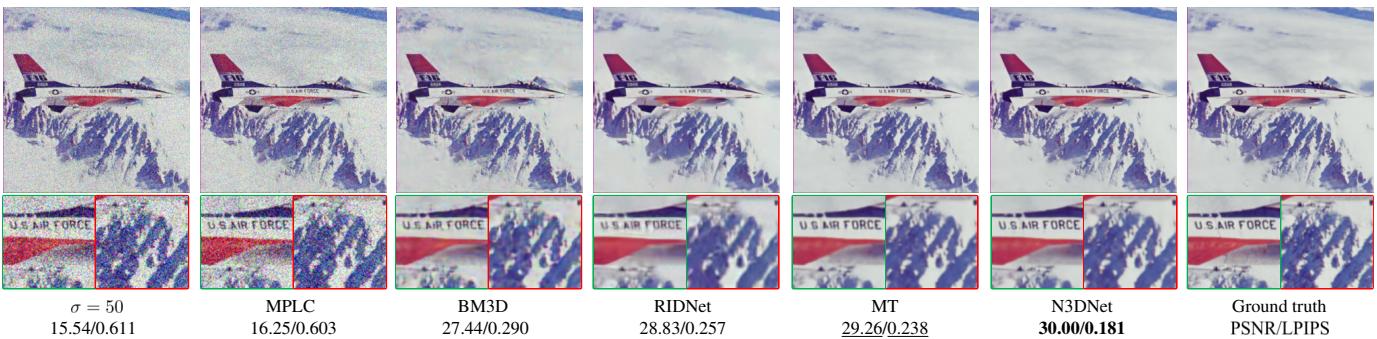
In visual comparisons (Figure 5), N3DNet recovers fine details (like the text on the aircraft) better than BM3D and rivals the best electronic deep learning methods. Quantitatively, N3DNet achieved the highest PSNR (Peak Signal-to-Noise Ratio) and SSIM (Structural Similarity Index) on almost all tested datasets.
Real-World Experimental Results
Simulations are great, but does the physical plastic block actually work?
The researchers tested the 3D-printed N3DNet against other optical methods (like MPLC) and electronic methods.
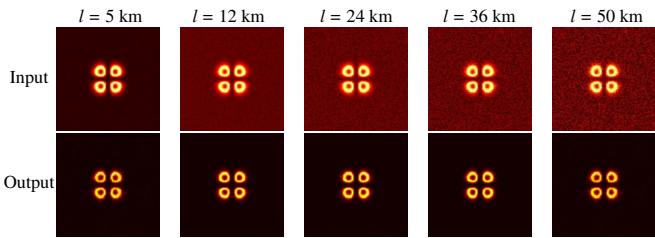
Figure 6 shows the results on real fiber modes. Even as the transmission distance \(l\) increases (which adds significantly more noise), N3DNet successfully reconstructs the clear four-lobe structure of the \(LP_{21b}\) mode.
The “Killer Feature”: Speed and Energy
The most staggering result of this research is the efficiency comparison.
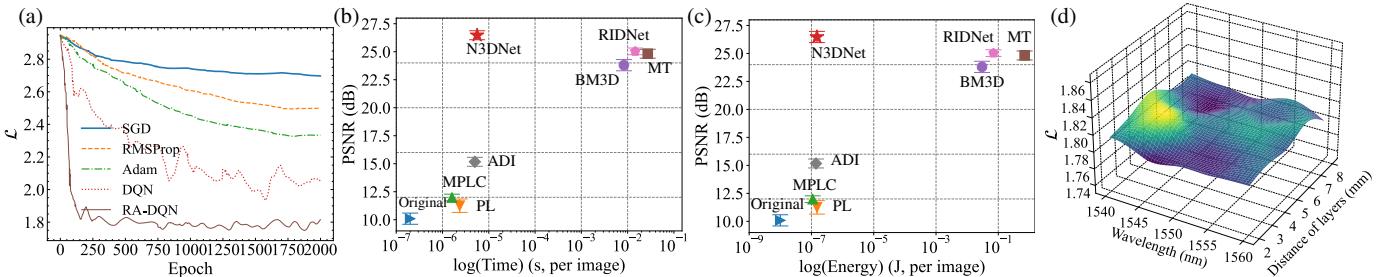
Take a look at graphs (b) and (c) in Figure 7:
- Speed: N3DNet takes about 4.4 microseconds per image. The electronic equivalents (on a high-end Snapdragon chip) take about 16.7 milliseconds. That is a ~3,800x speedup.
- Energy: The energy consumption per image for N3DNet is in the nanojoule range, roughly six orders of magnitude (1,000,000x) less than electronic methods.
Graph (a) also highlights the effectiveness of the RA-DQN training algorithm (the brown line), which converges to a lower loss much faster than standard SGD or Adam optimizers.
Conclusion
The N3DNet paper presents a compelling leap forward for optical computing. By successfully integrating nonlinear activation functions into diffractive networks and optimizing them with Reinforcement Learning, the authors have created a denoiser that is not only accurate but operates at speeds electronic chips simply cannot match.
Key Takeaways:
- Optical Advantage: Processing light with light eliminates the latency of converting to/from electrical signals, enabling microsecond inference times.
- Nonlinearity is Key: The introduction of the Phase Exponential Linear (PEL) function allows optical networks to handle complex noise that linear diffraction models miss.
- RL for Hardware: Designing physical hardware is a complex, non-convex optimization problem where Reinforcement Learning (RA-DQN) excels over traditional gradient descent.
This technology holds immense promise for the future of fiber optic communications, where signals degrade over long distances. Instead of converting optical signals to electrical digital data to clean them (creating a bottleneck), telecommunication hubs could one day use passive N3DNet blocks to “clean” the light instantly as it passes through.