](https://deep-paper.org/en/paper/file-1938/images/cover.png)
Introduction
Imagine trying to draw a precise blueprint of a house, but all you have is a grainy, satellite-like scan taken from a plane flying overhead. Some parts of the roof are missing, trees are blocking the walls, and the data is just a collection of scattered dots. This is the reality of reconstructing 3D building models from airborne LiDAR (Light Detection and Ranging) point clouds.
Building reconstruction is a cornerstone technology for smart cities, autonomous driving, and Virtual Reality/Augmented Reality (VR/AR). While we have become good at capturing data, turning that raw, noisy data into clean, lightweight “wireframes” (skeletal representations of geometry) remains a massive challenge.
In a recent CVPR paper, researchers introduced BWFormer, a Transformer-based model designed to tackle this specific problem. Unlike previous methods that struggle with the sparsity of LiDAR data, BWFormer employs a clever “2D-to-3D” strategy and a novel attention mechanism to reconstruct complete building wireframes.
In this post, we will break down how BWFormer works, why it outperforms existing methods, and how it uses Generative AI to solve the problem of limited training data.
The Problem with Airborne LiDAR
Airborne LiDAR sensors scan the ground from above, measuring the time it takes for laser pulses to return. This creates a “point cloud”—a collection of 3D coordinates representing the surface of the earth.
While valuable, this data is inherently difficult to work with for three main reasons:
- Sparsity: The points are not dense like pixels in a photo; there are gaps.
- Incompleteness: Due to the scanning angle, vertical walls often have no points at all, and roofs might have holes.
- Noise: Trees, chimneys, and sensor errors introduce data points that don’t belong to the building’s main structure.
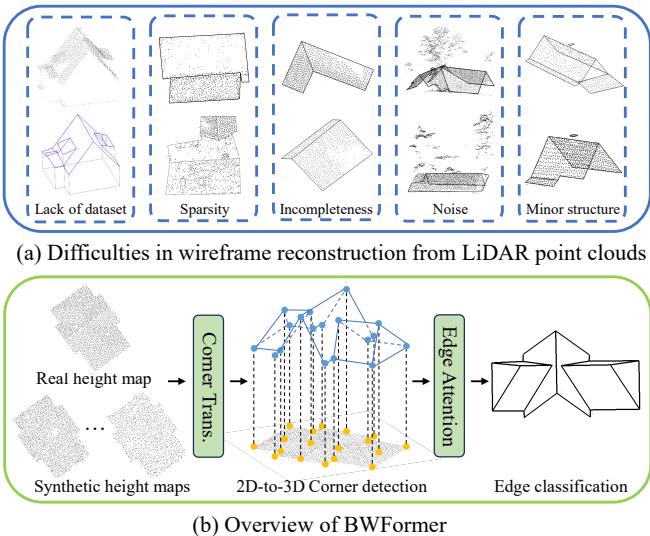
As shown in Figure 1 above, traditional methods often produce fragmented outlines or get confused by noise (like trees). BWFormer aims to solve this by moving away from purely 3D processing and leveraging the 2.5D nature of aerial scans.
The BWFormer Architecture
The core philosophy of BWFormer is to simplify the search space. Searching for building corners in a vast, empty 3D void is computationally expensive and error-prone. However, since these scans come from the sky (a Bird’s Eye View), we can project the data onto a 2D plane to make life easier.
The architecture follows a pipeline that processes data from the ground up:
- Input: A 2D “Height Map” created by projecting the point cloud.
- 2D Corner Detection: Finding corner candidates on the image plane.
- 3D Corner Lifting: Using a Transformer to predict the height of those corners.
- Edge Detection: Connecting the corners to form the wireframe using a specialized attention mechanism.

Let’s break down each component of this pipeline.
1. Input: From Point Cloud to Height Map
Instead of feeding raw 3D points into the neural network, the researchers project the points onto a 2D grid. Each pixel in this grid represents the height (\(z\)-value) of the point at that location. This creates a Height Map. This step effectively converts the problem from strictly 3D to “2.5D,” allowing the model to use powerful 2D image processing techniques (like ResNet) to extract features.
2. The 2D-to-3D Corner Detection Strategy
This is where BWFormer differentiates itself. Directly predicting 3D coordinates (\(x, y, z\)) is difficult because the vertical space is continuous and vast.
Step 1: 2D Detection. The model first predicts a “heat map” on the 2D image, identifying pixels that are likely to be building corners. This gives us the accurate \((x, y)\) coordinates.
Step 2: 3D Lifting. Once the 2D positions are known, the model initializes “queries” for the Transformer.
- Queries: In Transformer terminology, a query is a vector that asks the model to look for specific information. Here, the query is initialized with the 2D position of the corner.
- The Task: The Transformer Decoder takes these 2D-initialized queries and predicts the corresponding height (\(z\)) and whether the corner is valid.
By locking in the \((x, y)\) coordinates first, the model only has to search for the height, significantly reducing the “search space” (the number of possibilities the model has to consider). This makes the model faster and more accurate.
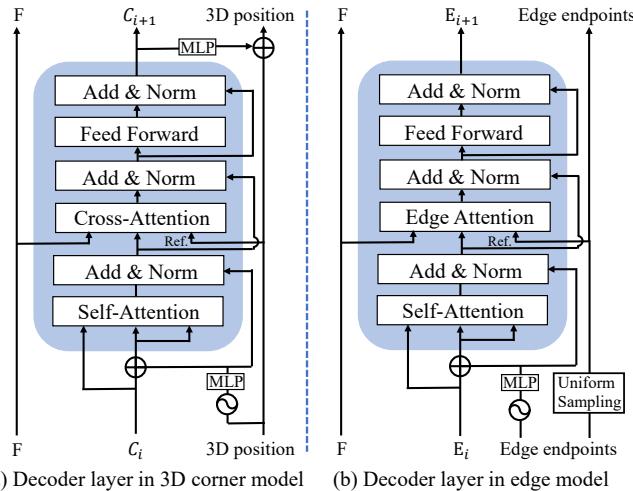
As seen in Figure 3(a), the decoder uses Deformable Cross-Attention. This allows the model to look at the image features around the specific 2D corner location to gather context before predicting the height.
3. Edge Detection with “Edge Attention”
Once we have the 3D corners, we need to connect them. The model treats every possible pair of corners as a candidate edge and performs binary classification: Is this a real edge? Yes or No.
However, standard attention mechanisms (like those used in DETR) usually look at a single reference point—typically the midpoint of the object. In sparse LiDAR data, the midpoint of a wall or roof edge might not have any data points at all! If the model only looks at the empty midpoint, it will fail to recognize the edge.
To fix this, the authors propose Holistic Edge Attention.
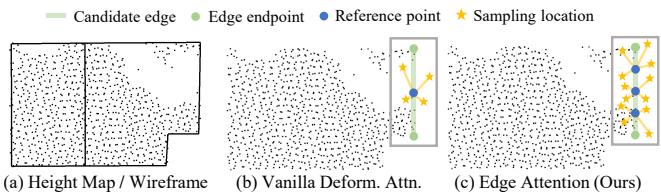
Instead of looking at one point, the model samples \(M\) points uniformly along the potential edge. It extracts features from all these points and aggregates them using a Max-Pooling operation. This ensures that even if parts of the edge are missing data, the model can “see” the edge structure from the other sampled points.
Mathematically, the Edge Attention (EA) is calculated as:

This formula effectively says: “Look at all sampled points \(S\) along the edge query \(q\). Find the strongest feature response among them.” This holistic view is crucial for handling the incompleteness of LiDAR data.
4. Loss Functions
To train the model, the researchers use a combination of loss functions to ensure accuracy in 2D placement, 3D lifting, and edge connection. The total loss is a weighted sum of these three tasks:

Here:
- \(L_{c_{2D}}\) ensures the 2D heat map correctly spots corners.
- \(L_{c_{3D}}\) ensures the 3D coordinates (specifically the height) match the ground truth.
- \(L_{e}\) ensures the edges connect the right corners.
Synthetic Data Augmentation: Faking it to Make it
One of the biggest hurdles in deep learning for 3D geometry is the lack of labeled data. There just aren’t enough high-quality datasets of airborne LiDAR point clouds with perfect ground-truth wireframes.
To solve this, the authors created a Conditional Latent Diffusion Model (LDM) to generate synthetic training data.
They didn’t just randomly generate points. They simulated the actual scanning pattern of a LiDAR sensor.
- Conditioning: They feed the model a “building footprint” (the shape of the building).
- Generation: The LDM predicts where a LiDAR laser would likely hit the roof, creating realistic sparsity patterns.
- Synthesis: They combine these predicted scan locations with the known height of the building model to create a “Synthetic Height Map.”
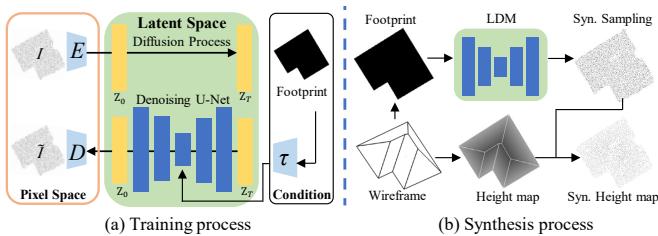
This synthetic data looks remarkably similar to real data, capturing the variations in density and missing chunks that occur in the real world.
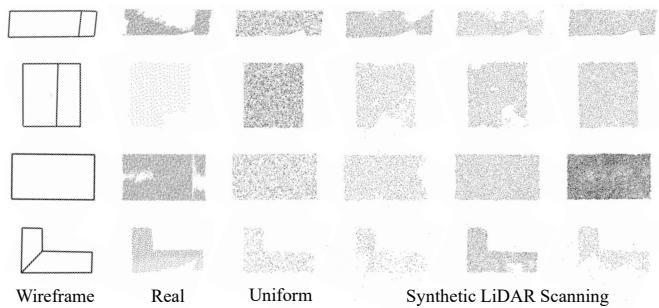
As shown in Figure 7, uniform sampling (the standard way to fake data) looks too perfect and dense. The “Ours” column shows the synthetic data generated by BWFormer’s pipeline, which mimics the irregular, sparse nature of real LiDAR scans. This realistic augmentation helps the model generalize better to real-world scenarios.
Experiments and Results
The researchers evaluated BWFormer on the Building3D dataset, a challenging urban-scale benchmark.
Quantitative Results
The results show a significant improvement over previous state-of-the-art methods like PBWR and PC2WF.
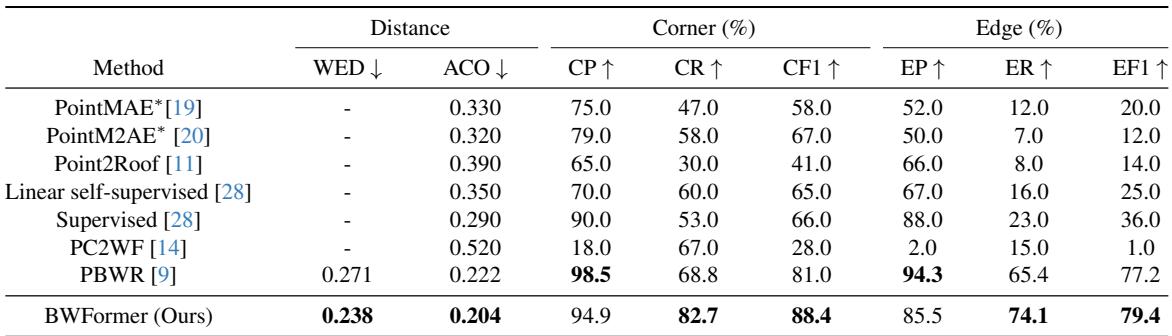
Key takeaways from Table 1:
- WED (Wireframe Edit Distance): Lower is better. BWFormer drops the error from 0.271 (PBWR) to 0.238.
- Corner Recall (CR): Higher is better. BWFormer jumps from 68.8% to 82.7%, meaning it finds significantly more of the building corners that other models miss.
- Edge F1 (EF1): The model achieves 79.4%, proving that its Edge Attention mechanism is effective at correctly identifying structural lines.
Qualitative Results
Visually, the difference is stark. In the figure below, compare the Ground Truth (or the raw point cloud) with the outputs of various models.
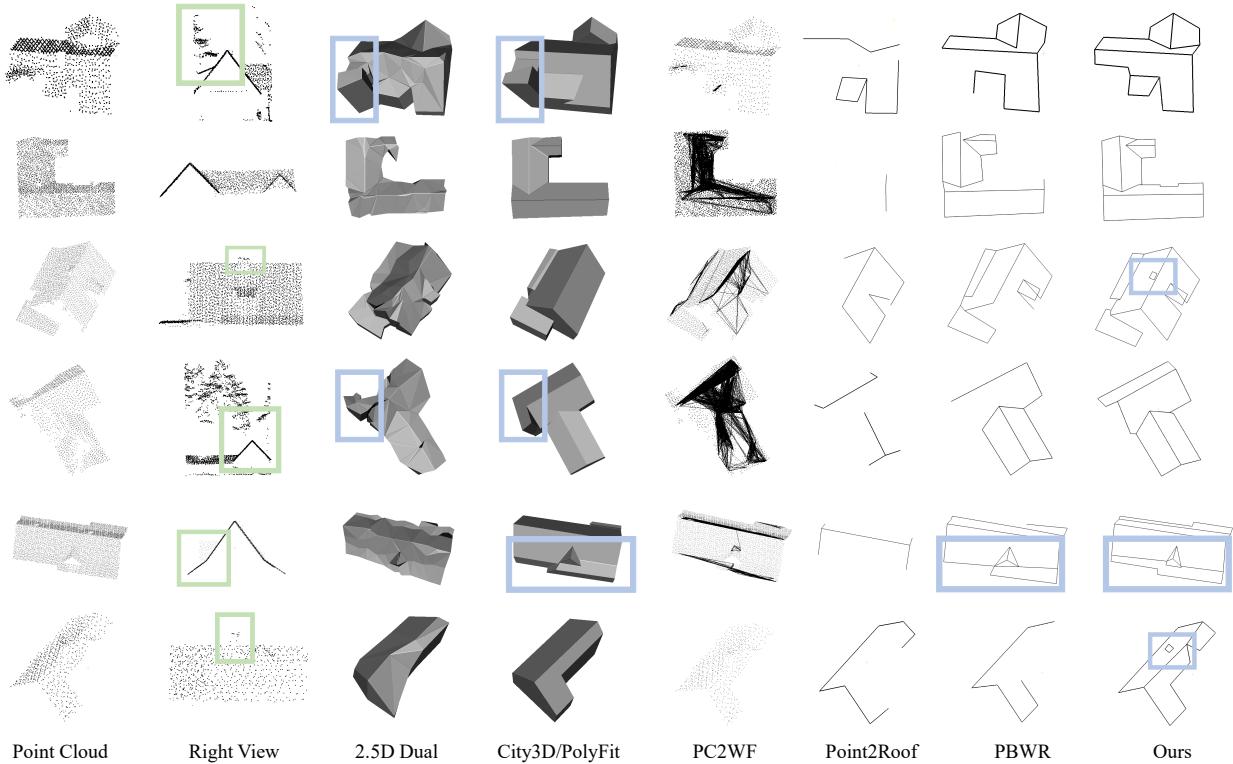
Traditional methods (columns 3-4) often output messy meshes that get confused by trees (noise). Previous deep learning methods (columns 5-7) often miss small details like chimneys or fail to close the wireframe geometry. BWFormer (last column) produces clean, complete wireframes that capture small details like the chimney (green boxes) and handle complex roof angles correctly.
Ablation Studies
The researchers also performed ablation studies to prove that each part of their model matters.
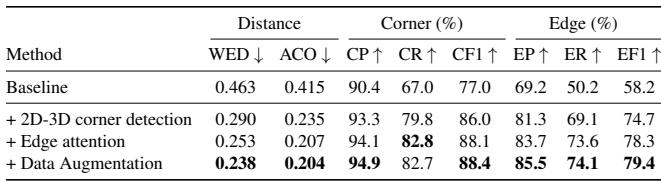
Table 3 clearly shows the progression:
- Baseline: Direct 3D prediction performs poorly (WED 0.463).
- + 2D-3D Detection: Separating the corner detection reduces error drastically (WED 0.290).
- + Edge Attention: Improves connection accuracy (WED 0.253).
- + Data Augmentation: Mixing synthetic data yields the best result (WED 0.238).
Limitations
No model is perfect. The authors frankly discuss failure cases in the paper.
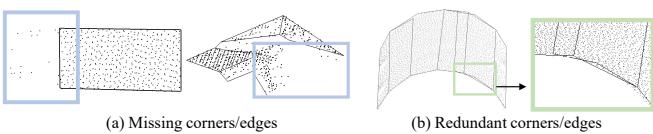
- Extreme Sparsity: If the point cloud is too sparse (Figure 8a), the model might still miss corners because there is simply no information in the height map.
- Redundancy: Sometimes, the 2D corner detector is too enthusiastic and predicts multiple corners for the same spot (Figure 8b), creating small, redundant edges.
Conclusion
BWFormer represents a significant step forward in 3D building reconstruction. By intelligently simplifying the problem (2D-to-3D corner lifting) and addressing the specific characteristics of the data (Edge Attention for sparse points), it achieves state-of-the-art results. Furthermore, its use of Generative AI (Latent Diffusion) to create synthetic training data demonstrates a clever way to overcome the data bottlenecks common in 3D computer vision.
For students and researchers entering this field, BWFormer illustrates an important lesson: Architecture should follow data. Rather than throwing a generic 3D network at the problem, the authors analyzed the specific flaws of LiDAR (sparsity, BEV nature) and designed a custom architecture to handle them.