](https://deep-paper.org/en/paper/file-1982/images/cover.png)
Introduction
In the rapidly evolving world of surveillance and security, Unmanned Aerial Vehicles (UAVs) present a unique challenge. They are small, agile, and often difficult to spot. Infrared (thermal) imaging has become the go-to solution for detecting these targets, offering visibility day and night regardless of lighting conditions. However, there is a catch: the hardware itself often gets in the way.
Thermal detectors are sensitive devices. Heat generated by the camera’s own optical lens and housing creates a phenomenon known as temperature-dependent low-frequency nonuniformity, often referred to as a “bias field.” Imagine trying to spot a tiny bird through a window that is foggy around the edges and smeared with grease in the center. That is essentially what a computer vision algorithm deals with when processing raw infrared footage. This bias field reduces contrast and obscures the faint heat signatures of drones.
Traditionally, engineers have treated this as two separate problems: first, clean the image (Nonuniformity Correction, or NUC); second, detect the object. But what if the cleaning process accidentally wipes away the target? What if the detector could tell the cleaner what to focus on?
In this post, we will dive deep into UniCD, a novel framework presented at CVPR that unifies image correction and target detection into a single, end-to-end pipeline. We will explore how the researchers combined polynomial mathematics with deep learning to create a system that doesn’t just make images look better—it makes them “detection-friendly.”
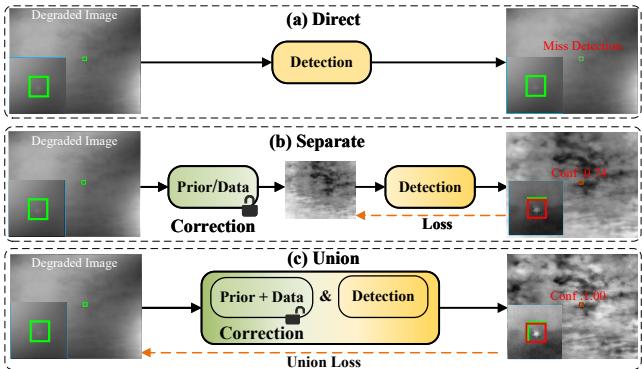
As shown in Figure 1, the “Union” approach (c) represents a paradigm shift. Unlike the Direct method (a), which ignores the noise, or the Separate method (b), which blindly corrects it, the Union framework allows the detection task to guide the correction process, resulting in significantly higher confidence.
Background: The Conflict Between Vision and Sensing
To understand why UniCD is necessary, we must first understand the limitations of existing approaches.
The Bias Field Problem
In infrared imaging, the “bias field” is a low-frequency interference. It doesn’t look like static grain (high-frequency noise); it looks like smooth, waving gradients of brightness overlaying the image. Because UAVs are often distant and appear as small, weak clusters of pixels, a strong bias field can completely wash them out.
The “Separate” Strategy Bottleneck
The standard industry approach is a cascade:
- NUC Module: Uses algorithms to estimate and subtract the bias field.
- Detection Module: Runs a standard object detector (like YOLO or Faster R-CNN) on the output.
The problem is the disconnect. Traditional NUC methods (model-based) rely on handcrafted features that often fail in complex scenes. Deep learning NUC methods require massive datasets of paired “clean/dirty” images, which are hard to capture in reality. Most importantly, the NUC module has no idea what a drone looks like. It might smooth out a “noise patch” that was actually a distant UAV.
The Solution: A Union Framework
The authors of UniCD propose that these two tasks shouldn’t be strangers. They should be partners. By training a network to perform both tasks simultaneously, the system can learn to remove noise specifically in a way that aids detection.
Core Method: The UniCD Architecture
The UniCD framework is an end-to-end pipeline composed of two main collaborative components: a Prior- and Data-Driven NUC Module and a Mask-Supervised Detector.
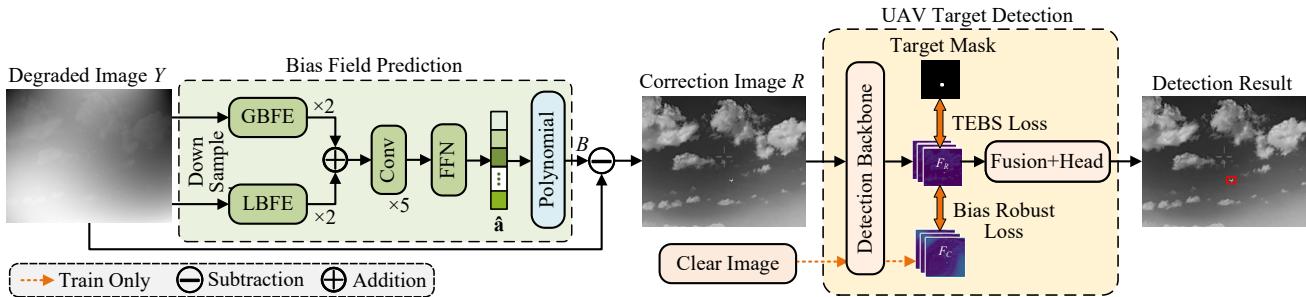
Let’s break down the architecture shown in the figure above step-by-step.
1. Prior- and Data-Driven Nonuniformity Correction
One of the most clever aspects of this paper is how it handles the bias field. Instead of using a heavy neural network to predict the corrected pixel value for every single pixel (which is computationally expensive), the authors use a parametric approach.
They model the degraded image \(Y\) as the sum of the clear image \(C\) and the bias field \(B\):
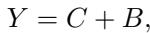
The key insight is that the bias field \(B\) is spatially smooth. Therefore, it can be approximated mathematically using a bivariate polynomial. Instead of learning millions of pixel values, the network only needs to learn a small set of polynomial coefficients.
The bias field is modeled as:
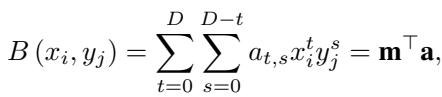
Here:
- \(x_i, y_j\) are the pixel coordinates.
- \(D\) is the degree of the polynomial (set to 3 in this paper).
- \(\mathbf{a}\) is the vector of coefficients the network needs to predict.
The Lightweight Prediction Network
To find these coefficients, the authors designed a lightweight network containing two encoders:
- Global Bias Field Encoder (GBFE): Uses Swin Transformer layers to capture long-range dependencies (the overall “shape” of the bias).
- Local Bias Field Encoder (LBFE): Uses spatial attention mechanisms to capture local variations.
The features are fused:

Finally, a regression head predicts the coefficients \(\hat{\mathbf{a}}\):

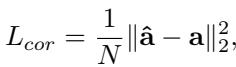
By predicting just a handful of coefficients (specifically 10 coefficients for a 3rd-degree polynomial), the model is incredibly fast and avoids overfitting to the image content. The correction loss is simply the difference between predicted and actual coefficients:
2. Mask-Supervised Infrared UAV Detector
Once the image is corrected, it is passed to the detection network. The authors use a customized version of DANet. However, detecting small infrared targets requires more than just standard bounding box regression. The features of drones are weak, and the background is often complex (clouds, buildings, trees).
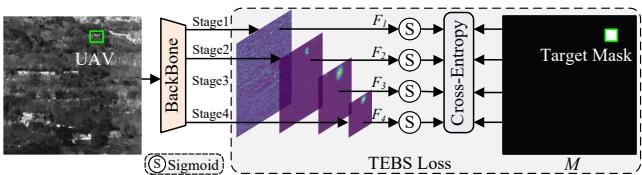
To solve this, they introduced the Target Enhancement and Background Suppression (TEBS) Loss.
How TEBS Works
Standard detectors look at the final output to calculate loss. TEBS intervenes earlier. It applies supervision inside the backbone of the network (at multiple stages).
It uses a binary mask \(M\):

The network is forced to perform a pixel-level classification (Target vs. Background) on the feature maps \(F_i\) at different stages. This forces the hidden layers of the neural network to “light up” only where the drone is and stay dark everywhere else.
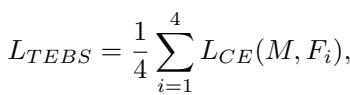
This auxiliary loss is added to the standard classification and regression losses:

By effectively suppressing the background noise in the feature maps, the detector becomes much more robust to clutter.
3. The Bridge: Bias-Robust (BR) Loss
We now have a corrector and a detector. How do we ensure they work together optimally? If we just join them, the detector might force the corrector to produce weird artifacts that happen to maximize detection scores but look terrible to humans.
To balance this, the authors introduce the Bias-Robust (BR) Loss. This is a self-supervised mechanism used during training.
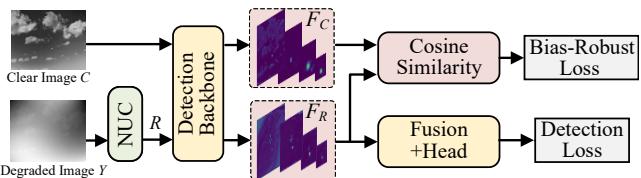
During training (using synthetic data where we have the “ground truth” clean image), the system feeds both the Corrected Image (R) and the Clear Image (C) into the detection backbone.
The goal is to ensure that the features extracted from the corrected image are identical to the features extracted from the clear image. This is measured using Cosine Similarity:
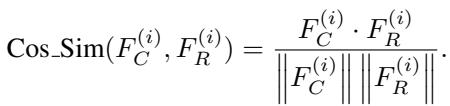
The loss minimizes the difference between these feature representations:

This ensures that the NUC module produces images that are not only visually clean but also semantically consistent with a perfect, bias-free image in the eyes of the detector.
The final loss function for the entire UniCD framework is the sum of the detection loss and the bias-robust loss:

Experiments and Results
To validate this method, the researchers constructed a massive new benchmark dataset called IRBFD (Infrared Bias Field Dataset), containing 50,000 images (30k synthetic, 20k real-world) with annotated UAV targets and various background types like forests, cities, and sea.
Quantitative Analysis
The results on the synthetic dataset (where ground truth is absolute) are compelling.
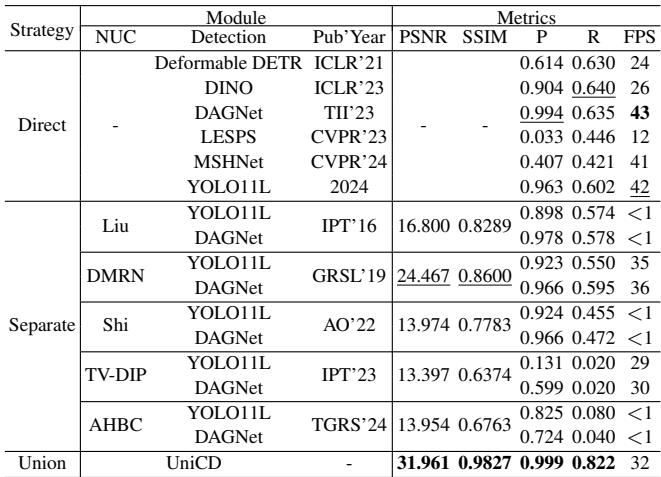
Looking at Table 1, we can see that UniCD outperforms both “Direct” methods and “Separate” (correction-then-detection) methods.
- Precision (P): 0.999 (Almost perfect)
- Recall (R): 0.822 (Significantly higher than the next best, which is around 0.602 for pure YOLO11L).
- FPS: 32 (Real-time performance).
The “Separate” methods (like Liu + YOLO or AHBC + DAGNet) often show a massive drop in recall. This confirms the hypothesis that disconnected correction steps often degrade target features.
The results on real-world data are equally impressive:
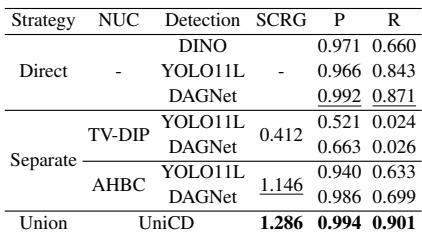
Table 2 shows that UniCD maintains high precision (0.994) and achieves a recall of 0.901 on real data, significantly outperforming the separate strategies. The SCRG (Signal-to-Clutter Ratio Gain) of 1.286 indicates that the targets are much more distinct against the background after correction.
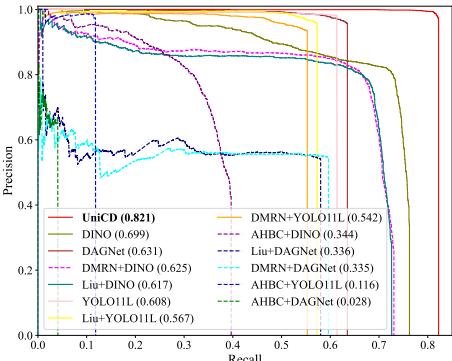
The Precision-Recall curves in Figure 5 visually demonstrate the superiority of UniCD (the red line), which encloses the largest area, indicating consistently high performance across different thresholds.
Visual Qualitative Results
Numbers are great, but in computer vision, seeing is believing.
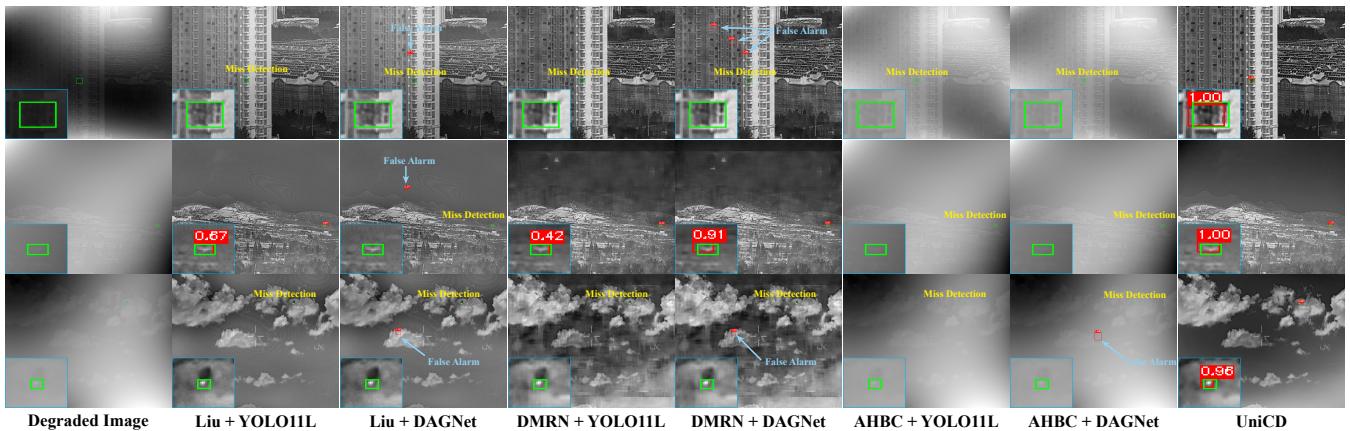
In Figure 6, notice the row for “Degraded Image.” The targets are barely visible.
- Traditional methods like “Liu” or “AHBC” leave behind significant nonuniformity (dark corners, vignetting), leading to missed detections (indicated by “Miss Detection” labels).
- UniCD (Bottom Row) produces a clean, flat image and successfully bounds the target with high confidence.
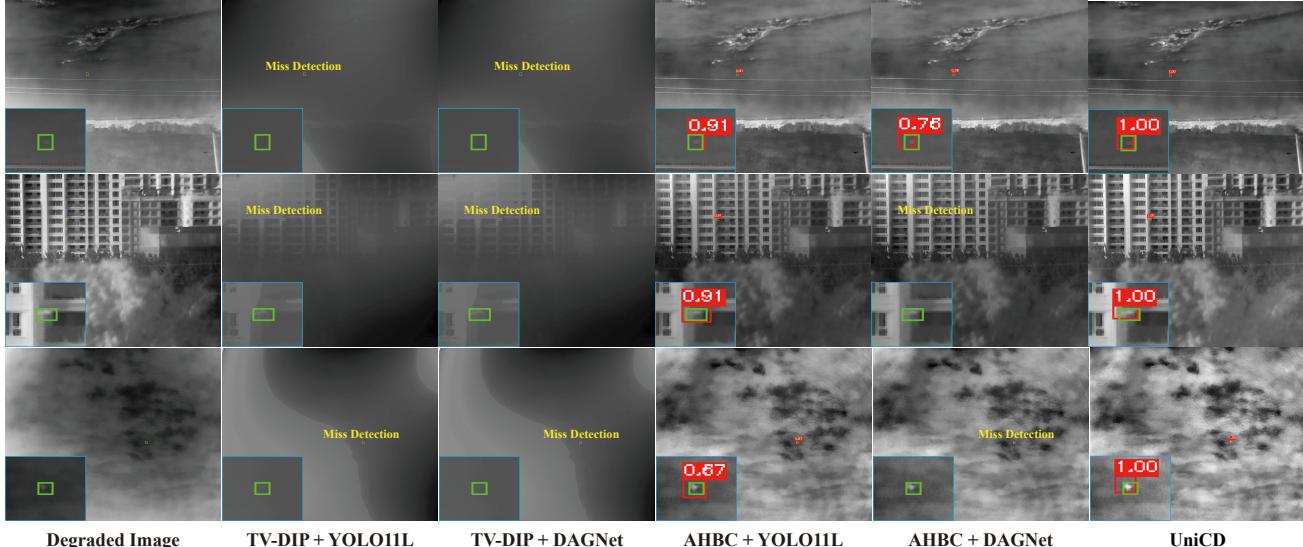
Figure 7 shows real-world examples. In the third row (cloudy sky), the “TV-DIP” method fails to remove the cloud texture interference, leading to a missed detection. UniCD clears the interference and spots the drone.
Why does it work? (Ablation Studies)
The authors performed ablation studies to prove that every part of their engine is necessary.
1. Polynomial Degree:
They tested different degrees for the bias field polynomial.
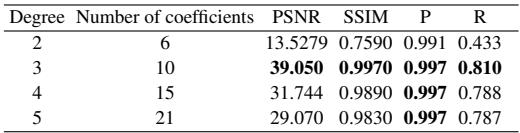 As seen in Table 3, Degree 3 is the sweet spot. Degree 2 is too simple (low recall), while Degree 4 and 5 introduce unnecessary complexity without performance gain.
2. Encoder Structure:
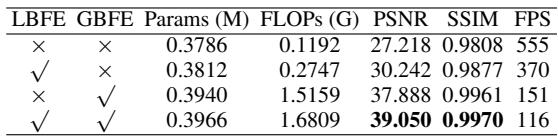 Using both the Local (LBFE) and Global (GBFE) encoders yields the highest PSNR (Peak Signal-to-Noise Ratio). Removing the Transformer-based GBFE hurts performance significantly, proving that capturing global context is vital for understanding bias fields.
3. TEBS Loss:
Does the internal mask supervision actually help?
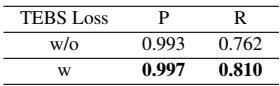 Table 5 shows a clear jump in recall (from 0.762 to 0.810) when TEBS is enabled.
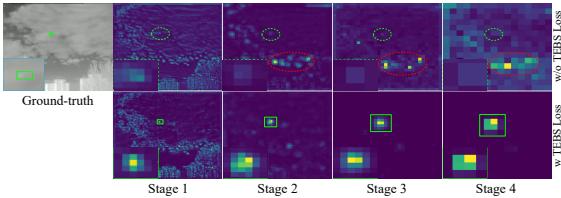 Figure 8 visualizes this impact. Without TEBS (left columns), the feature maps are noisy. With TEBS (right columns), the “hot spots” on the feature map focus tightly on the drone target.
4. Bias-Robust (BR) Loss:
Finally, the “glue” that holds the framework together.
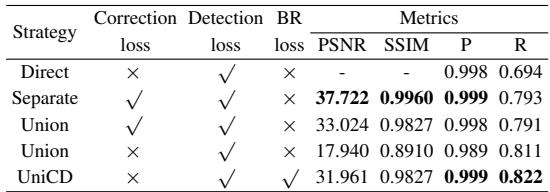 Table 6 reveals that without BR loss, the “Union” model actually performs worse (Recall 0.791) than the full UniCD model (Recall 0.822). This confirms that simply training the networks together isn’t enough; you need the BR loss to enforce feature consistency.
Conclusion
The UniCD framework represents a significant step forward in infrared surveillance. By treating Nonuniformity Correction and Target Detection not as sequential hurdles but as a unified, cooperative task, the authors have achieved state-of-the-art performance.
Key takeaways for students and researchers:
- Prior Knowledge Matters: Using a polynomial model (prior) instead of raw pixel prediction drastically reduces model size and complexity.
- Internal Supervision: The TEBS loss shows that supervising the inside of a neural network (intermediate features) is just as important as supervising the output.
- Task Alignment: The Bias-Robust loss teaches us that when combining tasks, we must mathematically ensure they are speaking the same “feature language.”
With a processing speed of 32 FPS, UniCD is not just a theoretical exercise—it is a practical solution ready for deployment on real-world UAV monitoring systems, potentially making our skies safer and our sensors smarter.