](https://deep-paper.org/en/paper/file-1985/images/cover.png)
The Art of Listening: How Diffusion Models Are Revolutionizing Digital Avatars
In the world of digital human generation, we often focus on the speaker. We want avatars that can talk, lip-sync perfectly, and deliver speeches with emotion. But communication is a two-way street. Think about your last video call: while you were talking, what was the other person doing? They were nodding, smiling, frowning, or perhaps tilting their head in confusion. These non-verbal cues are essential for natural interaction.
This brings us to the challenge of Listening Head Generation. The goal is to create a video of a listener that reacts realistically to a speaker’s audio and video input. It sounds simple, but it is notoriously difficult. Unlike lip-syncing, where a specific sound maps to a specific mouth shape, listening is a “one-to-many” problem. For any given sentence, a listener could nod, stay still, or smile, and all would be valid.
Historically, AI models have struggled here. They often produce blurry, low-resolution videos (typically \(256 \times 256\)) with robotic, repetitive movements. In this post, we will dive into a new paper, “Diffusion-based Realistic Listening Head Generation via Hybrid Motion Modeling,” which proposes a breakthrough method using Latent Diffusion Models (LDM) to generate high-fidelity (\(512 \times 512\)), expressive listening heads.
The Problem with “Pure” Approaches
Before understanding the solution, we need to understand why this is hard. Previous state-of-the-art methods usually followed a two-stage pipeline:
- Motion Prediction: Use a model (like an LSTM) to predict 3D coefficients (mathematical representations of facial expressions and pose) based on the speaker’s audio.
- Rendering: Feed those coefficients into a renderer to produce the video frames.
The problem? The 3D coefficients are “explicit”—they are rigid mathematical definitions that often miss the subtle details of human skin, wrinkles, and micro-expressions. The resulting videos often look like smooth, plastic masks.
On the other hand, modern Diffusion Models (like those behind Stable Diffusion) are incredible at generating detailed images. However, applying them directly to listening heads is tricky. Listening requires understanding long-term context (you don’t nod at a single word, you nod at the meaning of a sentence). Diffusion models are computationally heavy and usually struggle to “remember” long sequences of context.
The Solution: Hybrid Motion Modeling
The researchers propose a “best of both worlds” approach. They combine Explicit Motion Modeling (to guide the general movement) with Implicit Motion Modeling (to fill in the realistic details via diffusion).
Let’s look at the overall architecture:
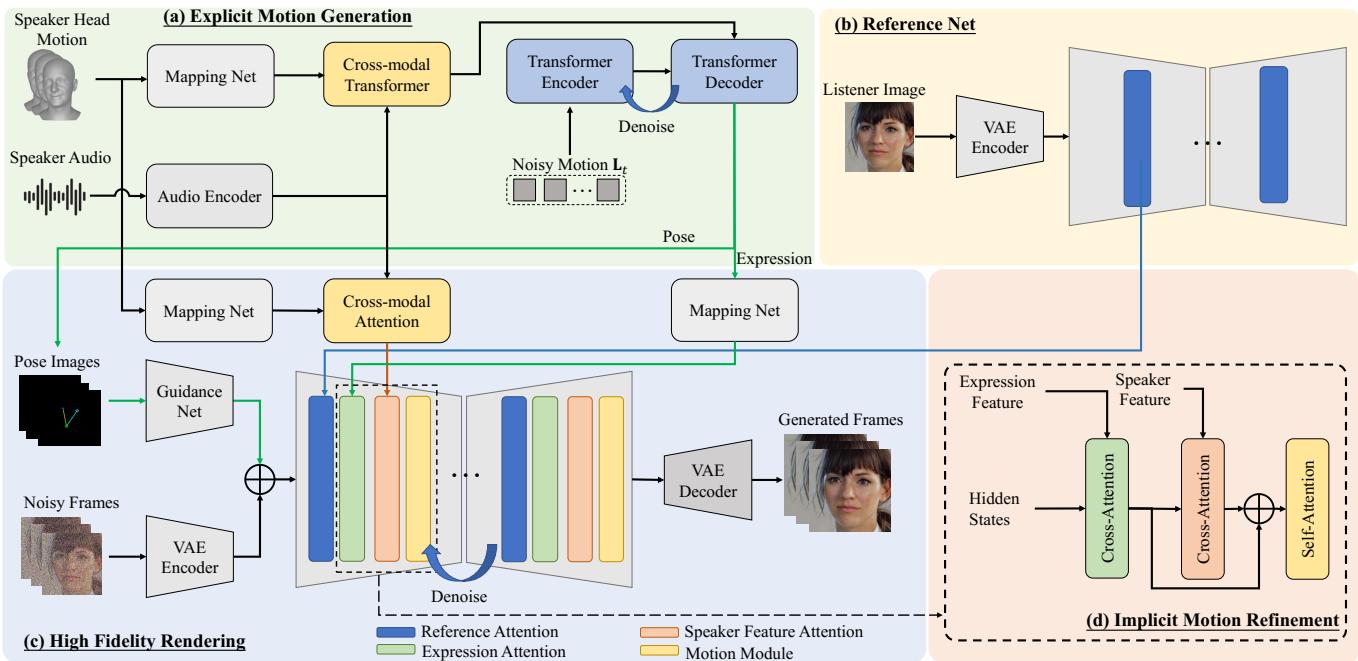
As shown in Figure 1 above, the framework takes a listener’s portrait and the speaker’s audio/motion as input. It then processes this through three main stages:
- Explicit Motion Generation (a): A lightweight module predicts the rough 3D pose and expression.
- High-Fidelity Rendering (c): A modified Stable Diffusion network generates the video frames.
- Implicit Motion Refinement (d): A special module injects the subtle details that the 3D model missed.
Let’s break these down step-by-step.
1. Explicit Motion Generation
The first step is to figure out what the listener should generally be doing. Should they turn their head? Should they smile?
The model uses a lightweight Transformer-based diffusion network for this. Instead of generating pixels immediately, it generates 3DMM coefficients (parameters for 3D Morphable Models). This is efficient and allows the model to look at a longer history of the speaker’s audio to make better decisions.
Mathematically, the goal is to predict the clean motion signal \(\hat{\mathbf{L}}\) (pose and expression) from a noisy input, conditioned on the speaker’s audio (\(\mathbf{A}\)) and motion (\(\mathbf{S}\)).

Here, \(\mathcal{G}\) is the motion generation module. By operating in this lower-dimensional “parameter space” rather than pixel space, the model can easily learn reasonable reactions without getting bogged down in rendering details.
2. High-Fidelity Rendering with Guidance
Now that we have the “skeleton” of the movement (the explicit motion), we need to flesh it out into a photorealistic video. The researchers employ a Latent Diffusion Model (LDM) derived from Stable Diffusion 1.5.
The rendering process \(\mathcal{R}\) generates the video frames \(\hat{\mathbf{V}}_{0}\) based on the noisy latents \(\mathbf{V}_{t}\), the explicit motion \(\hat{\mathbf{L}}\) we just calculated, the speaker’s audio/motion, and the listener’s reference image \(\mathbf{I}\).

However, simply throwing all these conditions into the model at once often confuses it. The researchers devised a clever Dual-Control Strategy to guide the diffusion model effectively.
Separating Pose and Expression
The researchers realized that Head Pose (where the head is looking) and Facial Expression (smiling, frowning) are fundamentally different types of motion.
- Pose is rigid: It affects the global position of the head.
- Expression is non-rigid: It affects local features like the mouth and eyes.
To handle this, they treat them differently in the network.
For Pose: They project the 3D pose keypoints onto an image (connecting the eyes and nose) and feed this “pose image” \(\mathbf{P}\) into the network using a specialized convolutional encoder. This signal is added directly to the network’s features:

For Expression: Since expressions are more subtle, they are injected via Cross-Attention layers. The expression features \(\mathbf{F}\) act as the “keys” and “values” that the rendering network attends to:

This separation ensures that the head rotates correctly without distorting the facial features, and the face emotes correctly without warping the head shape.
3. Implicit Motion Refinement
If we stopped at the explicit motion step, the results would look decent but “soulless.” 3DMM coefficients are low-dimensional approximations. They can capture a smile, but they can’t capture the crinkle of the eye or the tightening of a cheek muscle that makes a smile look real.
This is where the Implicit Motion Refinement comes in.
The researchers introduce a module that allows the diffusion model to look directly at the speaker’s audio and motion features again, bypassing the 3DMM bottleneck. This “implicit” path allows the model to hallucinate the high-frequency details—the “vibes”—that the explicit mathematical model missed.

In this equation, the model attends to the speaker’s raw signals (\(\mathbf{S}, \mathbf{A}\)) and adds this information to the features generated by the explicit guidance. This residual connection acts as a “detail polisher.”
4. Preserving Identity
Finally, to ensure the listener looks like the same person throughout the video, they use a Reference Net (shown as part (b) in Figure 1). This is a parallel copy of the network that processes the original static portrait of the listener.
The features from this static image are injected into the main video generation stream to lock in the identity.

Experimental Results
So, does this complex hybrid architecture actually work? The researchers tested their method against several state-of-the-art approaches, including RLHG, PCH, and L2L.
Visual Quality
The visual improvement is striking. Because the backbone is a heavy-duty diffusion model (Stable Diffusion), the output resolution is \(512 \times 512\), significantly sharper than previous methods.
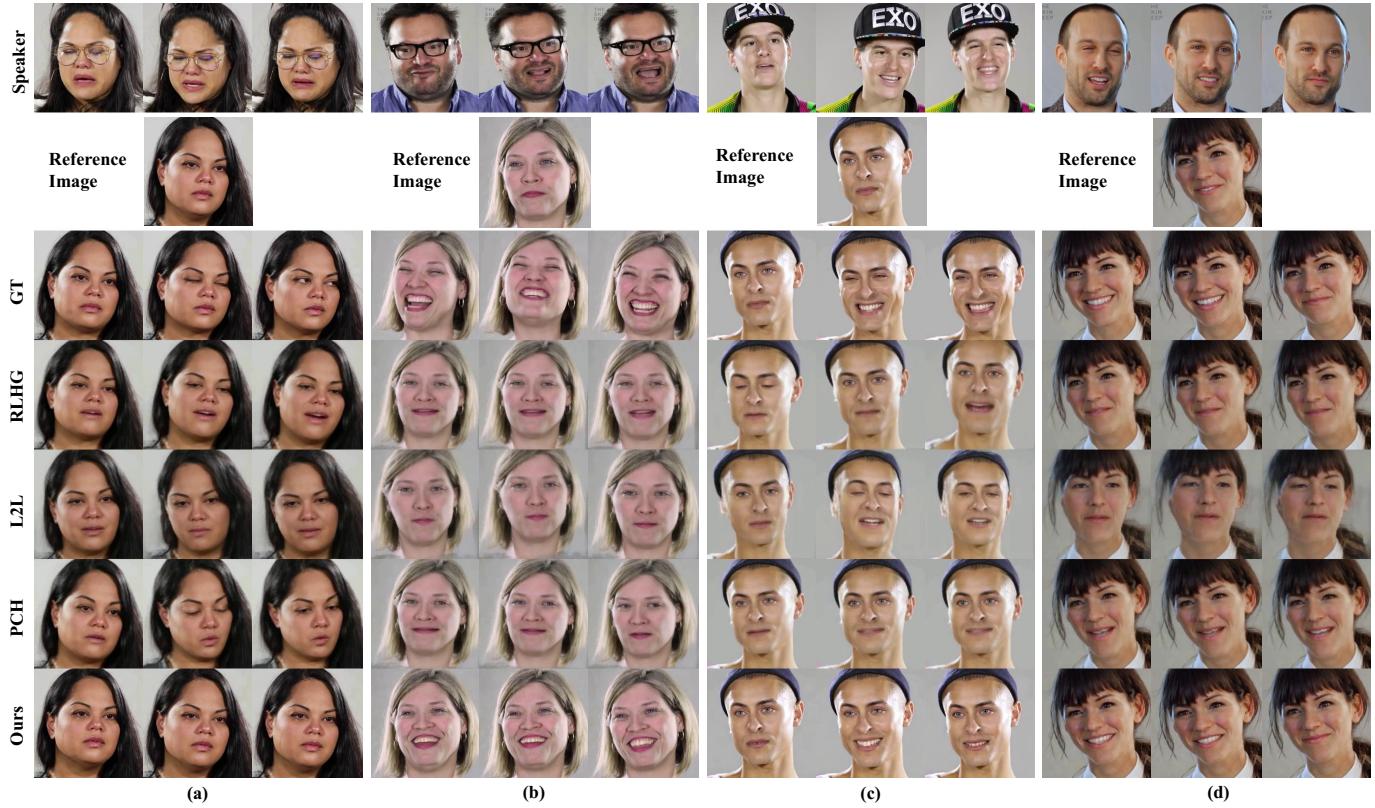
In Figure 2, look at the row labeled Ours. Compared to RLHG or L2L, the skin texture is more realistic, the lighting is better preserved, and the expressions (like the smile in column ‘b’) feel much more organic and less “stiff.”
The quantitative metrics back this up. In Table 1 (RealTalk dataset) and Table 2 (ViCo dataset), the proposed method scores best on FID (Fréchet Inception Distance), which measures how similar the generated images are to real images. Lower is better.
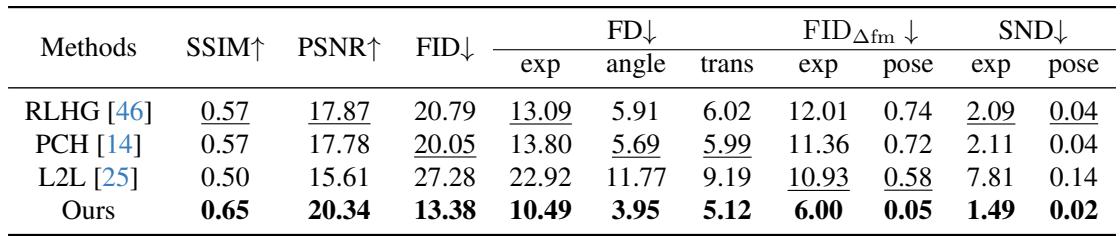
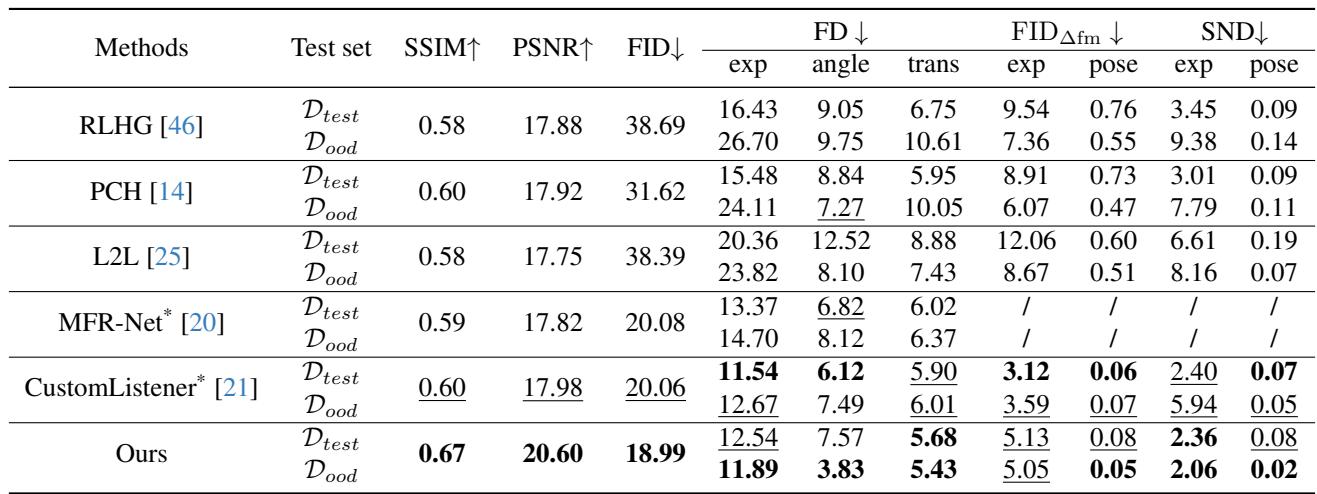
Notice the massive drop in FID scores compared to competitors (e.g., 13.38 vs 20.05 on RealTalk). This confirms that the diffusion backbone is generating much higher quality pixels.
Motion Quality
It’s not just about pretty pixels; the movement must be correct. The researchers used metrics like FD (Feature Distance) to measure how closely the generated motion matches ground truth distributions.
In Table 1, the method achieves the lowest FD scores for expression, angle, and translation. This suggests that the Explicit Motion Generation module is successfully learning appropriate reactions to the speaker.
Ablation Studies: Why Every Part Matters
The researchers didn’t just throw components together; they tested each one’s necessity.
1. Is Explicit Motion Guidance necessary?
They tried training the model without the explicit 3DMM guidance (relying only on the diffusion model to figure it out from audio).
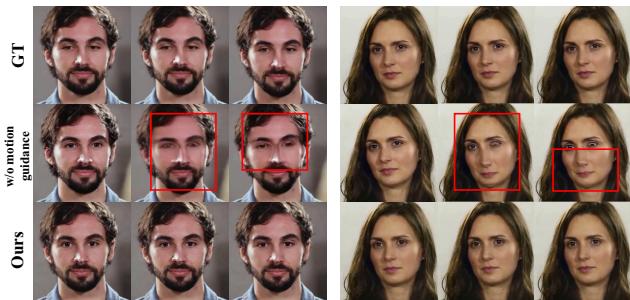 As Figure 3 shows, without motion guidance (middle row), the face collapses with severe artifacts around the eyes and mouth. The model struggles to learn geometry purely from limited data.
2. Why separate Pose and Expression?
They tried concatenating pose and expression into one signal instead of using the dual-control strategy.
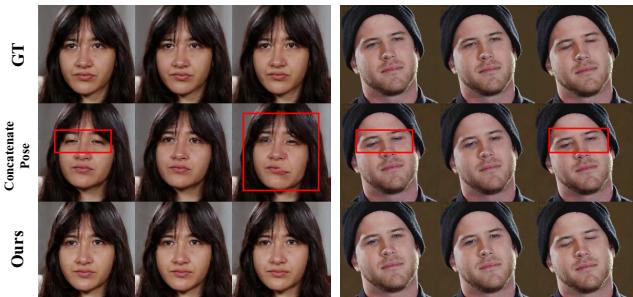 Figure 4 illustrates that mixing these signals (middle column) leads to “crosstalk”—where a head rotation might weirdly distort the eye shape. The separate control strategy (right column) keeps the face stable.
3. Does Implicit Refinement actually add detail?
This is the subtle but crucial part.
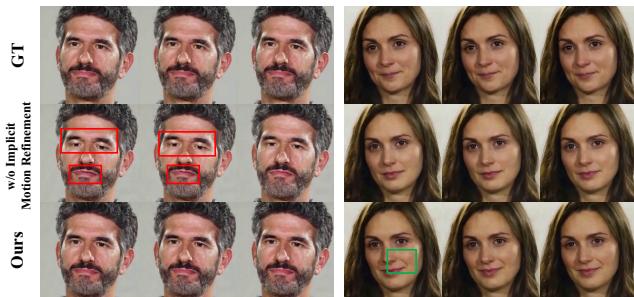 In Figure 5, the middle row lacks the refinement module. While the face is structured correctly, the expressions are flatter. The bottom row (“Ours”) shows improved micro-details, like subtle mouth shaping and eye realism, highlighted by the green boxes.
Conclusion and Implications
The paper “Diffusion-based Realistic Listening Head Generation via Hybrid Motion Modeling” represents a significant step forward in digital human interaction. By acknowledging that a single approach isn’t enough, the authors successfully combined the stability of explicit 3D modeling with the creative power of implicit diffusion generation.
Key Takeaways:
- Hybrid Modeling: Combining rigid 3D parameters with flexible latent features is a powerful way to get both control and realism.
- Control Strategies: How you feed data into a diffusion model matters. Separating pose (spatial) and expression (semantic) yields better results than mixing them.
- Resolution Leap: Moving from \(256 \times 256\) to \(512 \times 512\) brings us much closer to avatars that can pass the Turing test—at least visually.
As we move toward more immersive virtual assistants and NPCs in video games, technologies like this ensure that our digital counterparts won’t just talk at us—they’ll finally look like they’re listening, too.