](https://deep-paper.org/en/paper/file-2003/images/cover.png)
Introduction
In the world of medical artificial intelligence, precision is everything. A fraction of a millimeter can distinguish between a benign anomaly and a malignant tumor. Over the last few years, Deep Learning—specifically U-shaped architectures and Vision Transformers—has become the gold standard for automating this segmentation process.
However, this precision comes at a steep price. Modern State-of-the-Art (SOTA) models for 3D medical imaging, such as SwinUNETR or 3D UX-Net, are computationally massive. They require expensive GPUs with high memory, making them difficult to deploy in real-time clinical settings or on edge devices like portable ultrasound machines.
The problem isn’t usually the “encoder” (the part of the network that understands the image); it’s often the “decoder” (the part that reconstructs the segmentation mask). Decoders in 3D networks are notorious for consuming massive amounts of Floating Point Operations (FLOPs) and Parameters because they try to process high-resolution volumetric data with hundreds of feature channels.
In this post, we break down EffiDec3D, a novel research paper that challenges the “bigger is better” status quo. The researchers propose an optimized decoder strategy that slashes parameter counts by over 96% and FLOPs by 93%, all while maintaining the segmentation accuracy of the original heavy models.
Background: The Heavy Cost of 3D Segmentation
To understand the innovation of EffiDec3D, we first need to look at the standard architecture of a medical segmentation network. Most modern models follow a U-Net design, which consists of two main parts:
- The Encoder: Takes the input image and progressively downsamples it, extracting rich, abstract features.
- The Decoder: Takes those abstract features and progressively upsamples them back to the original image size to create a pixel-perfect (or voxel-perfect) segmentation map.
The 3D Problem
In 2D image analysis, increasing resolution or channel depth is manageable. However, medical data is often 3D (CT scans, MRIs). When you double the resolution in 3D, the computational complexity grows cubically.
Current SOTA models like SwinUNETR or 3D UX-Net use sophisticated mechanisms like self-attention or large-kernel convolutions. While effective, their decoders are often “symmetrical” to the encoders. If the encoder expands to 768 channels, the decoder often mirrors this. Furthermore, these decoders often perform heavy convolutional operations at the highest resolutions (reconstructing the fine details).
The authors of EffiDec3D analyzed these architectures and found two major bottlenecks:
- High-Resolution FLOPs: Processing data at full resolution \((D \times H \times W)\) requires massive computation.
- Excessive Channels: Keeping hundreds of channels in the decoder creates a parameter explosion without necessarily improving accuracy.
The Core Method: EffiDec3D
The researchers propose a plug-and-play optimized decoder that can be attached to various encoders (whether CNN-based or Transformer-based). The design philosophy is simple: minimize the channel count and restrict high-resolution operations.
Let’s visualize the difference. Below is a comparison between a standard 3D UX-Net architecture and the optimized version using EffiDec3D.
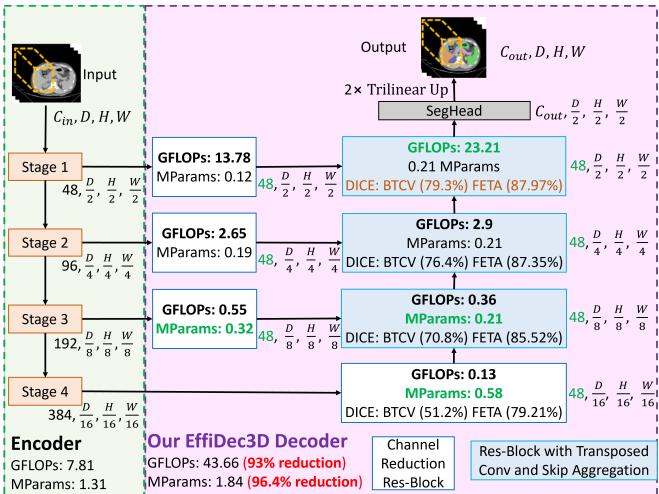
As seen in Figure 1 (b) above, the EffiDec3D decoder (right side) is significantly leaner. It replaces the heavy, channel-dense blocks with streamlined versions.
Strategy 1: The Channel Reduction
In traditional decoders, if an encoder stage outputs 384 channels, the corresponding decoder stage usually processes 384 channels. EffiDec3D argues this is redundant for reconstruction.
Instead, the method introduces a variable \(C_{reduced}\). This value is determined by finding the minimum number of channels used anywhere in the encoder.

For most standard networks, this minimum is around 48 channels. EffiDec3D forces all decoder blocks to operate at this reduced channel capacity (\(C_{reduced}\)), regardless of the stage depth.
This reduction is implemented via the ChannelReductionResidualBlock. When feature maps come from the encoder (\(\mathbf{F}_i\)), they are immediately projected down to this smaller channel dimension:

Inside the Block
The actual processing within this block is a lightweight residual design. It uses 3D convolutions (\(Conv3D\)), Instance Normalization (\(IN\)), and ReLU activation.
First, the block applies two convolution layers:


To ensure gradients flow smoothly during training (preventing the vanishing gradient problem), a residual connection is added. If the input channels don’t match the output, a \(1 \times 1 \times 1\) convolution adjusts the dimensions:

Finally, the output is the sum of the processed features and the residual identity:

By keeping the channel count low and constant (e.g., 48) throughout the decoder, the number of parameters drops precipitously.
Strategy 2: Resolution Restriction
The second major optimization targets FLOPs (computational operations). In a standard U-Net, the decoder upsamples the image all the way back to the original input size \((D, H, W)\) and performs heavy convolutions at that full scale.
EffiDec3D stops the heavy lifting early. It performs upsampling and feature aggregation only up to half-resolution \((D/2, H/2, W/2)\). The final step from half-resolution to full-resolution is handled by a simple trilinear upsampling, bypassing expensive convolutions at the largest scale.
The upsampling process is governed by the ResidualUpBlock:

Here, \(\mathbf{Dec}_{i+1}\) is the deeper (smaller) feature map, which is upsampled and combined with the skip connection \(\mathbf{F}'_i\).
Final Prediction Head
Once the decoder has reconstructed the features at the target resolution (half-scale), a final prediction head generates the segmentation map. This is a lightweight \(1 \times 1 \times 1\) convolution that maps the feature channels to the number of classes (e.g., organs or tumor types):

After this layer, the output is simply interpolated (resized) to match the original input dimensions.
Experiments and Results
The theory sounds solid: reduce channels and resolution to save compute. But does this destroy the model’s ability to segment complex medical anatomy? The authors tested EffiDec3D on three major datasets: FeTA 2021 (Fetal Brain), BTCV (Multi-organ CT), and MSD (Medical Segmentation Decathlon).
Efficiency Gains
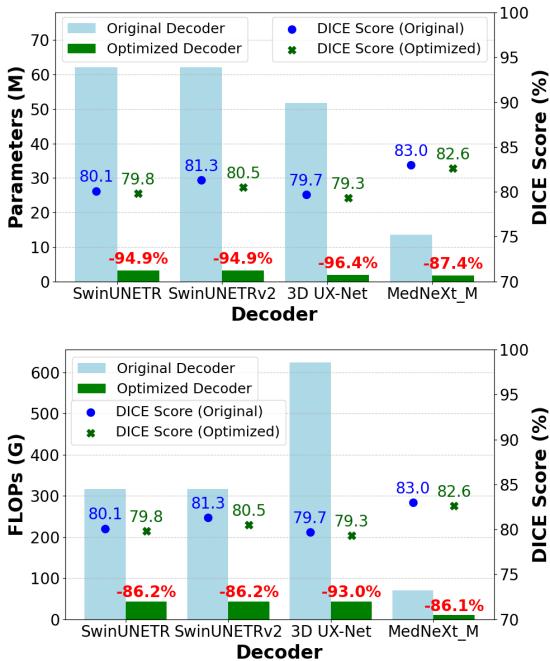
The primary claim of the paper is efficiency. The results are startling. The chart below compares the original decoders of popular models (SwinUNETR, SwinUNETRv2, 3D UX-Net) against their EffiDec3D counterparts.
Notice the pattern:
- Parameters (Params): The blue bars (Original) tower over the green bars (Optimized). For 3D UX-Net, parameters dropped from 53M to roughly 1.8M.
- FLOPs: Similarly, the computational cost plummets.
- DICE Score: The blue dots (Original accuracy) and green stars (Optimized accuracy) are nearly identical. In some cases, the optimized version is actually better.
Dataset 1: FeTA 2021 (Fetal Brain)
Fetal brain segmentation is challenging due to the rapid developmental changes in anatomy. The table below shows the results.
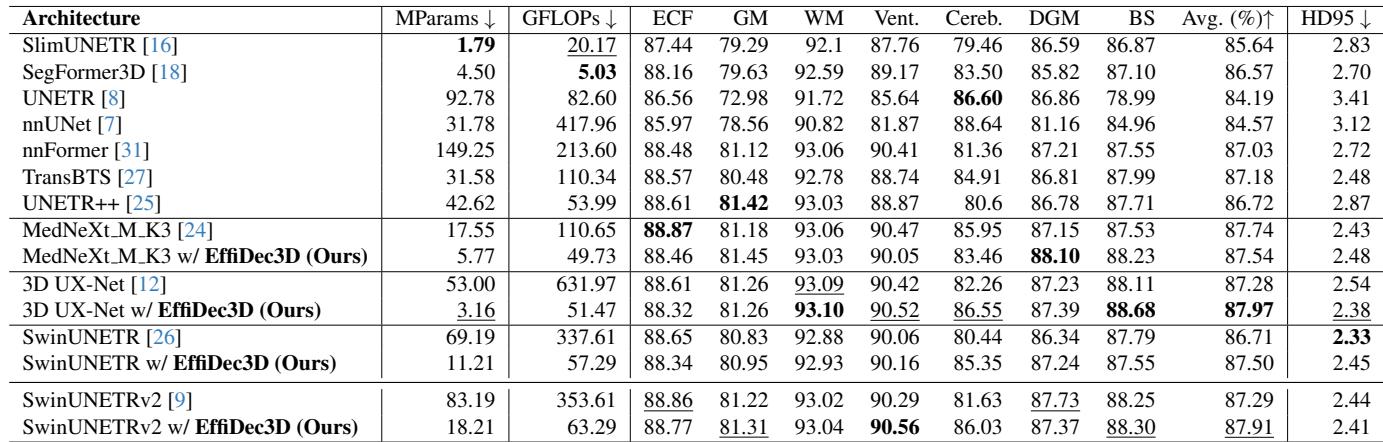
Take a look at the 3D UX-Net comparison. The original model achieves an 87.28% DICE score. The EffiDec3D version achieves 87.97%—it actually improved the performance while using 94% fewer parameters. This suggests that the original huge decoder was likely overfitting or contained redundant capacity that wasn’t helping generalization.
Dataset 2: BTCV (Multi-Organ Segmentation)
The BTCV dataset involves segmenting 13 different abdominal organs (Liver, Spleen, Kidneys, etc.).
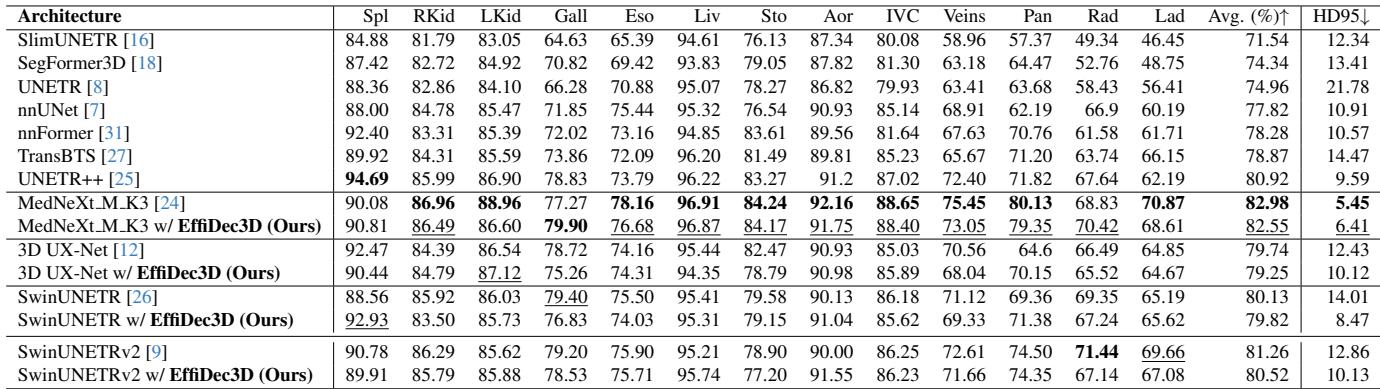
Here, we see a very slight trade-off. For 3D UX-Net, the average DICE score drops marginally from 79.74% to 79.25%. However, looking at specific organs, the performance on large organs like the Spleen and Liver remains robust. The massive reduction in GFLOPs (from 631.97 down to 51.47) arguably outweighs the 0.5% drop in accuracy for many practical applications.
Dataset 3: Medical Segmentation Decathlon (MSD)
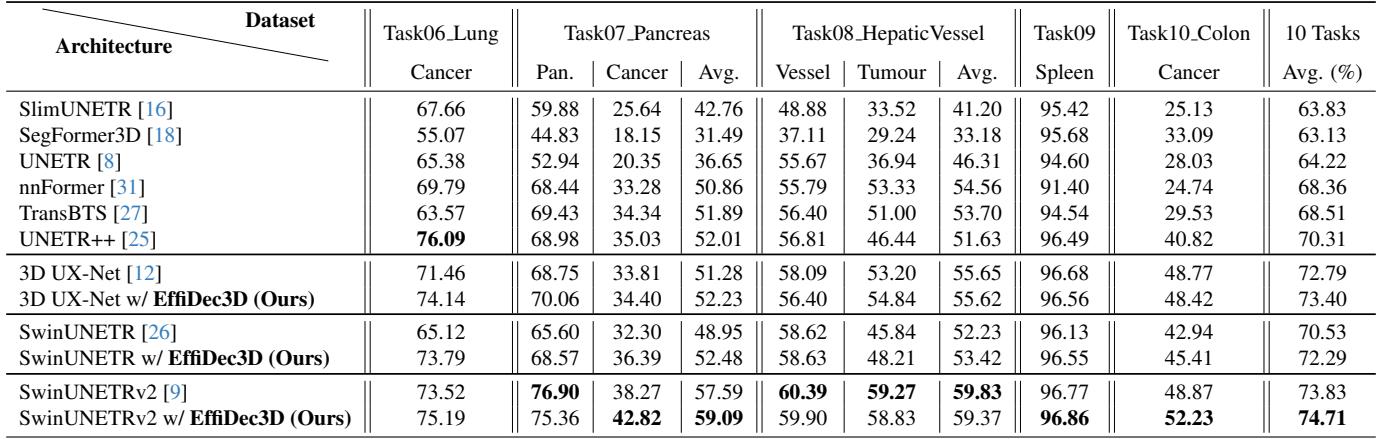
The MSD dataset is a collection of 10 different tasks, ranging from Brain Tumors to Heart and Prostate segmentation. It tests the generalizability of a model.
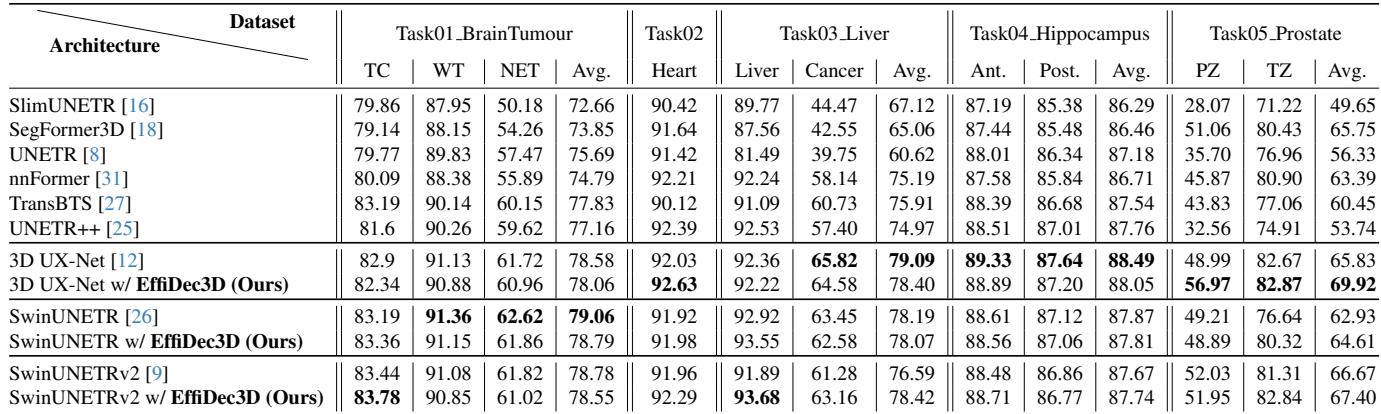
The SwinUNETRv2 with EffiDec3D (last row) achieves the best average score across all 10 tasks (74.71%), beating the original SwinUNETRv2 (73.83%). This confirms that EffiDec3D is not just a “lightweight approximation” but a highly effective architecture in its own right.
Ablation Studies: Why These Choices?
The authors didn’t just guess the optimal settings; they performed ablation studies to verify their design choices.
1. Output Resolution: They tested stopping the decoder at different resolutions (\(D/4, D/8\), etc.).
As shown in Table 4, stopping at \(D/2\) (Ours) strikes the perfect balance. Going down to \(D/4\) saves more compute but starts to hurt accuracy significantly (dropping from 79.25% to 76.41%).
2. Number of Channels: They also experimented with the fixed channel count (\(C_{reduced}\)).

Table 5 reveals that increasing the channels beyond 48 yields diminishing returns. Doubling the channels to 96 increases the parameter count significantly but practically yields no improvement in the DICE score. This validates the decision to stick to the minimum encoder channel count.
Conclusion and Implications
The “EffiDec3D” paper teaches a valuable lesson in Deep Learning architecture: redundancy is everywhere.
For years, the trend in 3D medical imaging has been to use heavier, deeper, and wider networks to squeeze out every percentage point of accuracy. This paper demonstrates that the decoder—often responsible for the bulk of computational cost—can be drastically simplified without sacrificing performance.
Key Takeaways:
- Less is More: You can remove 96% of a model’s parameters and maintain state-of-the-art accuracy.
- Resolution Matters: Avoiding full-resolution convolutions in the deep layers saves massive amounts of FLOPs.
- Accessibility: By reducing the model size from ~600 GFLOPs to ~50 GFLOPs, advanced AI segmentation becomes feasible on standard hospital computers or even portable medical devices, democratizing access to AI-assisted diagnosis.
EffiDec3D establishes a new standard for efficient design, proving that we don’t need supercomputers to see inside the human body with superhuman precision.