](https://deep-paper.org/en/paper/file-2012/images/cover.png)
Introduction
Imagine scanning hours of security footage trying to locate a specific individual. You aren’t just looking for a face; you are looking for descriptors: “a woman wearing a red dress,” “a man with a backpack,” or “someone wearing glasses.” In Computer Vision, this task is known as Pedestrian Attribute Recognition (PAR).
For years, this field was dominated by systems that simply looked at an image and tried to guess the tags. However, the rise of Vision-Language Models (like CLIP) has introduced a new paradigm: using text to help the computer “understand” the image better.
But there is a catch. Most current systems use “static” prompts. They ask the model, “Does this person have a hat?” using the same generic sentence for every single image. But a beanie in winter looks very different from a baseball cap in summer. If the prompt doesn’t adapt to the context of the image, the recognition suffers.
In this post, we are diving deep into a recent CVPR paper titled “Enhanced Visual-Semantic Interaction with Tailored Prompts for Pedestrian Attribute Recognition.” The researchers propose a new framework, EVSITP, that doesn’t just ask generic questions. Instead, it “tailors” its prompts based on what it sees in the image, creating a dynamic conversation between visual and textual data. We will also look at a new dataset they created, Celeb-PAR, designed to fix the lack of seasonal and scenario diversity in existing benchmarks.
Background: The Evolution of PAR Frameworks
To appreciate the innovation in this paper, we first need to understand where we came from. Generally, approaches to Pedestrian Attribute Recognition fall into two buckets: Unimodal and Bimodal.
The Unimodal Era
As shown in Figure 1(a) below, the traditional Unimodal framework is straightforward. You feed an image into a Convolutional Neural Network (CNN) or a Vision Transformer (ViT), extract visual features, and run them through a classifier. While effective, this approach completely ignores the semantic meaning of the attributes. It knows what a “hat” looks like as a cluster of pixels, but it doesn’t leverage the linguistic concept of a “hat.”
The Static Bimodal Era
With the advent of models like CLIP, researchers started using Bimodal frameworks (Figure 1(b)). These systems use both an Image Encoder and a Text Encoder. They use “prompts”—sentences like “This pedestrian wears a hat”—to extract text features. These text features are then combined (concatenated) with the image features.
While this is an improvement, it has two major flaws:
- Static Templates: The prompt is fixed. It uses the same sentence structure regardless of the image complexity. It cannot capture the massive variability within a class (e.g., the difference between a formal dress and a summer dress).
- Weak Interaction: The visual and text features are often just glued together (concatenated) at the end. They don’t truly “talk” to each other during the processing stage.
The Adaptive Approach (Our Focus)
This paper introduces the Adaptive Learnable Bimodal Framework (Figure 1(c)).
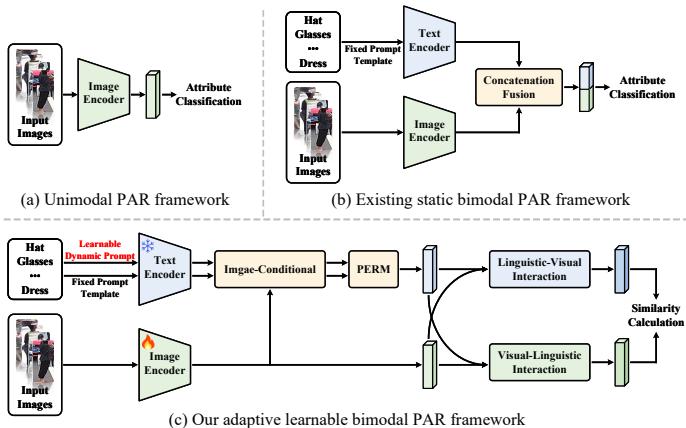
As you can see in section (c) of the image, the new framework introduces learnable components that sit between the image and text encoders. It allows the visual features to modify the prompts, and the text features to refine the visual processing.
Core Method: The EVSITP Framework
The proposed framework, EVSITP (Enhanced Visual-Semantic Interaction with Tailored Prompts), is built on the architecture of CLIP but introduces three highly specialized modules to handle the interaction between vision and language.
Let’s break down the full architecture visualized in Figure 2.
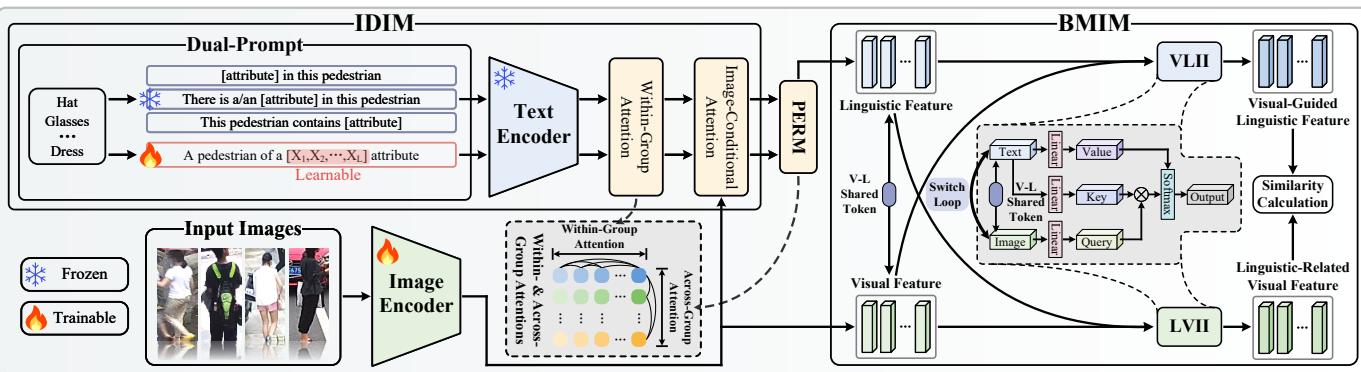
The architecture is composed of three main novel components:
- IDIM: Image-Conditional Dual-Prompt Initialization Module.
- PERM: Prompt Enhancement and Regularization Module.
- BMIM: Bimodal Mutual Interaction Module.
1. IDIM: Making Prompts Context-Aware
The first challenge is solving the “static prompt” issue. The researchers introduce IDIM to create prompts that adapt to the image. They use a Dual-Prompt strategy, combining fixed templates with learnable ones.
The Fixed Prompts: The model uses standard templates like “This pedestrian contains [attribute]” or “There is a [attribute] in this pedestrian.” These provide a stable baseline of semantic knowledge.
The Learnable Prompts: Here is where the magic happens. Instead of just hard-coded words, the model prepends learnable tokens to the attribute labels. These tokens are vectors that the model can adjust during training to represent complex concepts that words might miss.
Within-Group Attention: To understand how attributes relate to each other (e.g., “skirt” and “female” often appear together), the model applies self-attention to the label embeddings. The mathematical formulation for this relation-aware embedding is:
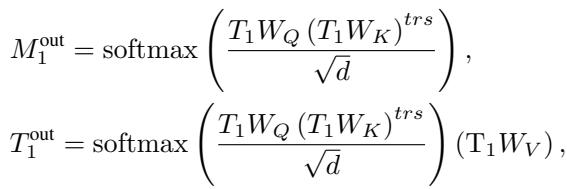
Image-Conditional Attention: This is the “tailoring” part. A prompt shouldn’t just be generic; it should be influenced by the specific image being analyzed. The IDIM uses a cross-attention mechanism where the Visual Features (\(F\)) guide the Learnable Prompts (\(T_L\)).
Essentially, the model looks at the image and says, “Okay, I see this specific type of clothing; let me adjust my text prompt to describe this specific instance of the attribute.”

In this equation, the text features are refined based on the visual input \(F\), resulting in image-conditional text features (\(T^{ica}\)).
2. PERM: Enhancing and Regularizing Prompts
With learnable prompts, there is a risk: the model might learn “gibberish” vectors that help it cheat on the training data but fail on new data (overfitting). The PERM module solves this.
Across-Group Attention: Since the model uses multiple prompt templates (Group 1, Group 2, etc.), PERM looks at the same attribute across different templates to consolidate information.
Regularization Loss: To prevent the learnable prompts from drifting too far into abstract nonsense, PERM applies a regularization loss. It forces the learned, image-conditioned prompts (\(t^{ica}\)) to stay relatively close to the original, fixed linguistic embeddings (\(t\)).
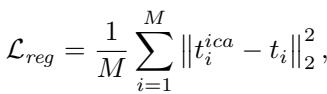
This ensures the prompts remain grounded in actual language semantics while still allowing for the necessary flexibility.
3. BMIM: A Two-Way Conversation
In previous methods, vision and text were combined crudely. BMIM (Bimodal Mutual Interaction Module) sets up a sophisticated bidirectional communication channel.
It introduces a Visual-Linguistic Shared Token that acts as a bridge. The module performs two specific interactions:
- VLII (Visual-Guided Linguistic Information Interaction): The text features query the visual features. The result is “Visual-Guided Linguistic Features” (\(T_V\)).
- LVII (Linguistic-Visual Information Interaction): The visual features query the text features. The result is “Linguistic-Related Visual Features” (\(F_L\)).
This means the final decision isn’t based just on what the image looks like, or just on what the text says. It’s based on text-that-has-seen-the-image and images-that-understand-the-text.
Final Classification
Instead of a standard linear classification layer, EVSITP calculates the similarity between these two refined feature sets directly in the feature space.

This dot-product similarity determines the probability of an attribute being present.
Optimization
The total loss function combines the standard Binary Cross-Entropy (BCE) loss for classification with the regularization loss we discussed in PERM.

Here, \(\lambda\) is a hyper-parameter that balances accuracy with the stability of the prompts.
The Celeb-PAR Dataset
One of the major critiques this paper offers is that existing datasets (like PETA or PA100K) are “biased.” They are often collected in short timeframes (limited seasons) or specific locations (like a single shopping mall).
If a dataset is collected only in summer, the model will never learn what a “coat” or “scarf” really looks like in diverse contexts.
To fix this, the authors introduced Celeb-PAR, derived from a long-term person re-identification dataset.
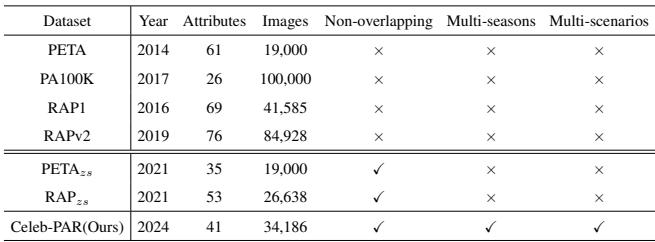
As shown in Table 1, Celeb-PAR is unique because it features Multi-seasons and Multi-scenarios, which are absent in previous benchmarks.
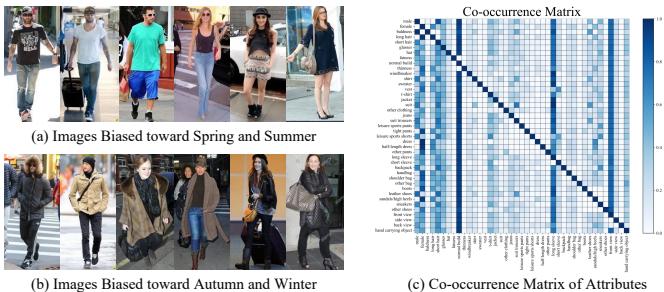
Figure 3 illustrates this diversity. You can see the stark contrast between spring/summer attire (panel a) and autumn/winter attire (panel b). This forces the model to learn attributes that are robust to weather and lighting changes.
Experiments and Results
The researchers compared EVSITP against State-of-the-Art (SOTA) methods, including Unimodal methods (like SOFAFormer) and Bimodal methods (like PromptPAR and VTB).
Benchmarking on Standard Datasets
Table 2 shows the performance on widely used datasets like PA100K and RAPv2.
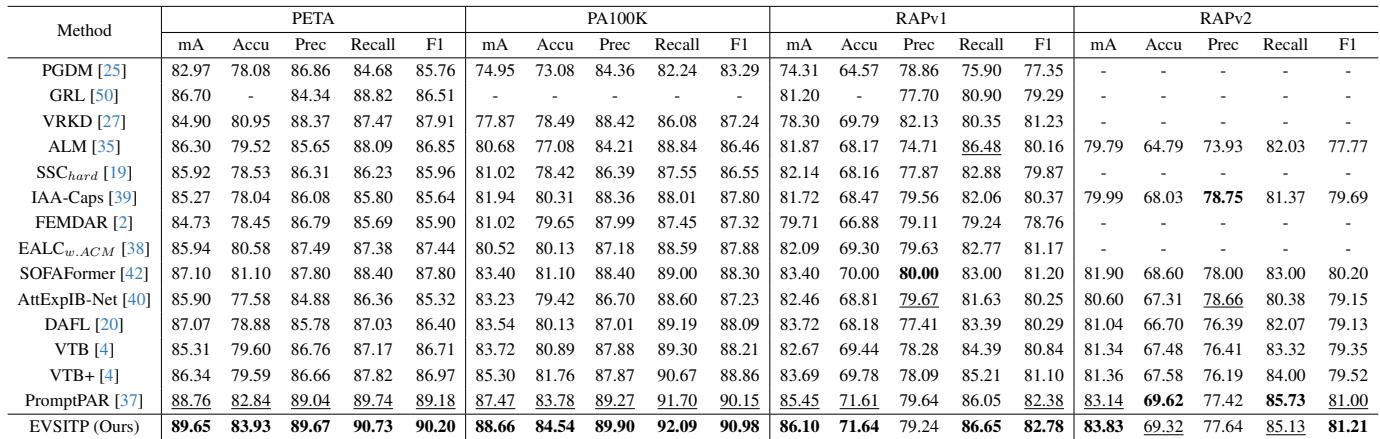
The results are impressive. On PA100K (the most challenging standard dataset), EVSITP achieves the highest Mean Accuracy (mA) of 88.66%, beating the previous best (PromptPAR) by over 1%. This confirms that the “tailored” prompt approach yields better feature representations than static prompting.
Benchmarking on Celeb-PAR
Since Celeb-PAR is a new, harder dataset with high variance, how did the models fare?
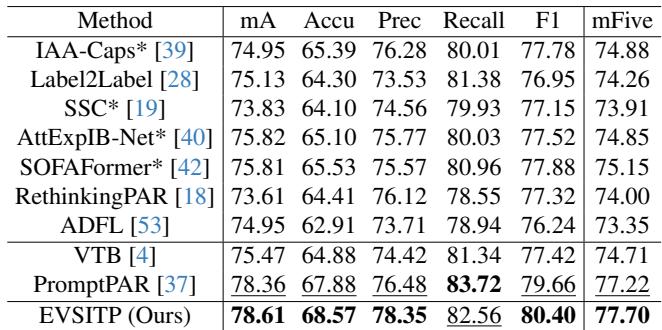
Table 3 shows that EVSITP outperforms both VTB and PromptPAR on the new dataset as well, achieving an F1 score of 80.40. This suggests that the model is better equipped to handle the “wild,” multi-season nature of real-world surveillance data.
Why does it work? (Ablation Studies)
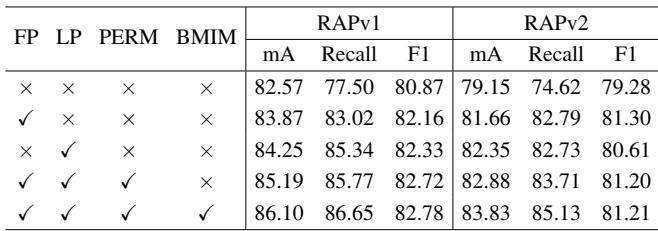
The authors performed ablation studies to prove that each specific module (IDIM, PERM, BMIM) actually contributes to the success.
Table 4 breaks this down. You can see a stepwise improvement.
- Adding Fixed Prompts helps.
- Adding Learnable Prompts helps more.
- Adding PERM boosts it further.
- The full model (with BMIM) yields the highest scores.
The Importance of Regularization
One specific ablation worth highlighting is the effect of the Regularization loss in PERM. Figure 4 visualizes the performance with and without this loss.
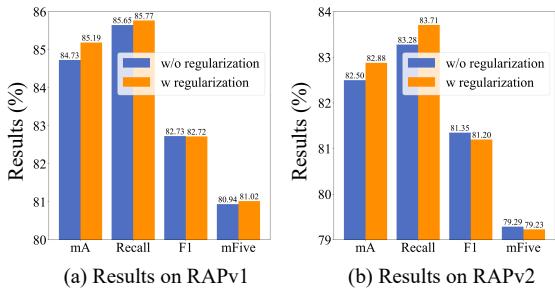
In almost every metric across RAPv1 and RAPv2, the orange bars (with regularization) are higher than the blue bars. This confirms the hypothesis: letting learnable prompts drift too far without constraints hurts generalization.
Generalization to Unseen Identities
Finally, to test if the model is just memorizing specific people, they tested on “Zero-Shot” (zs) versions of datasets where there is no overlap between training and testing identities.
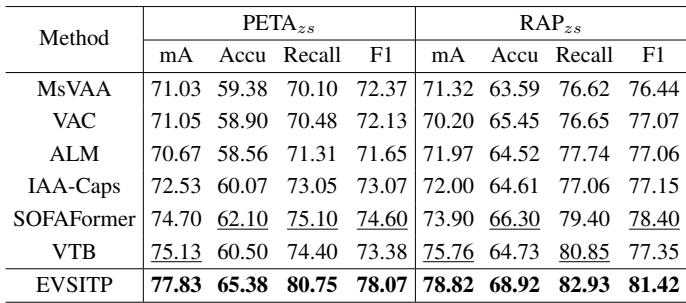
Table 5 shows EVSITP dominating the generalization test, significantly outperforming VTB and SOFAFormer. This is crucial for real-world applications where the system will encounter strangers it has never seen before.
Sensitivity Analysis
The authors also checked how sensitive the model is to hyper-parameters, specifically \(\lambda\) (the weight of the regularization loss) and \(L\) (the number of learnable prompt tokens).
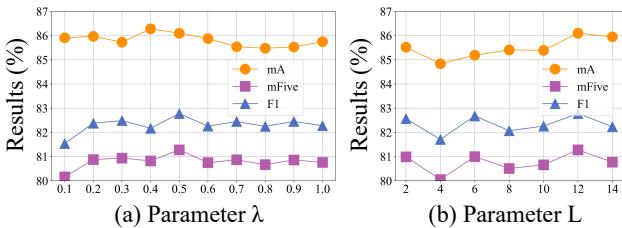
Figure 5 shows the results are relatively stable, but there is a “sweet spot.”
- For \(\lambda\) (Chart a), a value around 0.5 works best.
- For \(L\) (Chart b), using about 12 learnable tokens yields the peak performance.
Conclusion
The EVSITP framework represents a significant step forward in Pedestrian Attribute Recognition. By moving away from static prompt templates and embracing adaptive, image-conditional prompts, the model can capture the subtle nuances of how attributes appear in the real world.
Key takeaways from this research:
- Context Matters: A prompt describing an image should be influenced by the image itself.
- Interaction is Key: Visual and Linguistic features shouldn’t just be concatenated; they need to interact and guide each other via attention mechanisms.
- Data Diversity: The introduction of Celeb-PAR highlights the blind spots in previous datasets regarding seasonal and scenario variability.
This work not only improves accuracy benchmarks but also offers a blueprint for how vision-language models can be fine-tuned for specific, high-variance tasks in computer vision.