](https://deep-paper.org/en/paper/file-2026/images/cover.png)
Introduction
In the rapidly evolving landscape of Artificial Intelligence, Vision-Language Models (VLMs) like LLaVA and BLIP have emerged as powerful tools capable of understanding and generating content based on both visual and textual inputs. These models hold immense promise for specialized fields such as healthcare, where a model might need to analyze a chest X-ray and answer a doctor’s natural language questions about it.
However, deploying these massive “foundation models” in the real world presents a paradox. To make them useful for medical diagnosis, they must be fine-tuned on diverse, real-world medical data. Yet, strict privacy regulations (like HIPAA/GDPR) often prevent hospitals from sharing patient data with a central server.
Federated Learning (FL) solves the privacy issue by training models locally on client devices (e.g., inside the hospital’s secure network) and only sharing model updates. But this introduces a new problem: Resource Constraints. A massive VLM with billions of parameters cannot be easily fine-tuned on the limited hardware often found in clinical settings. Furthermore, standard FL approaches assume that all clients are somewhat similar, but in reality, one hospital might have high-end GPUs and CT scans, while another has basic laptops and microscope images.
How do we fine-tune massive models on diverse, weak devices without breaking privacy?
This article explores a new framework called F\(^3\)OCUS (Federated Finetuning of Foundation Models with Optimal Client-specific Layer Updating Strategy). The researchers behind F\(^3\)OCUS propose a sophisticated method that doesn’t just train the whole model or random parts of it. Instead, they mathematically determine which layers of the neural network are most important to train for each specific client and then use a server-side “meta-heuristic” optimization to ensure the global model remains robust.
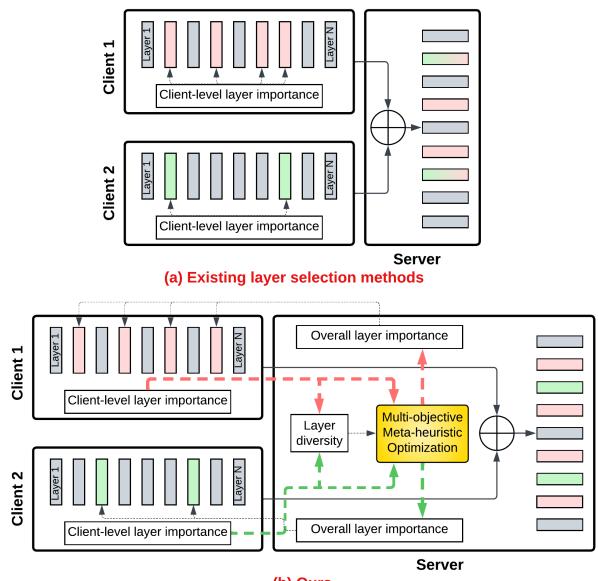
As illustrated in Figure 1, traditional methods (a) often select layers based solely on local data, ignoring the global picture. F\(^3\)OCUS (b) introduces a feedback loop where the server refines these selections to maximize both importance and diversity.
Background: The Challenge of Federated Fine-Tuning
Before diving into the mechanics of F\(^3\)OCUS, it is essential to understand the specific hurdles of Federated Learning (FL) when applied to foundation models.
1. Parameter-Efficient Fine-Tuning (PEFT)
Fine-tuning every parameter in a multi-billion parameter model is computationally prohibitive for most edge devices. PEFT techniques address this by freezing most of the pre-trained model and only updating a small subset of parameters (or adding small “adapter” layers).
2. The Heterogeneity Problem
In a perfect world, every client in a federated network would have the same computing power and similar data distributions. In the real world, we face:
- Data Heterogeneity: Different hospitals see different diseases.
- Modality Heterogeneity: One client deals with X-rays, another with MRIs.
- System Heterogeneity: Devices have vastly different memory and processing limits.
Naive combinations of FL and PEFT fail here. If we simply let every client train the layers they want, or force everyone to train the same layers, we either under-utilize powerful clients or crash the weak ones. Furthermore, if every client focuses only on the layers relevant to their data, the global model might suffer from “catastrophic forgetting” regarding other features.
The core research question F\(^3\)OCUS answers is: How can we dynamically select the optimal subset of layers for each client to update, such that we respect their hardware limits while maximizing the global model’s performance?
The F\(^3\)OCUS Framework
The F\(^3\)OCUS method operates on a “Define and Refine” principle. It consists of two main strategies:
- Client-Level Strategy (Define): Determine which layers are most critical for the local data using the Layerwise Neural Tangent Kernel (LNTK).
- Server-Level Strategy (Refine): Adjust these selections using Multi-Objective Meta-Heuristic Optimization to ensure a balanced global training process.
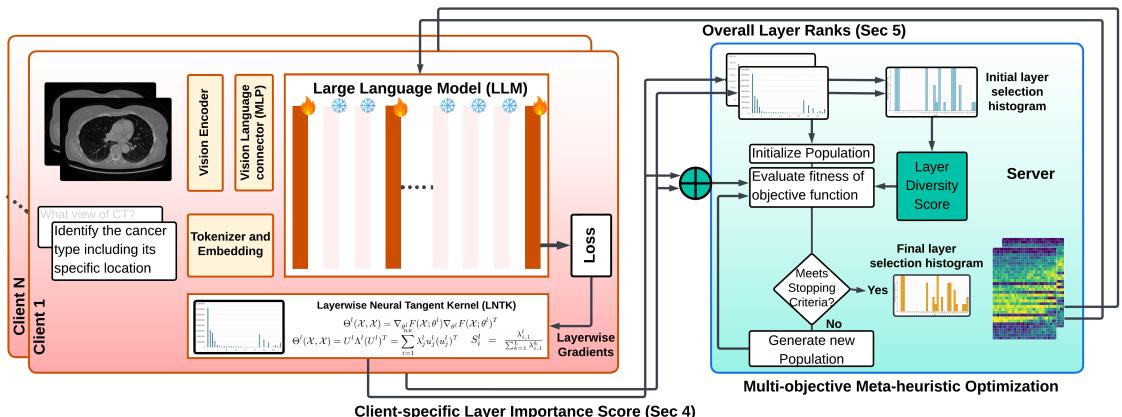
Figure 4 provides a high-level architectural view. On the left, clients process data (like CT scans) and calculate importance scores. On the right, the server processes these scores to output optimal layer ranks.
Step 1: Client-Specific Layer Importance via LNTK
The first challenge is determining which layers of the neural network actually matter for a specific client’s data. Random selection is inefficient, and training everything is impossible. The researchers utilize the concept of the Neural Tangent Kernel (LNTK) to solve this.
Understanding LNTK
Without getting lost in deep learning theory, the Neural Tangent Kernel describes the evolution of a neural network during training. It helps us understand how the model’s output changes as we tweak the weights.
The researchers posit that the principal eigenvalue of the LNTK for a specific layer indicates how well that layer’s parameters align with the client’s data distribution. A higher principal eigenvalue means that updating this layer will result in a more significant reduction in the loss function—essentially, the layer “learns” faster and is more important for that specific dataset.
The evolution of the network function \(f\) can be described by the following differential equation involving the NTK matrix \(\Theta\):

The integral NTK can be decomposed into the sum of layerwise NTKs (LNTK), as shown here:

By performing an eigen-decomposition of the LNTK (Eq. below), the researchers extract the eigenvalues \(\lambda\). The largest eigenvalue (\(\lambda_1^l\)) is the key indicator of importance.

Why Principal Eigenvalues?
Theoretical analysis suggests that training aligns most strongly with the direction associated with the principal eigenvalue. Therefore, layers with larger principal eigenvalues contribute more significantly to loss reduction.

Figure 3 visualizes this concept across different datasets (clients). You can clearly see that the importance profiles differ. For SLAKE (a), the first few layers are critical (high spikes on the left). For VQAMed 2020 (c), the importance is distributed more broadly across the middle layers. This proves that a “one-size-fits-all” strategy for layer selection would fail.
Based on this, the client calculates an Importance Score (\(S_i^l\)) for each layer, which is simply the normalized magnitude of that layer’s principal eigenvalue.

Figure 5 shows a heatmap of these raw rankings over training rounds. While informative, relying solely on this creates a problem: some layers might be ignored by everyone, while others are over-trained, leading to redundancy and a lack of model breadth.
Step 2: Server-Side Refinement via Meta-Heuristics
Once the server receives the Importance Scores from all clients, it doesn’t just blindly assign the top layers. It must balance two conflicting objectives:
- Maximize Importance: Select layers that the clients genuinely need (high LNTK scores).
- Maximize Diversity (Minimize Variance): Ensure that across all clients, different parts of the model are being trained so the entire network is fine-tuned eventually.
This is a classic Multi-Objective Optimization Problem. The server needs to find a configuration of layer assignments \(m\) that satisfies the following:

Here, the first term maximizes the sum of importance scores, and the second term minimizes the variance of layer usage counts (\(n_l\)) across the network.
Solving without Data
The server cannot run gradient descent to solve this because it has no data—only the scores sent by clients. This is where Meta-Heuristic Algorithms come in. These are optimization strategies inspired by nature that search for solutions in complex spaces without needing gradients.
The researchers investigated five different algorithms:
- NSGA-II (Genetic Algorithm): Uses evolution, crossover, and mutation to “breed” better layer assignments.
- Artificial Bee Colony (ABC): Simulates bees foraging for food, where “food sources” are layer configurations.
- Ant Colony Optimization (ACO): Uses “pheromones” to mark successful paths (layer selections).
- Simulated Annealing (SA): Mimics the cooling of metals to settle into a low-energy (optimal) state.
- Particle Swarm Optimization (MOPSO): Simulates a flock of birds moving toward the best solution.
The result of this optimization is a refined set of layer assignments that respects client budgets while forcing a healthier distribution of training across the model.

Compare Figure 6 (Refined) above with Figure 5 (Raw). In the refined version, the “hot” (yellow/green) regions are more distributed. The server has successfully intervened to ensure that while high-importance layers are prioritized, the “cold” layers are not completely abandoned.
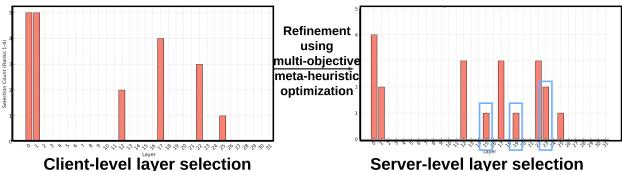
Figure 7 explicitly shows this correction. The red bars (Client-level selection) show high peaks and deep valleys—some layers are selected by everyone, others by no one. The blue bars (Server-level selection) show a much smoother distribution, ensuring the whole model participates in learning.
Dataset Contribution: Ultra-MedVQA
To rigorously test this framework, the authors needed a dataset that reflected the extreme heterogeneity of real-world healthcare. They curated and released Ultra-MedVQA, the largest medical Visual Question Answering (VQA) dataset to date.

As shown in Figure 8, the dataset covers 9 distinct modalities (MRI, CT, X-Ray, Pathology, etc.) and involves over 700,000 VQA triplets. This diversity makes it an incredibly difficult benchmark for Federated Learning, as the domain gap between a “Blood Cell” client and a “Chest X-Ray” client is massive.

Table 1 highlights the scale of this new dataset compared to existing benchmarks like SLAKE or VQA-RAD.
Experiments and Results
The researchers conducted over 10,000 client-level experiments using 4 different VLM architectures (ViLT, ALBEF, LLaVA, BLIP-2). They tested against 28 state-of-the-art baselines.
Convergence Speed
One of the most immediate benefits of F\(^3\)OCUS is faster convergence. Because the most relevant layers are targeted first, the loss drops significantly faster than with random or uniform strategies.
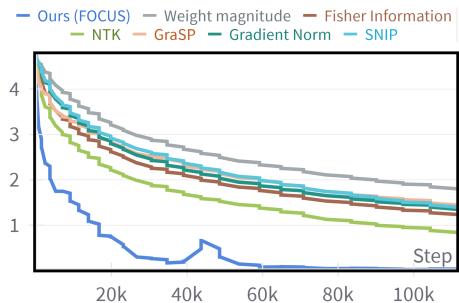
Figure 2 demonstrates this clearly. The F\(^3\)OCUS curve (blue) drops sharply and stays lower than other methods like Gradient Norm or Fisher Information. The gap between the green line (Client-specific NTK only) and the blue line (F\(^3\)OCUS) represents the value added by the server-side meta-heuristic optimization.
Accuracy and Performance
Does this strategy actually yield better medical diagnoses?
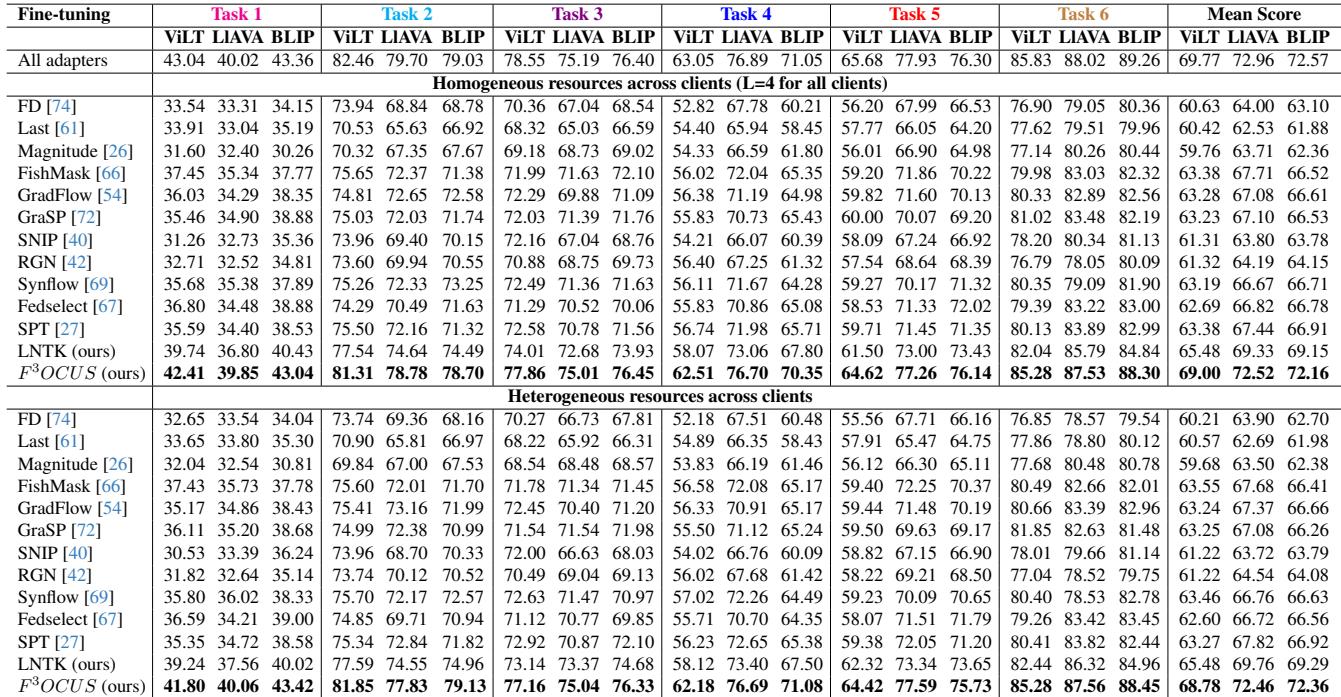
Table 2 presents the accuracy results across different tasks (VQA and Disease Classification).
- Homogeneous Resources: Even when clients have equal power, F\(^3\)OCUS outperforms “All adapters” tuning and other selection methods like “FedSelect.”
- Heterogeneous Resources: The gap widens when clients have unequal power (bottom half of the table). F\(^3\)OCUS consistently achieves the highest mean scores (e.g., 88.45% on Task 5 with BLIP, compared to ~82% for competitors).
Comparative Analysis with PEFT Methods
The method was also compared against popular parameter-efficient techniques like LoRA and Prompt Tuning.
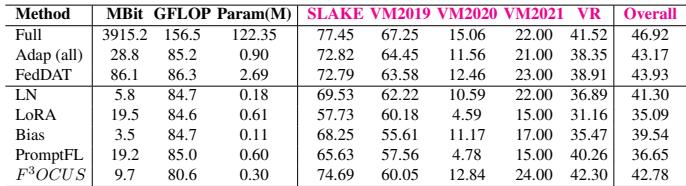
Table 3 shows that F\(^3\)OCUS achieves competitive accuracy (42.78% overall) while maintaining low communication costs (9.7 MBits) compared to full fine-tuning (3915 MBits) or standard adapter tuning. While FedDAT achieves slightly higher accuracy in some columns, it requires fine-tuning all adapters, which is computationally heavier.
Feature Separability
Finally, to visualize what the model is learning, the researchers used t-SNE plots to project the high-dimensional features of a specific client (Microscopy) into 2D space.
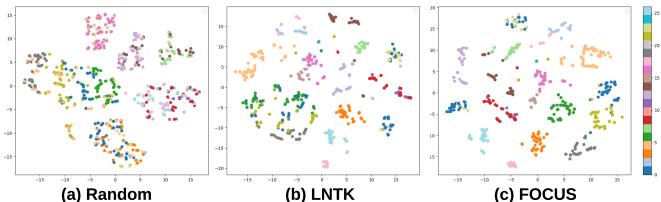
In Figure 9, we see:
- (a) Random: Classes are mashed together.
- (b) LNTK: Some clusters form, but there is significant overlap.
- (c) F\(^3\)OCUS: Distinct, tight clusters emerge. This indicates the model has learned discriminative features specific to the microscopy domain, despite being part of a federated network.
Conclusion
The F\(^3\)OCUS framework represents a significant step forward in making large-scale AI accessible in privacy-sensitive and resource-constrained environments. By treating layer selection as a two-part problem—local importance (via LNTK) and global diversity (via Meta-heuristics)—it allows disparate clients to collaborate effectively.
Key Takeaways:
- One size fits none: In Federated Learning, clients need personalized training strategies based on their unique data.
- Math guides intuition: The Neural Tangent Kernel provides a rigorous way to identify “important” layers without guessing.
- Global balance is key: Purely local optimization hurts the global model; a server-side “diversity check” is required to maintain model health.
- Real-world readiness: With the release of Ultra-MedVQA and success across diverse heterogeneous settings, F\(^3\)OCUS proves its viability for real-world medical applications.
As VLMs continue to grow in size, strategies like F\(^3\)OCUS will be essential for deploying them to the edge, ensuring that the benefits of AI in healthcare are available everywhere, from high-tech research centers to remote clinics.