](https://deep-paper.org/en/paper/file-2060/images/cover.png)
Introduction
Imagine driving a car at high speed. You rely on your eyes to detect motion instantly. Now, imagine if your brain only processed visual information in snapshots taken every few milliseconds. In that tiny fraction of a blind spot between snapshots, a sudden obstacle could appear, and you wouldn’t react in time.
This is the fundamental limitation of traditional, frame-based computer vision. Standard cameras capture the world as a series of still images. To calculate motion—specifically optical flow—algorithms compare one frame to the next. This introduces latency. You cannot detect motion until the next frame is captured and processed. For high-speed robotics, autonomous drones, or safety-critical systems, this delay (often tens of milliseconds) is an eternity.
Event cameras offer a solution. Instead of frames, they function like biological retinas, firing asynchronous signals (events) only when light intensity changes. This happens in microseconds. However, processing this continuous stream of data without losing that speed advantage is incredibly difficult.
Current Deep Learning methods often compromise: they either bundle events back into “frames” (losing speed) or process events individually but lack the “global context” to be accurate.
In this post, we will explore a novel architecture proposed in the paper “Graph Neural Network Combining Event Stream and Periodic Aggregation for Low-Latency Event-based Vision.” The researchers introduce a hybrid system—HUGNet2+PA—that combines the ultra-fast reflexes of asynchronous Graph Neural Networks (GNNs) with the contextual memory of periodic processing. The result? A system that predicts motion with a latency of 50 microseconds, approximately 1,000 times faster than state-of-the-art frame-based methods.
The Background: The Latency vs. Accuracy Dilemma
To understand the innovation here, we must first look at how machines currently “see” motion.
The Problem with Frames
In traditional computer vision, optical flow (the pattern of apparent motion of objects) is calculated by comparing pixel \(A\) in Frame 1 to pixel \(A'\) in Frame 2.
- Blind Time: Motion occurring between frames is missed.
- Computation Latency: You must wait for the entire Frame 2 to be exposed and read out before processing begins.
The Event Camera Alternative
Event cameras are bio-inspired sensors. Each pixel operates independently. When a pixel detects a change in brightness, it immediately spits out an “event”—a packet containing coordinates \((x, y)\), a timestamp \((t)\), and polarity \((p)\) (whether it got brighter or darker).
This data is sparse and asynchronous. There is no frame rate. The “temporal resolution” is in the order of microseconds.
The Processing Bottleneck
Having a fast sensor is useless if your brain (the algorithm) is slow.
- The CNN Approach: Most current methods take these fast events and stack them into a 2D grid (an “event frame”) so a standard Convolutional Neural Network (CNN) can process them. This reintroduces the latency we tried to avoid!
- The GNN Approach: Graph Neural Networks treat events as nodes in a graph connected by edges (spatio-temporal proximity). They can process data event-by-event. However, to be truly fast, these graphs cannot wait to accumulate data. They must look only at the past. This lack of “accumulated” knowledge means the network struggles to understand the global context of the scene, leading to noisy or inaccurate predictions.
The Challenge: How do you build a system that reacts instantly to new events (low latency) but still understands the broader scene context (high accuracy)?
The Core Method: HUGNet2 + Periodic Aggregation
The researchers propose a “best of both worlds” architecture. They split the problem into two parallel branches:
- The Event Branch: A lightning-fast, asynchronous branch that reacts to every single event.
- The Periodic Branch: A slower, synchronous branch that aggregates history to provide context.
Let’s visualize the high-level concept below.
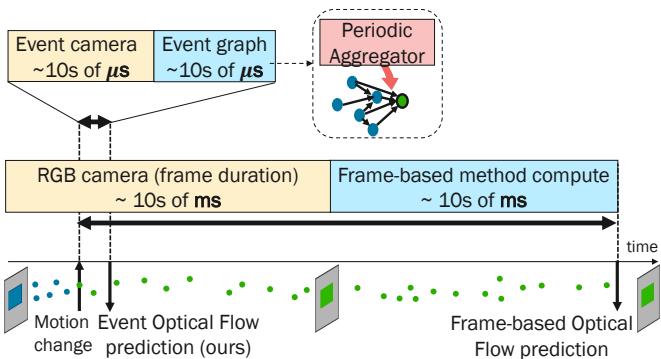
As shown in Figure 1, traditional frame-based methods (green line) update slowly. The proposed method (blue dots) updates continuously. While the frame-based method is stuck waiting for the next snapshot, the event-based prediction is already tracking the motion curve.
The Architecture in Detail
The proposed model is called HUGNet2+PA. It stands for “Hemi-spherical Update Graph Network (version 2) + Periodic Aggregator.”
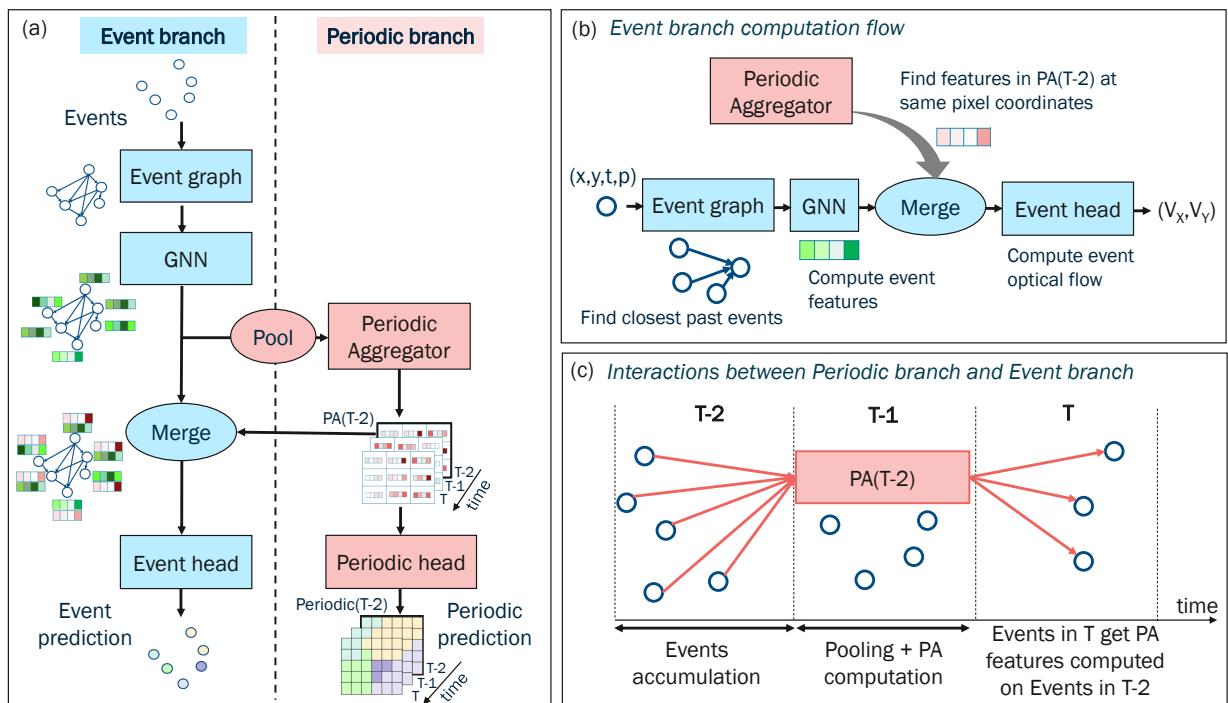
Figure 2(a) illustrates the dual-branch structure. Let’s break down the components.
1. The Event Branch (The “Reflexes”)
This branch is designed for speed. It uses HUGNet2, an improved version of a previous GNN.
- Asynchronous Graph: When a new event arrives, it is treated as a new node. It connects only to past events (directed edges).
- No Waiting: Because it doesn’t look into the future or wait for a batch of data, the graph update latency is effectively zero.
- Accumulation-Free: The researchers stripped away operations that require waiting, such as normalization across a whole graph or pooling layers.
- Processing: It uses a Point-Transformer convolution layer followed by Graph Convolutional Networks (GCNs). This extracts immediate, local features from the specific event.
2. The Periodic Branch (The “Memory”)
If the Event branch is the reflex, the Periodic branch is the memory.
- Periodic Aggregator (PA): This module runs in the background. It takes features from the GNN and accumulates them into a grid over a set period (e.g., every 50ms).
- Deep Processing: It uses Convolutional layers and Recurrent Neural Networks (ConvGRU) to process this accumulated data. It creates a dense representation of the scene’s motion history.
- The Output: It produces a dense feature map representing the “context” of the scene.
3. The Novel Merger: Solving the Time Gap
Here lies the clever engineering trick. The Event branch is operating in real-time (Time \(T\)). The Periodic branch, because it accumulates data, is always lagging behind. If the Event branch waits for the Periodic branch to finish calculating the current frame, it loses its speed advantage.
The researchers realized they didn’t need the current periodic context—they just needed some context.
As illustrated in Figure 2(c), the Event branch at Time \(T\) merges its data with the Periodic output from Time \(T-2\).
- Why T-2?
- Time \(T\): Events are happening now.
- Time \(T-1\): The Periodic branch is currently processing the data collected during this period.
- Time \(T-2\): This processing is finished and available in memory.
By using the “old” context (\(PA(T-2)\)) combined with “live” event features, the system achieves zero-wait latency. The Event head (a fully connected layer) learns to fuse these two distinct timelines. It uses the live event features to correct the old context, allowing it to detect sudden changes that the periodic branch hasn’t noticed yet.
Experiments & Results
The researchers validated their approach using two datasets: MVSEC (real-world driving/drone footage with smooth motion) and Rock Scenes (synthetic data with extremely fast, jerky motion changes).
Accuracy vs. Efficiency
First, let’s look at the performance on the MVSEC dataset.
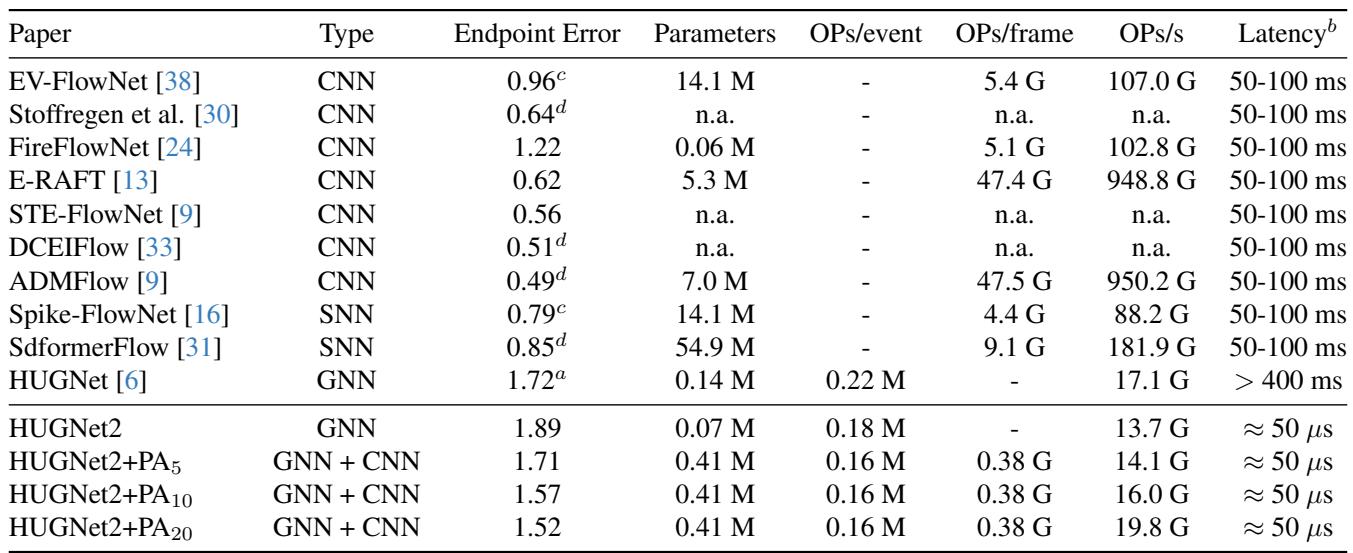
Table 1 reveals several key insights:
- Latency Dominance: The latency of HUGNet2+PA is \(\approx 50 \mu s\). Compare this to the 50-100 ms latency of CNN/SNN methods. This is a reduction of three orders of magnitude.
- Efficiency: The method requires drastically fewer operations. For example, compared to E-RAFT, HUGNet2+PA uses roughly 50x fewer operations per second (19.8 G vs 948.8 G).
- Accuracy Trade-off: The Endpoint Error (1.52) is higher than the heavy frame-based methods (like E-RAFT’s 0.62). This is expected; those methods use massive computation and look at future frames (smoothing). However, for applications requiring microsecond reactions, this accuracy is acceptable, especially given the speed.
The “Reflex” Test: Detecting Fast Motion
The real power of this method shines in the Rock Scenes dataset, which features abrupt, random motion changes (e.g., an object instantly changing direction). This simulates worst-case scenarios for autonomous systems.
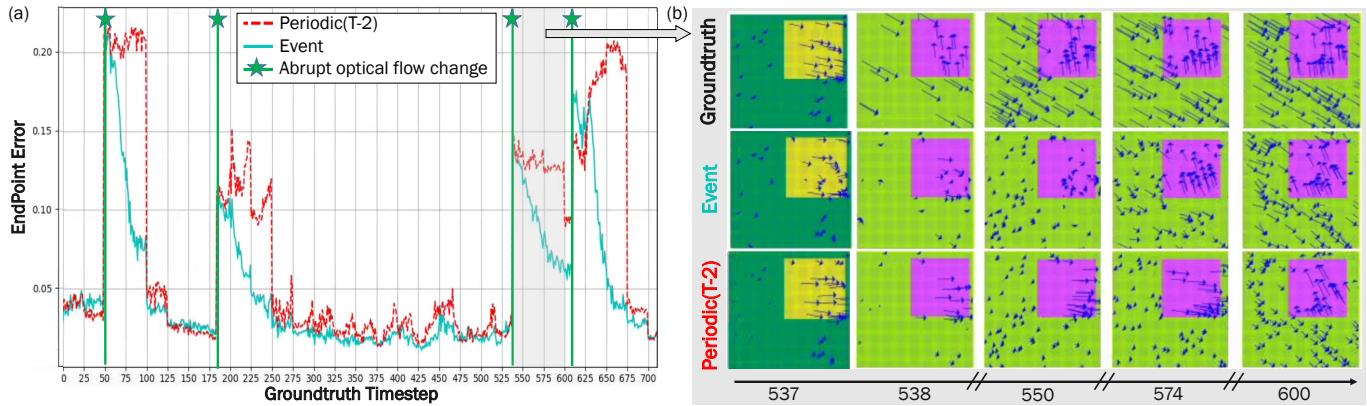
Figure 4 is perhaps the most critical visualization in the paper. It plots the error over time during an abrupt motion change (marked by the green star).
- The Red Line (Periodic T-2): This represents the “memory” or a standard frame-based approach. Notice how the error spikes and stays high for a long time after the change. It is “blind” to the new motion until its processing catches up.
- The Teal Line (Event): This is the HUGNet2+PA prediction. The error spikes at the moment of change, but recovers much faster.
Because the Event branch has access to the live stream of events, it “sees” the change immediately. Even though it is using old context (\(T-2\)), the GNN features from the new events provide enough signal to override the old memory and correct the trajectory.
Balancing the Branches
Is it better to rely more on the event stream or the periodic context? The researchers analyzed this trade-off.
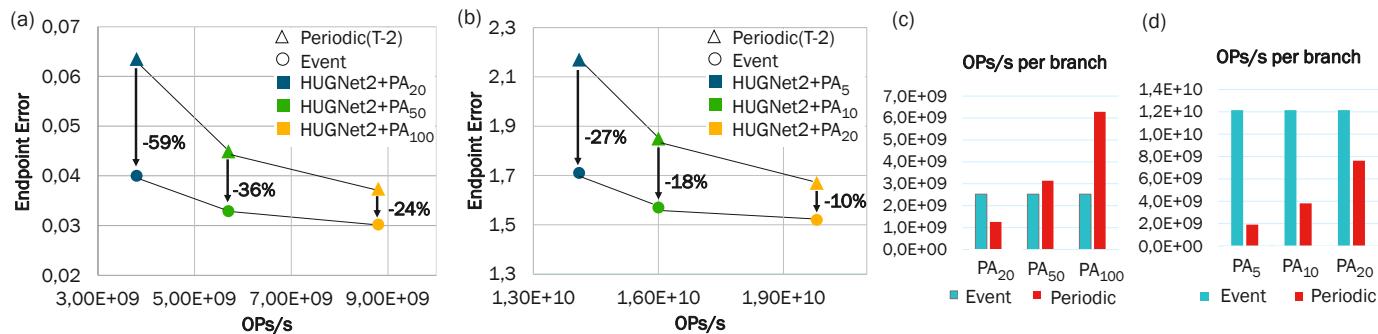
Figure 3 shows the relationship between computational cost (OPS/s) and error.
- The “Event” curve (Teal circles) consistently sits lower than the “Periodic” curve (Red circles) in plot (a). This means that for the same computational effort, the hybrid Event prediction is significantly more accurate—up to 59% better on Rock Scenes.
- This confirms that adding the asynchronous event branch isn’t just “faster”; it actually improves accuracy during dynamic scenes by filling in the gaps left by the periodic aggregator.
Comparison with Frame-Based Methods
The researchers also implemented a state-of-the-art frame-based method, ADMFlow, to compare directly on the Rock Scenes dataset.
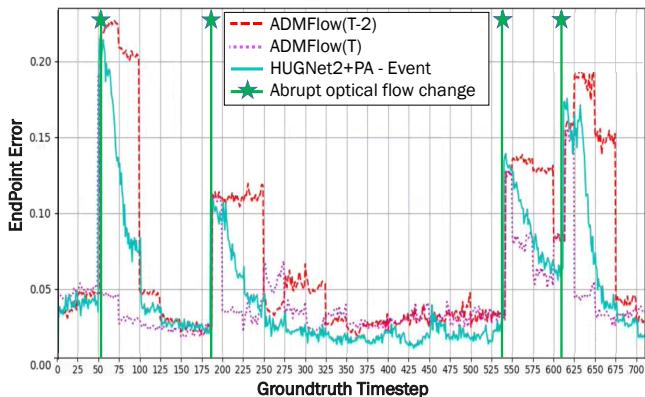
Figure 5 shows the timeline of errors.
- ADMFlow(T) (Purple Dotted): This method technically has lower error after it has processed the frame. However, in a real-time scenario, you don’t have the result at Time \(T\). You have to wait.
- ADMFlow(T-2) (Red Dashed): This represents the information actually available to a robot in real-time. It suffers from significant lag.
- HUGNet2+PA (Teal Solid): It provides a much more stable and responsive error profile than the delayed frame-based method. It bridges the gap between the “perfect but slow” future and the “available but old” past.
Conclusion and Implications
The paper “Graph Neural Network Combining Event Stream and Periodic Aggregation for Low-Latency Event-based Vision” presents a significant step forward for neuromorphic engineering. By accepting that we cannot process everything instantly, the authors designed a system that processes context slowly and changes instantly.
Key Takeaways:
- Architecture: A hybrid GNN (Event) + CNN/RNN (Periodic) structure.
- Innovation: Merging live event features with delayed (\(T-2\)) context features to ensure zero-wait latency.
- Performance: 50 \(\mu s\) latency (vs 50ms for standard methods) with massive power savings.
- Application: Ideal for scenarios where “reaction time” is more valuable than “pixel-perfect smoothing,” such as drone racing, collision avoidance, and high-speed robotics.
This work suggests that the future of computer vision isn’t just about bigger models or higher frame rates. It’s about rethinking time—treating vision not as a sequence of photographs, but as a continuous, flowing stream of information, just like the real world.