](https://deep-paper.org/en/paper/file-2068/images/cover.png)
Introduction
In the world of 3D computer vision and graphics, reconstructing a surface from a point cloud is a fundamental task. Whether you are scanning a room for AR applications or creating assets for a video game, the goal is often the same: take a cloud of disconnected dots and turn them into a watertight, smooth, and detailed 3D mesh.
For years, the gold standard for this process has been Marching Cubes (MC). When combined with Neural Implicit Representations—specifically Signed Distance Functions (SDFs)—MC is incredibly reliable. However, it has a significant flaw: it is rigid. MC operates on a fixed resolution grid. If you want high details, you need a high-resolution grid, which generates millions of tiny triangles, leading to massive file sizes and memory usage. If you want a lightweight file, you lower the grid resolution, but you immediately lose sharp edges and fine details.
This creates a frustrating trade-off: High Fidelity vs. Lightweight. Usually, you can’t have both.
In this post, we will dive deep into a CVPR paper titled “High-Fidelity Lightweight Mesh Reconstruction from Point Clouds.” The researchers propose a novel pipeline that bypasses the limitations of the traditional voxel grid. Instead of treating every part of space equally, their method adapts to the geometry, placing more mesh elements where the surface curves and fewer where it is flat.
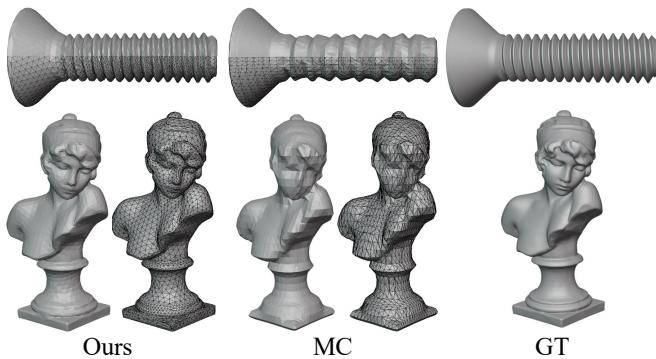
As shown in Figure 1, when restricted to the same number of elements (vertices and faces), traditional Marching Cubes (MC) fails to capture the intricate facial features of the sculpture. In contrast, the method we are discussing today (Ours) produces a result that is nearly indistinguishable from the Ground Truth (GT).
Let’s explore how they achieved this.
Background: The Problem with Uniform Grids
To understand the innovation here, we must first understand the current standard. Modern reconstruction methods often learn a Signed Distance Function (SDF) from a point cloud. An SDF is a continuous mathematical function that tells you, for any point in 3D space, how far you are from the surface. If the value is 0, you are on the surface.
Once the SDF is learned, we need to extract the mesh. Algorithms like Marching Cubes divide the 3D space into a uniform grid of cubes (voxels). It checks the SDF value at the corners of every cube. If a cube intersects the zero-level set (the surface), it draws triangles inside that cube.
The problem is uniformity. A flat wall requires very few triangles to represent, while a detailed statue face requires thousands. Marching Cubes treats the wall and the face exactly the same. This results in “redundant mesh elements”—wasted triangles on flat surfaces—and a lack of resolution in detailed areas unless the entire grid resolution is cranked up.
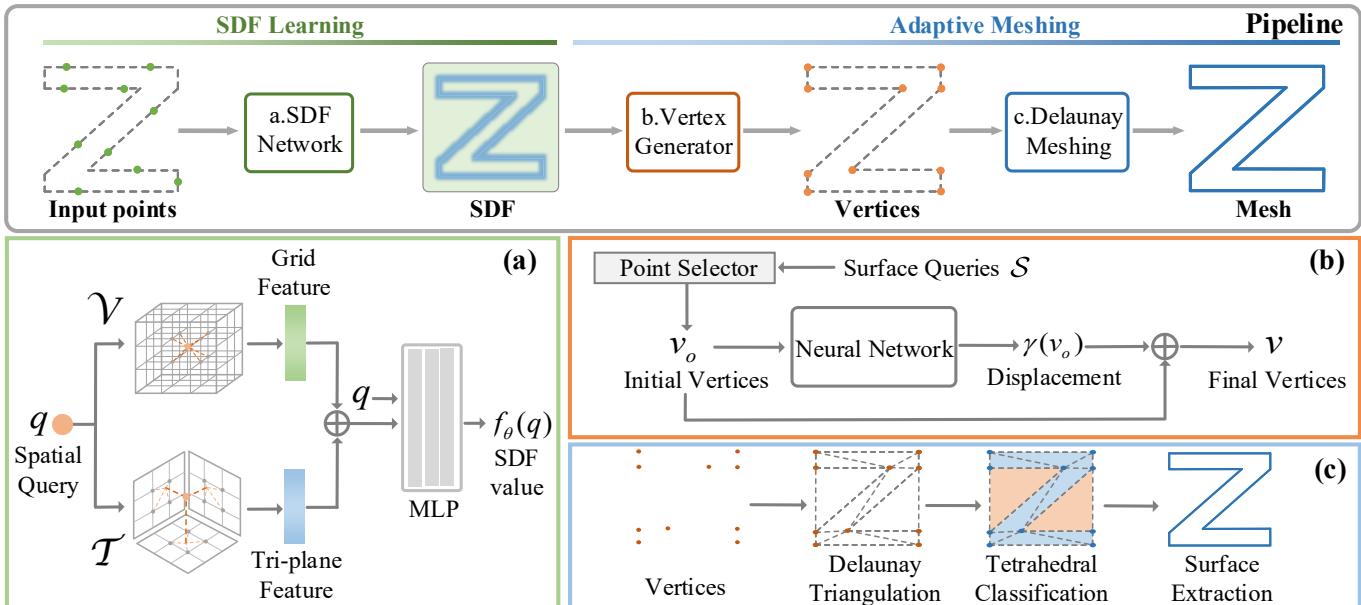
The researchers propose a Lightweight Mesh Reconstruction (LMR) pipeline that moves away from this uniform approach. Their method consists of two main stages:
- SDF Learning: Using a hybrid feature representation to learn a highly accurate implicit surface.
- Adaptive Meshing: Generating vertices based on surface curvature and connecting them using Delaunay triangulation.
Part 1: Learning a Better SDF
Before generating a mesh, we need a high-quality implicit representation of the shape. Many previous methods utilize a simple Multi-Layer Perceptron (MLP) to learn the SDF. While MLPs are continuous, they often struggle to memorize high-frequency details (sharp edges or textures) because they tend to over-smooth data.
To solve this, the authors introduce a Hybrid Feature Representation.
Combining Grids and Tri-planes
Instead of relying solely on an MLP, this method explicitly stores learnable features in two structures:
- Voxel Grid (\(\mathcal{V}\)): A 3D grid of feature vectors. This provides strong spatial awareness.
- Tri-plane (\(\mathcal{T}\)): Three 2D planes (\(xy, yz, zx\)) that store projected features. This helps maintain smoothness and reduces the artifacts that sometimes appear with pure voxel grids.
When the network needs to know the feature at a specific query point \(q\), it pulls data from both the grid and the tri-planes.
The feature extraction is defined as:

Here, \(TriI\) represents trilinear interpolation from the 3D grid, and \(BiI\) represents bilinear interpolation from the 2D planes. By summing these up, the model gets a rich feature vector \(fea(q)\) that combines 3D precision with 2D smoothness.
This feature vector is concatenated with the coordinate \(q\) and passed into a small MLP (\(g_{mlp}\)) to predict the SDF value:

Training with Neural Pull
To train this network, the authors utilize the Neural Pull mechanism. The core idea is to project a query point \(q\) onto the surface using the predicted SDF value \(f_\theta(q)\) and its gradient \(\nabla f_\theta(q)\).
The projection operation looks like this:

Here, \(s_{\theta, q}\) is the projected point on the surface. The network is trained by minimizing the distance between this projected point and the nearest point \(p\) in the ground truth point cloud.
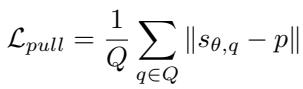
Additionally, to ensure the gradients are accurate (which is crucial for the meshing step later), they enforce a gradient consistency loss:

This ensures that the gradient at the query point \(q\) aligns with the gradient at the surface point \(s\). The total loss for SDF learning combines these two objectives:

Part 2: Curvature-Adaptive Vertex Generation
This is the heart of the paper. Once the SDF is learned, standard methods would run Marching Cubes. This method, however, builds the mesh from the ground up by placing vertices intelligently.
The Intuition
Imagine you are an artist sketching a face. You wouldn’t draw dots evenly spaced everywhere. You would bunch your dots together around the eyes, nose, and lips (high curvature) and spread them out on the forehead and cheeks (low curvature). This method does exactly that mathematically.
Calculating Curvature
First, the system needs to “see” the surface curvature. It creates a set of Surface Queries (\(S\)) by projecting random points onto the zero-level set of the SDF.
For a specific point \(s\), the curvature is estimated by looking at its neighbors. The method calculates how much the surface normal (the direction perpendicular to the surface) changes between point \(s\) and its neighbor \(s_k\).

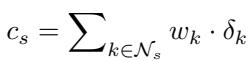
Here, \(\delta_k\) represents the deviation. If the normals are pointing in the same direction, \(\delta_k\) is near 0 (flat). If they diverge, the value is higher (curved). These deviations are weighted by a Gaussian kernel \(w_k\) based on distance:
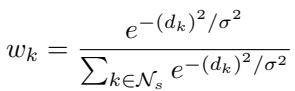
Finally, the mean curvature \(c_s\) for the point is obtained by summing these weighted deviations:
The Vertex Generator Network
The system initializes a set of vertices \(v_o\) (using Farthest Point Sampling to ensure good coverage) and then uses a Vertex Generator network to refine their positions. The goal is to move these vertices so they cluster in high-curvature areas.
The refined position \(v\) is calculated as the original position plus a learned displacement:

The network \(\gamma\) is a Point-Transformer. But how does it know where to move the points? The authors design specific loss functions to guide this behavior.
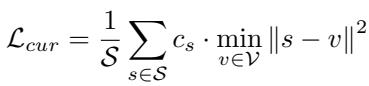
1. Curvature-Weighted Attraction (\(\mathcal{L}_{cur}\)): This loss pulls vertices toward surface points (\(s \in S\)), but it pulls harder if the surface point has high curvature (\(c_s\)).
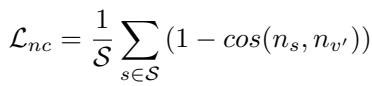
2. Normal Consistency (\(\mathcal{L}_{nc}\)): To ensure the vertices settle on the surface correctly, their normals must align with the underlying SDF normals.
3. Repulsion Loss (\(\mathcal{L}_{rep}\)): To prevent all vertices from collapsing into a single singularity or clustering too densely, a repulsion loss forces them to maintain some distance from each other.

Combining these losses creates a “force field” where vertices slide along the implicit surface, naturally accumulating at sharp edges and corners while maintaining a sparse distribution on flat areas.
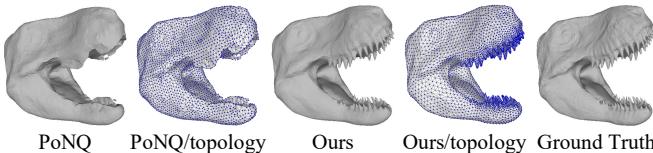
Figure 5 clearly illustrates the result. Notice how the “Ours” method concentrates the blue vertices along the sharp edges of the shape, whereas the comparison method (PoNQ) has a more uniform, less efficient distribution.
Part 3: Delaunay Meshing
We now have a cloud of optimized vertices sitting on the surface. To turn this into a mesh, we need to connect them with triangles.
The authors use Delaunay Triangulation. In 3D, this algorithm connects points to form tetrahedrons (pyramids with 4 triangular faces) that fill the volume. The result is a solid block of tetrahedrons.
To extract the surface mesh, we must classify each tetrahedron as being either Inside or Outside the shape. The surface of the object is essentially the boundary between the “Inside” tetrahedrons and the “Outside” tetrahedrons.
Multi-label Voting
Determining if a tetrahedron is inside the shape can be tricky near the boundaries. The authors propose a probabilistic approach. They sample multiple random reference points inside each tetrahedron. For every reference point, they check the SDF value.
- SDF < 0: The point is inside.
- SDF > 0: The point is outside.
The tetrahedron is assigned the label (Inside/Outside) that receives the most votes.
Neighborhood Label Constraint
A common issue with this voting approach is that thin, narrow tetrahedrons near the surface can be misclassified, leading to “non-manifold” geometry (edges shared by more than two faces, or vertices connecting two disconnected volumes). This ruins the mesh topology.
To fix this, the authors implement a constraint based on neighbors.

As visualized in Figure 3, the method looks at the four neighbors of a tetrahedron. If a tetrahedron has a label that disagrees with the majority of its neighbors, its label is flipped. This simple “peer pressure” rule smooths out the classification noise and ensures the resulting mesh is watertight, manifold, and free of self-intersections.
Experiments and Results
The authors tested their method against several state-of-the-art techniques, including Neural Marching Cubes (NMC), Neural Dual Contouring (NDC), and PoNQ.
Visual Quality
The visual results are striking, particularly when looking at complex organic shapes and sharp mechanical parts.
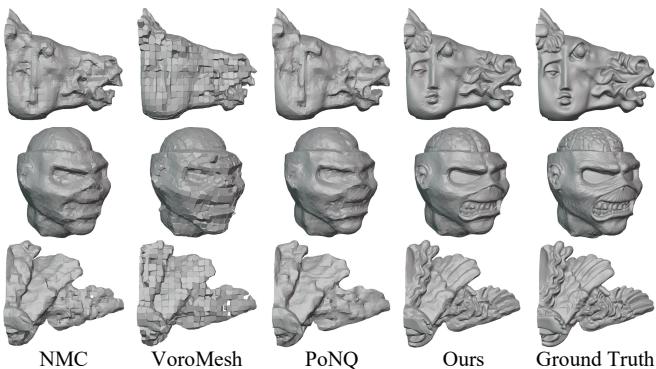
In Figure 4, look at the dinosaur skull (bottom row). The methods NMC and VoroMesh struggle with the thin structures of the bone, leaving gaps or creating blobs. The proposed method (Ours) maintains the structural integrity of the skull even at this low resolution.
Detail Preservation
When comparing reconstruction on the Stanford dataset, the method demonstrates its ability to preserve detail significantly better than standard approaches.
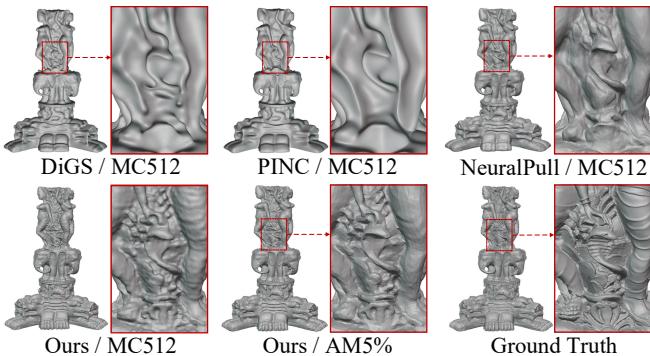
In Figure 6, compare “Ours / MC512” (using high-res Marching Cubes) with “Ours / AM5%” (Adaptive Meshing using only 5% of the vertex count). The visual difference is negligible, yet the AM version uses a fraction of the data. This validates the core premise of the paper: adaptive meshing allows for lightweight files without sacrificing fidelity.
Scalability
The method isn’t just for single objects; it scales to entire scenes.
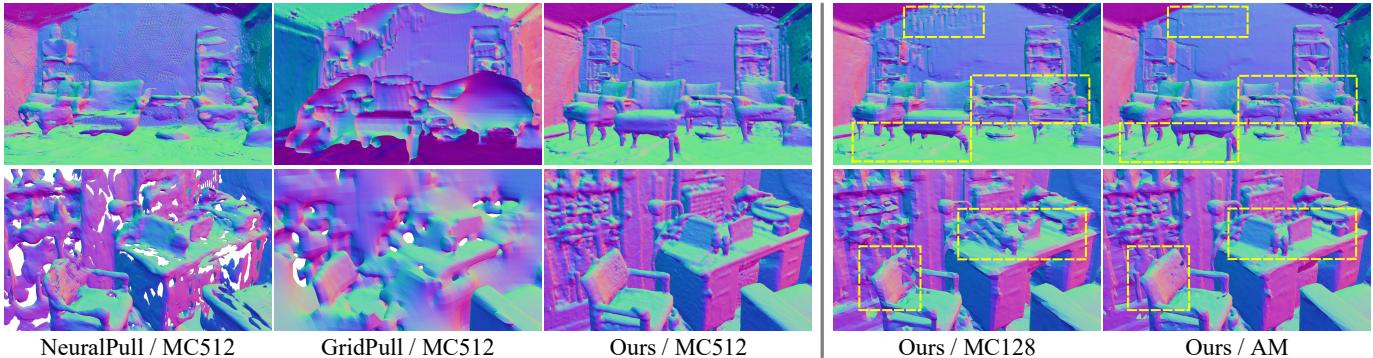
Figure 8 shows reconstructions of indoor scenes from ScanNet. The adaptive meshing (AM) preserves the sharp boundaries of the furniture (like the desk and chair) much better than GridPull or NeuralPull, which tend to generate noisy or bumpy surfaces.
Quantitative Analysis
The paper provides extensive tables, but the key takeaway is regarding the Curvature Error (CE) and Topology Correctness (CT).
- Curvature Error: The proposed method consistently achieves lower curvature error, meaning it accurately follows the bends and twists of the ground truth surface.
- Topology: Many neural meshing methods fail to produce manifold meshes (CT < 1.0). The proposed method achieves a perfect 1.0 score for watertightness and manifoldness in almost all tests.
Conclusion
The research presented in “High-Fidelity Lightweight Mesh Reconstruction from Point Clouds” offers a compelling solution to the efficiency problem in 3D reconstruction. By abandoning the uniform grid of Marching Cubes and adopting a curvature-adaptive strategy, the authors bridge the gap between high visual fidelity and low storage requirements.
Key takeaways from this work:
- Hybrid Features Matter: Combining Voxel Grids with Tri-planes creates a more robust SDF than MLPs alone.
- Point-Based Representation: Treating the implicit surface as a dynamic set of points allows for direct optimization of vertex positions based on geometry.
- Topology is Key: Using Delaunay triangulation with neighborhood constraints ensures the final mesh is usable in downstream applications (like physics simulations or 3D printing) without needing extensive cleanup.
As 3D content becomes more prevalent on the web and in mobile applications, techniques like this—which maximize quality while minimizing bandwidth and processing power—will become increasingly standard in the computer vision pipeline.