](https://deep-paper.org/en/paper/file-2083/images/cover.png)
Dreaming of Data: How ImagineFSL Revolutionizes Few-Shot Learning with Synthetic Pretraining
In the world of deep learning, data is the fuel that powers the engine. But what happens when that fuel runs low? This is the core challenge of Few-Shot Learning (FSL)—teaching a model to recognize new concepts with only one or a handful of examples.
Recently, Vision-Language Models (VLMs) like CLIP have shown incredible promise in this area. However, adapting these massive models to specific tasks with tiny datasets remains a hurdle. The community’s recent answer has been Generative AI. If we don’t have enough data, why not just generate it using Text-to-Image (T2I) models like Stable Diffusion?
Most current approaches treat synthetic images as a side dish—a simple augmentation to mix in with real images during fine-tuning. But a new paper titled “ImagineFSL” asks a bolder question: What if synthetic images were the main course?
In this post, we will dive deep into ImagineFSL. We will explore how the authors propose treating synthetic data as a standalone knowledge repository (an “Imagined Base Set”), and how they developed a novel self-supervised learning method called HoM-DINO to extract rich representations from this “dreamt” data.
The Problem: The Scarcity Trap
Imagine you want to build a system to classify rare bird species. You have a powerful foundation model like CLIP, but you only have one or two photos of each bird (1-shot or 2-shot learning).
Fine-tuning a massive model on such a tiny dataset usually leads to overfitting—the model memorizes the specific few images rather than learning what the bird actually looks like.
To fix this, researchers started using T2I models to generate “fake” images of the birds to pad the dataset. Current methods (like IsSynth or DataDream) typically generate these images and immediately mix them with real data to fine-tune the model. While effective, the authors of ImagineFSL argue this is sub-optimal. It treats synthetic data merely as a complement, ignoring the fact that modern T2I models contain a vast, diverse understanding of the world derived from their own distinct training.
The Solution: ImagineFSL
The core insight of ImagineFSL is a paradigm shift: Frame synthetic images as an independent, large-scale dataset called the Imagined Base Set (iBase).
Instead of jumping straight to fine-tuning, ImagineFSL introduces a two-stage process:
- Pretraining: The model spends time learning solely from the iBase using a specialized Self-Supervised Learning (Self-SL) technique.
- Fine-Tuning: Only after pretraining does the model adapt to the downstream task using the few real images available (augmented by task-specific synthetic ones).
Let’s break down the architecture.
Stage 1: Self-Supervised Pretraining on iBase
The goal of this stage is to train an Adapter—a small, learnable module attached to the frozen CLIP image encoder—to understand visual concepts purely from synthetic data. To do this, the authors introduce a method called HoM-DINO.
The Architecture: HoM-DINO
The method builds upon DINO (Self-distillation with NO labels), a popular self-supervised learning framework. It uses a Teacher-Student setup. The “Student” network tries to match the output of the “Teacher” network. The Teacher is simply a moving average of the Student, providing a stable target.
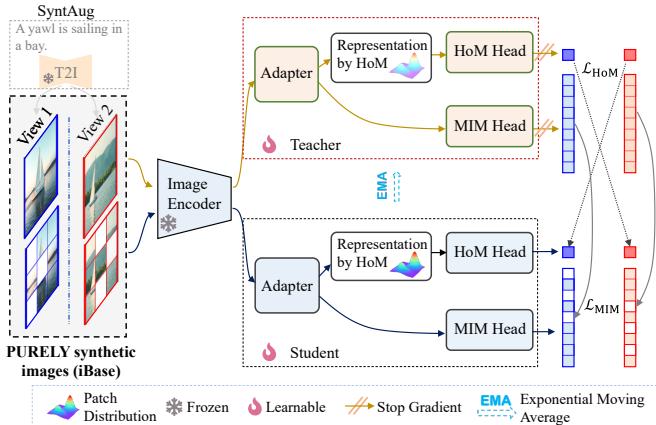
As shown in Figure 1 (a) above, the architecture introduces two critical innovations tailored for synthetic data: Synthetic Augmentation (SyntAug) and Higher-order Moments (HoM).
Innovation 1: Synthetic Augmentation (SyntAug)
In traditional self-supervised learning, you take one image and apply random crops or color jitters to create two “views.” The model learns that these two distorted views represent the same object.
ImagineFSL takes a smarter approach. Since they are generating the data, they use the T2I model to generate two different images from the same text caption. For example, the prompt “A yawl is sailing in a bay” generates two distinct synthetic images. These images depict the same semantic concept but possess natural, realistic variations in lighting, angle, and style. This pushes the model to learn semantic consistency rather than just invariance to cropping.
Innovation 2: Higher-order Moments (HoM)
Standard DINO relies on the [CLS] (classification) token to represent an image. However, in few-shot tasks, local details (patches) are crucial. The authors argue that a single token isn’t enough.
Instead, they propose representing the image by modeling the distribution of patch tokens. Rather than assuming a simple Gaussian distribution, they explicitly calculate Higher-order Moments:
- First Moment (\(m_1\)): The mean (center) of the patch features.
- Second Moment (\(m_2\)): The variance (spread), utilizing square root normalization.
- Third Moment (\(m_3\)): The skewness (asymmetry), utilizing cubic root normalization.
By concatenating the [CLS] token with these statistical moments, they create a rich, dense representation of the image, denoted as vector \(\mathbf{r}\).

The model minimizes the difference between the Student’s and Teacher’s representations using the HoM Loss, which is based on the Kullback-Leibler (KL) divergence:

Innovation 3: Masked Image Modeling (MIM)
To further force the model to look at details, they employ Masked Image Modeling. They randomly mask parts of the image fed to the Student. The Student must then predict the features of the missing patches, using the Teacher’s view of the full image as the ground truth.

By combining the global semantic understanding from HoM and the local dense understanding from MIM, the adapter becomes incredibly robust before it ever sees a real photograph.
Stage 2: Fine-Tuning for Downstream Tasks
Once the adapter is pretrained on the iBase, the student branch is discarded, and the teacher’s adapter is kept. Now, the model is ready for the specific task (e.g., classifying aircraft or flowers).
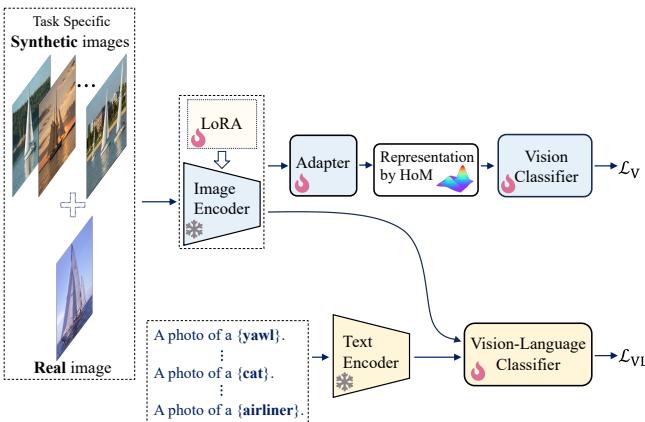
As illustrated in Figure 1 (b) above, the fine-tuning stage involves:
- Inputs: A mix of the few available Real Images and Task-Specific Synthetic Images.
- Vision Classifier (\(L_V\)): A standard classifier trained on image features.
- Vision-Language Classifier (\(L_{VL}\)): This integrates CLIP’s text capabilities. Text prompts (like “A photo of a {cat}”) are passed through the Text Encoder to initialize the classifier weights, ensuring the model retains its language-aligned knowledge.
The authors also introduce a variant called ImagineFSLLoRA, which further fine-tunes the CLIP image encoder itself using Low-Rank Adaptation (LoRA), squeezing out even more performance.
The Engine Room: Synthesizing the Data
A major contribution of this paper is not just how to use synthetic data, but how to generate it effectively at scale. The authors developed a pipeline using Chain-of-Thought (CoT) and In-Context Learning (ICL).
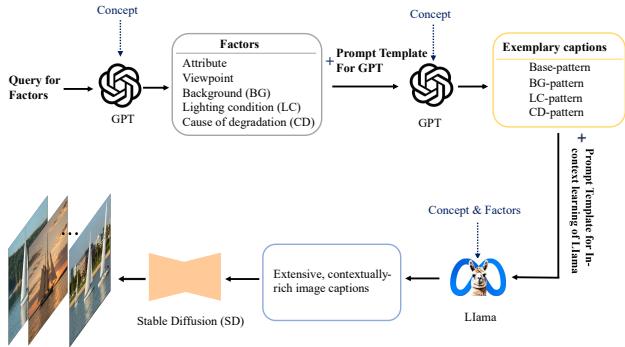
As shown in Figure 2, the pipeline works in three steps:
- Factor Analysis (GPT-4): The system asks GPT-4 to analyze a concept (e.g., “Airship”) and identify key visual factors like Attribute, Background, Viewpoint, Lighting, and Degradation.
- Caption Generation (Llama): GPT-4 creates a few “exemplary captions” based on patterns (e.g., Background-focused pattern). These examples are fed into a locally hosted Llama model, which then generates thousands of diverse, detailed captions.
- Image Generation (Stable Diffusion): Finally, Stable Diffusion 3 generates the images based on these rich captions.
This automated pipeline ensures the iBase is diverse and high-quality without requiring manual prompt engineering for thousands of classes.
Experiments and Results
Does “dreaming” before learning actually help? The authors validated ImagineFSL across 11 diverse datasets (ImageNet, EuroSAT, UCF101, etc.).
Comparison with Synthetic-Based Methods
First, they compared ImagineFSL against other methods that use synthetic data, such as IsSynth, CaFo, and DataDream.
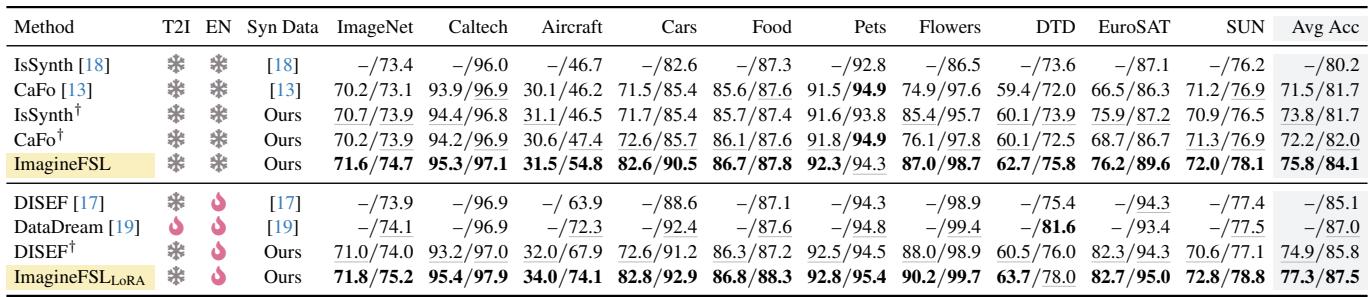
Table 1 shows clear dominance. In the 1-shot setting (learning from a single image), ImagineFSL outperforms the closest competitor (CaFo+) by nearly 2% on average. The variant ImagineFSLLoRA pushes this lead even further, establishing a new state-of-the-art.
Comparison with Real-Only Methods
Next, they compared it against standard Few-Shot Learning methods that utilize only real images (Prompt Tuning, Adapter Tuning).
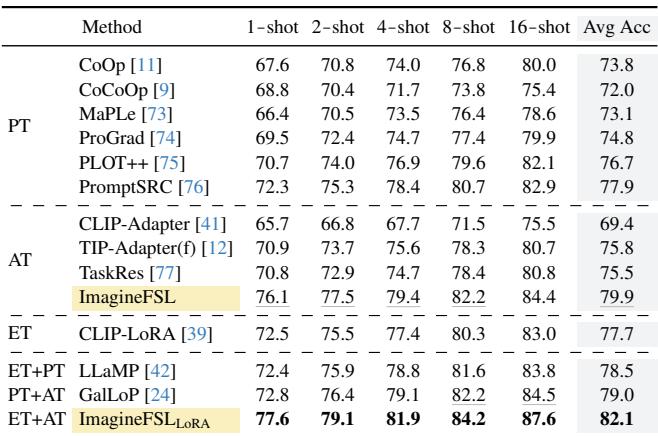
Table 2 highlights the massive advantage of leveraging synthetic data correctly. ImagineFSL beats standard adapter methods like Tip-Adapter by over 4% in accuracy in the 1-shot setting. This proves that the “imagined” knowledge provides a robust foundation that real data alone cannot match when samples are scarce.
Domain Generalization
A true test of a model is how well it handles data that looks different from its training set (e.g., sketches or adversarial examples).
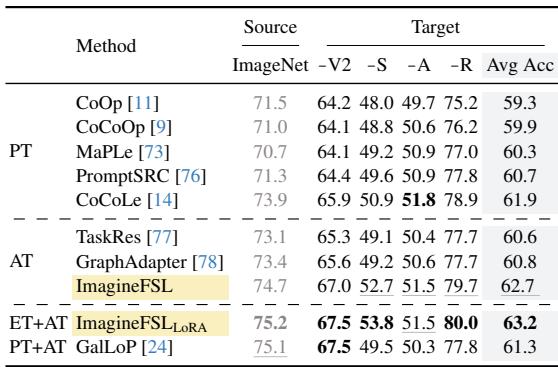
In Table 3, the model was trained on ImageNet (real photos) and tested on difficult variants like ImageNet-Sketch (IN-S) and ImageNet-Rendition (IN-R). ImagineFSL achieves the highest accuracy, suggesting that the diverse, hallucinated variations seen during pretraining help the model generalize to unseen artistic styles.
Zero-Shot Recognition
Perhaps most impressively, the method works even with zero real examples. By fine-tuning strictly on the synthetic iBase and task-specific synthetic data, the model can recognize categories it has never seen in reality.
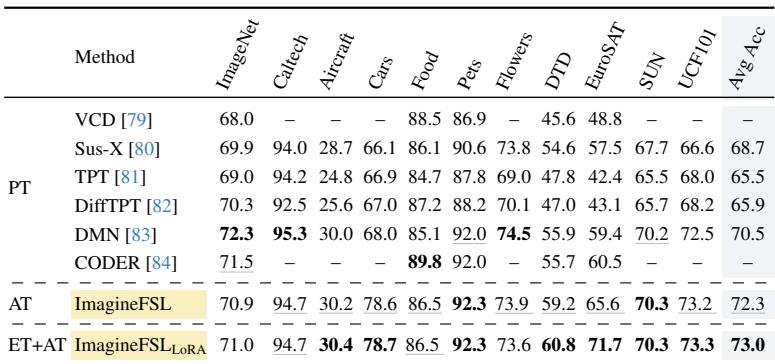
Table 4 shows that ImagineFSL outperforms specialized zero-shot methods like TPT and DMN. This confirms that the synthetic data generated by the pipeline is high-fidelity enough to serve as a proxy for reality.
Efficiency and Ablation
You might worry that adding a pretraining stage makes the process too slow.
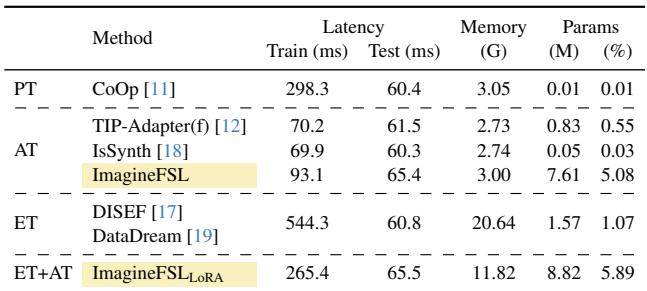
Table 5 reveals that while ImagineFSL takes slightly longer to train than simple adapters (due to the pretraining stage), it is significantly faster and more memory-efficient than full fine-tuning methods like DISEF. The inference speed (test latency) remains comparable to lightweight adapters.
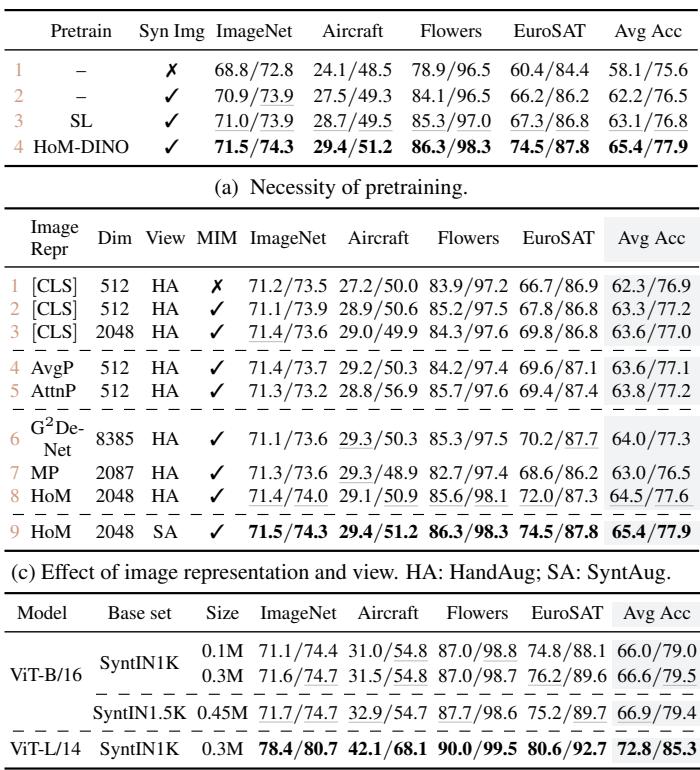
Finally, an ablation study (Table 6 below) confirms that every component matters.
- Row 3 vs. Row 4: Self-Supervised Learning (HoM-DINO) beats Supervised Learning (SL) for pretraining.
- Row 1 vs. Row 8: Using Higher-order Moments (HoM) is significantly better than just using the
[CLS]token.
Conclusion
ImagineFSL makes a compelling case for a new workflow in AI: Pretrain on dreams, fine-tune on reality.
By treating synthetic data as a standalone repository of knowledge—an “Imagined Base Set”—and applying sophisticated self-supervised learning techniques like HoM-DINO, we can extract deep, transferable representations. This approach solves the data scarcity problem not just by adding more data, but by changing how the model learns from that data.
The implications are exciting. As Generative AI models (T2I) continue to improve in realism and diversity, the effectiveness of methods like ImagineFSL will only grow. We are moving toward a future where AI models effectively teach each other—one generating the curriculum, and the other learning to see.