](https://deep-paper.org/en/paper/file-2084/images/cover.png)
Beyond Matching: How Implicit Learning Solves Image-to-Point Cloud Registration
Imagine you are a robot navigating a city. You have a pre-built 3D map of the city (a point cloud), and you just took a picture with your onboard camera. To know where you are, you need to figure out exactly where that 2D picture fits inside that massive 3D world. This problem is known as Image-to-Point Cloud Registration.
It sounds simple in theory—just line up the picture with the 3D model—but in practice, it is incredibly difficult. Why? Because you are trying to match two completely different types of data: a 2D grid of pixels (the image) and an unordered set of spatial coordinates (the point cloud).
For years, researchers have relied on “matching-based” methods. These involve finding key feature points in the image, finding feature points in the 3D cloud, and trying to force them to match. However, this approach is often brittle. The modality gap between 2D appearance and 3D structure leads to many incorrect matches, and the final step usually relies on traditional algorithms that can’t be optimized by the neural network itself.
In this post, we are diving deep into a paper titled “Implicit Correspondence Learning for Image-to-Point Cloud Registration” (CVPR). This research introduces a new architecture that moves away from explicit feature matching. Instead, it uses “implicit queries” and geometric priors to achieve state-of-the-art accuracy.
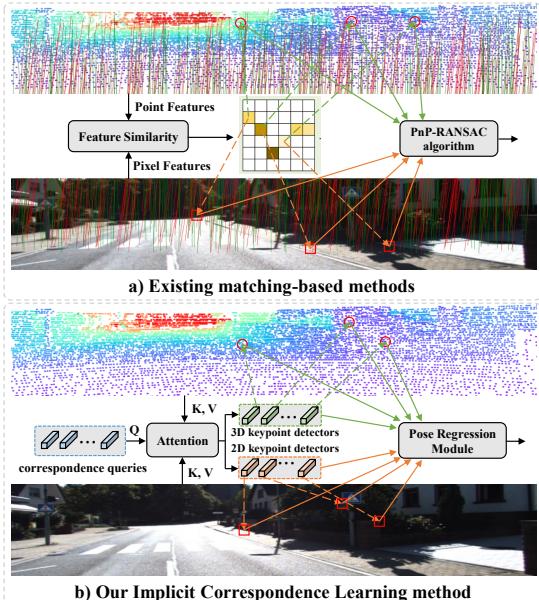
As illustrated in Figure 1 above, the traditional approach (a) often results in a “spaghetti” of red incorrect correspondences. The proposed method (b), which we will unpack in this article, uses a smarter, query-based system to find robust connections between the two worlds.
The Core Problem: The Modality Gap
Before understanding the solution, we must appreciate the difficulty of the problem.
1. The Overlap Issue
When you look at a large 3D point cloud of a city, your camera only sees a tiny slice of it (the camera frustum). The first step in registration is usually determining which specific 3D points are actually visible in the 2D image. Existing methods use “point-wise classification,” asking the network to look at every single 3D point and say “Yes/No” to whether it’s in the picture. This is noisy and often results in ragged, inaccurate boundaries.
2. The Matching Issue
Standard methods try to force a 2D pixel feature to look mathematically identical to a 3D point feature. This is unnatural. A pixel contains color and texture information; a point contains geometric structure. Forcing them into the same latent space often confuses the network, leading to the mismatches seen in Figure 1(a).
3. The Optimization Issue
After finding matches, traditional pipelines hand the data over to an algorithm called PnP-RANSAC (Perspective-n-Point with Random Sample Consensus) to calculate the final position. While robust, this step is usually a “black box” to the neural network—it cannot learn to improve the PnP step during training.
The Solution: Implicit Correspondence Learning
The authors propose a unified framework that tackles these three problems using three distinct modules. Let’s break down the architecture.
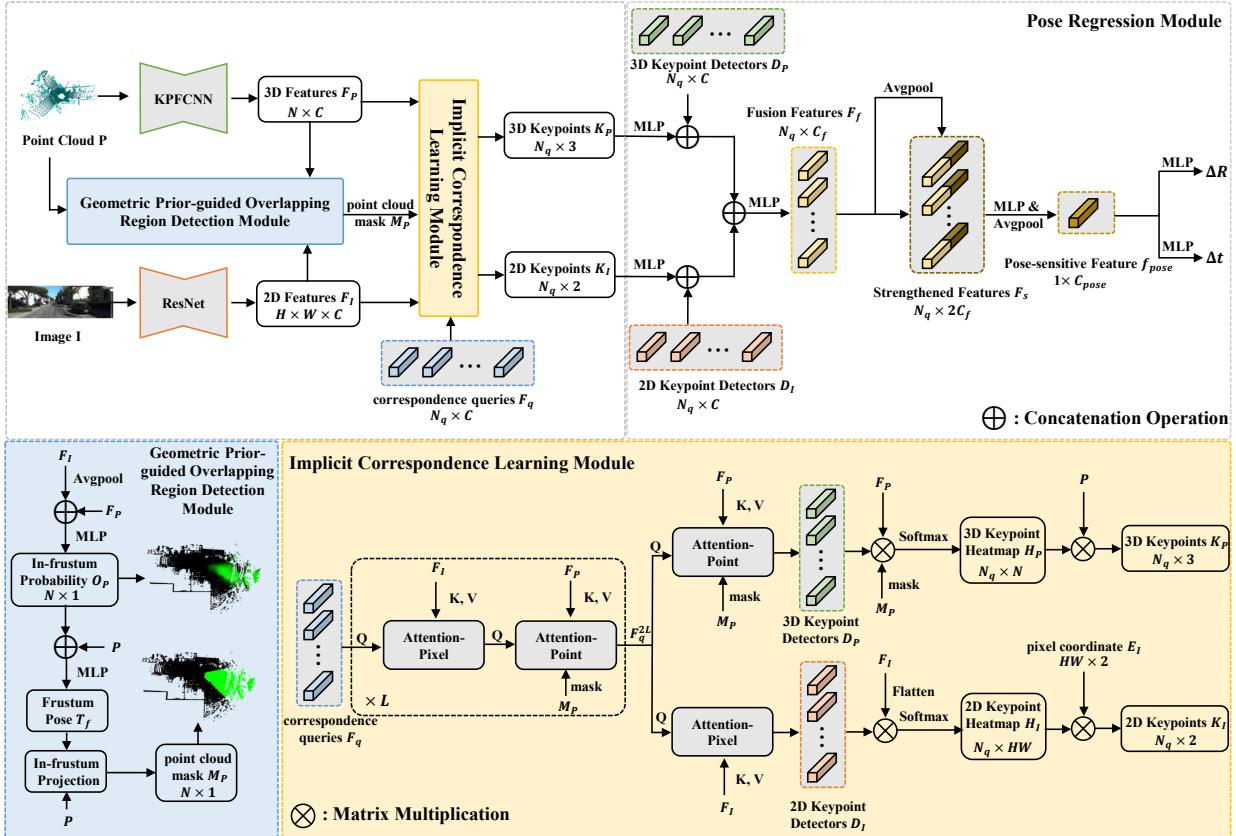
As shown in Figure 2, the pipeline consists of:
- GPDM: A module that uses geometric logic (not just classification) to find the overlapping region.
- ICLM: A module that uses “Queries” to implicitly learn where 2D and 3D data correspond, without forcing their features to be identical.
- PRM: A regression module that predicts the final pose end-to-end, replacing the non-differentiable RANSAC step.
Let’s walk through each module in detail.
Module 1: Geometric Prior-guided Overlapping Region Detection (GPDM)
The first challenge is filtering the massive point cloud down to just the points visible in the image.
Most previous works treat this as a simple binary classification task: “Is point \(X\) in the image?” However, this ignores a fundamental geometric truth: a camera’s field of view is a frustum (a pyramid shape with the top cut off). The points inside the image must form a continuous geometric shape, not a random cloud of scattered points.
The GPDM leverages this “Geometric Prior.”
Step A: Frustum Pose Prediction
First, the network extracts features from both the image (\(F_I\)) and the point cloud (\(F_P\)). It combines these to predict a coarse probability (\(O_P\)) that a point is in the frame.
But here is the clever part: instead of stopping there, the network uses these probabilities to guess the Frustum Pose (\(T_f\)). It tries to predict the rotation (\(R_f\)) and translation (\(t_f\)) of the camera frustum relative to the cloud.

In this equation, the network uses a Multi-Layer Perceptron (MLP) to regress the rotation and translation based on the point cloud coordinates and their initial inclusion probabilities.
Step B: The Projection Check
Once the network has a guess for where the camera frustum is (\(R_f, t_f\)), it can mathematically verify which points fall inside it. It projects every 3D point (\(p_i\)) onto the virtual camera plane using the camera’s intrinsic matrix (\(K\)).
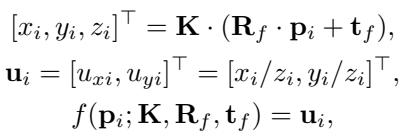
Here, \(u_i\) represents the 2D pixel coordinates obtained by projecting the 3D point.
Step C: Creating the Mask
Now, the determination of the overlapping region is strictly geometric. A point is considered “inside” the region (\(M_p = 1\)) only if its projected coordinates fall within the image height (\(H\)) and width (\(W\)) and it is in front of the camera (\(z \geq 0\)).

By enforcing this frustum geometry, the network eliminates the random noise common in point-wise classification. It creates a clean, geometrically valid subset of points to focus on.
Module 2: Implicit Correspondence Learning Module (ICLM)
This is the heart of the paper. Now that we have the overlapping region (thanks to GPDM), we need to match specific points to specific pixels.
Instead of calculating the similarity between a pixel feature and a point feature directly (which, as discussed, is error-prone), the authors use a Transformer-based attention mechanism.
They introduce a set of learnable Correspondence Queries (\(F_q\)). Think of these queries as “agents” that are trained to look for specific landmarks (e.g., “a corner of a building” or “top of a pole”). These agents look at the image, then look at the point cloud, and try to find their specific landmark in both places.
The Attention Loop
The process works iteratively. The queries interact with the Image Features (\(F_I\)) and the Point Cloud Features (\(F_P\)) in alternating steps: Attention-Pixel and Attention-Point.

In the Attention-Pixel step, the queries extract information from the 2D image. In the Attention-Point step, they extract information from the 3D point cloud (masked by the GPDM result so they don’t look at irrelevant points).
The attention mechanism itself is the standard “Query-Key-Value” calculation used in Transformers:


By repeating this loop (experimentally, 3 times works best), the queries (\(F_q\)) become rich representations that “understand” the scene in both 2D and 3D contexts simultaneously.
Generating Keypoints
After the attention loops, the system converts these queries into actual coordinates.
For the image, the queries generate a heatmap (\(H_I\)) over the image grid:

For the point cloud, they generate a similar heatmap (\(H_P\)) over the 3D points. By applying these heatmaps to the coordinate grids, the model computes the weighted average position for each query.

The result is a set of \(N_q\) paired keypoints: \(K_I\) (2D coordinates) and \(K_P\) (3D coordinates). Crucially, these matches were found implicitly. The network wasn’t forced to make the feature vectors identical; it was allowed to learn an intermediate representation (the queries) that bridges the gap.
Module 3: Pose Regression Module (PRM)
At this stage, we have a set of paired 2D and 3D points. A traditional method would feed these into a mathematical solver (PnP-RANSAC). This paper replaces that with a neural network, allowing the entire system to be trained end-to-end.
Remember the GPDM module from the beginning? It already gave us a “coarse” guess of the camera pose (\(R_f, t_f\)). The goal of the PRM is to calculate the residual, or the correction needed to make that coarse guess perfect.
The difference between the ground truth pose and the coarse frustum pose is defined as:

To find this \(\Delta R\) and \(\Delta t\), the network combines the information from the keypoint detectors (\(D_P, D_I\)) and the coordinates (\(K_P, K_I\)) into a “fusion feature” (\(F_f\)).

This feature is processed and pooled into a single vector, \(f_{pose}\), representing the global alignment info.

Finally, two parallel MLPs regress the rotation and translation corrections.

By adding these corrections to the initial frustum pose, the system outputs the final, precise camera location.
Training the Model
How do we teach this complex network? The authors use a composite loss function that guides every part of the pipeline simultaneously.
Classification Loss (\(\mathcal{L}_{cls}\)): Teaches the GPDM to correctly predict which points are in the frustum.

Frustum-Pose Loss (\(\mathcal{L}_{fru}\)): Teaches the GPDM to make a good initial guess at the camera pose.

Correspondence Loss (\(\mathcal{L}_{corr}\)): Ensures that if we project the learned 3D keypoints (\(K_P\)) onto the image, they land exactly on the learned 2D keypoints (\(K_I\)).

Diversity Loss (\(\mathcal{L}_{div}\)): This is interesting. We don’t want all our queries to converge on the same easy point (like a single streetlamp). This loss forces the keypoints to be spread out spatially in both 2D and 3D.
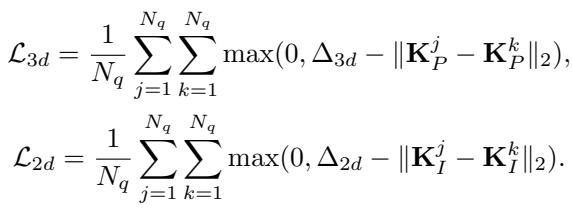
Camera-Pose Loss (\(\mathcal{L}_{cam}\)): The ultimate goal—minimize the error of the final regressed pose.

These are summed up into a total loss:

Experiments and Results
The researchers tested their model on two major autonomous driving datasets: KITTI and nuScenes. They measured success using Relative Translational Error (RTE), Relative Rotation Error (RRE), and Accuracy (Acc).
Quantitative Success
The results were not just marginally better; they were a leap forward.
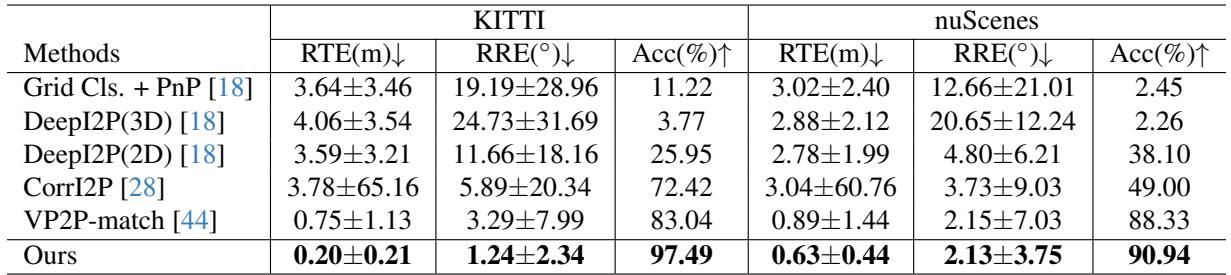
Looking at Table 1:
- On the KITTI dataset, the proposed method achieved 97.49% accuracy, compared to 83.04% for the previous best (VP2P-match).
- The translation error (RTE) dropped from 0.75m to 0.20m.
- The rotation error (RRE) dropped from 3.29° to 1.24°.
This is a massive reduction in error, suggesting that implicit learning is far superior to explicit matching for this task.
Qualitative Success
Visualizations help us understand why the method works better.
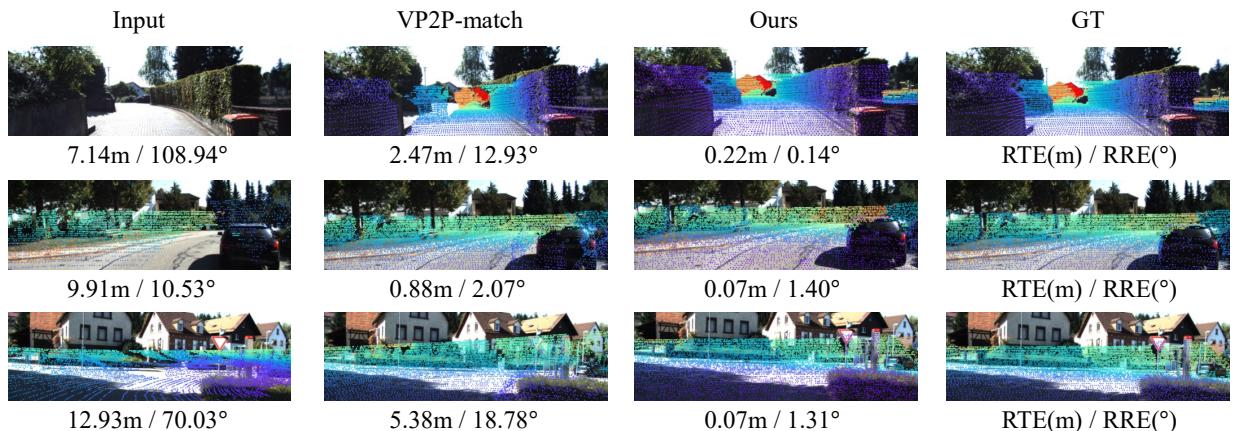
In Figure 3, we see the projected depth maps. The “Ours” column shows sharp, accurate alignment with the real world, whereas the competitor (VP-match) often misaligns the camera, leading to ghosting or completely wrong perspectives (see the bottom row).
We can also visualize the correspondences directly:
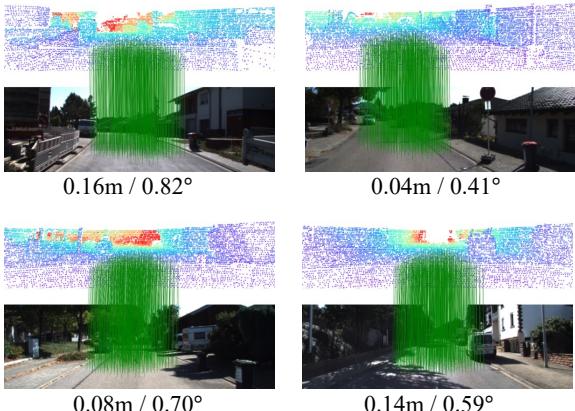
Figure 4 shows the green correspondence lines. Notice how parallel and consistent they are. If the matches were wrong, these lines would be crossing each other or pointing in random directions. The consistency here proves the ICLM module is finding reliable landmarks.
Why does GPDM matter?
The authors performed an ablation study to prove that the geometric prior (GPDM) was actually helping.
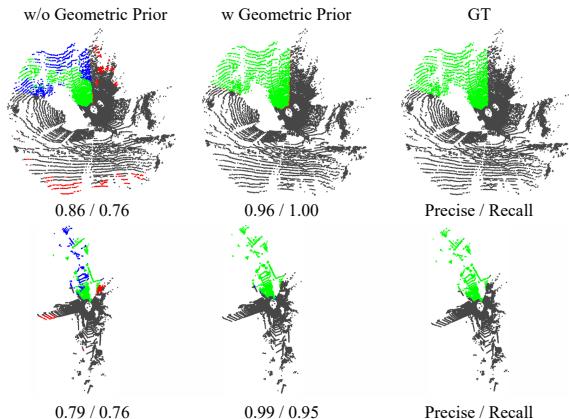
In Figure 5, the left column shows detection without Geometric Prior. It’s messy—there are blue points (missed detections) and red points (false positives) scattered everywhere. The middle column shows detection with Geometric Prior. The detection creates a clean, solid shape that matches the actual camera frustum (the green points).
This is quantitatively backed up in Table 2:
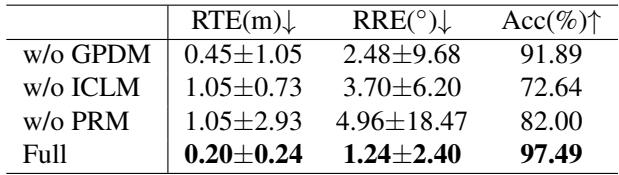
Removing the GPDM drops the accuracy from 97.49% to 91.89%. Removing the ICLM (Implicit Correspondence) crashes the performance to 72.64%, showing that the implicit matching is the most critical component.
Conclusion and Implications
The paper “Implicit Correspondence Learning for Image-to-Point Cloud Registration” presents a compelling argument: when dealing with cross-modal data (like 2D images and 3D points), forcing explicit feature matching is a sub-optimal strategy.
By shifting to an implicit learning framework, the authors achieved three major improvements:
- Better Detection: Using the geometric shape of the frustum filters out noise.
- Better Matching: Learnable queries bridge the gap between pixels and points more effectively than direct feature comparison.
- End-to-End Optimization: Replacing RANSAC with a regression module allows the network to learn the entire task holistically.
For students and researchers in computer vision, this work highlights the power of geometric priors—using what we know about the physical world (how cameras work) to constrain deep learning models. It also showcases the versatility of attention mechanisms beyond just language or standard image classification, proving them to be powerful tools for spatial reasoning in 3D space.