](https://deep-paper.org/en/paper/file-2100/images/cover.png)
Introduction
We have all seen the trope in crime investigation shows: a grainy, pixelated video of a getaway car is played, an agent says “Enhance,” and suddenly the license plate is crystal clear. In reality, License Plate Image Restoration (LPIR) is incredibly difficult. Factors like high speeds, poor lighting, long distances, and camera shake combine to create severe degradation that confuses even the best Optical Character Recognition (OCR) systems.
While Deep Learning has revolutionized image restoration, there is a hidden flaw in many existing approaches: they rely on synthetic data. Researchers typically take a high-quality image and artificially add blur or noise to train their models. But a Gaussian blur applied in software looks nothing like the complex, non-linear distortion caused by a vehicle moving at 60 mph on a rainy night.
In this post, we are diving into LP-Diff, a new research paper that tackles this problem head-on. The researchers introduce two major breakthroughs: a massive dataset of real-world degraded images (MDLP) and a novel diffusion-based architecture designed specifically to recover texture and temporal details from these difficult images.
The Real-World Data Gap
Before understanding the solution, we must understand the problem with current datasets. Most existing License Plate (LP) datasets consist of high-resolution, static images. To train restoration models, researchers usually degrade these images synthetically.
The authors of LP-Diff argue that synthetic degradation fails to capture the “domain-specific” traits of real-world cameras and environments. To prove this, they trained models on synthetic data and tested them on real footage. The models failed significantly.
To fix this, the researchers collected the MDLP (Multi-frame Degraded License Plate) dataset. It contains 10,245 pairs of images captured automatically using high-speed cameras in real road environments. Crucially, they captured multiple consecutive frames. This allows the model to see the license plate as it changes over time—moving closer to the camera or changing angles—providing vital temporal cues that a single static image cannot offer.
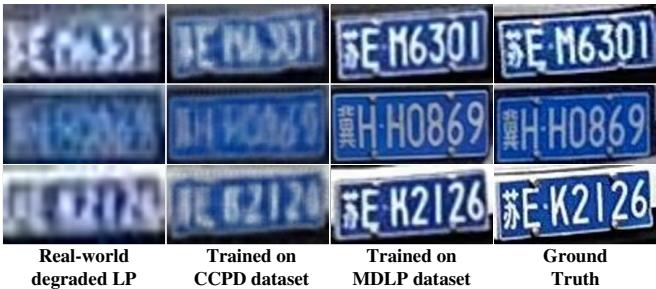
As shown in Figure 5 above, the difference is stark. The second row shows the output of a model trained on synthetic data (CCPD)—it fails to reconstruct legible text. The third row shows the same model trained on the new real-world MDLP dataset, recovering sharp, readable characters.
LP-Diff: The Architecture
Restoring these images requires more than just a standard neural network. The researchers proposed LP-Diff, a framework that combines the generative power of Diffusion models with specific modules designed to enhance text texture and fuse information across time.
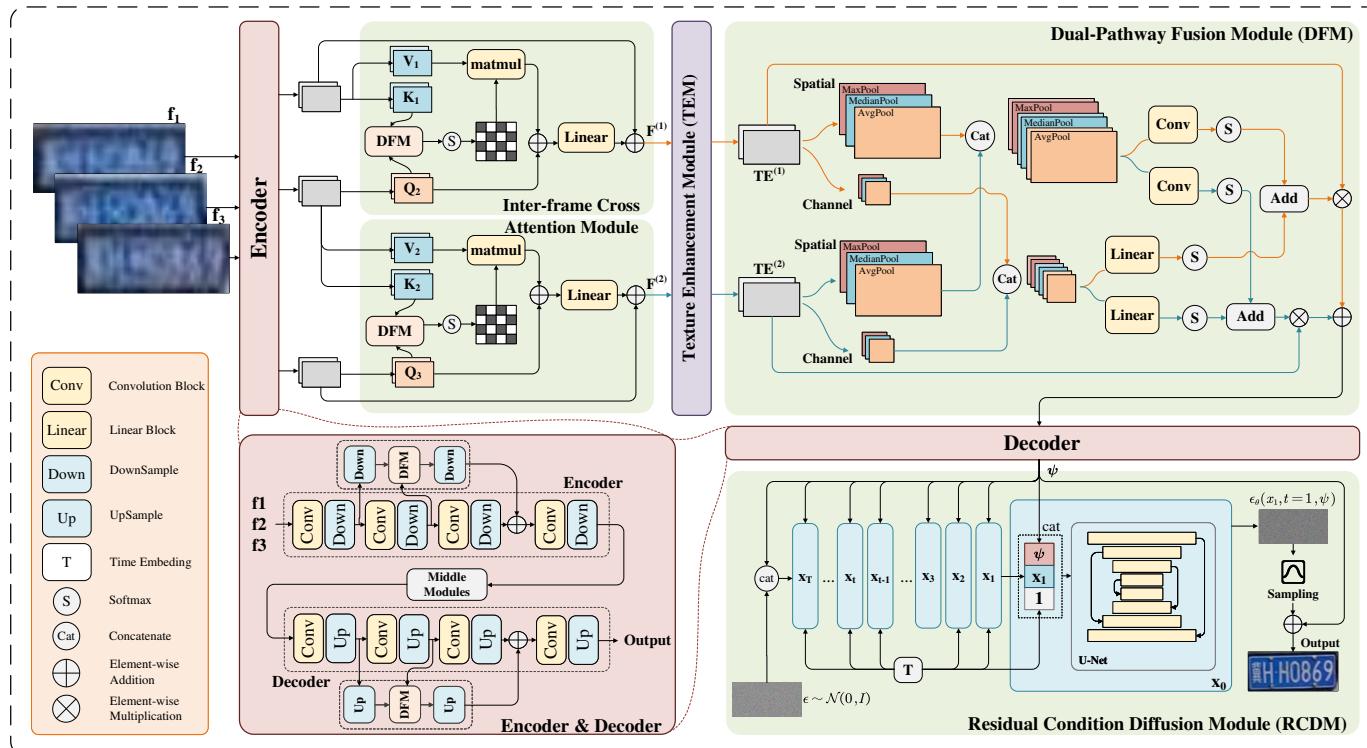
Figure 2 illustrates the complete pipeline. The model takes three consecutive frames (\(f_1, f_2, f_3\)) as input. It isn’t enough to just look at one blurry frame; by looking at three, the model can cross-reference information. If a character is smeared in frame 1 due to motion, it might be slightly clearer in frame 2.
The architecture consists of four key components, which we will break down:
- Encoder/Decoder: For feature extraction.
- ICAM: Fusing time-series data.
- TEM: Enhancing the specific shapes of letters and numbers.
- DFM & RCDM: Filtering features and performing the final diffusion generation.
1. Inter-frame Cross Attention Module (ICAM)
Because the input consists of three frames, the model needs a way to align and merge them. The Inter-frame Cross Attention Module (ICAM) handles this.
The assumption is that consecutive frames contain highly correlated features but also dynamic changes (like the car moving forward). The ICAM uses a cross-attention mechanism to capture these correlations. It takes the encoded features of the frames and computes attention maps to highlight dynamic changes while suppressing redundant background information.
Mathematically, the fusion of the first and second frames can be represented as:

Here, DFM (Dual-Pathway Fusion Module) is used to filter the Query (\(Q\)) and Key (\(K\)) relationship to reduce background noise before applying it to the Value (\(V\)). This ensures the model focuses on the changing pixels—the moving car—rather than the static road.
2. Texture Enhancement Module (TEM)
This is perhaps the most interesting contribution of the paper. License plates are distinct from general images (like landscapes or faces) because they rely heavily on edges and geometric shapes to form characters. Severe degradation destroys these high-frequency details.
To restore them, the researchers designed the Texture Enhancement Module (TEM).
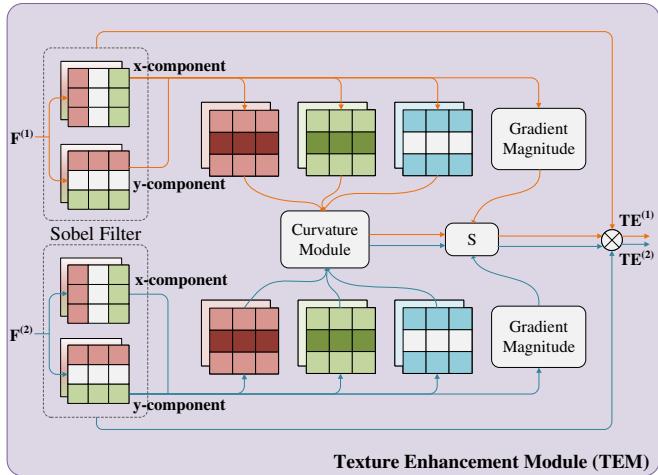
As seen in Figure 3, the TEM doesn’t just process pixel values; it explicitly calculates the geometry of the image features. It does this in three steps:
Step A: Sobel Filtering
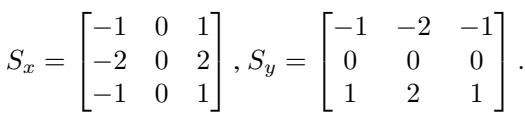
First, the module applies Sobel filters to decompose the features into X and Y directional components. This highlights the vertical and horizontal strokes common in alphanumeric characters.
Step B: Curvature Calculation
Text characters have specific curvatures (think of the curve in ‘C’, ‘O’, or ‘8’). Standard noise reduction often smooths these curves out. The TEM calculates the Curvature of the feature map to distinguish between flat regions and the abrupt changes found in character strokes.

By calculating this curvature (\(Cur^{(m)}\)), the model gains a geometric understanding of the shapes it is trying to reconstruct.
Step C: Gradient Magnitude
Finally, to measure the intensity of these edges, the model calculates the Gradient Magnitude (\(GM\)).

The combination of Curvature (shape) and Gradient Magnitude (strength) allows the TEM to selectively enhance the texture of the license plate characters, making them pop out from the blurry background.
3. Dual-Pathway Fusion Module (DFM)
With the texture enhanced, the features still contain noise and background redundancy. The Dual-Pathway Fusion Module (DFM) acts as a gatekeeper.
It processes features along two dimensions:
- Channel Dimension: Determines what to look at (which feature maps contain the most relevant info).
- Spatial Dimension: Determines where to look (focusing on the license plate area rather than the bumper or road).
It uses pooling operations (Average, Max, Median) followed by linear and convolutional layers to weigh the importance of different features.
4. Residual Condition Diffusion Module (RCDM)
The final stage is the generation. The authors use a Diffusion Model, which is the state-of-the-art technology behind image generators like DALL-E or Stable Diffusion.
However, generating a license plate from scratch is inefficient. Instead, they employ a Residual Condition Diffusion Module (RCDM). The model attempts to predict the residual—the difference between the blurry input and the clear ground truth.
The forward process adds noise to the image (standard in diffusion models), and the reverse process attempts to denoise it, guided by the features extracted from the Encoder, ICAM, and TEM ($ \psi $).
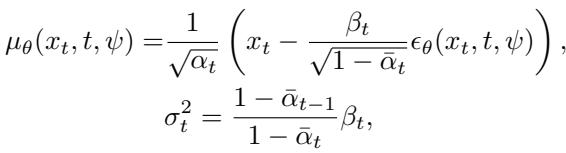
The model is trained to predict the noise \(\epsilon_\theta\) added at each step. By iteratively removing this noise, conditioned on the texture-enhanced features, the RCDM reconstructs a sharp, high-fidelity license plate.
Experiments and Results
Does this complex architecture actually work? The researchers compared LP-Diff against several State-of-the-Art (SOTA) methods, including SRCNN, Real-ESRGAN, and ResShift.
Visual Comparison
The visual results are compelling. In the image below, you can see the input (top row) is heavily degraded.
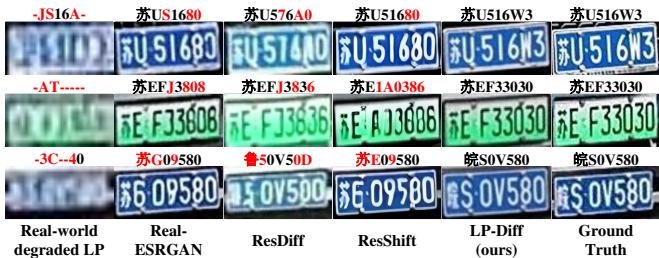
- Real-ESRGAN (a popular restoration tool) tends to over-smooth or hallucinate incorrect artifacts.
- ResDiff and ResShift struggle with the severe blur, often leaving characters illegible.
- LP-Diff (Ours) consistently recovers the correct characters. Look at the top right example: the ground truth is “JS16A”. LP-Diff recovers it almost perfectly, while other models produce blurry blobs.
Quantitative Analysis
The visual improvements are backed by hard numbers. The authors tested on both the MDLP dataset and the synthetic CCPD dataset.
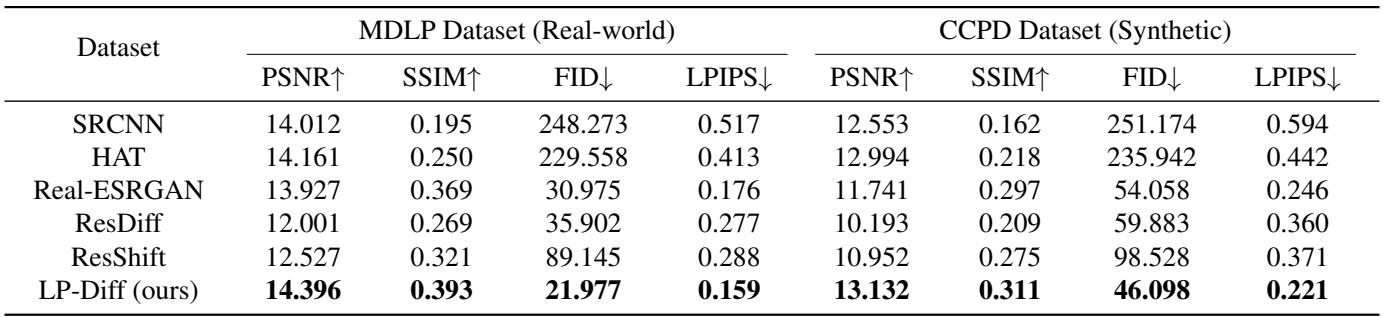
In Table 1:
- PSNR (Peak Signal-to-Noise Ratio): Higher is better. LP-Diff achieves 14.396, the highest score.
- SSIM (Structural Similarity Index): Higher is better. LP-Diff leads with 0.393.
- LPIPS (Learned Perceptual Image Patch Similarity): Lower is better. LP-Diff scores 0.159, indicating its output looks most like the ground truth to human eyes.
Text Recognition Accuracy
The ultimate goal of restoring a license plate is to read it. The researchers ran the restored images through a text recognition model (CRNN) to see if the restoration actually helped machines read the plates.
They measured NED (Normalized Edit Distance)—essentially, how many characters the OCR got wrong.
- Input degraded image: 0.709 error rate (very high).
- Real-ESRGAN: 0.279 error rate.
- LP-Diff: 0.198 error rate.
This confirms that LP-Diff doesn’t just make images look pretty; it restores the specific semantic information needed for identification.
Ablation Study: Do we need all the parts?
To ensure every module was necessary, the authors performed an ablation study, removing components one by one.
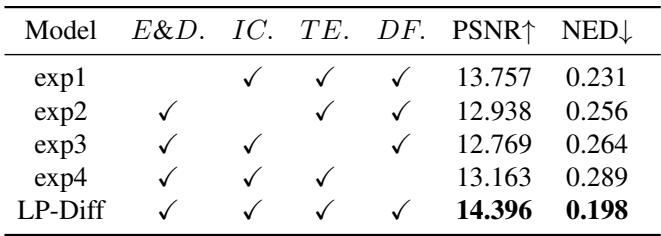
- Removing ICAM (exp2): PSNR drops significantly (14.39 -> 12.93). This proves that using multiple frames (temporal info) is crucial.
- Removing TEM (exp3): PSNR drops to 12.76. Without the curvature and edge enhancement, the model struggles to define character shapes.
- Removing DFM (exp4): PSNR drops to 13.16. Without spatial and channel filtering, noise overwhelms the system.
Conclusion
The paper “LP-Diff” makes a strong case that real-world image restoration cannot rely on synthetic training data. By collecting the MDLP dataset, the researchers provided a benchmark that reflects the messy reality of traffic surveillance.
Furthermore, the LP-Diff architecture demonstrates that generic diffusion models can be significantly improved by integrating domain-specific knowledge. By forcing the model to pay attention to temporal changes (via ICAM) and geometric texture (via TEM), they achieved results that outperform general-purpose super-resolution models.
For students and researchers in computer vision, this paper highlights an important lesson: Understand your data. The sophisticated Texture Enhancement Module works because license plates are texture-rich objects. The multi-frame attention works because traffic involves motion. Designing architectures that fit the physical nature of the problem often yields the best results.
The dataset and code for this paper are available on GitHub, paving the way for future improvements in Intelligent Transportation Systems.