](https://deep-paper.org/en/paper/file-2102/images/cover.png)
In the idealized world of machine learning, data is static. We train a model on a dataset, validate it, and deploy it, assuming the world will behave exactly like our training set forever. But in the real world, data is a restless stream. Trends change, behaviors shift, and the distributions of classes we are trying to predict fluctuate wildly over time.
Imagine a human activity recognition system running on a smartphone. During the morning commute, the model sees a lot of “walking” and “sitting” data. At the gym in the evening, the stream shifts to “running” and “jumping.” Later at night, it’s mostly “lying down.” The relationship between the sensor data (features) and the activity (labels) hasn’t changed—a jump is still a jump—but the frequency of those labels has shifted dramatically.
This phenomenon is known as Online Label Shift (OnLS). Adapting to it is notoriously difficult, particularly because we don’t have the luxury of labeled data in real-time. We have to adapt our models “on the fly” using only unlabeled data streams.
In this post, we will dive deep into a CVPR paper titled “Label Shift Meets Online Learning: Ensuring Consistent Adaptation with Universal Dynamic Regret.” The researchers propose a robust framework called LASU that doesn’t just adapt to these shifts—it does so with mathematical guarantees of optimality.
The Core Problem: When the World Changes
To understand the contribution of this paper, we first need to define the problem clearly. In a label shift scenario, we assume the conditional distribution \(P(x|y)\) (what an object looks like given its class) remains fixed, but the marginal label distribution \(P(y)\) (how common that class is) changes.
In an online setting, this becomes a nightmare for two reasons:
- Data Scarcity: Data arrives in small batches (streaming). We can’t wait to collect a massive dataset to retrain.
- No Labels: We see the features (\(x\)) but not the labels (\(y\)). We have to infer the shift in \(P(y)\) purely from the unlabeled data.
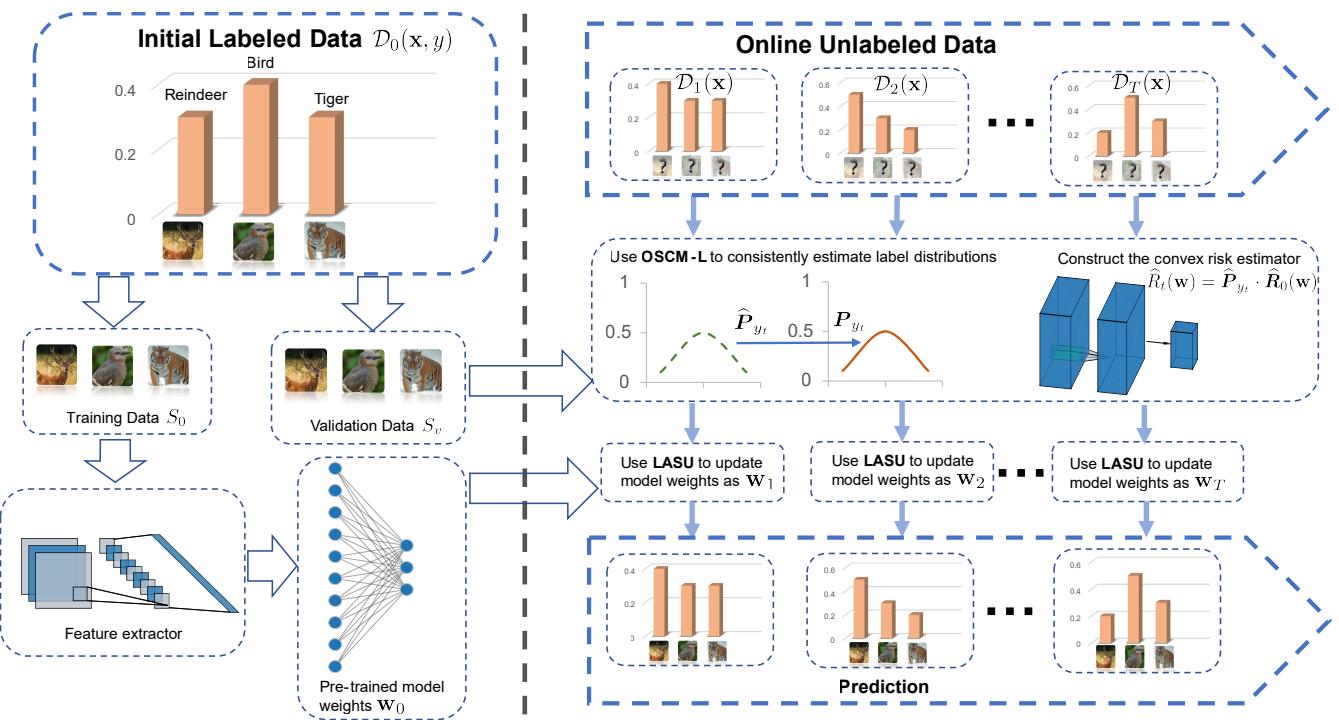
As shown in Figure 1 above, the setup involves an initial labeled dataset used to train a feature extractor and an initial model. Once we move to the online stage (the right side of the diagram), the feature extractor is frozen. A stream of unlabeled data arrives (\(D_1, D_2, \dots\)), and we must update our linear model weights (\(W_t\)) to account for the shifting label distribution.
The Flaw in Traditional Methods
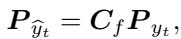
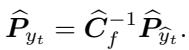
Previous attempts to solve this simply adapted offline methods to the online world. The most common technique is Black Box Shift Estimation (BBSE). The logic is simple: if we know how confused our classifier usually is (via a Confusion Matrix, \(C_f\)), and we observe its current predictions (\(P_{\hat{y}}\)), we can mathematically reverse-engineer the true label distribution (\(P_y\)).
The relationship is captured by this linear equation:
To find the true label distribution \(P_{y_t}\), you simply invert the confusion matrix:
Here is the problem: In an online stream, you might only see 10 or 20 samples at a time. With such a small sample size, the empirical confusion matrix or the prediction vector can be noisy. Inverting a matrix based on sparse data often results in a “singular” matrix (unsolvable) or, worse, yields negative probabilities.
You cannot have a negative probability of a class occurring. When these negative values are plugged into the loss function, the risk estimator becomes non-convex. In optimization terms, a non-convex loss function is a minefield of local wait-optima and instability. It breaks the theoretical guarantees that online learning relies on.
The Solution: Consistent Adaptation with LASU
The researchers propose a method called LASU (Label Shift with Universal dynamic regret). It addresses the non-convexity issue and provides a powerful way to update the model.
Part 1: OSCM-L (The Estimator)
Instead of blindly inverting a matrix and hoping for the best, the authors introduce OSCM-L (Online Soft Confusion Matrix to maximize the Likelihood).
The key insight is to treat the problem as a statistical estimation task. If we observe \(n_t\) predictions for different classes, the likelihood of seeing this specific distribution of predictions follows a multinomial distribution:
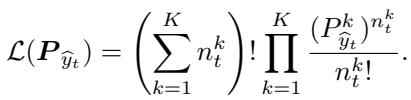
By substituting the relationship between predicted labels and true labels (via the confusion matrix), we get a likelihood function for the true label distribution \(P_{y_t}\):
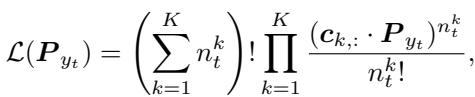
Our goal is to find the distribution \(P_{y_t}\) that maximizes this likelihood. We can convert this to a log-likelihood maximization problem, which is numerically more stable:
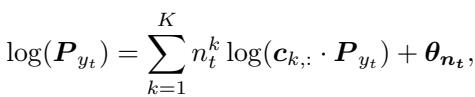
Because we are maximizing a likelihood, we are naturally constrained to valid probability distributions. We don’t get negative probabilities. To solve this optimization, the authors use Projected Gradient Ascent. This is an iterative process where we take steps in the direction of the gradient and then “project” the result back onto the valid probability simplex (ensuring everything sums to 1 and stays positive).
The update rule looks like this:

Where the gradient is calculated as:
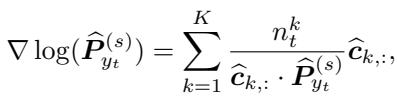
Why does this matter? By using OSCM-L, the estimated label distribution \(\hat{P}_{y_t}\) is guaranteed to be non-negative. This allows the researchers to construct a valid, convex risk estimator:

This convex risk estimator (\(\hat{R}_t\)) is the foundation. It allows the model to be optimized reliably using standard convex optimization frameworks, something previous methods failed to guarantee.
Part 2: The Base Learner (Opt-OMD)
With a valid risk estimator in hand, how do we update the model weights? Standard Online Gradient Descent (OGD) is reactive—it only corrects mistakes after they happen.
The authors instead use Optimistic Online Mirror Descent (Opt-OMD). The “Optimistic” part means the algorithm tries to predict the next gradient using a hint vector, \(M_t\). If the environment changes gradually (which is common in label shift), the loss at the current step is a good predictor of the loss at the next step.
The update consists of two steps. First, an intermediate update based on the current gradient, and second, a final update using the “optimism”:
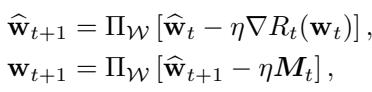
This method allows the model to adapt faster to changes in the data stream compared to standard gradient descent.
Part 3: The Ensemble (LASU)
There is one final hurdle: Step Size (\(\eta\)). In online learning, the step size determines how quickly the model adapts.
- Small step size: Stable, but slow to react to sudden shifts.
- Large step size: Fast reaction, but unstable and prone to overfitting noise.
Since the intensity of label shift is unknown and changing, picking a single fixed step size is impossible. The authors solve this with an Online Ensemble Algorithm.
They run multiple instances of the Opt-OMD learner in parallel, each with a different step size from a candidate pool. Then, they combine their predictions using a meta-algorithm called Optimistic Hedge.
The weights of the ensemble members are updated dynamically. If a learner with a specific step size performs poorly (high loss), its weight is exponentially decreased.

This allows the system to automatically “switch gears.” When the label distribution is stable, it favors learners with small step sizes. When a sudden shift occurs, it shifts weight to learners with aggressive step sizes.
Theoretical Guarantees: Universal Dynamic Regret
One of the paper’s strongest contributions is its theoretical analysis. In online learning, we measure success using “Regret”—the difference between our total loss and the loss of the best possible model we could have chosen in hindsight.
The authors prove that LASU achieves Universal Dynamic Regret.
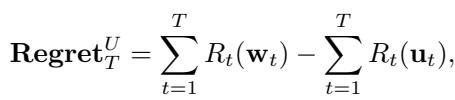
Specifically, they derive a bound that depends on two key factors:
- Path Variation (\(P_T\)): How much the optimal model parameters change over time.
- Label Shift Measure (\(V_T\)): How intensely the label distribution is changing.
The bound is stated as:

This result is minimax optimal, meaning that for the worst-case scenario, no algorithm can possibly do better (in terms of order of magnitude). This provides a strong theoretical safety net for the method.
Experimental Validation
Theory is good, but does it work? The authors tested LASU on standard benchmarks (MNIST, CIFAR-10, EuroSAT) and a real-world human motion detection dataset (SHL). They simulated various types of shifts: linear trends, sudden Bernoulli flips, and sinusoidal waves.
Overall Performance
The results were decisive. The table below compares LASU against state-of-the-art methods like ROGD, ATLAS, and weak baselines (Fixed).
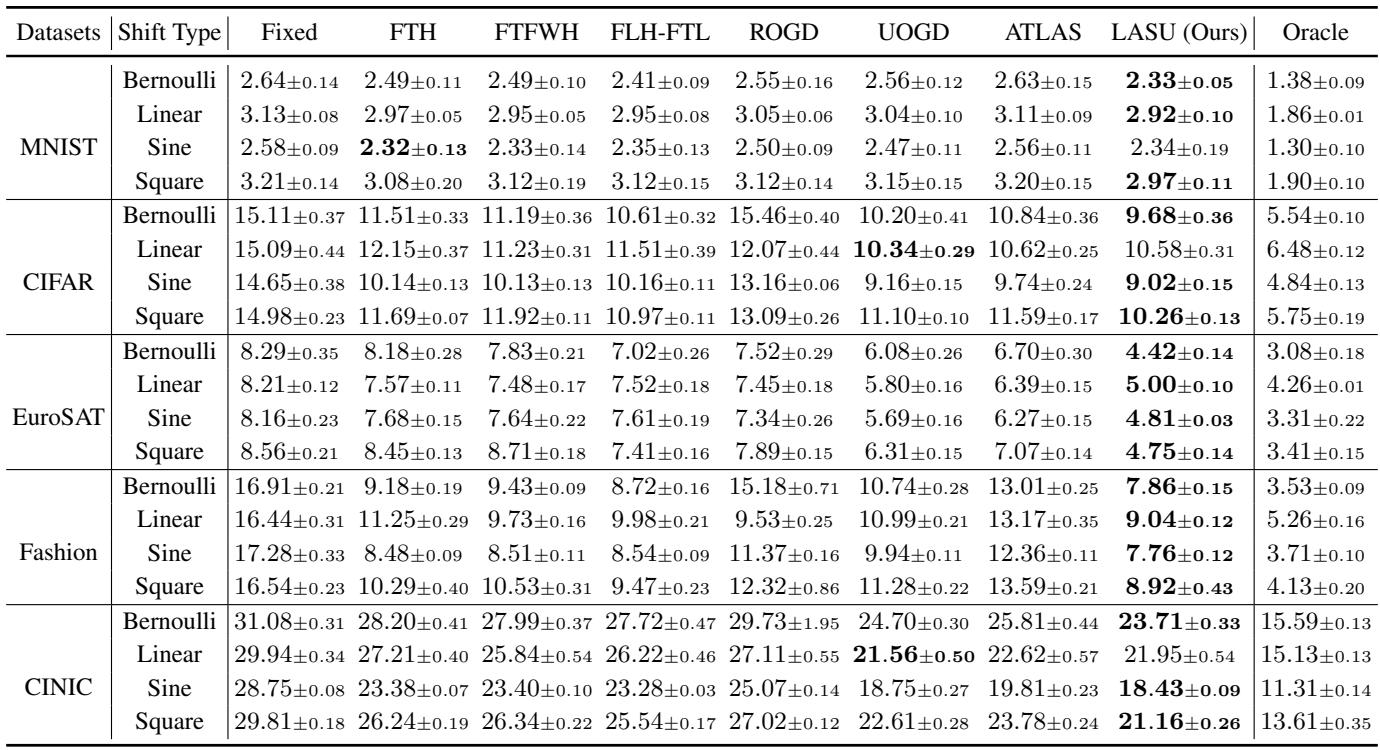
Key Takeaway: LASU achieves the lowest average error in almost every single category. In some cases, such as CIFAR-10 with Bernoulli shift, it reduces the error from ~10-15% (competitors) to 9.68%.
The Importance of Adaptive Step Sizes
The authors visualized why the ensemble approach is necessary. The plot below shows the performance of individual Opt-OMD learners with fixed step sizes (the colored lines) versus the ensemble LASU (black line).
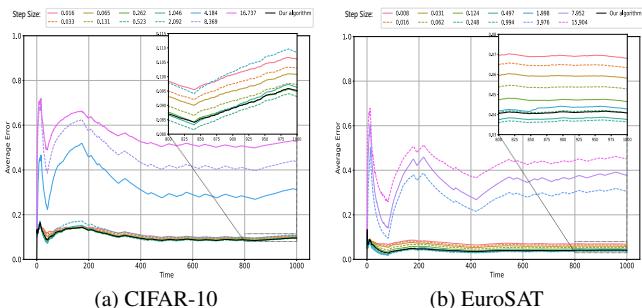
Notice how some step sizes perform horribly (high error), while others are good. The black line (LASU) consistently hugs the bottom, effectively matching the performance of the best single step size without knowing which one it is beforehand.
Visualizing the Ensemble in Action
How does the ensemble decide which step size to trust? The authors plotted the internal weights of the ensemble over time.
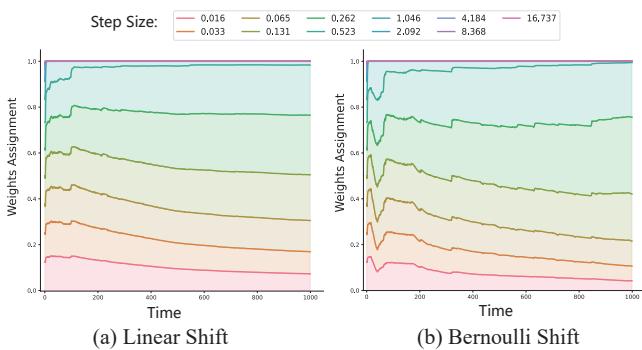
In Chart (a) (Linear Shift), the shift is gradual. You can see the weights distribute and settle. In Chart (b) (Bernoulli Shift), the shift is drastic and sudden. Notice how the weights react aggressively. The model rapidly identifies that the current step size is insufficient and re-allocates trust to learners that can handle the volatility.
Robustness to Sample Size
A major claim of the paper is that OSCM-L handles small sample sizes better than matrix inversion. The experiments confirm this. As the online sample size (batch size) drops to as low as 1 or 2, competitor methods like ROGD and ATLAS degrade significantly.
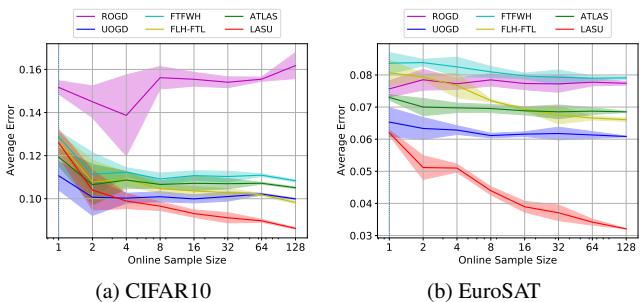
LASU (the red line) maintains superior performance even when data is extremely scarce, validating the robustness of the maximum likelihood estimation approach.
Conclusion
The paper “Label Shift Meets Online Learning” tackles a pervasive problem in real-world AI deployment. By moving away from brittle matrix inversion techniques and adopting a Maximum Likelihood (OSCM-L) approach, the authors ensured that the risk estimator remains convex and consistent.
Coupling this with an Optimistic Mirror Descent strategy and an Ensemble of step sizes, LASU provides a “set it and forget it” solution that adapts to both slow drifts and sudden jumps in data distribution.
For students and practitioners, this work highlights a crucial lesson: Assumptions matter. Simply taking a method that works offline (like BBSE) and applying it online can lead to mathematical contradictions (negative probabilities). By redesigning the estimator to respect the constraints of the online environment, we can build systems that are not just empirically better, but theoretically sound.