](https://deep-paper.org/en/paper/file-2108/images/cover.png)
Introduction
Reconstructing a 3D world from a jumbled collection of 2D photographs is one of the “magic tricks” of computer vision. This process, known as Structure-from-Motion (SfM), powers everything from Google Earth 3D views to autonomous vehicle mapping and digital heritage preservation.
While the results can be stunning, the process is mathematically fragile. Traditional methods, known as incremental SfM, build the 3D model one image at a time. They are accurate but slow, often taking hours or days for large datasets. The alternative is global SfM, which attempts to solve the entire puzzle at once. Global methods are fast and scalable, but they have a major Achilles’ heel: they are incredibly sensitive to noise.
When you try to align thousands of cameras simultaneously, a few bad data points—or “outlier edges” in the graph connecting the images—can cause the entire mathematical structure to collapse, resulting in a distorted or broken 3D model.
In this post, we are diving deep into a new approach titled “Learning to Filter Outlier Edges in Global SfM.” The researchers propose a clever solution that uses Graph Neural Networks (GNNs) to identify and delete these bad connections before they ruin the reconstruction. By reframing the problem using “line graphs” and applying Transformer-based attention, they achieve a level of robustness that rivals slower, incremental methods.
Background: The Global SfM Pipeline
To understand why filtering outliers is so critical, we first need to look at how Global Structure-from-Motion works. The pipeline is generally a sequence of estimations, where each step relies on the success of the previous one.
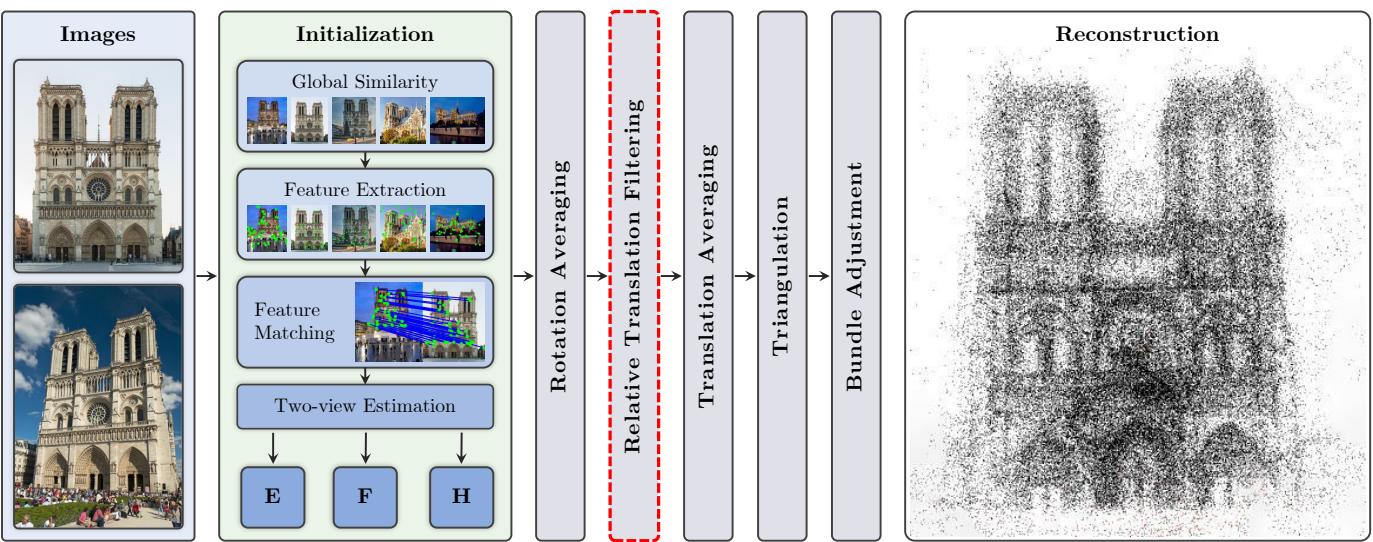
As shown in Figure 2 above, the process starts with Initialization. The system finds overlapping images, detects feature points (like corners or edges), and matches them across different photos. From these matches, it estimates the relative geometry between pairs of cameras.
This collection of cameras and their pairwise relationships forms a Pose Graph. In this graph:
- Nodes (Vertices) represent the images (cameras).
- Edges represent the relative pose (rotation and translation) between two cameras.
The Two-Step Averaging Problem
Global SfM solves for the camera poses in two distinct steps:
- Rotation Averaging: The system first determines the global orientation of every camera. This step is currently quite robust and well-studied.
- Translation Averaging: Once rotations are fixed, the system tries to determine the global position (translation) of every camera.
This is where things go wrong. While we can estimate the direction of movement between two cameras fairly well, estimating the scale (distance) is difficult without stereo calibration. Furthermore, the relative translation estimates are often riddled with outliers due to repetitive textures or moving objects in the scene.
If the pose graph contains “outlier edges”—connections between cameras that claim a movement happened which actually didn’t, or is wildly inaccurate—the translation averaging algorithm tries to satisfy these impossible constraints, warping the final 3D structure. Therefore, filtering these outliers before averaging is the holy grail of robust Global SfM.
The Core Method: Learning to Filter
The researchers propose a learning-based filter. Instead of relying on hand-crafted geometric rules (which often fail in complex scenarios), they train a neural network to look at the pose graph and classify every edge as either an Inlier (keep it) or an Outlier (throw it away).
However, applying deep learning to this specific graph problem comes with two major structural challenges:
- The Entity Mismatch: Standard Graph Neural Networks classify nodes, but here we need to classify edges.
- The Memory Explosion: Pose graphs for large scenes are massive.
The authors solve these problems using Line Graphs and Graph Clustering.
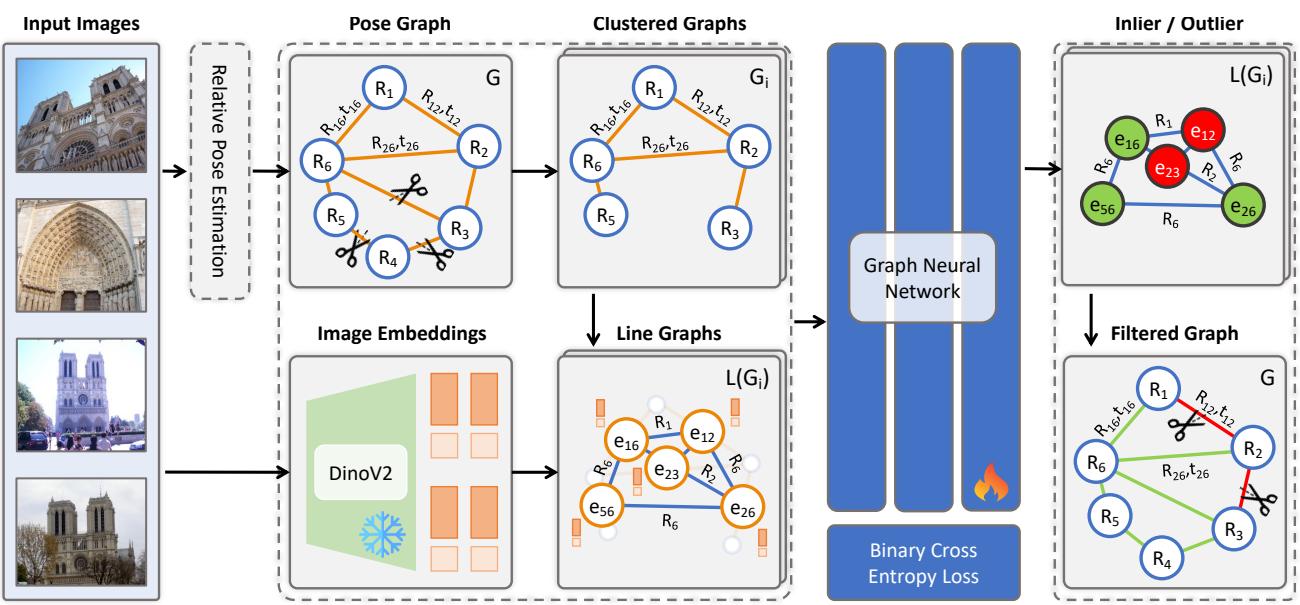
1. Flipping the Graph: The Line Graph Transformation
Standard GNNs are excellent at node classification. They look at a node, look at its neighbors, and decide what label that node should have. But in SfM, the nodes (cameras) aren’t “bad”; the edges (relative measurements) are.
To fix this, the authors transform the original Pose Graph (\(\mathcal{G}\)) into a Line Graph (\(L(\mathcal{G})\)).
In a line graph representation:
- The Edges of the original graph become the Nodes of the new graph.
- Two nodes in the new graph are connected if the original edges shared a common camera.
This transformation is visualized in the system overview below:
Mathematically, the edge set of the line graph \(\mathcal{E}_L\) is defined as:

This equation states that a connection exists between two new nodes (\(v_{ij}\) and \(v_{kl}\)) if the original edges \((v_i, v_j)\) and \((v_k, v_l)\) share a vertex (i.e., \(v_i = v_k\), \(v_j = v_l\), etc.).
By performing this transformation, the problem of “edge classification” in the original space becomes a standard “node classification” problem in the line graph space, which standard GNN architectures can handle natively.
2. Feature Engineering: What Does the Network See?
Once the graph is transformed, what information does each node in the Line Graph actually hold? The researchers attach a feature vector to every node (which, remember, represents a relative pose) containing two key pieces of information:
- Geometric Data: The estimated relative pose (rotation and translation).
- Visual Context: Deep image embeddings extracted using DINOv2.
The inclusion of visual features is crucial. DINOv2 provides a semantic understanding of the image content. If the geometric calculation suggests two cameras are looking at the same wall, but the DINOv2 features suggest one looks at a wall and the other at a tree, the network can learn to flag this geometric connection as an outlier.
3. The Transformer Architecture
To process this graph, the authors employ a Transformer-based architecture. Specifically, they use a TransformerConv layer. This allows the network to weigh the importance of different neighbors dynamically using an attention mechanism.
The update rule for a node \(x_i\) (representing an edge in the original graph) aggregates information from its neighbors \(\mathcal{N}(i)\):

Here, \(x'_i\) is the updated feature. The term \(\alpha_{i,j}\) represents the attention coefficient—how much the network should “listen” to neighbor \(j\). This coefficient is calculated using a softmax function over the query and key vectors, standard in Transformer architectures:

This attention mechanism is vital for SfM. It allows the network to learn consistency. If a relative pose is consistent with its neighbors (i.e., “I moved left, and my neighbor also says I moved left”), the attention weights will reflect that strong relationship. If a pose contradicts its neighbors, the network can isolate it.
To prevent the network from “forgetting” the original information as it passes through multiple layers (a phenomenon called over-smoothing), they add a gated residual connection:

The parameter \(\beta_i\) acts as a learned gate, controlling how much of the old information is retained versus how much new information from neighbors is accepted.
4. Scaling Up: The Clustering Solution
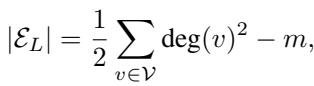
There is a catch to using Line Graphs. They are memory hogs. The number of edges in a Line Graph grows quadratically with the degree of the nodes in the original graph. If you have a popular image connected to 100 other images, that single cluster generates nearly 5,000 edges in the Line Graph.
The size of the Line Graph edges is calculated as:
For large-scale scenes with thousands of images, the Line Graph becomes too large to fit into GPU memory.
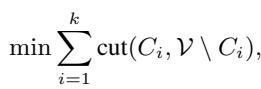
To solve this, the researchers introduce a Graph Clustering step. Before converting to a Line Graph, they partition the original pose graph into smaller, manageable sub-graphs (\(C_i\)).
They use a normalized cut objective to split the graph while breaking as few strong connections as possible:
Each cluster is processed independently by the network. Because an edge might appear in multiple clusters (if it sits on a boundary), the system might generate multiple predictions for a single edge. The authors use a simple majority voting scheme to make the final Inlier/Outlier decision. This allows the method to scale to arbitrarily large datasets without running out of memory.
Experiments and Results
The authors integrated their filter into two major SfM libraries: Theia and GLOMAP. They compared their method against the standard “1DSfM” filter and other recent approaches like the “Triangle” filter (which targets degenerate geometries rather than just outliers).
The training was done on a single scene (Piazza San Marco) and tested on completely different datasets, demonstrating the model’s ability to generalize without retraining.
Performance on 1DSfM Dataset
The 1DSfM dataset is a benchmark collection of internet photo sets. Table 1 below details the results using the Theia pipeline.
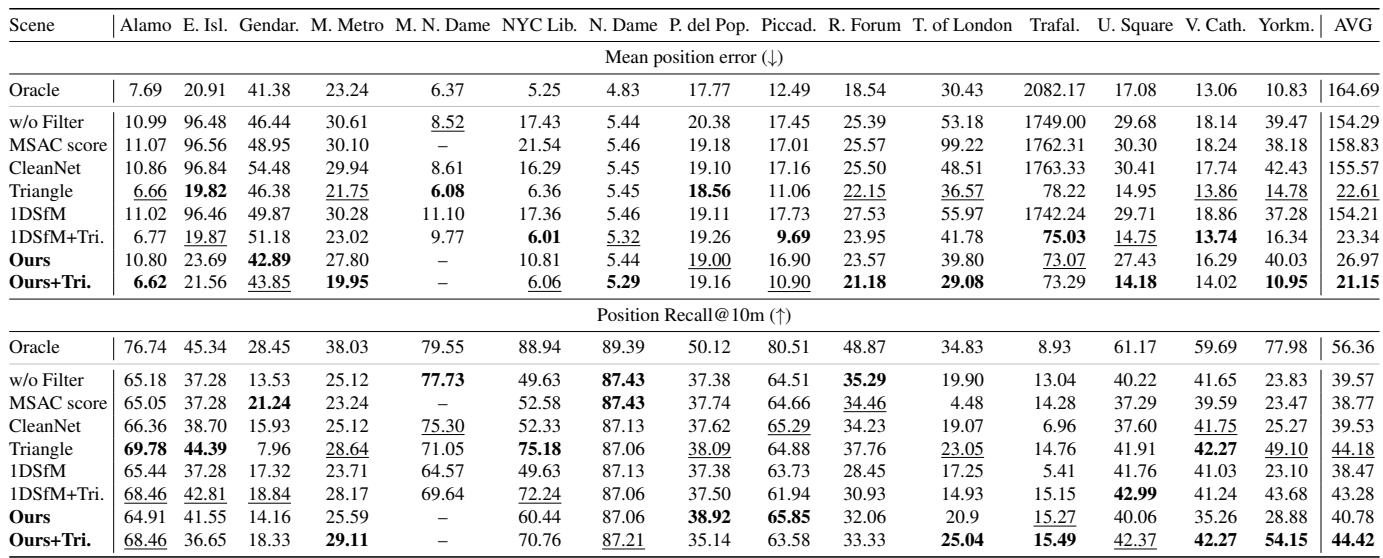
Key Takeaways from Table 1:
- Drastic Error Reduction: Compare the “w/o Filter” row (154.29m error) with “Ours” (26.97m error). The proposed method cleans up the graph effectively.
- Beating the Baseline: The standard “1DSfM” filter has an average error of 154.21m (it fails significantly on complex scenes like Trafalgar). The proposed method is roughly 5x more accurate on average.
- Complementary Strengths: When combined with the “Triangle” filter (Ours + Tri.), the error drops even further to 21.15m, achieving the best overall performance. This suggests the GNN removes “loud” outliers, while the Triangle filter handles subtle geometric degeneracies.
Integration with GLOMAP
GLOMAP is a state-of-the-art global SfM system. Table 2 shows that even in this highly optimized pipeline, the proposed filter adds value.
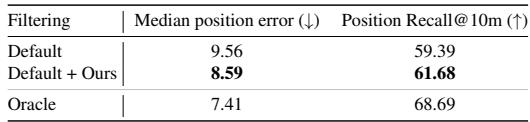
The method improves position recall (the percentage of cameras correctly positioned) from 59.39% to 61.68%. While this might look like a small percentage bump, in 3D reconstruction, recovering even a few dozen more cameras can mean the difference between a complete model and one with missing walls or buildings.
PhotoTourism and ScanNet
The authors also tested on the PhotoTourism dataset (outdoor landmarks) and ScanNet (indoor environments).
PhotoTourism Results:
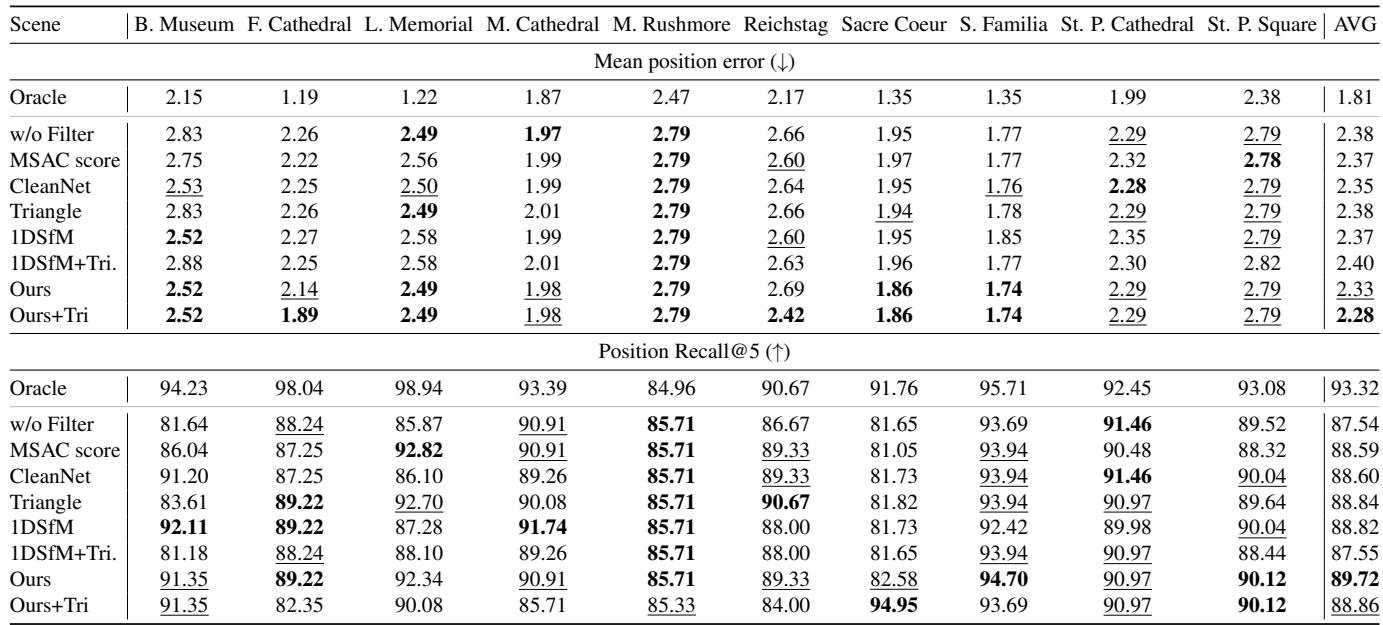
On PhotoTourism (Table 3), the proposed method consistently achieves high recall. Notably, on the “Sacre Coeur” scene, the combined approach (Ours+Tri) reaches 94.95% recall, significantly higher than the baseline’s 81.73%.
ScanNet Results:
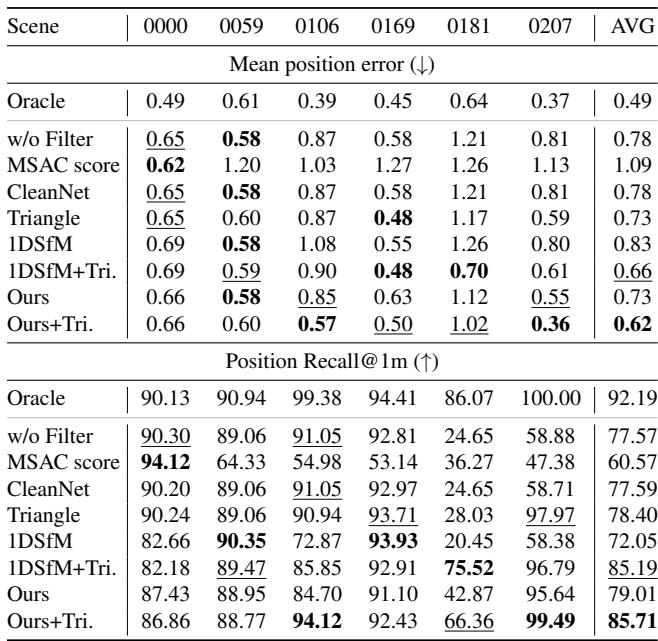
ScanNet (Table 4) represents indoor scenes, which are notoriously difficult for SfM due to textureless walls and repetitive patterns. Here, the standard 1DSfM filter actually hurt performance (increasing error from 0.78m to 0.83m) because it deleted good edges. The proposed learning-based method, however, improved the error to 0.73m, demonstrating it is much smarter about preserving valid connections in difficult geometric configurations.
Ablation Studies: What Matters?
Finally, the researchers stripped parts of their model to see what was actually driving the performance.
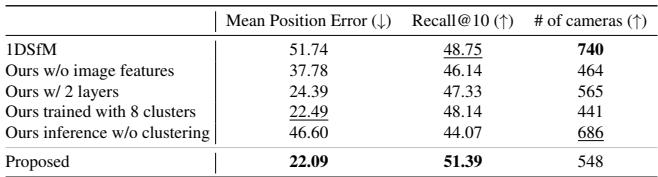
Table 5 reveals two critical insights:
- Image Features are Key: Removing the DINOv2 image features (“Ours w/o image features”) increased the error from 22.09m to 37.78m. The network needs to “see” the images to judge the geometric relationship accurately.
- Clustering Works: Running the inference without clustering (“Ours inference w/o clustering”) actually resulted in worse performance (46.60m error). This is likely because the full graph is too noisy; clustering allows the network to focus on local consistency within sub-graphs, acting as a form of regularization.
Conclusion
The paper “Learning to Filter Outlier Edges in Global SfM” presents a compelling case for integrating deep learning into the geometric pipeline of 3D reconstruction. By converting the Pose Graph into a Line Graph and applying a Transformer-based GNN, the method effectively acts as a “smart filter,” cleaning up noisy data before the heavy mathematical lifting begins.
The key innovations—specifically the use of line graphs to frame the problem and clustering to solve the memory constraints—allow this method to scale to large, real-world datasets. The results are clear: accurate camera positioning, fewer catastrophic failures, and a more robust pipeline overall.
For students and practitioners in Computer Vision, this work highlights a growing trend: the best systems often aren’t purely “learning-based” or purely “geometric.” They are hybrids—using deep learning to handle the messiness of real-world data (outlier detection) and rigorous geometry to perform the final reconstruction.