](https://deep-paper.org/en/paper/file-2119/images/cover.png)
Introduction
“In computer vision, there is only one problem: correspondence, correspondence, correspondence.”
This famous quote by Takeo Kanade highlights a fundamental truth about how machines “see.” Whether a robot is navigating a room, an AI is editing a photo, or a system is tracking a moving car, the core task is almost always the same: identifying which pixel in Image A corresponds to which pixel in Image B.
However, historically, we haven’t treated this as one problem. We have fragmented it into three distinct domains:
- Geometric Correspondence: Matching points in the same static scene from different viewpoints (e.g., for 3D reconstruction).
- Semantic Correspondence: Matching parts of different objects that belong to the same category (e.g., the left eye of a cat vs. the left eye of a tiger).
- Temporal Correspondence: Tracking points on a moving, deforming object across video frames.
Traditionally, if you wanted to solve these problems, you needed three different algorithms. A geometric matcher would fail at semantic tasks, and a semantic matcher would lack the precision for geometry. But humans don’t work this way. We use a unified visual system to align points across all these scenarios effortlessly.
Enter MATCHA.
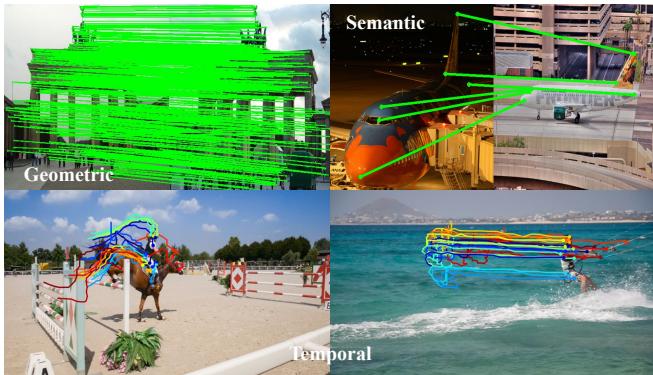
In the paper “MATCHA: Towards Matching Anything,” researchers propose a unified feature model designed to “rule them all.” By leveraging the power of modern foundation models (like Stable Diffusion and DINOv2) and a clever fusion architecture, MATCHA creates a single feature descriptor capable of handling geometric, semantic, and temporal matching simultaneously.
In this post, we will deconstruct how MATCHA works, why it outperforms specialized methods, and what this means for the future of computer vision.
The Background: Why is Unification Hard?
To understand MATCHA’s contribution, we first need to look at the “giants” it stands upon: Diffusion Models and Self-Supervised Learning.
The Ingredients
- Stable Diffusion (SD): While famous for generating images, diffusion models implicitly learn rich representations of the world. A prior method called DIFT (Diffusion Features) showed that features extracted from SD’s internal layers are surprisingly good at correspondence. Low-level layers capture geometry; high-level layers capture semantics.
- DINOv2: This is a vision transformer trained with self-supervision. It is incredible at object-level understanding (semantics) and handling viewpoint changes.
The Problem with Existing Foundation Features
While DIFT and DINOv2 are powerful, they have distinct weaknesses when used individually.
- DINOv2 is excellent at recognizing a specific object (e.g., a horse) even if it rotates or scales. However, it struggles when there are multiple instances of the same object (e.g., identifying which horse in a herd) or when fine-grained geometric precision is needed.
- DIFT requires you to manually select different layers for different tasks (a “geometric” feature vs. a “semantic” feature). It isn’t a single, unified representation. Furthermore, purely unsupervised diffusion features often lack the precision of supervised methods.
The researchers visualized these limitations using heatmaps.
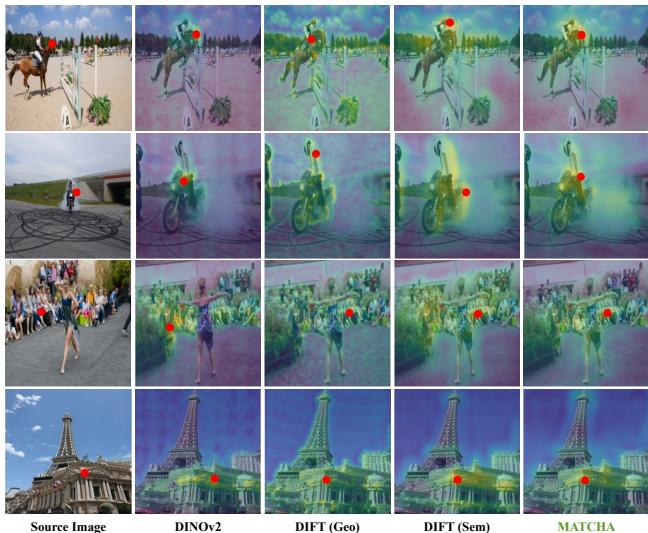
As shown in the image above:
- Row 1 & 2: DINOv2 (second column) focuses beautifully on the single object.
- Row 3: When there are multiple spectators (instances of the same class), DINOv2 gets confused and highlights all of them. DIFT (third column) is better at distinguishing specific instances but can be noisy.
- MATCHA (last column): It achieves the best of both worlds—clean, precise, and instance-specific.
The Core Method: How MATCHA Works
The goal of MATCHA is to output a single feature map \(F_m\) for an input image, where every pixel is represented by a vector that encodes both semantic and geometric information robustly.
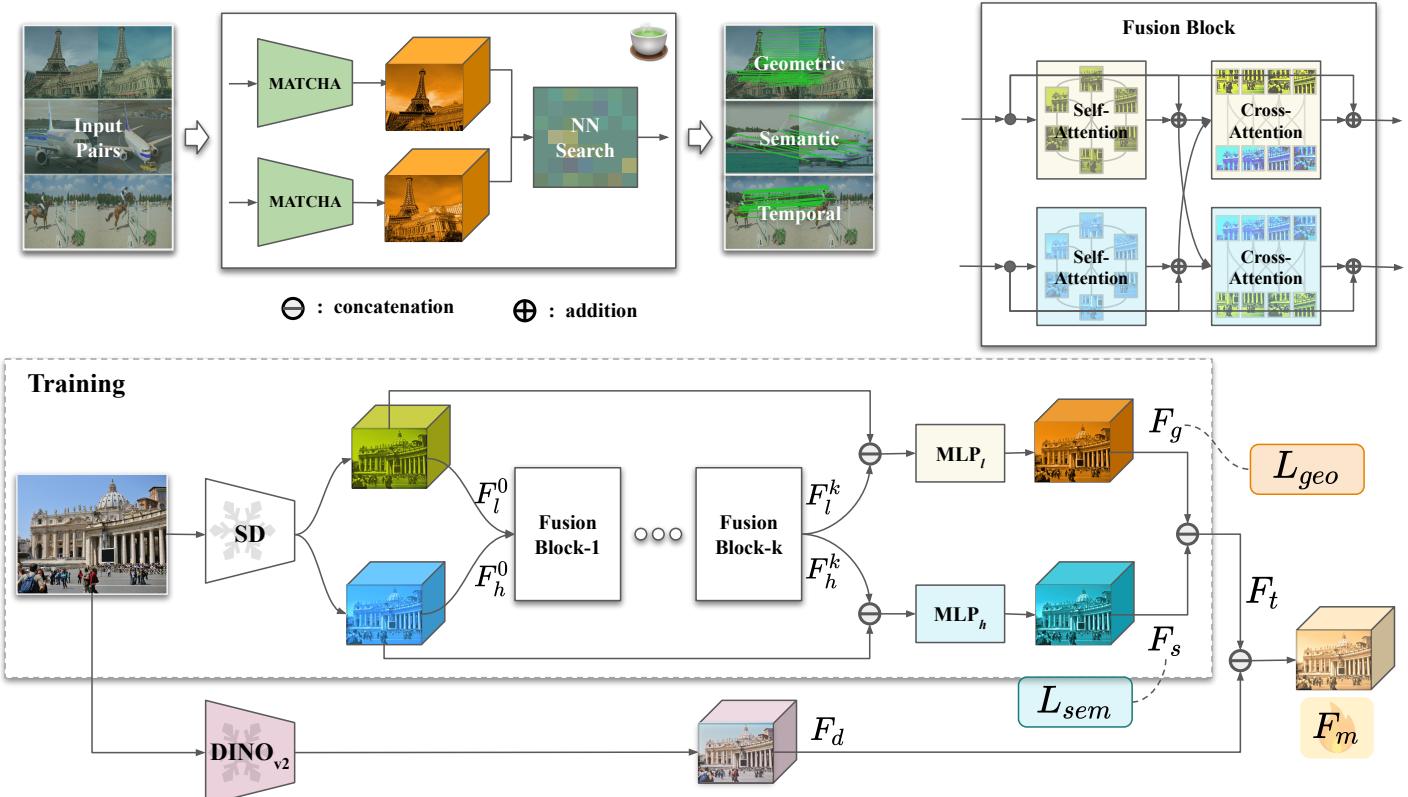
The architecture involves three main stages:
- Extraction from foundation models.
- Dynamic Fusion using Transformers.
- Merging into a unified descriptor.
Step 1: Feature Extraction
The model takes an RGB image and passes it through two frozen backbones:
- Stable Diffusion: It extracts a low-level geometric feature (\(F_l\)) and a high-level semantic feature (\(F_h\)).
- DINOv2: It extracts a robust object-level semantic feature (\(F_d\)).
Step 2: Dynamic Feature Fusion
This is the most critical innovation of the paper. Simply concatenating these features isn’t enough; they need to “talk” to each other.
The researchers use a Transformer module with Self-Attention and Cross-Attention to fuse the geometric (\(F_l\)) and semantic (\(F_h\)) features from Stable Diffusion.
- Self-Attention: Helps the features refine themselves based on the global context of the image.
- Cross-Attention: Allows the geometric stream to borrow context from the semantic stream, and vice versa.
Why is this necessary?
- Geometry needs Semantics: To distinguish between repetitive patterns (like windows on a building), the model needs to understand the broader semantic context.
- Semantics needs Geometry: To pinpoint exact keypoints (like the corner of an eye), the model needs low-level edge and texture details.
The mathematical update rule for the \(i\)-th block of the fusion module is:
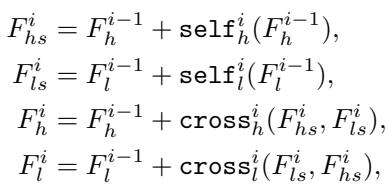
Here, \(F_{hs}\) and \(F_{ls}\) represent the features after self-attention, which are then fed into the cross-attention layers. This intertwines the two streams, creating “augmented” features.
After \(k\) layers of attention, the features are projected using a Multi-Layer Perceptron (MLP) to create the enhanced semantic (\(F_s\)) and geometric (\(F_g\)) descriptors:

Step 3: Feature Merging
Finally, the model combines the enhanced diffusion features with the DINOv2 features. This is done via simple concatenation. The DINOv2 feature (\(F_d\)) acts as a strong “anchor” for high-level object understanding, complementing the fine-tuned diffusion features.

The result, \(F_m\), is a single vector per pixel that contains the “DNA” of the image required for any type of matching.
Supervision Strategy
You might wonder: “If we want a unified feature, why not just train on a massive dataset of everything?”
The problem is data scarcity. We don’t have large-scale datasets that possess ground truth for geometry, semantics, and temporal tracking simultaneously.
MATCHA solves this by applying targeted supervision during the fusion stage:
- The Geometric branch (\(F_g\)) is supervised using geometric matching losses (forcing it to be good at precise alignment).
- The Semantic branch (\(F_s\)) is supervised using semantic matching losses (forcing it to understand object parts).
By supervising the branches before the final merge, the model forces the Dynamic Fusion module to learn how to extract and share the most relevant information between the streams.
Experiments & Results
The researchers evaluated MATCHA across all three standard correspondence tasks. Let’s look at the performance.
1. Semantic Matching
This task involves matching points between different instances of the same category (e.g., SPair-71k dataset).
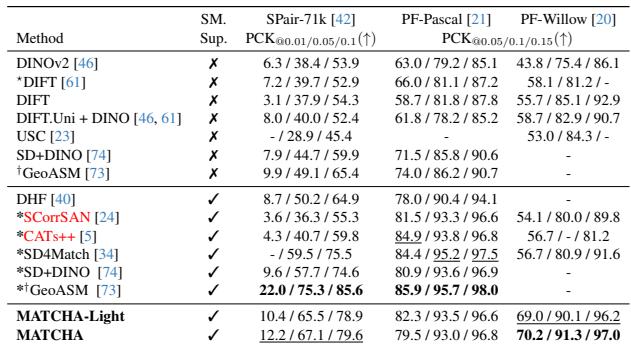
MATCHA achieves state-of-the-art results among feature-based methods. Notably, it significantly outperforms DIFT (which is unsupervised) and even outperforms specialized supervised methods like SD+DINO on the challenging SPair-71k dataset. The MATCHA-Light variant (which doesn’t use the final DINOv2 concatenation) also performs remarkably well, proving the effectiveness of the Dynamic Fusion module.
2. Geometric Matching
Here, the model must match points across large viewpoint changes (HPatches dataset) and estimate camera poses (MegaDepth, ScanNet).
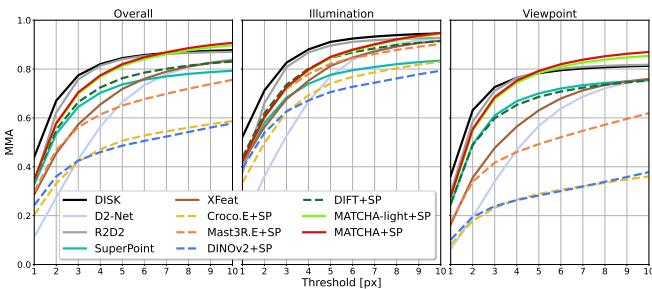
In Figure 4, we see the Mean Matching Accuracy (MMA).
- Solid Green Line (MATCHA): It consistently performs at the top tier, especially at tighter error thresholds (1-3 pixels).
- It beats unsupervised foundation models (dashed lines) by a significant margin.
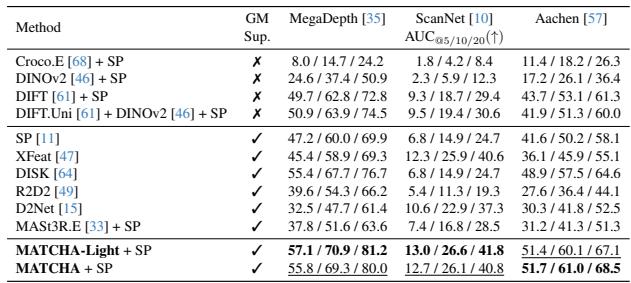
Table 2 confirms this dominance in pose estimation. On the MegaDepth dataset, MATCHA achieves an AUC (Area Under Curve) of 55.8, compared to 49.7 for DIFT and 24.6 for DINOv2. This huge gap highlights that DINOv2 alone lacks the spatial precision for geometry, but MATCHA successfully injects that precision back in.
3. Temporal Matching (Zero-Shot)
This is perhaps the most impressive result. The model was not trained on video data. The researchers used the TAP-Vid benchmark to test “Zero-shot” temporal tracking—using the features to track points frame-by-frame.
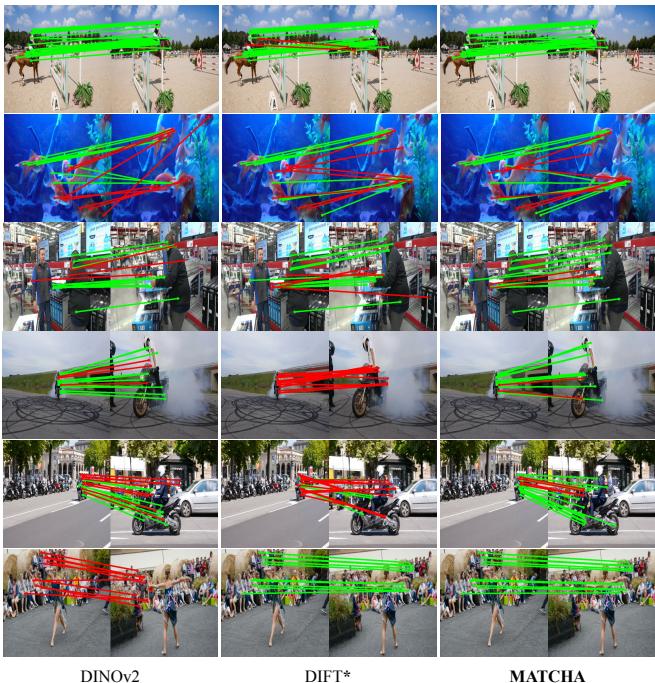
Figure 5 visualizes the trajectories.
- Row 2 (Fish): DINOv2 loses track due to occlusion and the similarity of the fish. MATCHA maintains the lock.
- Row 3 (Motorcycle): MATCHA handles the rapid motion and dynamic background better than the baselines.
Because MATCHA combines DINOv2’s robustness to deformation with Stable Diffusion’s texture awareness, it becomes a superior tracker without ever seeing a video during training.
The Verdict: Matching Anything
Finally, the authors compiled a ranking across all tasks to answer the core question: Can one feature really do it all?
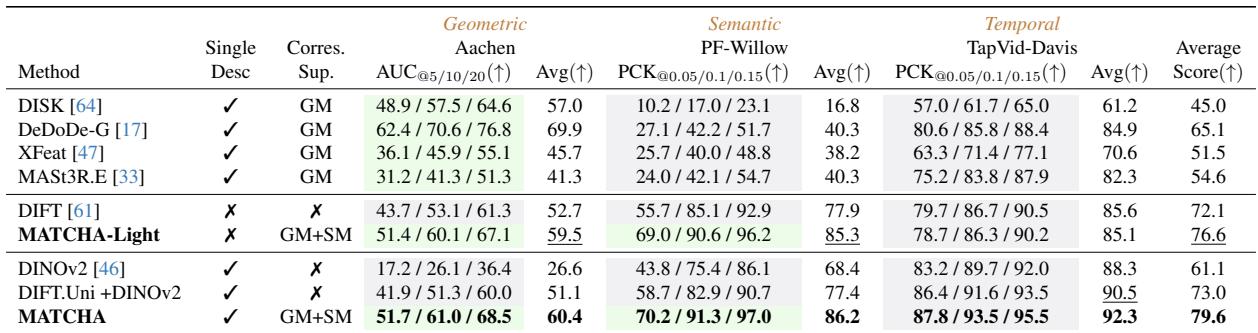
As Table 4 shows, specialized methods (like DISK for geometry) fail at semantics. Unsupervised methods (DIFT) are “jacks of all trades, masters of none.” MATCHA (bottom row) achieves the highest average score (79.6), effectively bridging the gap. It is the only method that provides state-of-the-art performance across geometric, semantic, and temporal domains simultaneously.
Conclusion
MATCHA represents a significant step toward general-purpose computer vision. It challenges the long-held assumption that we need specialized feature descriptors for different correspondence tasks.
Key Takeaways:
- Unification is possible: We can condense geometric, semantic, and temporal understanding into a single vector representation.
- Synergy via Fusion: Geometric features help semantic tasks (by providing precision), and semantic features help geometric tasks (by providing context). The Dynamic Fusion module is the key mechanism that enables this exchange.
- Foundation Models are Complementary: Stable Diffusion and DINOv2 have different strengths. MATCHA shows that the best way forward is not to choose between them, but to intelligently combine them.
While MATCHA is computationally heavier than simple local features (due to the use of two foundation backbones), it paves the way for a future where a single “visual cortex” model handles all correspondence problems, simplifying the pipeline for downstream applications like SLAM, editing, and robotics.