](https://deep-paper.org/en/paper/file-2135/images/cover.png)
Stop Guessing, Start Learning: Automating PEFT Hyperparameters with Meta-Learning
In the era of massive foundation models like GPT-4, CLIP, and Stable Diffusion, the paradigm of machine learning has shifted. We rarely train models from scratch anymore. Instead, we take a pre-trained giant and “fine-tune” it for our specific needs.
But what happens when your specific need is incredibly niche, data-scarce, or imbalanced? Consider Remote Sensing (RS)—analyzing satellite imagery to detect specific types of ships or terrain. Training a foundation model from scratch for this is impossibly expensive. Full fine-tuning (updating all parameters) is computationally heavy and often leads to overfitting, especially on “tail classes” (rare objects that don’t appear often in the data).
The industry solution has been Parameter-Efficient Fine-Tuning (PEFT) techniques like LoRA (Low-Rank Adaptation) or Adapters. These methods freeze the giant model and only train tiny add-on modules. They are efficient and effective.
But there is a catch. Where exactly do you put these modules? How strong should their influence be? Which layers benefit the most?
A new paper, “Meta-Learning Hyperparameters for Parameter Efficient Fine-Tuning”, reveals that these “hyperparameter” choices are not just minor details—they can make or break your model’s performance. More importantly, the authors propose a clever way to stop guessing these values and let the model learn them automatically.
In this post, we will dissect why PEFT is harder than it looks, explore the complex behavior of fine-tuning hyperparameters, and dive into MetaPEFT, a bi-level optimization framework that automates the adaptation process.
The Hidden Complexity of PEFT
To understand the solution, we first have to appreciate the problem. When we use a method like LoRA, we are injecting small trainable matrices into a frozen Transformer block.
Most practitioners rely on heuristics or default settings. For example, a common default is to apply LoRA to the Query and Value projection layers of every attention block. But is that optimal for satellite imagery? Probably not.
The authors of this paper conducted a comprehensive study on transferring knowledge from natural images (ImageNet-21K) to remote sensing datasets (DOTA). They analyzed different PEFT methods and found two major insights.
Observation 1: Additive Methods Win on the Tail
PEFT methods generally fall into two buckets:
- Selective: Modifying a subset of existing parameters (e.g., BitFit).
- Additive: Adding new parameters to the network (e.g., LoRA, Adapters).
The researchers found that additive methods significantly outperform selective methods, particularly on “tail classes”—the rare categories that usually suffer the most during transfer learning.
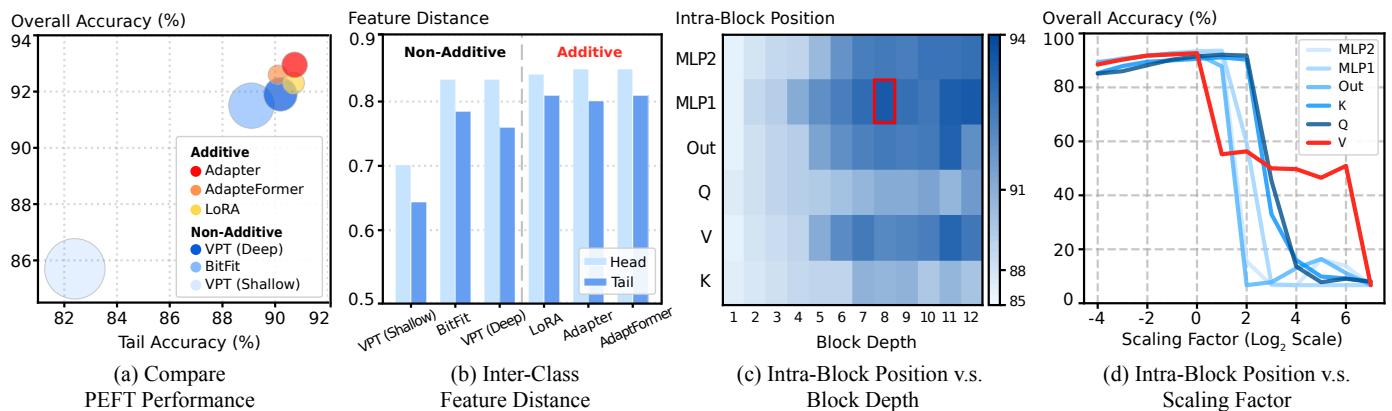
As shown in Figure 1 (a), additive methods (red bubbles) consistently achieve higher accuracy and lower variance than non-additive methods (blue bubbles). Furthermore, Figure 1 (b) shows that additive methods create larger “inter-class feature distances.” This means the model is better at pushing the representations of different classes apart, which is crucial for distinguishing between rare, similar-looking objects.
Observation 2: The Hyperparameter Trap
Here is where it gets tricky. If you stick with additive methods, you have to decide:
- Intra-block Position: Which specific layers inside a Transformer block should we adapt? (Attention Query/Key/Value? The Feed-Forward Network?)
- Block Depth: Which blocks in the 12-layer stack should we adapt? (Early layers? Deep layers?)
- Scaling Factor (\(\alpha\)): How heavily should the new parameters influence the output?
You might think you can tune these one by one—find the best depth, then find the best layer. You would be wrong.
The authors discovered that these hyperparameters have non-monotonic combinations. Look at Figure 1 (c) above. The heatmap shows accuracy based on block depth and intra-block position.
- Deeper blocks generally yield better performance (lighter colors at the bottom).
- However, the position marked with
Irepresents the optimal individual settings combined. Surprisingly, combining the “best” depth with the “best” position actually caused a 0.6% drop in accuracy compared to other configurations.
Even more drastic is the scaling factor sensitivity shown in Figure 1 (d). Increasing the scaling factor for the output layer (Out) causes accuracy to collapse from 87% to 6.7%.
This creates a massive optimization headache. You have a mix of discrete choices (which layer?) and continuous choices (how much scale?). Brute-forcing this search space is computationally impossible.
Enter MetaPEFT: Learning to Learn
The core innovation of this paper is to treat these hyperparameters not as fixed settings to be chosen by a human, but as learnable parameters to be optimized by the model.
The authors propose MetaPEFT, a framework that unifies discrete and continuous decisions into a single differentiable “modulator.”
1. The Unified Modulator (\(\gamma\))
Standard additive PEFT works by injecting a module \(\Delta(x; \phi)\) into a frozen layer \(f(x; \theta)\). It usually looks like this:

Here, \(\mathbb{1}_p\) is a binary switch (insert or not?) and \(\alpha\) is the scaling factor. This is hard to optimize because you can’t calculate a gradient for a binary switch.
MetaPEFT replaces both the binary switch and the scaling factor with a single continuous parameter, \(\gamma\):

- If \(\gamma \approx 0\): The module is effectively turned off (equivalent to the binary switch being 0).
- If \(\gamma > 0\): The module is active, and the value of \(\gamma\) acts as the scaling factor \(\alpha\).
This simple change converts a discrete selection problem into a continuous optimization problem that standard deep learning frameworks (like PyTorch) can handle.
2. Integrating the Modulator
This modulator isn’t just a theoretical variable; it’s physically added to the network architecture.
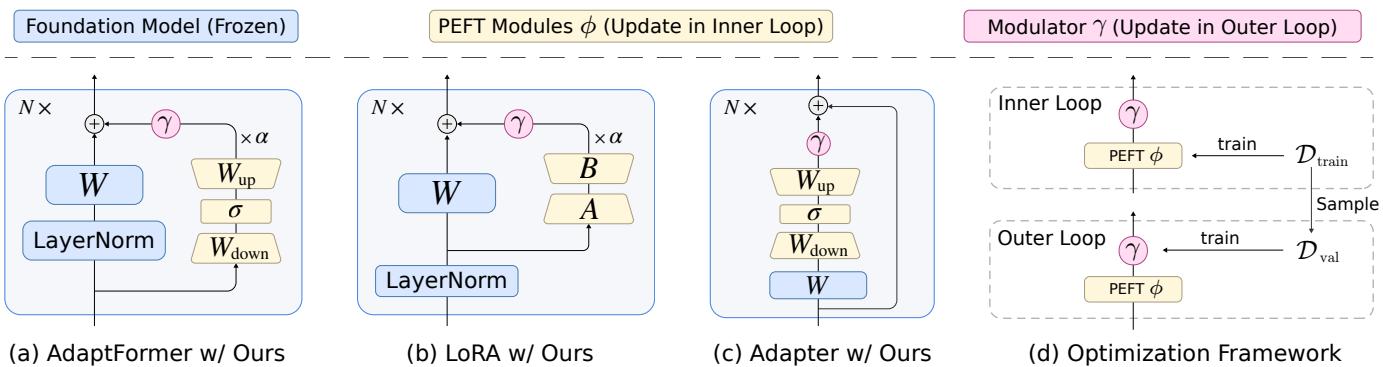
Figure 2 (a-c) illustrates how this works for different PEFT methods:
- AdaptFormer: The modulator \(\gamma\) scales the output of the adapter branch.
- LoRA: The modulator scales the output of the low-rank matrices \(BA^T\).
- Adapter: Similarly, it scales the bottleneck output.
This design introduces minimal overhead (less than 800 additional parameters for a ViT-B/16 model) but grants the system granular control over every single insertion point in the network.
3. Bi-Level Optimization
We cannot simply train \(\gamma\) alongside the model weights \(\phi\) on the same training data. If we did, the model would likely just greedily increase \(\gamma\) to memorize the training set, leading to severe overfitting—a disaster for data-scarce domains like Remote Sensing.
Instead, the authors use a Bi-Level Optimization strategy, inspired by meta-learning.
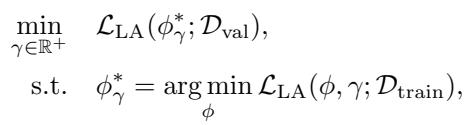
The process works in two alternating loops, as shown in Figure 2 (d):
Inner Loop (The Learner): We freeze the modulator \(\gamma\) and update the PEFT parameters \(\phi\) using the training set. This teaches the modules what features to extract.

Outer Loop (The Meta-Learner): We freeze the PEFT parameters \(\phi\) and update the modulator \(\gamma\) using a validation set (a sampled subset of the training data). This teaches the model how strong the adaptation should be to generalize well.

By updating \(\gamma\) on a held-out subset, the model explicitly optimizes for generalization, effectively “meta-learning” the best hyperparameters for the task.
Experimental Results: Does it Work?
The researchers tested MetaPEFT across three scenarios:
- Natural Vision: ImageNet to CIFAR/Places/iNaturalist.
- Natural to Remote Sensing: ImageNet to DOTA (Satellite imagery).
- Cross-Spectral: Optical Satellite (SatMAE) to SAR (Synthetic Aperture Radar).
The results validated the “meta” approach.
Comparison with State-of-the-Art
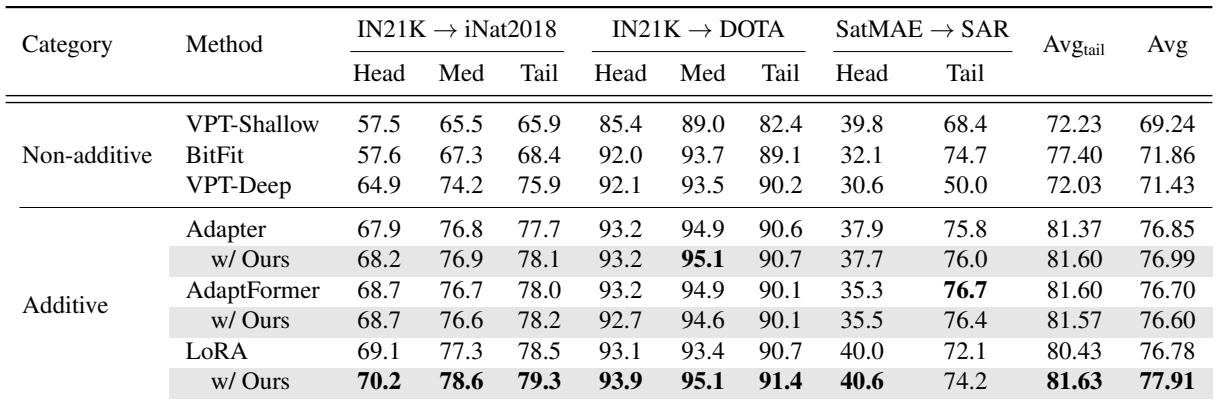
Table 4 presents the main scorecard. The rows marked in gray show standard PEFT methods enhanced with MetaPEFT.
- Consistent Gains: MetaPEFT improves performance across the board compared to static baselines.
- LoRA Synergy: The combination of LoRA + MetaPEFT achieves the highest average accuracy.
- Tail Class Dominance: Look at the
Avg_tailcolumn. MetaPEFT achieves 81.63% on tail classes compared to 80.43% for standard LoRA. In the difficult “SatMAE \(\rightarrow\) SAR” transfer (where domain gap is huge), the improvement on tail classes is significant.
What Did the Model Learn?
Since the model “learned” its own hyperparameters, we can peek inside to see what configurations it chose. The results confirm that manual heuristics are often wrong.
1. Which Intra-Block Layer is Best?
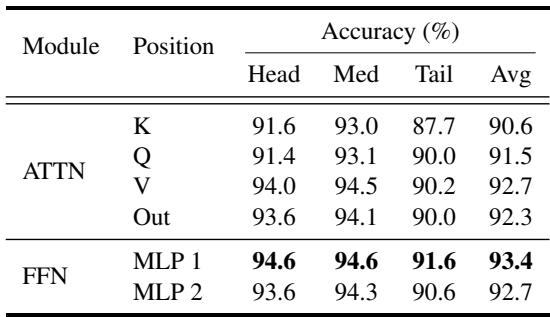
Standard LoRA is often applied to Attention layers (Q/K/V). However, Table 2 shows that applying adaptation to the FFN (Feed-Forward Network) layers—specifically MLP 1—yields better results (93.4% vs 90.6% for Key projection). The FFN layers are responsible for feature transformation, which seems more critical for domain adaptation than the spatial correlation handled by attention layers.
2. Which Block Depth is Best?
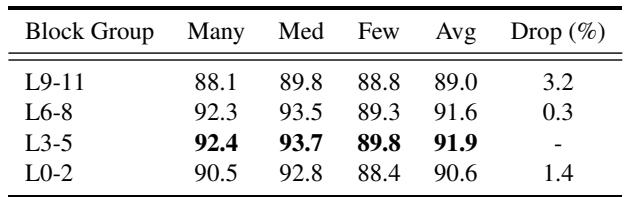
Intuition suggests that the deepest layers (closest to the output) are the most important to fine-tune. Table 3 contradicts this. The “middle-lower” blocks (Layers 3-5) actually achieved the best performance. The deepest blocks (Layers 9-11) saw a 3.2% performance drop. This suggests that for domain transfer, adapting the intermediate feature representations is more effective than just changing the final high-level semantics.
Why Does It Work? Better Feature Separation
Finally, why does this lead to better accuracy? The authors analyzed the “Inter-Class Feature Distance”—a measure of how distinct the model’s understanding of different classes is.
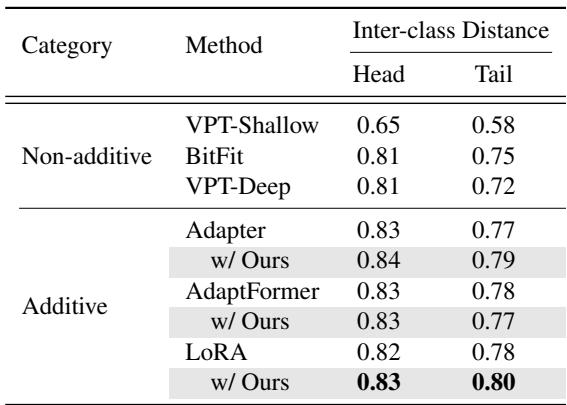
Table 5 shows that MetaPEFT (combined with LoRA) maximizes the distance between classes, specifically for tail classes (0.80 cosine distance vs 0.78 for standard LoRA). By dynamically scaling the adaptation at specific layers, the model learns to carve out distinct distinct spaces in the feature manifold for rare objects, preventing them from being drowned out by common classes.
Conclusion
The “Meta-Learning Hyperparameters for Parameter Efficient Fine-Tuning” paper highlights a crucial inefficiency in how we currently adapt foundation models. We are using sophisticated models but configuring them with crude, manual guesses.
MetaPEFT offers a compelling alternative:
- Unify discrete and continuous choices into a single differentiable parameter.
- Automate the search using bi-level optimization.
- Generalize better by separating the learning of features (inner loop) from the learning of hyperparameters (outer loop).
For students and practitioners, the takeaway is clear: as models grow larger and tasks become more specific, the “engineering” of fine-tuning is becoming as complex as the modeling itself. Techniques that can self-regulate and automate this complexity—like MetaPEFT—will likely become the standard for deploying foundation models in the real world.