](https://deep-paper.org/en/paper/file-2142/images/cover.png)
Introduction: The High Cost of Knowing Where Things Are
In the world of computer vision, Semantic Segmentation is one of the “Holy Grail” tasks. It’s not enough to just say “there is a cat in this picture”; we want to know exactly which pixels belong to the cat. This level of detail is critical for autonomous driving (distinguishing the road from the sidewalk) and medical imaging (isolating a tumor from healthy tissue).
But there is a major bottleneck: Annotation.
To train a fully supervised model, humans have to painstakingly color in every single pixel of thousands of training images. It is slow, expensive, and laborious. This has led to the rise of Weakly Supervised Semantic Segmentation (WSSS). The goal of WSSS is ambitious: train a model to generate pixel-perfect masks using only image-level labels (e.g., just tagging an image as “Cat” and “Grass”).
While WSSS is promising, it has a persistent flaw known as Classification Bias. Models trained this way tend to cheat. If you tell a model to find a “Cat,” it learns to look for the most obvious feature—like the ears or the face—and ignores the rest of the body. The result? Incomplete segmentation masks that look like scattered blobs rather than coherent objects.
In this post, we are diving deep into a CVPR paper that proposes a clever solution: Multilabel Prototype Visual Spatial Search (MuP-VSS). Instead of just classifying images, this method treats segmentation as a search problem, using “prototypes” to find every piece of an object in a scene.
The Problem: Why Traditional Methods Miss the Big Picture
To understand why MuP-VSS is necessary, we first need to look at why current methods fail. Most WSSS approaches rely on two techniques:
- CNN-based Class Activation Maps (CAM): These highlight the regions a Convolutional Neural Network uses to make a decision.
- Transformer-based Self-Attention: These use the attention mechanism of Vision Transformers (ViT) to find related patches.
Both suffer from the classification bias mentioned earlier. They focus on the discriminative regions—the parts that make a cat a cat—rather than the entire cat.
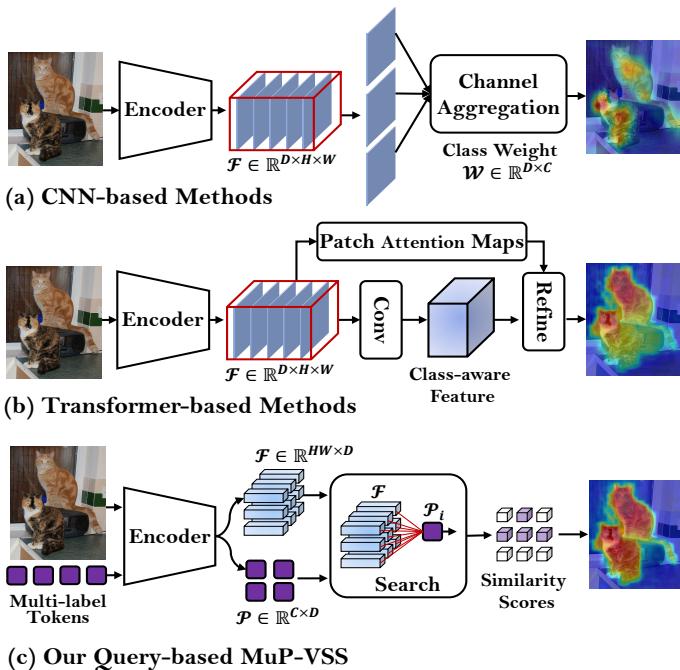
As shown in Figure 1 above:
- (a) CNN-based methods: Focus heavily on the cat’s head (the most discriminative part) but miss the body.
- (b) Transformer-based methods: Do slightly better by using self-attention to cover more area, but they still miss large chunks (like the red area in the diagram).
- (c) MuP-VSS (The proposed method): Generates a complete mask. It achieves this by defining Multi-label Prototypes. Think of these prototypes as “Query Vectors.” The model uses these queries to scan the entire image and “search” for every patch that matches the semantic meaning of “Cat.”
The Core Method: MuP-VSS Architecture
The researchers propose that instead of asking “What is in this image?”, we should be asking “Where are the parts that match this concept?”
To do this, they transform WSSS into an embedding representation task. The architecture consists of two main pillars:
- Multi-label Prototype Representation: Creating a rich vector summary for each class in the image.
- Multi-label Prototype Optimization: Training these prototypes using contrastive learning (since we don’t have pixel labels).
Let’s break down the architecture shown in Figure 3.
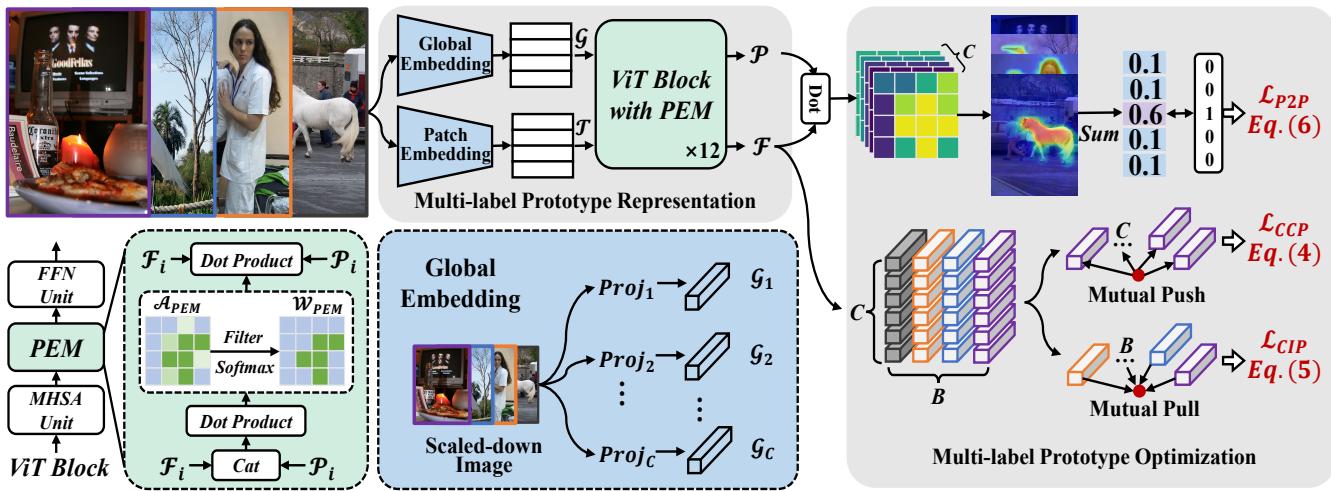
The pipeline takes an image and processes it through a Vision Transformer (ViT). However, it adds a few specialized components to generate and refine the prototypes.
1. Multi-label Prototype Representation
Standard ViTs break an image into local patches. MuP-VSS needs to understand the global context to form a prototype.
Global Embedding
First, the model takes the image and creates Global Tokens. It resizes the input image and uses a projection function (Convolution + Normalization) to create a set of global tokens, \(\mathcal{G}\), representing the categories.
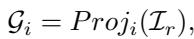
Here, \(Proj_i\) transforms the scaled-down image into global tokens. These global tokens capture the long-range feature dependencies of the image, ensuring the model isn’t just looking at tiny details.
The Prototype Embedding Module (PEM)
This is where the magic happens. We have Global Tokens (the prototypes) and Patch Tokens (the local image parts). We need them to talk to each other. If the prototype for “Dog” is going to be accurate, it needs to absorb information from the specific “Dog” patches in the image.
The researchers introduce the Prototype Embedding Module (PEM). It calculates an affinity map (similarity score) between the prototypes and the patch tokens.
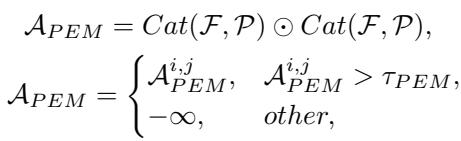
In this equation:
- \(\mathcal{F}\) are the image features (patches).
- \(\mathcal{P}\) are the prototypes.
- \(\tau_{PEM}\) is a threshold. This is crucial. It filters out noise, ensuring that the “Dog” prototype only updates itself based on patches that actually look like a dog, ignoring the background grass.
Once the affinity is calculated, the model uses SoftMax to create weights and updates both the patch features and the prototypes. This mutual update ensures that prototypes become more accurate representations of the specific objects in the image.

2. Multi-label Prototype Optimization
Now that we have these prototypes, how do we train them? Remember, we don’t have pixel labels. We only know that the image contains a “Dog” and a “Person.”
The authors use Contrastive Learning. They rely on the principles of Exclusivity and Consistency, visually summarized in Figure 2.
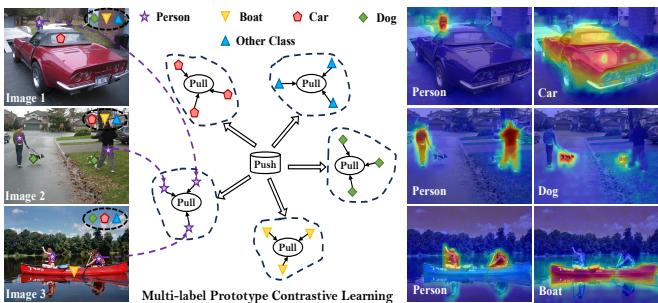
- Exclusivity (Mutual Push): Different objects in the same image (e.g., Dog vs. Person) should have very different prototypes. They should be pushed apart in the feature space.
- Consistency (Mutual Pull): The “Dog” in Image A should look similar to the “Dog” in Image B. They should be pulled together.
This intuition is formalized into three specific loss functions.
Loss 1: Cross-Class Prototype Contrastive Loss (CCP)
This loss enforces exclusivity. Within a single image, the prototype for Class A and Class B must be distinct. We minimize the cosine similarity between different class prototypes.
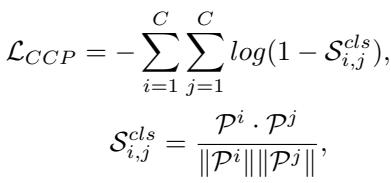
By minimizing this similarity (\(S^{cls}\)), the model forces the features of “Cat” and “Dog” to be orthogonal (unrelated) to each other, reducing confusion.
Loss 2: Cross-Image Prototype Contrastive Loss (CIP)
This loss enforces consistency. It looks across the batch of images. If Image 1 has a bike and Image 2 has a bike, their “Bike” prototypes should differ slightly (due to lighting/angle) but should be fundamentally close in the embedding space.
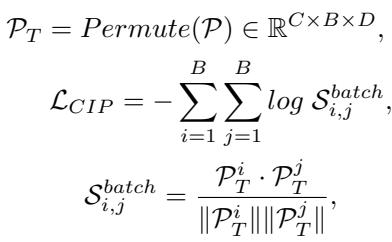
Here, the Permute function aligns the dimensions to compare the same categories across the batch size \(B\). This allows the model to learn a robust, generalized representation of a “Bike” rather than overfitting to a single image.
Loss 3: Patch-to-Prototype Consistency Loss (P2P)
Finally, we need to ensure the local patches agree with the global prototypes. If a patch belongs to a foreground object, it should have high similarity to that object’s prototype.
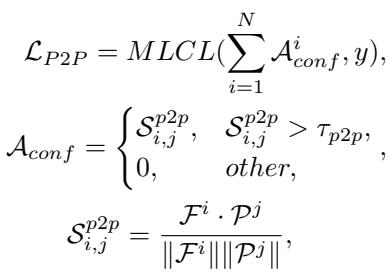
This loss (\(L_{P2P}\)) acts as a guide, encouraging patch tokens to match the correct foreground prototypes while suppressing responses to irrelevant background classes.
Total Loss
The final training objective combines these three contrastive/consistency losses with a standard classification loss (\(L_{CLS}\)) to ensure the model still correctly identifies which classes are present.

Inference: The Spatial Search
Once the model is trained, how do we actually get a segmentation mask?
We use the learned prototypes as Queries. We take the prototype for “Cat” and perform a dot product with every patch token in the image. This generates a similarity map—essentially a heatmap showing where the “Cat” is.
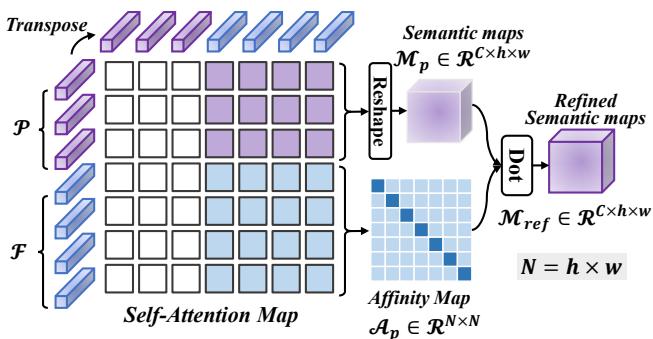
As shown in Figure 4, the process is:
- Dot Product: Match Prototypes \(\mathcal{P}\) with Patch Tokens \(\mathcal{F}\) to get the initial Semantic Map \(\mathcal{M}_p\).
- Refinement: Use an affinity map \(\mathcal{A}_p\) (how similar patches are to their neighbors) to smooth out the result, producing \(\mathcal{M}_{ref}\).


Experiments and Results
The researchers tested MuP-VSS on two standard benchmarks: PASCAL VOC 2012 and MS COCO 2014.
Quantitative Performance
The results show that MuP-VSS significantly outperforms previous state-of-the-art (SOTA) methods.
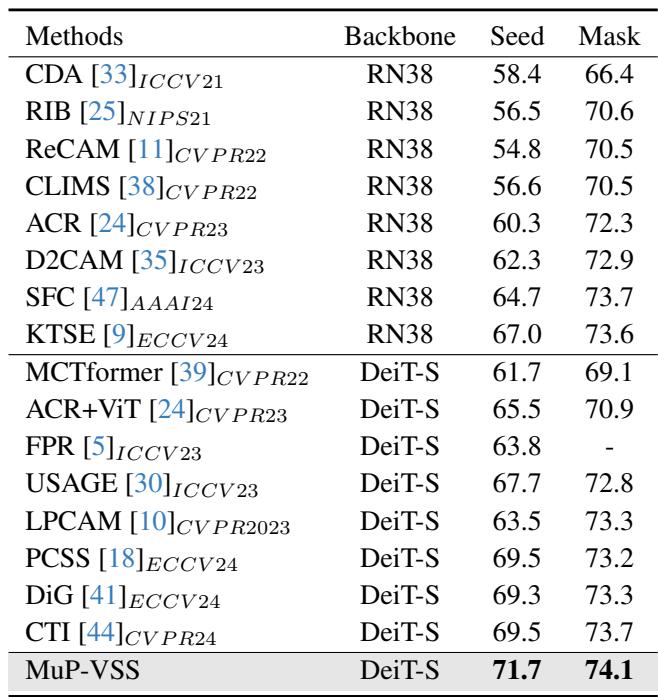
Table 1 shows the quality of the “Seed” (the initial guess) and the “Mask” (the refined pseudo-label). MuP-VSS achieves 71.7% mIoU (mean Intersection over Union) on the seed, which is a massive jump over methods like MCTformer (61.7%).
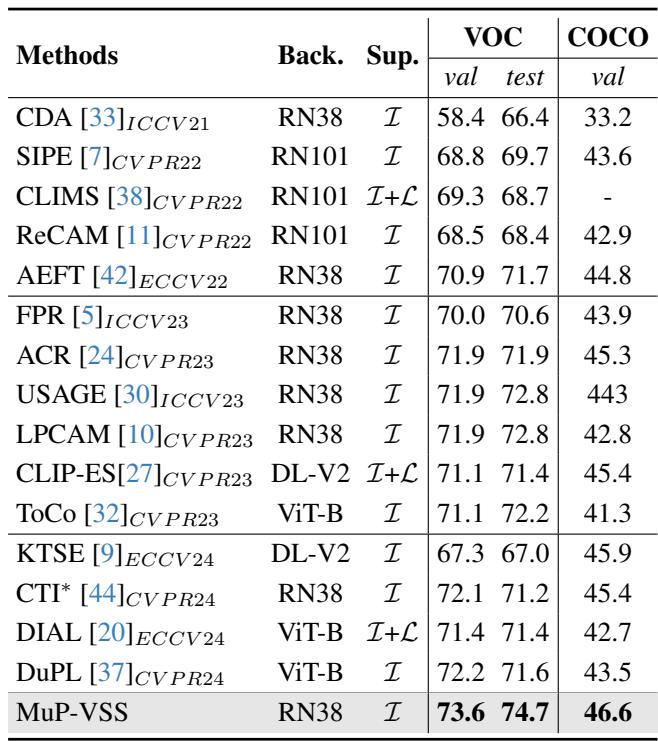
When looking at the final semantic segmentation performance on the validation and test sets (Table 2), MuP-VSS continues to dominate, even beating methods that use additional pre-trained language models (like CLIP).
Qualitative Visualization
Numbers are great, but in computer vision, seeing is believing.
Figure 5 compares MuP-VSS against CTI (a previous SOTA method). Notice the third column (the cat). CTI misses parts of the cat’s body, while MuP-VSS captures the entire shape. In the last column (dining table), CTI confuses the chairs with the table, whereas MuP-VSS separates them more effectively.
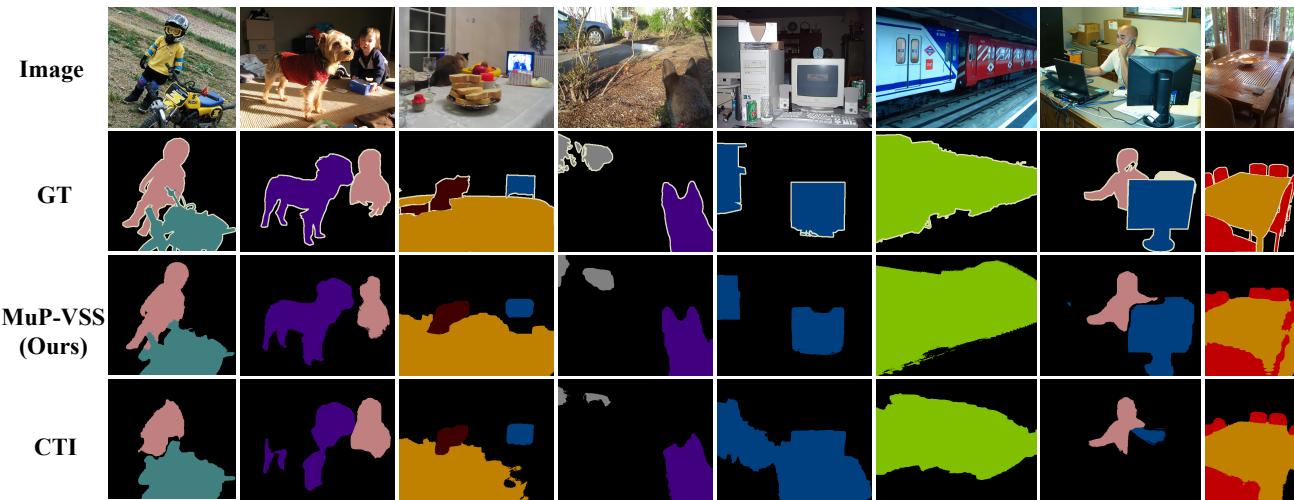
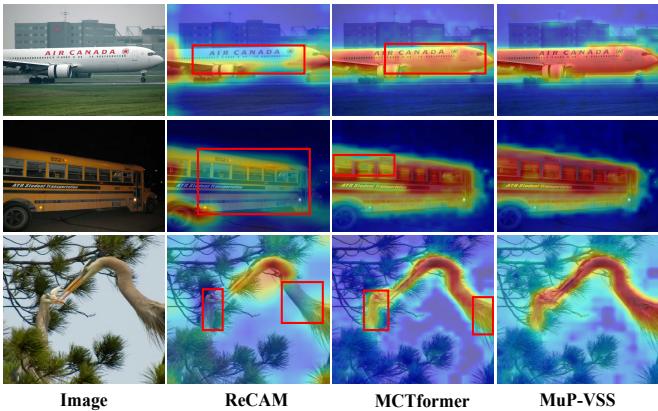
Figure 6 provides a thermal map visualization. This is perhaps the clearest demonstration of fixing the “Classification Bias.”
- ReCAM (CNN-based): Highlights only the text on the airplane or the windows of the bus.
- MuP-VSS: The entire fuselage of the airplane and the whole body of the bus “light up” in the thermal map.
Component Analysis
The authors also performed ablation studies to prove that every part of their architecture matters.
Table 3 shows that removing the Multi-label Prototype Optimization (MPO) or Representation (MPR) drops performance significantly.
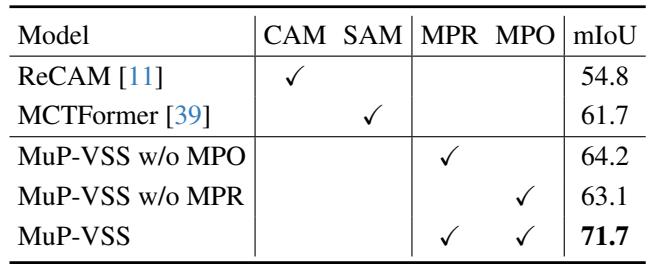
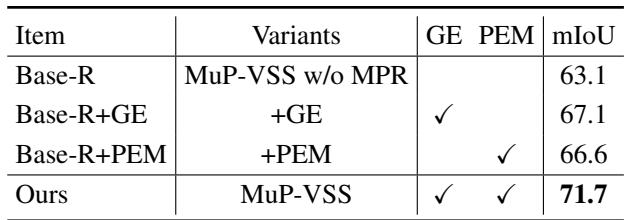
Table 4 & 5 dive deeper, showing that the specific loss functions (CCP, CIP, P2P) and the Global Embedding module each contribute 3-4% improvements individually.
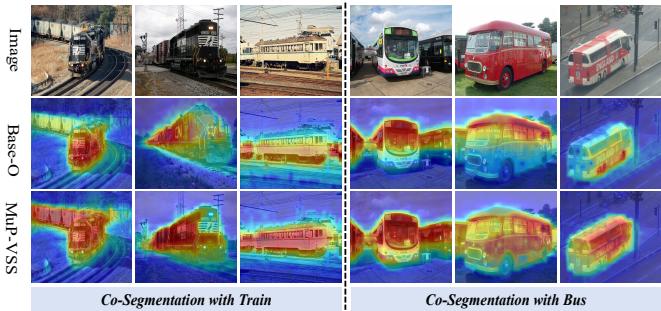
Finally, Figure 7 demonstrates Co-segmentation. Because of the Cross-Image (CIP) loss, the model learns what a “Train” looks like across different photos. Even if a train looks different in two photos, the model identifies the common semantic features, showing strong generalization.
Conclusion
The MuP-VSS paper represents a shift in thinking for Weakly Supervised Semantic Segmentation. By moving away from simple classification activation maps and towards a prototype-based spatial search, the authors tackled the long-standing issue of classification bias.
Key Takeaways:
- Don’t just classify; Search. Using prototypes as queries allows the model to find the whole object, not just the most distinct part.
- Context is King. The Global Embedding and Prototype Embedding Module (PEM) ensure that prototypes understand the specific context of the image.
- Physics of Features. Using contrastive losses to “push” different classes apart and “pull” similar classes together creates a robust feature space without needing pixel-level labels.
This method achieves state-of-the-art results on PASCAL VOC and MS COCO, proving that we can get high-quality segmentation masks without the high cost of manual annotation. As we move toward Foundation Models and Vision-Language Models, techniques like MuP-VSS that effectively bridge global semantics with local pixels will be essential.