](https://deep-paper.org/en/paper/file-2149/images/cover.png)
Introduction
We have all been there. You are trying to edit a photo, perhaps cutting out a subject to place on a new background. You use a smart selection tool, click on the object, and for the most part, it works like magic. But then you reach the hair, the bicycle spokes, or the thin strings of a kite. The magic fades. You find yourself zooming in to 400%, trying to click precisely on a pixel-thin line, only for the tool to select the entire sky instead.
This is the classic bottleneck of Interactive Segmentation. While recent advancements like the Segment Anything Model (SAM) have revolutionized how computers perceive objects, they still struggle with two major issues:
- The “Fat Finger” Problem: Accurately clicking on extremely thin or intricate structures is frustrating and time-consuming for humans.
- The Resolution Wall: Processing high-resolution images to capture those tiny details requires massive computational memory, forcing models to downsample images and lose the very details they are trying to select.
In a recent CVPR paper, researchers propose NTClick, a novel approach that fundamentally changes how we interact with segmentation models. Instead of forcing users to be pixel-perfect, NTClick introduces “Noise-Tolerant” clicks and a smart two-stage architecture that handles 4K resolution images on consumer hardware.
In this post, we will break down how NTClick works, why “uncertainty” is a superpower in computer vision, and how it manages to segment thin objects better than the current state-of-the-art.
The Background: Clicks, Scribbles, and Trade-offs
To understand why NTClick is necessary, we first need to look at how we currently talk to segmentation models.
The Standard Interaction
The most popular method is the Click-based approach (used by RITM, SimpleClick, and SAM). You click on the object (Foreground Click) or on the background (Background Click). It is fast and intuitive. However, as objects get more complex, the number of clicks required to fix mistakes skyrockets.
The Scribble Alternative
To solve the precision issue, some methods use Scribbles (like the Slim Scissors method). Instead of a precise point, you draw a rough line over the object. While this requires less precision, it is physically more demanding. If you have a dense cluster of leaves or wires, you end up having to “color in” large areas, which defeats the purpose of a quick interaction.
The Resolution Problem
Under the hood, most modern segmentation models use Vision Transformers (ViT). These are powerful, but they have a weakness: the Self-Attention mechanism. The computational cost of standard self-attention grows quadratically with image size. To prevent running out of memory, models often shrink images to \(1024 \times 1024\) pixels. For a thin kite string in a high-res photo, downsampling acts like an eraser—the string simply vanishes before the model even gets a chance to see it.
The Core Method: NTClick
The researchers behind NTClick tackled these problems by rethinking both the interaction (how the user inputs data) and the architecture (how the computer processes it).
1. The Noise-Tolerant Click
The first innovation is behavioral. Traditional models treat a click as a definitive statement: “This specific pixel belongs to the object.” If you miss by a few pixels on a thin wire, the model gets confused because you just labeled the sky as the object.
NTClick introduces a third type of interaction: the Noise-Tolerant Click.
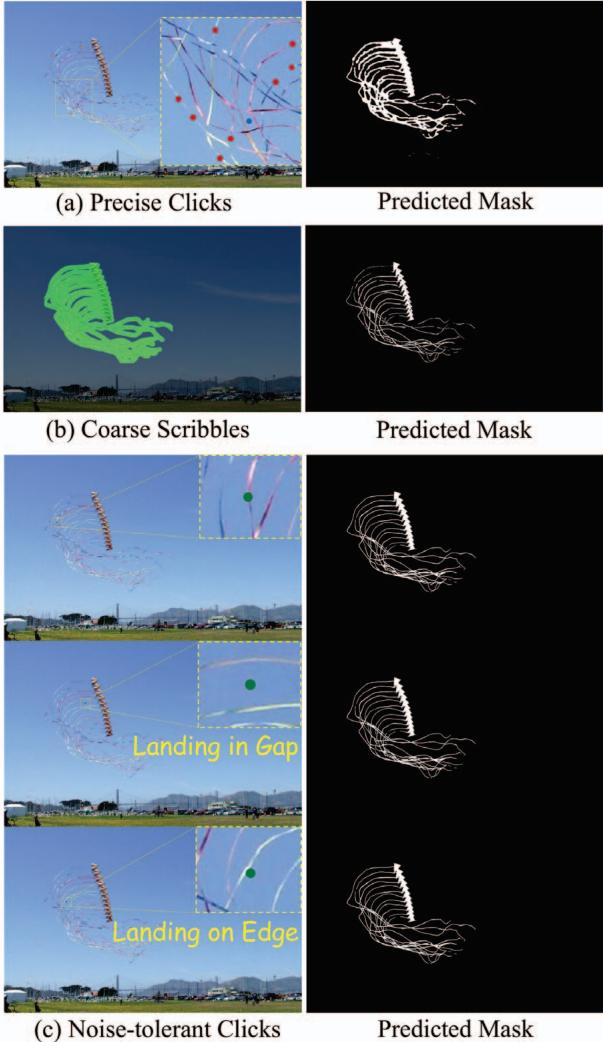
As seen in Figure 1, distinct from foreground (red) and background (blue) clicks, the noise-tolerant click (green) serves a different purpose. It tells the model: “There is a fine structure somewhere near here.”
It does not demand pixel-perfect accuracy. Whether you click on the object, in the gap between objects, or on the edge, the model interprets this as a signal to look for high-frequency details in that vicinity. This drastic reduction in user effort is the “User-Friendliness” aspect of the paper.
2. The Two-Stage Architecture
How does the model handle these loose instructions? NTClick divides the workload into two stages: Coarse Perception and High-Resolution Refinement.
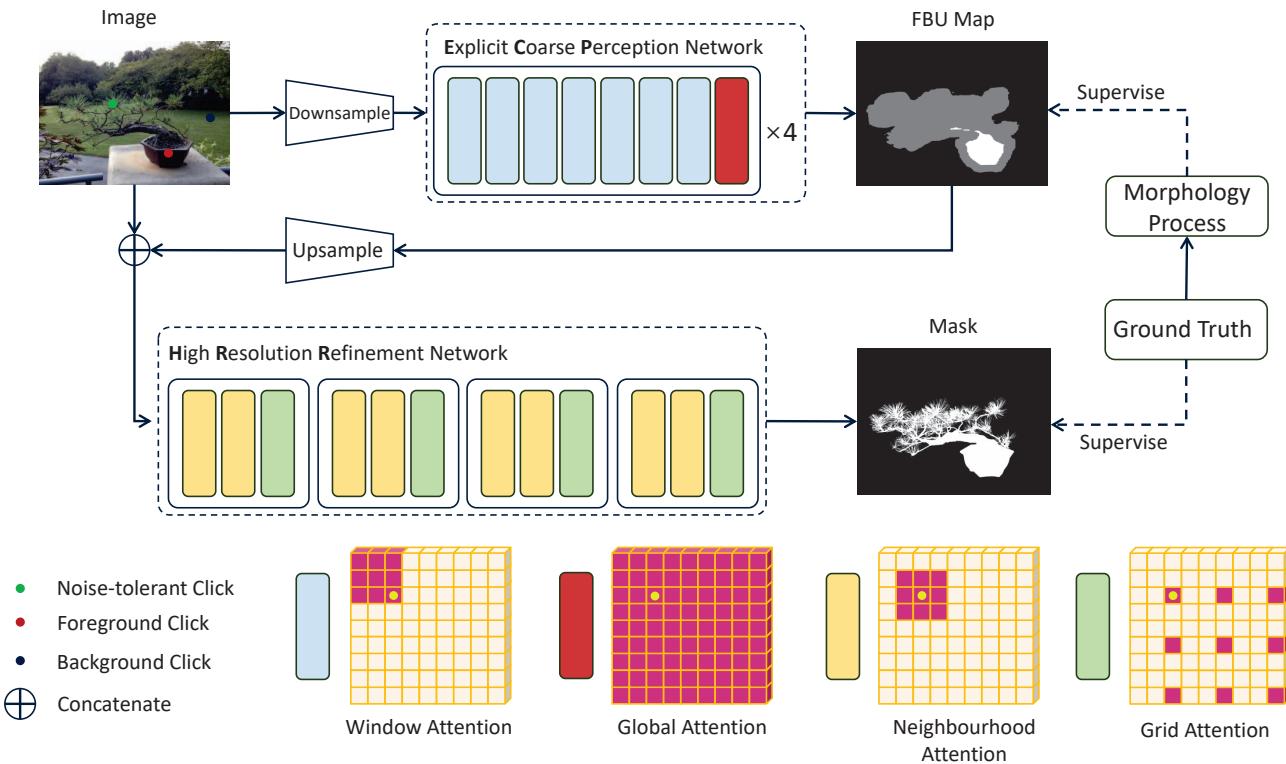
Stage 1: Explicit Coarse Perception (ECP)
The first network (shown in the top path of Figure 2) takes the image and the user’s clicks as input. It operates at a lower resolution to save memory.
Crucially, it does not try to make a final binary decision (Object vs. Background) immediately. Instead, it generates a Foreground-Background-Uncertain (FBU) Map.
\[ \mathrm { F B U } \operatorname* { m a p } \in \{ f o r e g r o u n d , b a c k g r o u n d , u n c e r t a i n \} ^ { W \times H } \]This map classifies the image into three zones:
- Solid Foreground: Easy stuff (e.g., the trunk of a tree).
- Solid Background: Clear areas (e.g., the sky).
- Uncertain: Complex regions (e.g., leaves, hair, edges).
By explicitly identifying the “Uncertain” regions, the model knows exactly where it needs to focus its energy in the next step.
Stage 2: High Resolution Refinement (HRR)
This is where NTClick shines. The second network takes the FBU map and the original high-resolution image (up to \(4096^2\)) to classify those uncertain pixels.
Why is high resolution necessary? Look at the comparison in Figure 3:
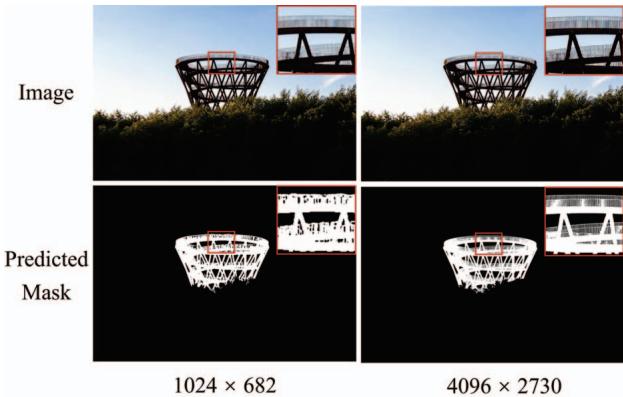
At standard resolutions (1024x682), the fine structural details of the stadium roof blur together. At 4K resolution, the separation is clear. However, processing 4K images with standard Transformers is computationally impossible on standard GPUs due to the quadratic complexity of Global Attention.
Solving the Memory Bottleneck
To process 4K images efficiently, the authors replaced the standard Global Attention with a hybrid approach: Grid Attention + Neighborhood Attention.
The Mathematical Save: Standard Global Attention compares every pixel patch to every other patch. Grid Attention only compares patches at fixed intervals (\(K\)).
\[ \begin{array} { r } { \Omega ( \mathrm { G l o b a l ~ A t t e n t i o n } ) = 4 w h C ^ { 2 } + 2 ( w h ) ^ { 2 } C } \\ { \Omega ( \mathrm { G r i d ~ A t t e n t i o n } ) = 4 w h C ^ { 2 } + 2 \frac { ( w h ) ^ { 2 } } { K ^ { 2 } } C } \end{array} \]As shown in the equation above, the complexity is divided by \(K^2\). If \(K=8\), the computational cost drops significantly, making 4K processing feasible.
The “Wall” Problem: Grid Attention is great for long-range context (seeing the whole image), but it creates “walls” between adjacent pixels that aren’t on the grid. They can’t “talk” to each other directly. To fix this, the authors use Neighborhood Attention.
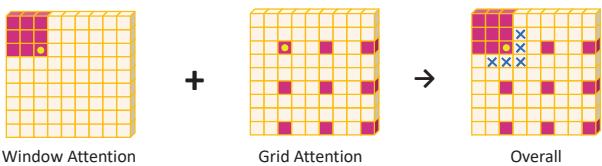
Figure 4 illustrates this beautifully.
- Window Attention (Left): Confines focus to a specific box.
- Grid Attention (Middle): Spreads focus sparsely across the image.
- Neighborhood Attention (Right): Allows every pixel to talk to its immediate neighbors.
By combining these, NTClick gets the best of both worlds: global context to understand the object’s shape, and local focus to trace pixel-perfect edges, all without blowing up the GPU memory.
Experiments & Results
The researchers tested NTClick on several challenging datasets, including DIS5K (highly accurate dichotomous segmentation) and ThinObject-5K.
Performance vs. State-of-the-Art
The primary metric used is NoC@90 (Number of Clicks to reach 90% Intersection over Union) and 5-mIoU (Mean accuracy after 5 clicks). Lower NoC is better; higher mIoU is better.
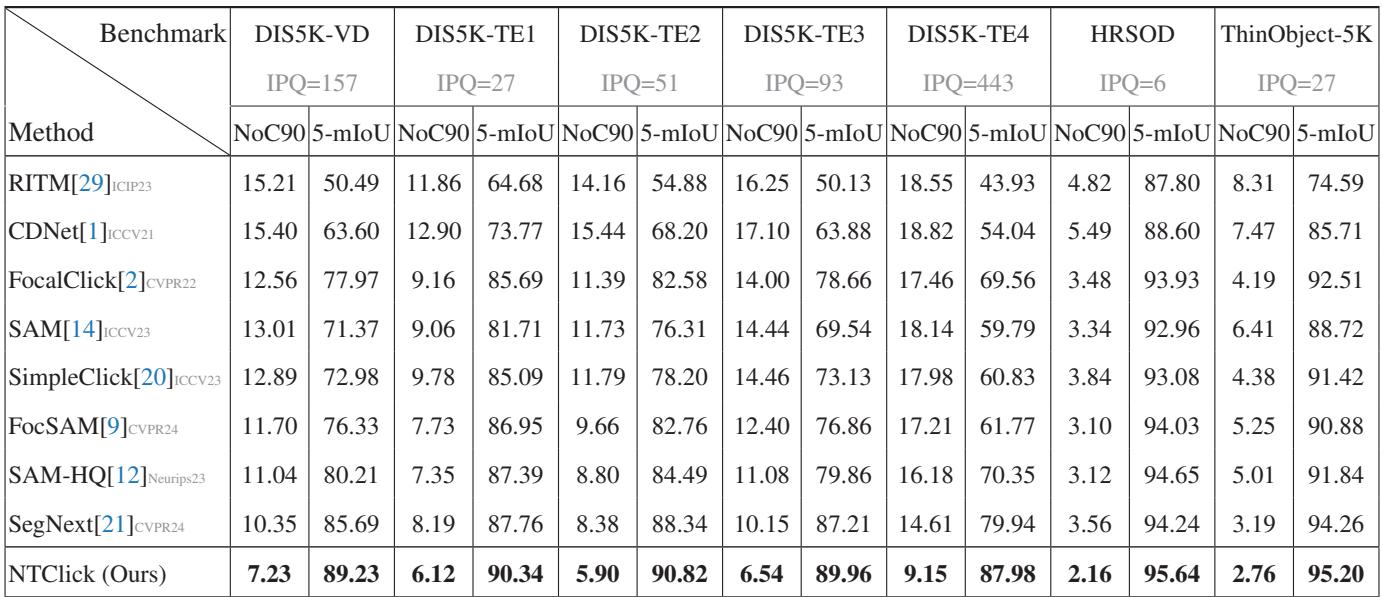
As shown in Table 1, NTClick outperforms major competitors, including SAM-HQ and SegNext, particularly on the hardest dataset, DIS5K-TE4 (which has the most complex structures).
- SegNext requires roughly 9.15 clicks to get a good mask on TE4.
- NTClick only needs roughly 7.23 clicks.
Efficiency and User Effort
The improvement isn’t just in raw accuracy; it’s in the rate of improvement.
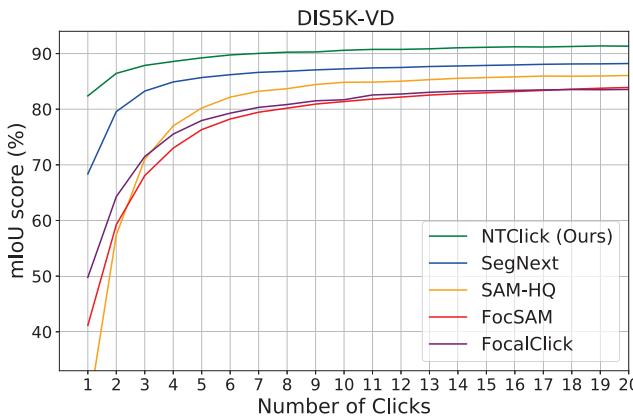
Figure 5 shows the IoU curves. NTClick (the green line) starts stronger and stays higher than SegNext (blue), SAM-HQ (orange), and others. This means users spend less time correcting the model.
Visual Proof
Quantitative data is good, but in segmentation, seeing is believing.
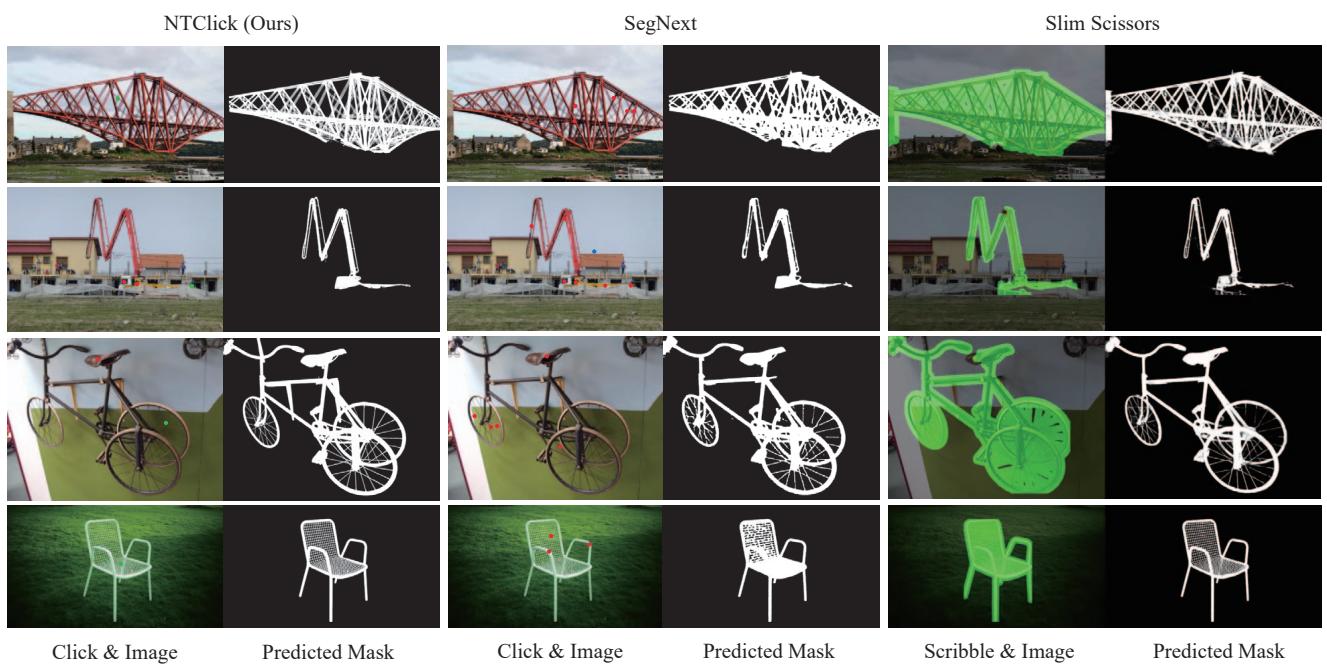
In Figure 7, we can see the practical difference. Look at the bridge cables or the chair legs.
- SegNext (Column 3) often misses the thinnest lines or hallucinates connections.
- Slim Scissors (Column 4) struggles with the boundaries.
- NTClick (Column 2) captures the fine geometry cleanly, even though the user input (noise-tolerant clicks) was not perfectly precise.
Robustness to “Sloppy” Clicks
One of the most impressive results is the robustness test. The researchers simulated users missing the target by varying amounts (random seeds).

Table 6 shows that the performance (NoC@90 and 5-mIoU) remains almost identical regardless of the random variation in click placement. This proves that the “Noise-Tolerant” design works as intended—the model figures out what you meant, even if you didn’t click exactly right.
Conclusion
NTClick represents a significant step forward in interactive computer vision because it acknowledges a human reality: we are not pixel-perfect, and we don’t like waiting.
By introducing the Noise-Tolerant Click, the authors made the tool more forgiving. By engineering the Coarse-to-Fine architecture with Grid and Neighborhood attention, they broke through the resolution barrier that limited previous Transformer-based models.
The implications for this are wide-ranging. From accelerating dataset annotation for future AI models to giving graphic designers and radiologists tools that handle fine details without frustration, NTClick demonstrates that the key to better AI isn’t just bigger models—it’s smarter interaction and efficient architecture.