](https://deep-paper.org/en/paper/file-2152/images/cover.png)
Introduction
In the world of computer vision, we are constantly fighting a war against hardware limitations. We want to process massive, gigapixel images—satellite maps, 4K medical scans, detailed pavement inspections—but our GPUs have finite memory (VRAM).
The standard approach for handling these massive images typically falls into two buckets:
- Downsizing: Shrinking the image until it fits, which destroys the fine details needed for accurate diagnosis or detection.
- Patch Selection: Cutting the image into small grids, finding the few most “salient” (important) patches, and ignoring the rest.
The second approach, patch selection, has become the industry standard for High-Resolution Image Recognition (HRIR). It’s smart: why process the empty sky in a satellite photo when you are looking for buildings? However, a recent paper titled “No Pains, More Gains: Recycling Sub-Salient Patches for Efficient High-Resolution Image Recognition” argues that this approach has a fatal flaw. By strictly focusing on the most important parts, we lose the “sub-salient” context—the background information that helps the model understand what it’s looking at.
Imagine trying to identify a specific type of crack in the pavement. If you only look at the crack itself (the salient part), you might miss the texture of the surrounding road (the sub-salient part) that tells you why the crack formed.
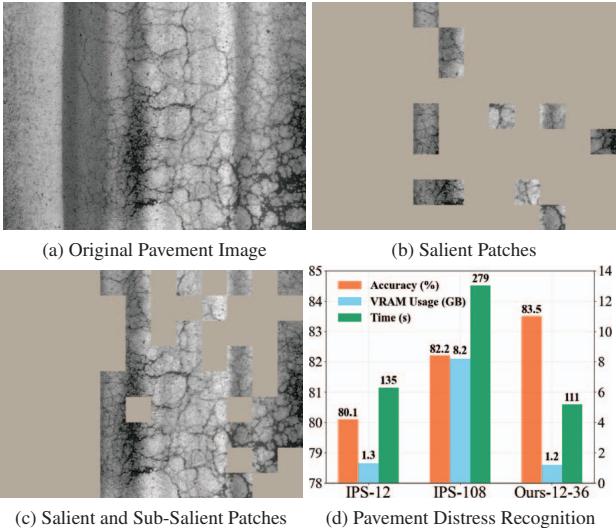
As illustrated in Figure 1, standard methods (b) miss a lot of the picture. The researchers behind this paper propose a novel method called Dual-Buffer Patch Selection (DBPS). Their technique “recycles” those discarded sub-salient patches to boost accuracy without skyrocketing memory costs.
In this post, we will break down how they achieved this “free lunch”—more gains with no computational pains.
The Background: The Dilemma of High-Resolution
To understand the innovation here, we first need to understand the baseline they are improving upon: the IPS-Transformer (Iterative Patch Selection Transformer).
In a typical patch selection workflow, a high-resolution image is chopped into hundreds or thousands of small patches. Because we can’t feed all of them into a heavy neural network for training (it would cause an Immediate Out-Of-Memory error), the model performs a cheap, “no-gradient” scan to score the patches. It keeps the top \(M\) patches with the highest scores and discards the rest.
These top \(M\) patches are then processed fully (with gradients enabled) to train the network.
The Problem
The authors noticed a strict limitation in this logic. Many complex scenes have valuable information distributed across the entire image, not just in the top 10 or 20 patches. If you increase the number of selected patches (\(M\)) to capture this context, the training cost explodes because the GPU has to store gradients for every additional patch.
If you keep \(M\) small to save memory, you lose the context. It seems like a zero-sum game: you either pay in VRAM or you pay in Accuracy.
The Core Method: Dual-Buffer Patch Selection (DBPS)
The authors’ solution is elegant in its resource management. They realized that while we need the information from sub-salient patches, we don’t necessarily need to train the encoder on them directly.
They propose a strategy using two buffers (storage lists) instead of one.
1. The Two Buffers
- The Fundamental Buffer (\(P_M\)): This stores the embeddings of the “Most Salient” patches. These are the critical regions of the image (e.g., the tumor in a biopsy, the car in a satellite view).
- The Auxiliary Buffer (\(P_S\)): This stores the “Sub-Salient” patches. These are regions that aren’t the main focus but provide essential context (e.g., the healthy tissue around the tumor, the road leading to the car).
2. The Workflow
The pipeline operates in two distinct modes: No-Gradient Mode (cheap) and Gradient Mode (expensive).
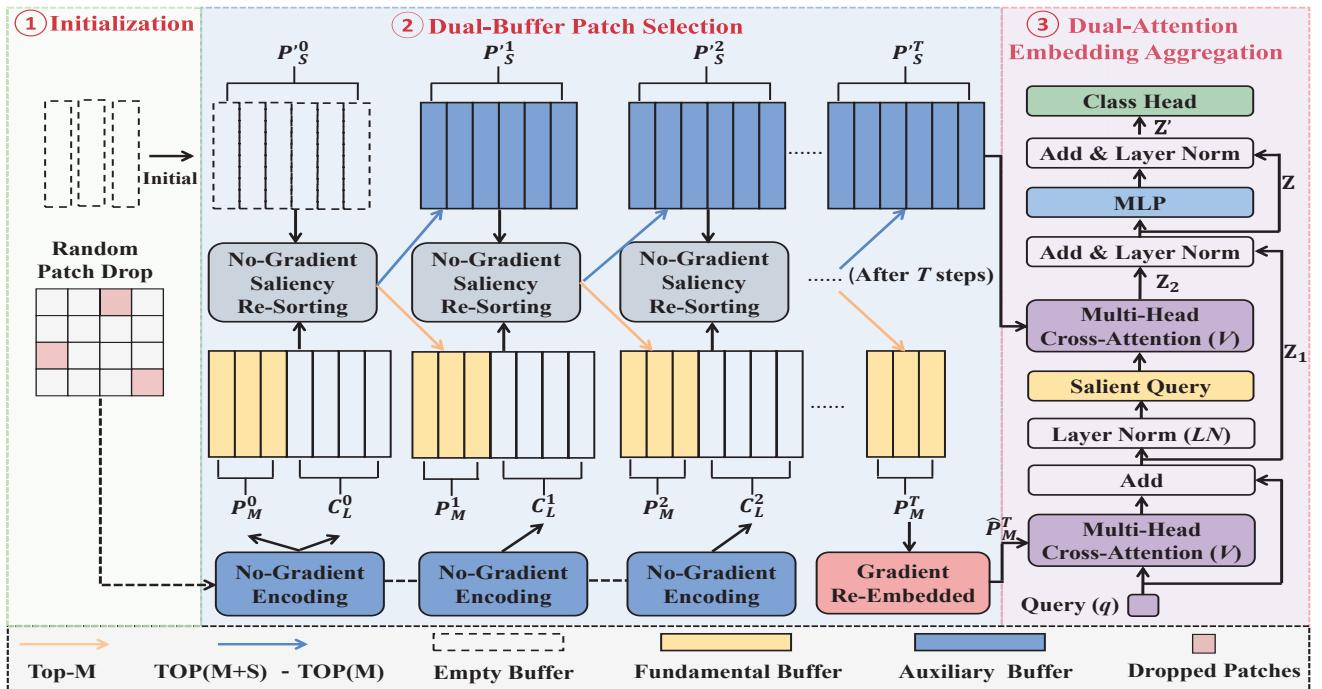
As shown in Figure 2, the process works like this:
- Initialization: The image is divided into patches. A “Random Patch Drop” (explained later) reduces the workload immediately.
- Selection (No-Gradient): The model iterates through the patches. It scores them and sorts them into the two buffers. The top \(M\) go to the Fundamental Buffer, and the next best \(S\) patches go to the Auxiliary Buffer.
- Recycling: This is the key. The sub-salient patches (\(P_S\)) are usually thrown away in other methods. Here, they are kept.
3. The “No Pains” Trick
Here is the genius part regarding efficiency. When it’s time to perform the final classification and update the neural network:
- The Salient Patches (\(P_M\)) are re-embedded with gradients enabled. This allows the network to learn and update its weights based on these critical features.
- The Sub-Salient Patches (\(P_S\)) represent the “Recycled” data. They are used in the forward pass to help the model make a decision, but their gradients are not back-propagated to the encoder.
By blocking the gradient flow for the sub-salient patches, the GPU doesn’t need to store massive activation maps for them. You get the benefit of the extra context (the “More Gains”) without the heavy memory cost of training on them (the “No Pains”).
Mathematically, the selection process updates the buffers iteratively:

The system constantly updates the “Top-M” and “Top-S” lists as it scans the image, ensuring the best possible combination of focus and context.
Dual-Attention Embedding Aggregation
Simply throwing more patches at the classifier isn’t enough. Sub-salient patches, by definition, might contain some irrelevant background noise. If we treat them exactly the same as the salient patches, we might confuse the model.
To solve this, the authors designed a Dual-Attention Multiple Instance Learning (MIL) architecture. Think of this as a two-stage filter.
Stage 1: Aggregate the Salient Patches First, the model takes the salient patches (\(\hat{P}_M^T\)) and aggregates them using a standard cross-attention layer with a learnable query (\(q\)).

This creates a vector \(Z_1\), which represents the core “subject” of the image.
Stage 2: Filter the Sub-Salient Patches The model then uses \(Z_1\) (the aggregated salient info) as the Query to look at the sub-salient patches (\(P_S\)).

Why do this? It allows the model to say, “Okay, I know the main subject is a ‘pavement crack’ (from \(Z_1\)). Now, look at the background patches (\(P_S\)) and only pay attention to the ones that are relevant to ‘pavement cracks’.”
This suppresses uninformative background noise while amplifying useful context. Finally, everything is combined for the final prediction:

Boosting with Random Patch Drop
The authors introduce one final efficiency trick: Random Patch Drop.
Before the selection process even begins, they randomly delete a percentage of the image patches.
- Why? High-resolution images have high spatial redundancy. If you delete 20% of the sky patches in a satellite image, you haven’t lost any real information.
- Benefit: It reduces the number of patches the selector has to process (\(N\)), speeding up training. It also acts as a regularizer, preventing the model from overfitting to specific visual cues.
Experiments and Results
Does this dual-buffer strategy actually work? The authors tested DBPS on six diverse datasets, including pavement distress (CQU-BPDD), satellite imagery (fMoW), and medical pathology (CAMELYON16).
Accuracy vs. Efficiency
The results in Table 1 are striking. Let’s look at the Pavement Distress (CQU-BPDD) section.
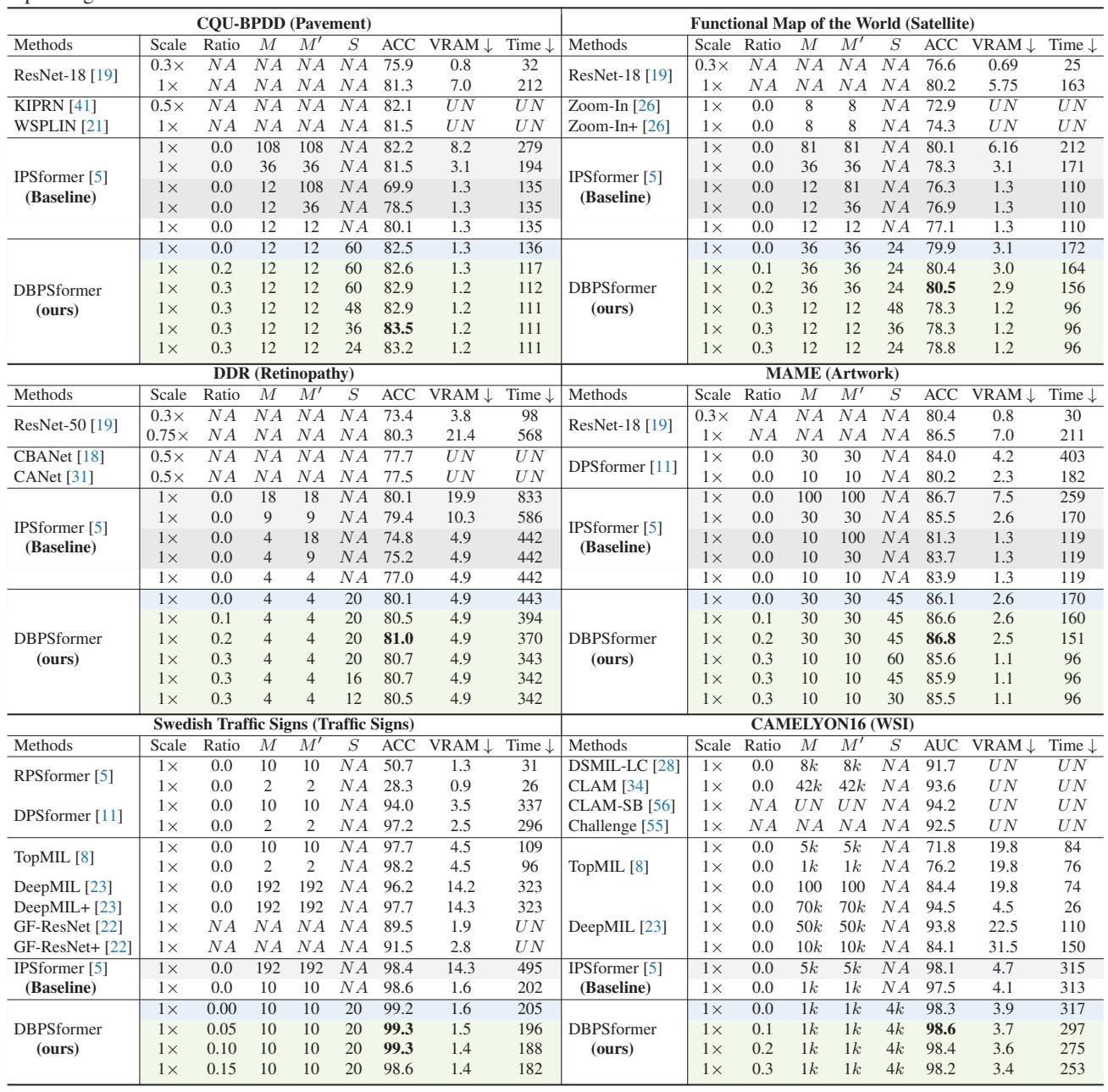
- The Baseline (IPS-Transformer): To get an accuracy of 82.2%, it required 8.2 GB of VRAM and 279 ms per batch. This is the heavy cost of training on many patches.
- The Proposed Method (DBPS): It achieved a higher accuracy of 83.5% using only 1.2 GB of VRAM and taking 111 ms.
That is roughly 85% less memory usage and 60% faster training, all while beating the baseline in accuracy. This pattern repeats across the other datasets, proving that the “sub-salient” patches provide the necessary boost without the computational penalty.
Visualization: What does the model see?
To prove that the sub-salient patches are doing their job, the authors visualized the patches selected by the buffers.
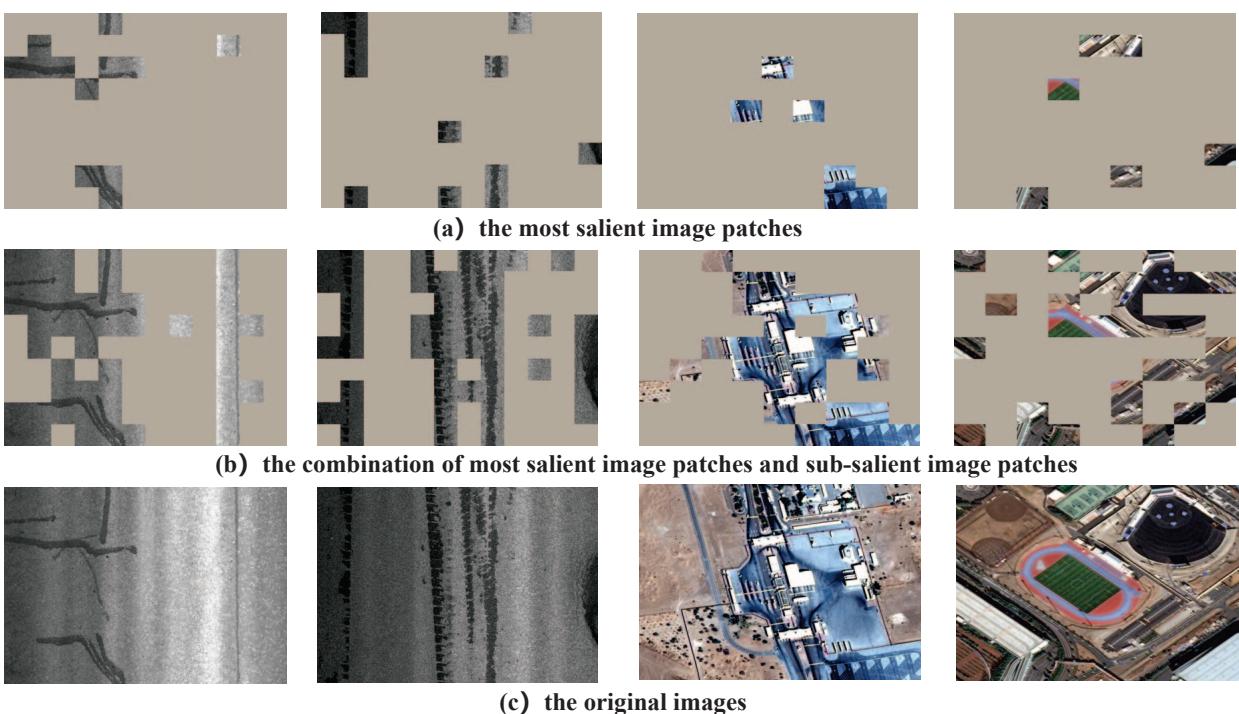
- Row (a) shows the “Salient” patches. In the satellite images, you can see specific buildings or structures isolated against a blank background. It’s informative, but fragmented.
- Row (b) adds the “Sub-Salient” patches. Suddenly, the road networks connect, the neighborhood layout becomes visible, and the context of the scene is restored. This allows the model to make a decision based on the whole scene, similar to how a human would perceive it.
Ablation Studies
The researchers also broke down their contribution to see which parts mattered most.

As Table 2 shows:
- Adding the Dual-Buffer (recycling patches) provided the biggest jump in accuracy.
- Adding Dual-Attention (the query filtering) refined that accuracy further.
- Patch Drop significantly reduced time and memory costs while maintaining (or even slightly improving) accuracy.
Conclusion
The paper “No Pains, More Gains” presents a refreshing take on efficiency in AI. Rather than inventing a complex new neural architecture, the authors looked at the data flow—specifically, the data we usually throw away.
By recognizing that sub-salient patches are useful for inference but don’t necessarily require gradient updates, they unlocked a massive efficiency gain. The Dual-Buffer Patch Selection (DBPS) strategy allows undergraduate students and researchers with limited GPU resources to train high-resolution models that compete with (or beat) heavy, resource-hungry baselines.
Key Takeaways:
- Context Matters: Focusing only on the “most important” pixels blinds your model to the bigger picture.
- Recycle Data: You can use data in the forward pass to provide context without paying the memory tax of back-propagation.
- Filter Smartly: When adding more data, use attention mechanisms (like the Dual-Attention module) to filter out noise.
For students working on projects involving medical imaging, satellite data, or industrial inspection, this paper offers a blueprint for handling massive images without needing a massive server farm.