](https://deep-paper.org/en/paper/file-2161/images/cover.png)
Imagine walking into a library where every book is thrown onto the floor in a random pile. Finding “Moby Dick” would be a nightmare. Now, imagine a library where every book is shelved, spine out, upright, and categorized. This is essentially the problem of 3D Object Canonicalization.
In computer vision and 3D generation, we often deal with “messy libraries.” We scrape 3D models from the internet, but they come in arbitrary orientations—some are upside down, some face left, others face right. To make this data useful for AI, we need to “canonicalize” it: align every object to a standard coordinate system (e.g., all cars face positive X, all chairs stand upright on Y).
Traditionally, solving this requiring massive datasets to “teach” an algorithm what a standard chair looks like. But what if you have a rare object? Or what if you don’t have thousands of examples?
In this post, we dive into a fascinating paper, “One-shot 3D Object Canonicalization based on Geometric and Semantic Consistency,” which proposes a method to align 3D objects using only one reference example (a “prior”) per category. By combining the geometric precision of math with the semantic understanding of Large Language Models (LLMs), the authors have built a framework that can tidy up the messy world of 3D data efficiently.
The Problem: The Long Tail of 3D Data
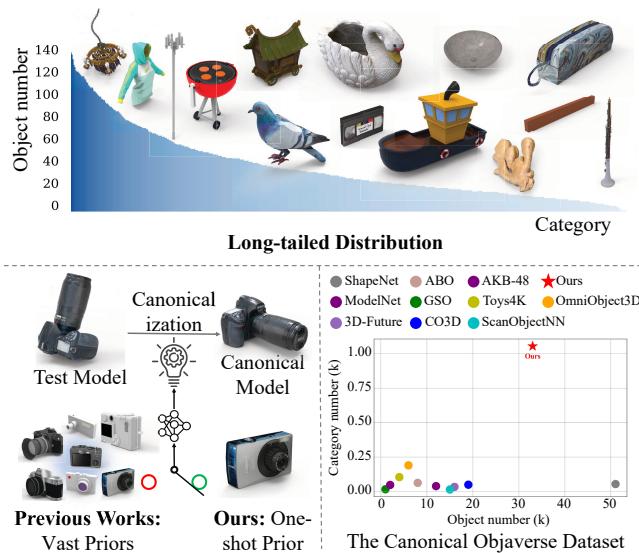
As shown in Figure 1, real-world data follows a “long-tail distribution.” A few categories (like tables and chairs) have thousands of examples, but the vast majority of categories (like a specific type of turtle or a niche tool) have very few samples.
Existing learning-based methods rely on “priors” learned from extensive training samples. If you want to train a network to canonicalize a “toaster,” you need to show it thousands of toasters. This approach fails miserably for that long tail of rare objects where data is scarce.
The authors of this paper ask a bold question: Can we canonicalize an object using only a single reference model?
If we have just one perfectly aligned “prior model” (e.g., one standard horse), can we take any other random horse model—regardless of its shape or pose—and align it to that prior?
The Solution: A One-Shot Framework
The researchers propose a framework that doesn’t need to be trained on thousands of objects. Instead, it leverages the “zero-shot” capabilities of modern AI foundation models (like ChatGPT and GLIP) combined with classical geometric alignment.
The workflow, illustrated in Figure 2, operates in three distinct stages:
- Zero-shot 3D Semantic Perception: Understanding what the object is and where its parts are using LLMs and Vision-Language Models (VLMs).
- Canonicalization Hypothesis Generation: Creating several possible alignment “guesses” (hypotheses) using a novel energy function.
- Canonical Pose Selection: Choosing the best alignment based on semantic consistency.
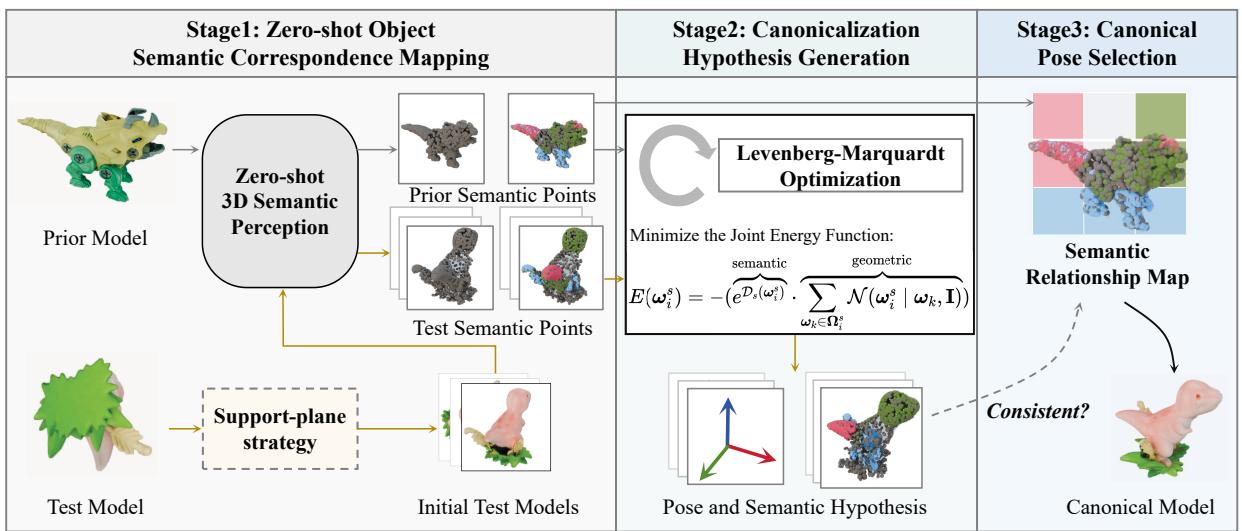
Let’s break these stages down.
Stage 1: Zero-Shot 3D Semantic Perception
To align a test object (let’s say, a random dinosaur mesh) to a prior model (a reference dinosaur), we first need to know which parts correspond to each other. We need to know that the “head” of the test mesh should align with the “head” of the reference mesh.
However, since we are doing this “one-shot” for arbitrary categories, we can’t train a specific “dinosaur head detector.” Instead, the authors use a clever pipeline involving ChatGPT and GLIP.
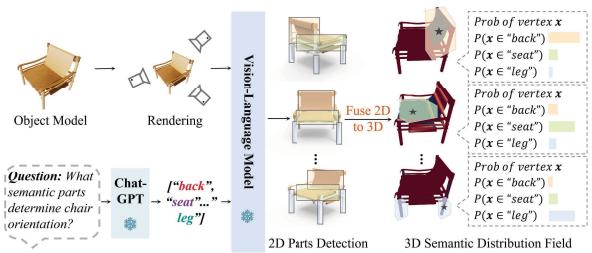
As shown in Figure 3, the process works like this:
- Rendering: The 3D object is rendered into 2D images from multiple views.
- LLM Query: The system asks ChatGPT a question like, “What semantic parts determine the orientation of this object?” ChatGPT might reply with [“head”, “tail”, “legs”].
- VLM Detection: These text labels are fed into GLIP (a Vision-Language Model), which looks at the 2D renders and draws bounding boxes around those parts.
- Projection: These 2D detections are projected back onto the 3D mesh vertices.
This results in a probability distribution for every vertex on the mesh, telling us how likely it is that a specific point belongs to a “head” or a “leg.”
Mathematically, for a model with vertices \(\mathbf{x}_l\), we define a semantic confidence vector \(\mathbf{c}_l\) that contains the probabilities for each semantic label:

The “Chicken-and-Egg” Initialization Problem
There is a catch. Vision-Language Models like GLIP are trained on standard photos, usually taken by humans. They are great at recognizing a chair when it’s upright, but if the 3D model is rotated 90 degrees or upside down, the VLM often fails to recognize the parts.
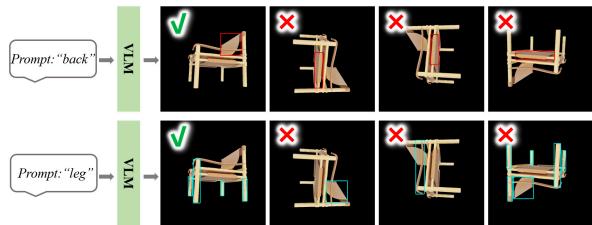
Figure 4 illustrates this limitation. When the chair is upright, GLIP finds the “back” and “legs” perfectly. When the chair is tilted, the detection fails.
This creates a paradox: We need the object to be roughly aligned to get good semantic labels, but we need good semantic labels to align the object.
To solve this, the authors introduce the Support-Plane Strategy.
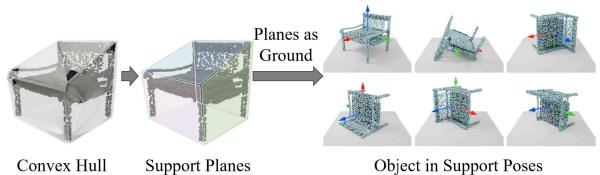
Most objects in the real world have a “preferred” way of resting on the ground due to gravity. By calculating the “convex hull” of the object (a simplified wrapper around the shape) and analyzing its center of mass, the system can calculate stable “support planes” (Figure 5).
Instead of searching every possible rotation, the system only needs to consider the few poses where the object sits stably on a surface. This generates a set of “Initial Test Models” (\(\mathcal{X}_{\mathrm{init}}\)), drastically reducing the search space and ensuring the VLM sees the object in a “natural” orientation.

Stage 2: Canonicalization Hypothesis Generation
Now that we have semantic labels (even if they are a bit noisy) and a set of stable initial poses, we need to perform the actual alignment.
The goal is to find a rotation that aligns the Test Model to the Prior Model. The authors discovered that relying on just one type of signal is insufficient.
The Failure of Geometry Alone
If you only look at geometric shape (using a metric like Chamfer Distance), the algorithm might align the shapes perfectly but get the orientation wrong. For example, a camera looks somewhat like a box. A geometric algorithm might align the camera upside down or backwards because the “box” shape overlaps well, ignoring where the lens is.
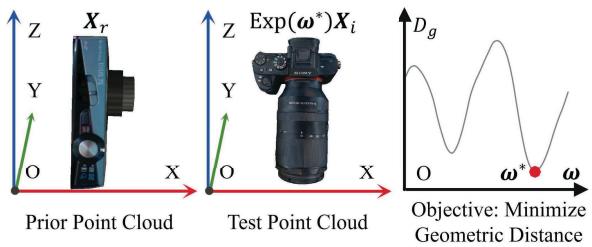
Figure 6 shows this geometric failure. The shape is matched, but the camera is pointing the wrong way compared to the prior.
The Failure of Semantics Alone
Conversely, if you only rely on the semantic labels (aligning the “lens” cloud to the “lens” cloud), you get the general direction right, but the precision is terrible. Semantic predictions from zero-shot models are noisy and “blobby.”
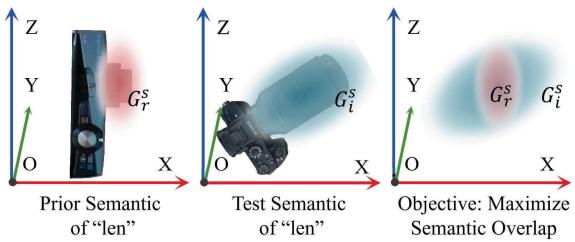
Figure 7 shows semantic failure. The camera is pointing the right way, but it’s tilted and not perfectly overlapping because the semantic “blobs” are not precise enough for fine alignment.
The Joint Energy Function
To get the best of both worlds, the authors propose a Joint Energy Function. This function combines:
- Geometric Constraint (\(\mathcal{D}_g\)): Ensures the physical shapes overlap tightly.
- Semantic Constraint (\(\mathcal{D}_s\)): Ensures the functional parts (head, legs, wheels) are in similar positions.
The geometric distance is calculated using the Chamfer distance, which measures the distance between nearest points in two clouds:
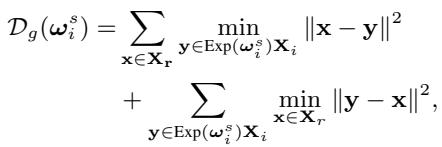
The semantic similarity is modeled by treating the semantic points as Gaussian distributions and measuring their overlap:

The final Joint Energy Function (\(E\)) is a sophisticated blend of these two. It doesn’t just add them up; it uses the semantic score to weight the geometric alignment. It effectively says: “Find the rotation that creates the tightest geometric fit, but penalize it heavily if the semantic parts don’t align.”

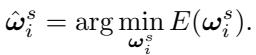
This energy function is non-differentiable, so it is optimized using the Levenberg-Marquardt algorithm to find the optimal rotation \(\hat{\omega}\).
Stage 3: Canonical Pose Selection
Because the system started with multiple “Support Plane” initializations (Stage 1.5), the optimization process produces several different candidate poses (hypotheses).

We need to pick the single best one. To do this, the authors utilize a Semantic Relationship Map.
They divide the canonical space into a 3D grid of blocks. For the Prior Model, they calculate which semantic label is dominant in each block (e.g., “Top-Left-Front block contains the Head”).

They do the same for each of the test hypotheses. They then compare the spatial distribution of semantics. If a hypothesis claims the “Head” is in the “Bottom-Right-Back” block, it disagrees with the Prior Model’s map and is likely incorrect. The hypothesis with the highest semantic correlation to the Prior is selected as the winner.
Experiments and Results
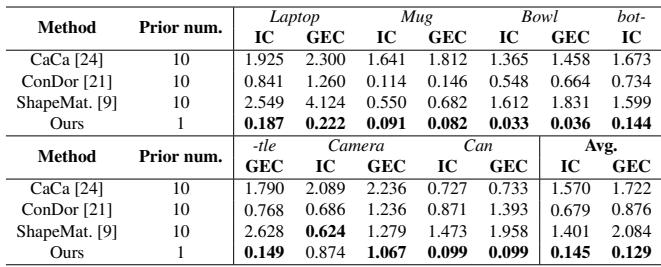
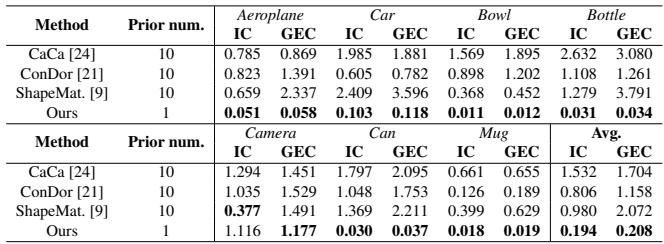
The authors tested their “One-Shot” method against state-of-the-art learning-based methods like ConDor, CaCa, and ShapeMatcher. Crucially, those competing methods were allowed to train on 10 priors, whereas this method used only one.
Performance on ShapeNet
On the ShapeNet dataset (simulated data), the results were stark.
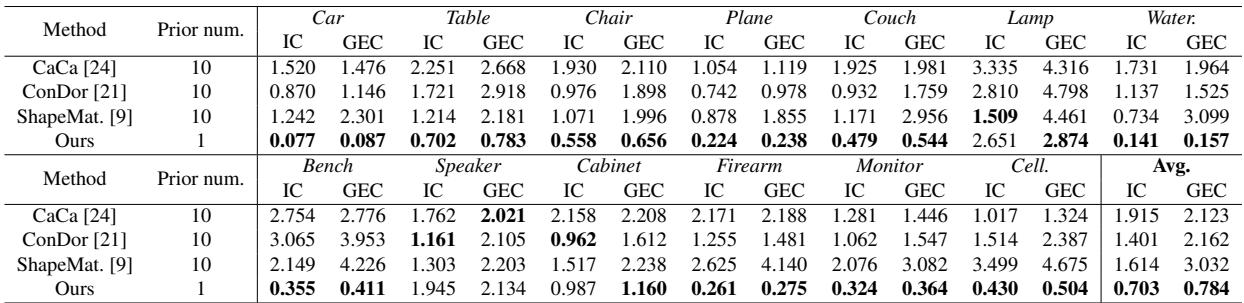
As seen in Table 1, the proposed method achieved significantly lower errors (IC and GEC metrics) compared to competitors. In the “Car” category, for example, the error dropped from ~1.5 (CaCa) and ~0.87 (ConDor) to just 0.077.
Visual Comparisons
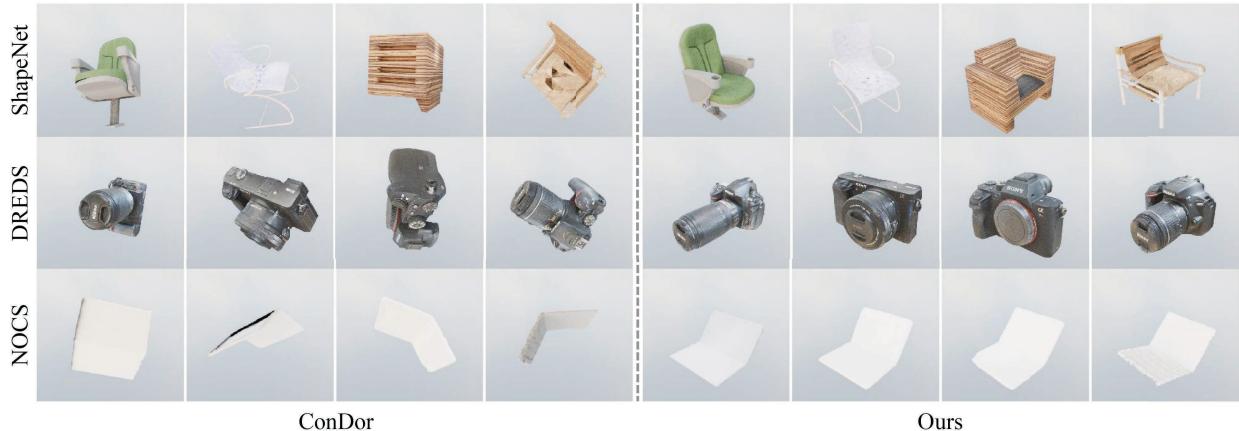
The visual results in Figure 8 highlight the difference. Look at the “Chair” examples in the top row. The competing method (“ConDor”, left column) often fails to align the rotation correctly, leaving chairs tilted. The “Ours” column (right) shows precise alignment.
Real-World Datasets
The method also proved robust on real-world scan datasets like NOCS (noisy, textureless) and DREDS (high quality). Despite the noise and artifacts in real scans, the semantic-geometric combination held up.
Ablation Study: Do we really need both constraints?
The authors performed an ablation study to prove that their complex energy function was necessary.
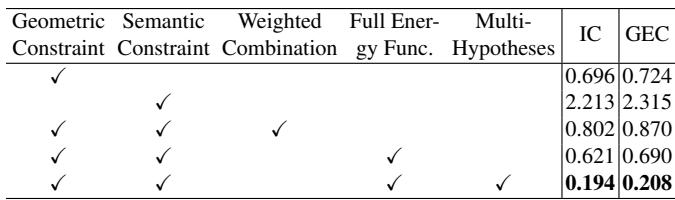
- Geometric only: High error (0.696 IC) – gets stuck in local minima.
- Semantic only: High error (2.213 IC) – too vague/blobby.
- Full Energy Function + Multi-Hypotheses: Lowest error (0.194 IC).
This confirms that Geometry provides the precision, Semantics provides the direction, and the Support-Plane strategy provides the robustness.
The Canonical Objaverse Dataset (COD)
Perhaps the most impactful contribution of this paper is the application of the framework to the massive Objaverse-LVIS dataset. Because this method doesn’t require training, the authors were able to process wild, unaligned data at scale.
They created the Canonical Objaverse Dataset (COD), containing 32,000 shapes across 1,054 categories. This is currently the dataset with the largest number of categories among all canonical 3D datasets.
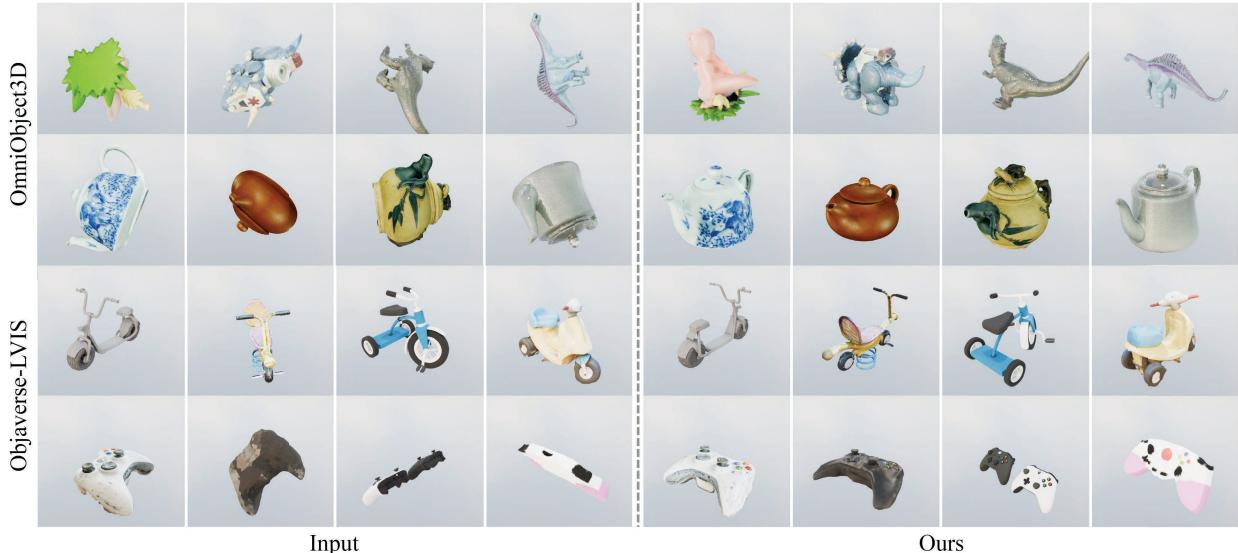
Figure 9 shows the method working “in the wild.” Whether it’s a complex statue or a simple household item, the framework aligns it correctly without ever having been trained on that specific category.
Conclusion
The “One-shot 3D Object Canonicalization” framework represents a significant shift in how we handle 3D data. By moving away from brute-force training with thousands of examples and instead leveraging the “common sense” reasoning of LLMs and VLMs, we can process the long tail of the 3D world.
The key takeaways are:
- Semantics + Geometry is King: Neither is sufficient alone. You need semantics to know what fits where, and geometry to know how tightly it fits.
- Priors allow scaling: If you only need one good example to organize a whole category, you can curate datasets much faster than if you need thousands of examples.
- Initialization matters: Simple physics-based heuristics (like support planes) are often the missing link in making AI models robust to rotation.
This work paves the way for larger, cleaner, and more diverse 3D datasets, which are the fuel for the next generation of 3D generative AI.