](https://deep-paper.org/en/paper/file-2165/images/cover.png)
Breaking the Laws of Physics? How OpticalNet Uses AI to See the Invisible
For centuries, the quest to see the “tiny world” has been a driving force in science. From the rudimentary magnifying glasses of antiquity to the sophisticated microscopes of today, we have relentlessly pursued higher resolution. But there has always been a fundamental wall: the diffraction limit.
Physics dictates that optical systems cannot resolve features significantly smaller than half the wavelength of the light used to illuminate them. For visible light, this limit is around 200 nanometers. This means viruses, DNA strands, and the intricate machinery of life often remain just out of focus, appearing as blurry blobs rather than distinct structures.
While Electron Microscopy (EM) can see smaller, it requires a vacuum and blasts samples with high-energy beams, often killing living specimens. The holy grail has always been to achieve EM-level resolution with the gentle, easy-to-use nature of standard optical microscopy.
Enter OpticalNet. In a groundbreaking CVPR paper, researchers have proposed a method to smash through the diffraction limit using deep learning. But they didn’t just build a model; they built the first-ever general-purpose dataset designed to teach computers how to decode the “invisible.”
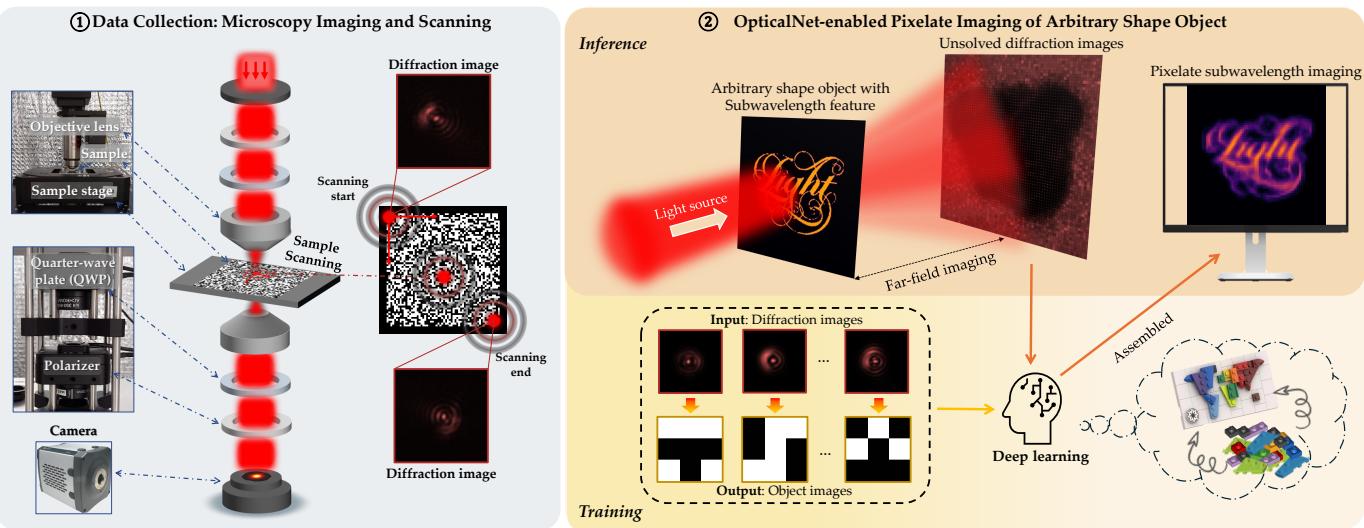
As illustrated in Figure 1, the core idea is elegant: if we can teach an AI to recognize the fundamental “building blocks” of matter from their blurry light patterns, we can reconstruct complex, sub-wavelength objects that no human eye could ever resolve.
The Physics Barrier: What is the Diffraction Limit?
To understand the solution, we must first understand the problem. Why can’t we just zoom in infinitely?
Light behaves as a wave. When light passes through an aperture (like a microscope lens) or interacts with a tiny object, it diffracts—it spreads out. An ideal point of light doesn’t appear as a point on your camera sensor; it appears as a fuzzy bullseye known as an Airy disk.
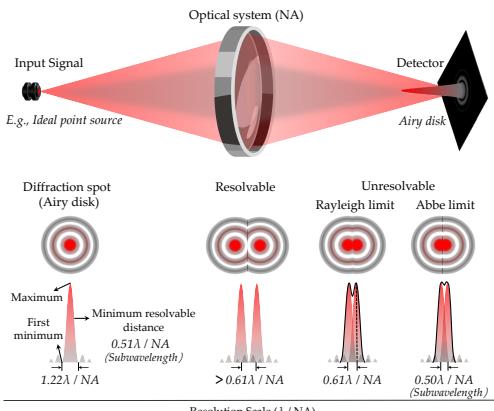
Figure 2 demonstrates this phenomenon perfectly.
- Diffraction Spot: A single point creates a central peak of intensity surrounded by rings.
- Resolvable: If two points are far apart, you see two distinct peaks.
- Unresolvable (Abbe Limit): As the points move closer (below \(\approx 200\)nm for visible light), their Airy disks merge. The camera sees one blob, not two.
This is the Diffraction Limit. Information about the fine details is physically encoded in the light, but it is so scrambled by diffraction that standard lenses cannot resolve it. However, the information isn’t gone—it’s just encrypted. This is where Deep Learning enters the equation.
The Data Paradox
Deep learning has revolutionized computer vision. If you want to train a model to recognize cats, you feed it thousands of images of cats. But how do you train a model to see “invisible” sub-wavelength objects?
To train a Super-Resolution model, you generally need pairs of images:
- Input: The low-quality, blurry image.
- Ground Truth: The high-quality, sharp image.
The problem in microscopy is that we cannot take the ground truth photo. By definition, these objects are too small to be photographed with an optical microscope. This paradox—the absence of high-quality optical data of sub-wavelength objects—has been the biggest bottleneck in the field. You cannot simply label what you cannot see.
The OpticalNet Solution: Building Blocks
The researchers behind OpticalNet solved this by manufacturing their own ground truth. Instead of trying to find existing microscopic objects, they fabricated them using Focused Ion Beam (FIB) technology. This allows them to etch shapes with nanometer precision.
They adopted a “Lego” approach. They hypothesized that any complex object is just a collection of smaller, fundamental shapes. If a neural network can learn to resolve basic square units, it should be able to generalize that knowledge to reconstruct anything—even letters or stars.
The Dataset Construction
The team created three specific datasets to train and test their models:
- The Block Dataset (Training): This consists of grids (e.g., \(3 \times 3\), \(5 \times 5\)) containing 180nm squares. These squares are smaller than the diffraction limit. The pattern of etched (white) and unetched (black) squares serves as the “Ground Truth.”
- The “Light” Dataset (Testing): A cursive writing of the word “Light.” This tests if the model can handle curves and arbitrary shapes, not just the squares it was trained on.
- The Siemens Star (Testing): A classic resolution benchmark with spokes radiating from the center. As the spokes get closer to the center, the distance between them shrinks, providing a continuous test of resolution limits.
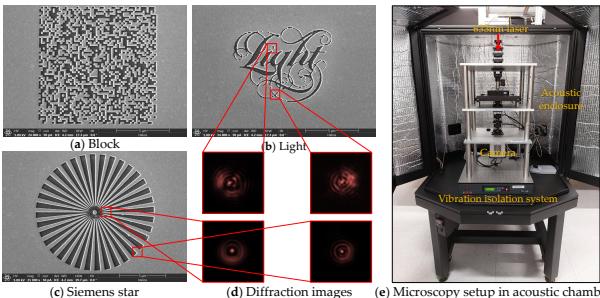
Figure 3 showcases the physical reality of this project. Panel (a) shows the “Block” samples. Panel (d) shows the raw data the microscope captures—these are diffraction images. They look like ripples in a pond, bearing little resemblance to the actual object. Panel (e) highlights the extreme engineering required: the microscope is housed in an acoustic chamber on a vibration isolation platform to prevent even the slightest tremor from ruining the data.
The Problem of “Surroundings”
One might assume you can just look at a small \(3 \times 3\) grid and predict the object. However, light diffraction is non-local. The ripples from a neighbor pixel interfere with the ripples of the target pixel.
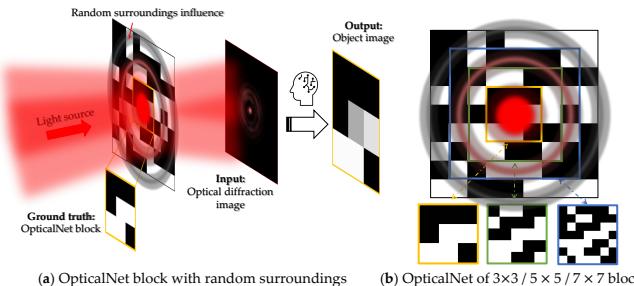
Figure 4 illustrates this challenge. The diffraction pattern you see isn’t just coming from the center red box; it is heavily polluted by light diffracting off the surrounding blocks. The model must learn to disentangle the signal of the target from the noise of the environment.
The Method: Image-to-Image Translation
The researchers framed this physics problem as a computer vision task: Image-to-Image Translation.
The goal is to map the input space (Diffraction Images) to the output space (Binary Object Images). The input is a grayscale image of interference patterns, and the output is a binary grid where 1 represents an object (etched gold) and 0 represents empty space.
The Loss Function
To train the neural networks, the researchers utilized a specific loss function designed for pixel-level binary classification. Since the ground truth is binary (is there a piece of gold here or not?), Binary Cross-Entropy (BCE) is the natural choice.
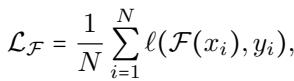
Here, \(\mathcal{F}(x_i)\) is the model’s prediction for a diffraction image \(x_i\), and \(y_i\) is the ground truth.
Expanding this to the pixel level, the loss is calculated over the height (\(H\)) and width (\(W\)) of the image:
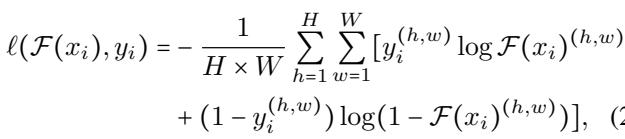
This equation forces the model to minimize the difference between the predicted probability map and the actual binary structure of the nano-object.
Inference and Thresholding
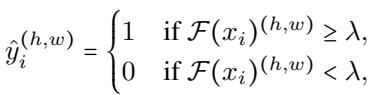
Once the model predicts a probability map (where a pixel might have a value of 0.8, meaning 80% confident it’s an object), the researchers apply a threshold \(\lambda\) (usually 0.5) to convert it back to a sharp, binary image.
From Prediction to Reconstruction: The Stitching Strategy
The researchers don’t try to image the whole sample at once. Remember, the diffraction creates a massive amount of interference. Instead, they scan the object, taking a picture, moving 180nm, and taking another picture.
This creates a massive overlap of data. A single point on the object might appear in the “center” of one scan and on the “edge” of another.
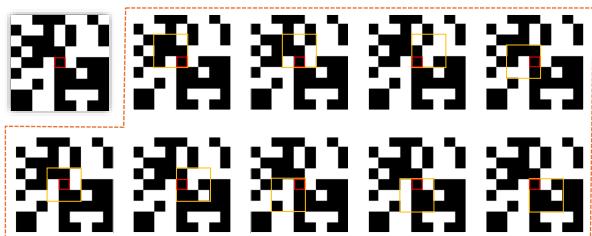
As shown in Figure 6, a single red target square is covered by multiple overlapping yellow scanning blocks. The researchers utilize this redundancy to improve accuracy. They average the predictions from every scan that covers a specific point.
The mathematical formulation for this “stitching” expectation is:

This equation essentially says: “To decide if there is an object at position \((k,l)\), look at every diffraction image \(x_m\) that covers this spot, check the model’s prediction for that spot, and average them.” This statistical ensemble approach significantly reduces noise.
Benchmarking: Simulation vs. Reality
Before cutting gold with ions (which is expensive and slow), the team built a sophisticated simulation engine. This allowed them to pre-train models and validate their theories.
They tested several architectures:
- CNNs: ResNet-18, ResNet-34, U-Net variants (Standard deep learning workhorses).
- Transformers: Vision Transformers (Newer architectures that use self-attention).
Simulation Results
The initial results on simulated data were promising. Most models could solve the “Block” puzzle. However, interesting divergences appeared when they moved to the “Light” logo and the Siemens Star (SS).
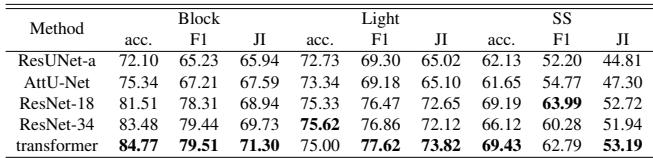
In Table 2, we see the Transformer generally outperforming the CNN-based architectures, particularly in the difficult “Light” test set which contains shapes the model never saw during training (it only saw squares!).
Experimental Results (The Real World)
The true test, however, is real-world data. Real optical systems have noise, vibrations, and imperfections that simulations miss.
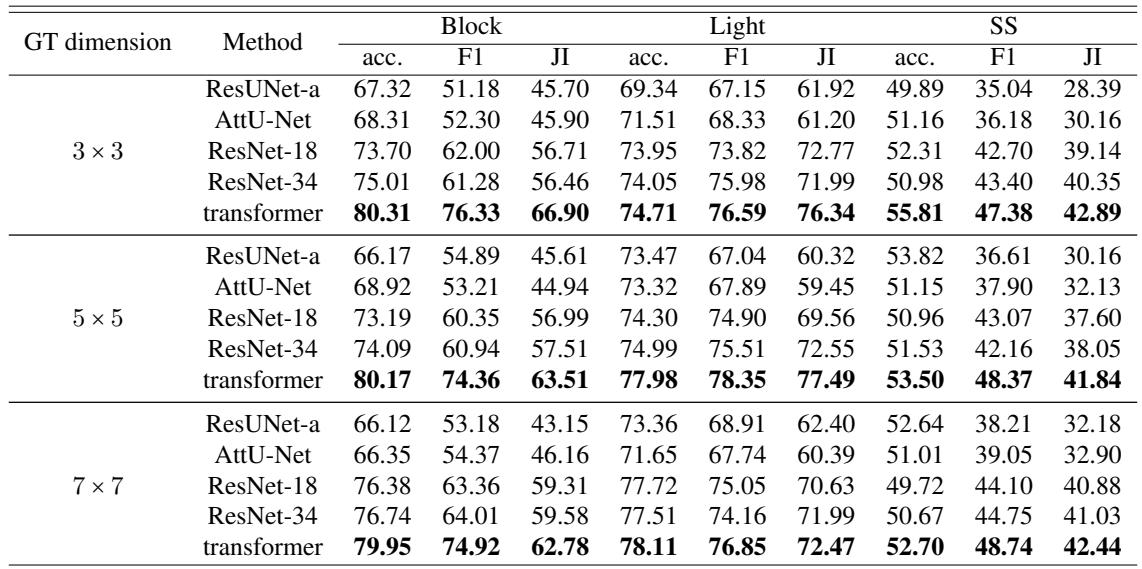
Table 3 reveals the reality of the challenge. The Transformer model dominates here. Notice the “SS” (Siemens Star) column. The Convolutional Neural Networks (ResNets and U-Nets) struggle significantly, achieving accuracies near 50% (which is essentially random guessing for binary data). The Transformer, however, maintains much higher fidelity.
Visual Proof
The numbers are one thing, but the visual reconstructions tell the real story.
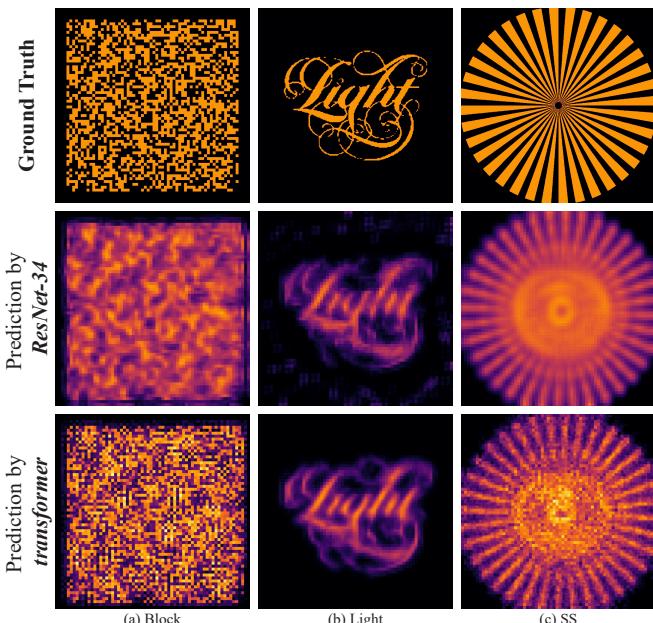
Figure 8 is the “smoking gun” for this research.
- Row 1 (Ground Truth): This is what the object actually looks like.
- Row 2 (ResNet-34): The CNN struggles. Look at the “Light” text—it’s fuzzy and surrounded by artifacts. The Siemens Star (SS) is a blur.
- Row 3 (Transformer): The Transformer output is remarkably sharp. It successfully reconstructs the cursive “Light” and separates the spokes of the Siemens Star much closer to the center than the CNN.
Why did the Transformer win? The authors hypothesize that this is due to Global Context. In diffraction, a pixel on the left of the image is influenced by light waves from the right side of the image. CNNs are biased toward “local” processing (looking at neighbors). Transformers, with their self-attention mechanisms, are designed to look at the entire image at once, understanding long-range dependencies. This allows them to “de-noise” the diffraction pattern much more effectively.
Analyzing the Limits
The team also analyzed how the size of the “Block” used for training affected the outcome.
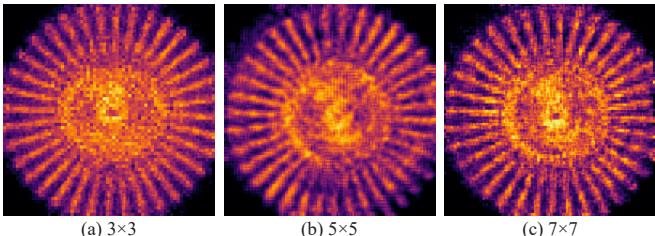
Figure 9 shows reconstructions of the Siemens Star using models trained on \(3 \times 3\), \(5 \times 5\), and \(7 \times 7\) blocks.
- \(3 \times 3\): The center is decent, but the outer rings are messy.
- \(7 \times 7\): The resolution improves, but it introduces more noise artifacts in the outer regions.
This suggests a trade-off: larger blocks contain more information (more surrounding context), but they also introduce more complexity and potential for noise, making the model’s job harder.
Conclusion and Future Implications
The OpticalNet paper presents a significant leap forward in computational imaging. By combining high-precision nanofabrication, optical physics, and modern deep learning, the researchers have created a pipeline to see the unseeable.
Key Takeaways:
- The Dataset is Key: By fabricating their own ground truth using “building blocks,” they bypassed the data scarcity problem in nanoscopy.
- Transformers > CNNs: For optical diffraction problems, the global attention mechanism of Transformers beats the local processing of CNNs.
- Generalization Works: A model trained only on simple squares can successfully reconstruct cursive text and star patterns, proving it learned the physics of diffraction, not just the shape of squares.
This work opens the door to label-free super-resolution. Imagine a future where a biologist can place a live virus under a standard optical microscope—no vacuum, no lethal electron beams—and an AI instantaneously decodes the diffraction patterns to reveal its structure in nanometer detail. OpticalNet is the first step toward that reality.