](https://deep-paper.org/en/paper/file-2168/images/cover.png)
Imagine you are a student taking a test. You encounter a question showing a picture of a grassy field with a small, blurry animal in it. You aren’t 100% sure what the animal is, but you know that cows are usually on grass. So, you guess “cow.” You get it right.
But what if the next picture is a grassy field with a boat in it? If you rely solely on the “grass” shortcut, you might still guess “cow.”
This is exactly what happens with state-of-the-art Artificial Intelligence, specifically Vision-Language Models (VLMs) like CLIP. These models are incredibly powerful, but they are also lazy. They learn “shortcuts”—associations between backgrounds (like water) and objects (like whales)—instead of actually identifying the object itself.
In the world of AI safety, this is a massive problem, particularly for Out-of-Distribution (OOD) detection. If an autonomous car sees an unknown object (OOD) on a familiar road (In-Distribution background), we want it to say “Unknown,” not “Car” just because it’s on a road.
In this post, we will dive deep into a CVPR paper titled “Overcoming Shortcut Problem in VLM for Robust Out-of-Distribution Detection”. We will explore how researchers from Huazhong University of Science and Technology have proposed a clever method called OSPCoOp to force models to stop cheating and start looking at the actual objects.
1. The Problem: The “Smart” but Lazy Model
Before we fix the problem, we have to understand it. Vision-Language Models (VLMs) like CLIP are trained on massive amounts of image-text pairs from the internet. They learn to associate visual features with text concepts.
While this allows them to perform tasks they weren’t explicitly trained for (Zero-Shot Learning), it introduces a flaw: Coupling. The semantic information of the foreground (the object) and the background (the scene) are often coupled together in the training data.
The researchers identified that this coupling leads to shortcut learning. When a VLM encounters an image, it often ignores the foreground object and makes its decision based on the background.
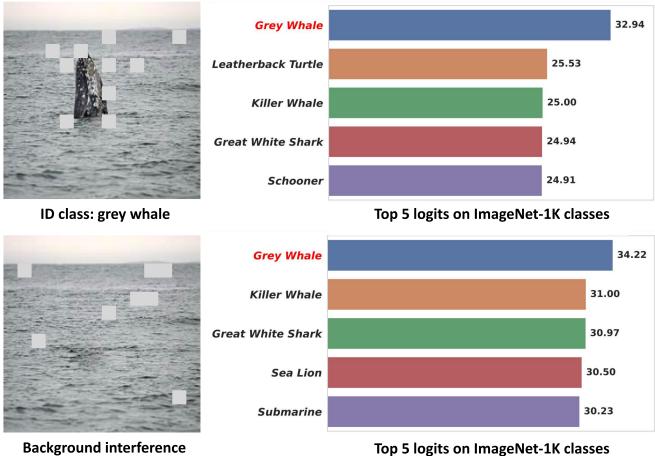
As shown in Figure 1, CLIP is confident that an image contains a “Grey Whale” even when the actual whale is removed and only the water remains. The model isn’t looking for a whale; it’s looking for water.
Why is this dangerous?
In Out-of-Distribution (OOD) detection, the goal is to separate familiar data (ID) from unknown anomalies (OOD).
- ID (In-Distribution): Things the model knows (e.g., a dog).
- OOD (Out-of-Distribution): Things the model shouldn’t classify (e.g., a spaceship).
If a “spaceship” (OOD) appears in a “park” (a background associated with dogs), a shortcut-dependent model will look at the park, ignore the spaceship, and confidently say: “It’s a dog!”
This failure to detect the anomaly is what the authors aim to solve.
2. The Solution: OSPCoOp
The researchers propose a method called OSPCoOp (which stands for a method involving Background Decoupling and Mask-Guided Region Regularization).
The core philosophy is simple: To stop the model from focusing on the background, we must explicitly teach it that the background is NOT the object.
This requires three main steps:
- Background Decoupling: Separating the object from the scene to create training data.
- Augmentation: Creating tough “fake” OOD examples.
- Mask-Guided Region Regularization: A new way to train the model to ignore the background.
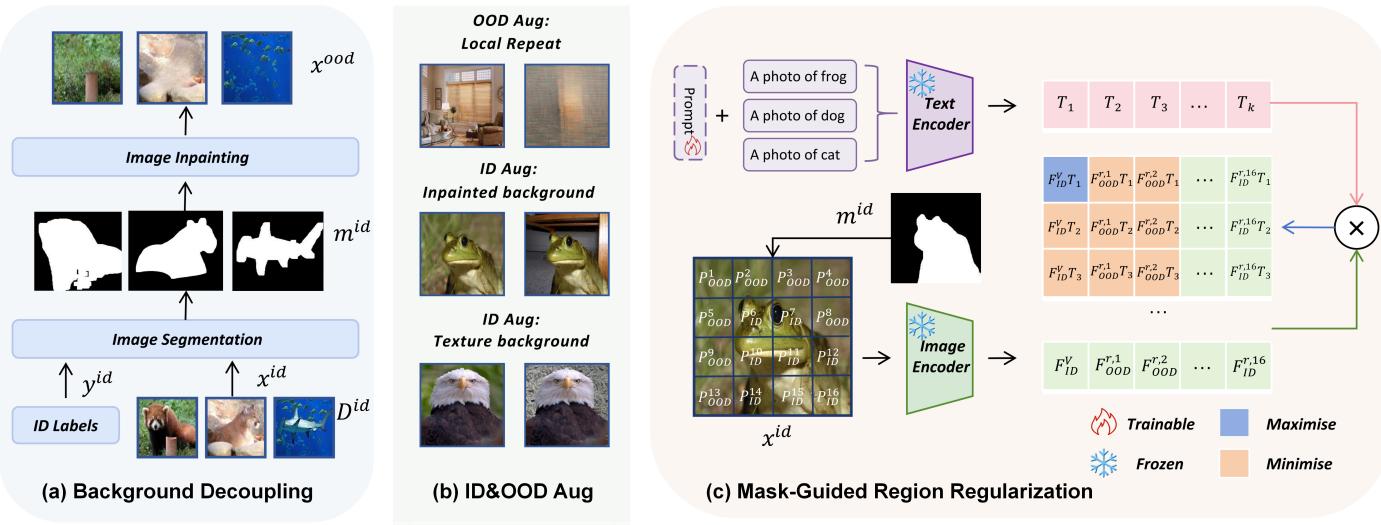
Let’s look at the entire pipeline below before breaking it down.
Step 1: Background Decoupling
The first challenge is obtaining data. We have images of objects (ID), but we don’t have labeled images of “just backgrounds.” The researchers automate this using segmentation and inpainting.
For an In-Distribution (ID) image \(x^{id}\) containing an object (like a frog), they use a segmentation model (like the Segment Anything Model, SAM) to create a mask \(m^{id}\) that covers the frog.
They then remove the frog and use an inpainting model to fill in the hole with background textures. This creates a new image, \(x^{ood}\), which is pure background.
The mathematical formulation for this process is:
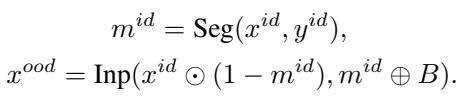
Here, Seg is the segmentation model, Inp is the inpainting model, and \(B\) represents a dilation kernel (making the mask slightly larger to ensure no edges of the frog remain).
The Filter: Sometimes, segmentation isn’t perfect. A piece of the frog might remain. To ensure the new image is truly just background, they pass it through CLIP. If CLIP still thinks the image looks too much like a frog (high similarity score), they discard it.

This ensures that the generated “OOD” data is purely background noise and contains no class-relevant features.
Step 2: Augmentation Strategy
Now that the researchers have “pure background” images, they use them as Pseudo-OOD supervision. This means they train the model by saying: “If you see this image (the background), the answer is NOT frog.”
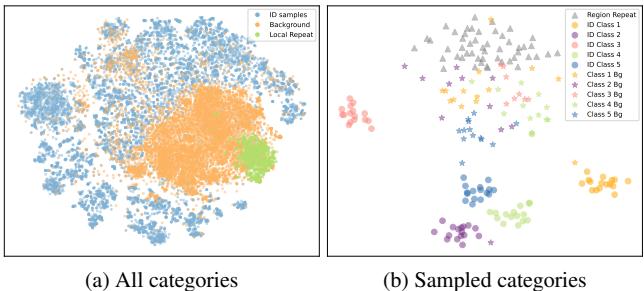
To make the model even more robust, they don’t just use the inpainted backgrounds. They also generate Texture OOD samples by taking small patches of the image and repeating them. This simulates scenarios where an image might have the texture of an object (like fur) but not the shape.
In Figure 5 below, you can see how the generated OOD samples (orange and green) sit on the edges of the real data distribution (blue). This helps define a tighter boundary for what counts as “In-Distribution.”
Step 3: Mask-Guided Region Regularization
This is the most technical and innovative part of the paper. Standard training looks at the whole image. OSPCoOp looks at regions.
The authors divide the image into small patches. Using the mask generated in Step 1, they classify every patch as either ID-relevant (part of the object) or ID-irrelevant (part of the background).
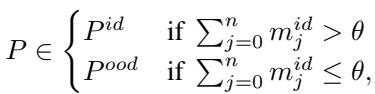
If a patch contains enough pixels from the object mask (\(m^{id}\)), it is an ID patch (\(P\)). Otherwise, it is an OOD patch (\(P^{ood}\)).
The Loss Functions (How the Model Learns)
The training process involves minimizing a total loss function that combines three specific goals.
Goal 1: Recognize the Object (ID-Global Relevance) The model must still correctly classify the original image. This is standard Cross-Entropy loss.

Goal 2: Ignore the Background (OOD-Region Irrelevance) This is the game-changer. The model is forced to look at the background patches (\(P^{ood}\)) and be uncertain about them.
In information theory, Entropy is a measure of uncertainty. If a model predicts “Dog: 99%, Cat: 1%”, entropy is low (it’s certain). If it predicts “Dog: 50%, Cat: 50%”, entropy is high (it’s unsure).
The researchers want high entropy for background patches. They want the model to look at the grass and say, “I have no idea what class this is.”

Goal 3: Reject Pure Backgrounds (OOD-Global Irrelevance) Finally, for the fully inpainted background images generated in Step 1, the model should also be globally uncertain.
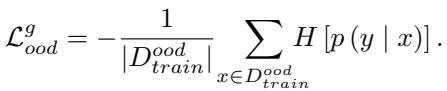
Putting it all together
The final objective function sums these up. By minimizing this equation, the model learns to:
- Identify the object.
- Ignore the background patches.
- Ignore full background images.

3. A New Challenge: ImageNet-Bg
One of the issues the authors found with existing research is that standard benchmarks don’t specifically test for background interference. To prove their point, they built a new dataset: ImageNet-Bg.
They took the validation set of ImageNet and removed all the foreground objects, leaving only the backgrounds.
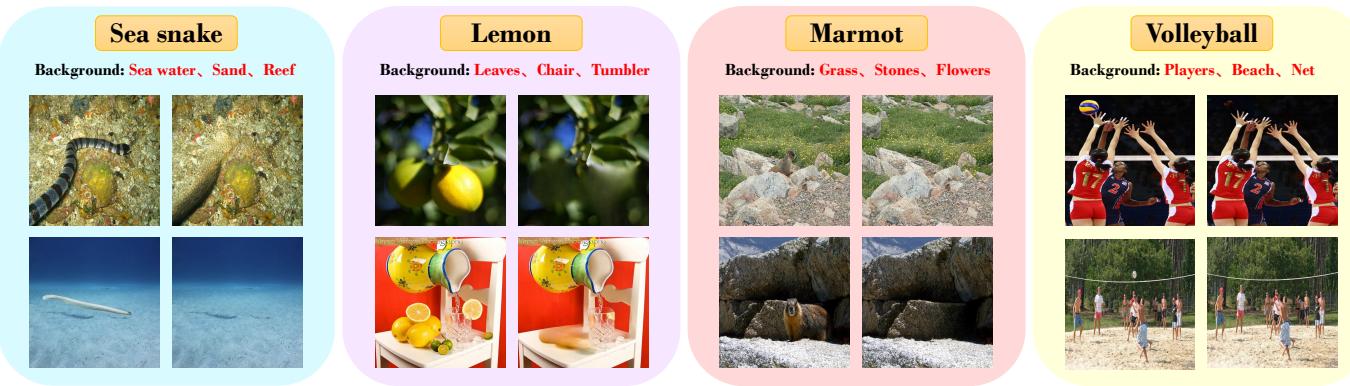
As you can see in Figure 3, the “Sea Snake” images (top left) have distinct blue water and sand. In ImageNet-Bg, only that water and sand remain. A model relying on shortcuts will still classify these empty images as “Sea Snake.” A robust model will realize there is no snake.
This dataset serves as the ultimate litmus test for shortcut learning.
4. Experiments and Results
So, does OSPCoOp actually work? The authors tested it against several state-of-the-art methods, including LoCoOp, which was the previous best method for few-shot OOD detection.
Performance on Standard Benchmarks
First, they looked at standard OOD datasets (iNaturalist, SUN, Places, Texture).
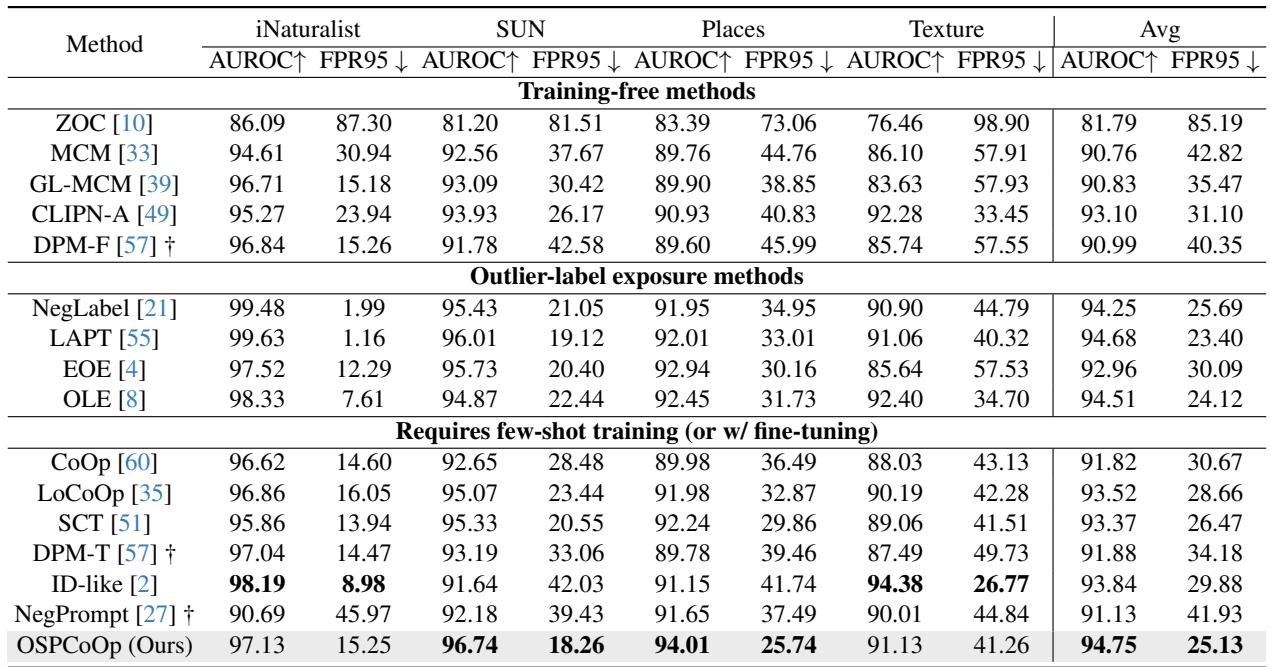
In Table 1, you can see the results.
- AUROC (Area Under Receiver Operating Characteristic): Higher is better. It measures how well the model separates ID from OOD.
- FPR95 (False Positive Rate): Lower is better. It measures how often the model mistakes OOD for ID.
OSPCoOp (Ours) achieves the best average performance, particularly excelling on datasets like SUN and Places, which are scene-heavy and prone to background bias.
Performance on ImageNet-Bg (The Real Test)
The results on the new background-only dataset are even more telling.
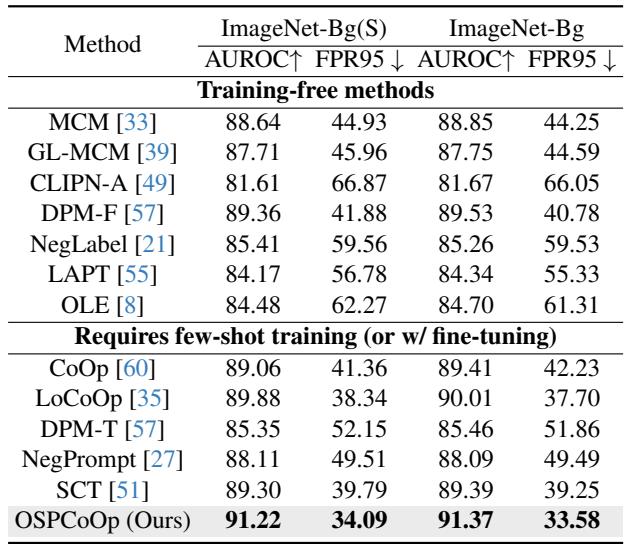
Looking at Table 3:
- CLIPN-A drops to 81.67% AUROC.
- LoCoOp achieves 90.01%.
- OSPCoOp reaches 91.37%.
This confirms that OSPCoOp is significantly better at realizing, “Hey, there’s no object here,” while other models are still tricked by the scenery.
Few-Shot Robustness
One of the constraints of this research is “few-shot learning,” meaning the model only gets to see 1, 2, 4, 8, or 16 examples per class during training.
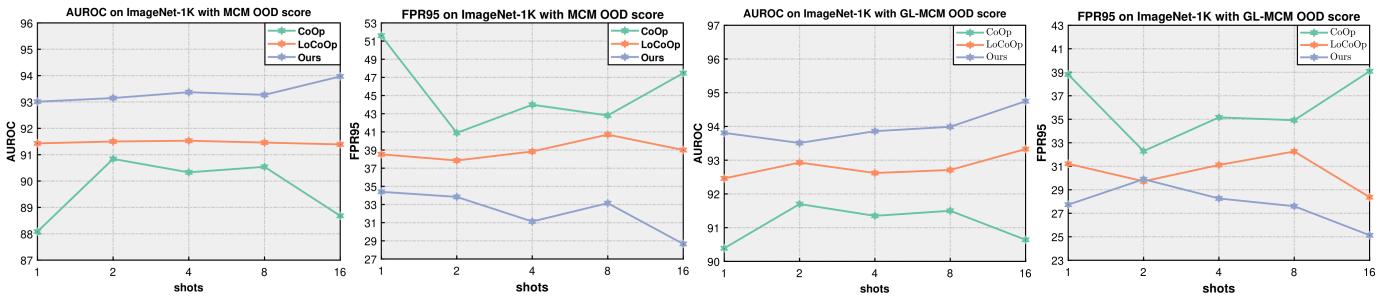
Figure 4 shows that OSPCoOp (the green line) consistently outperforms LoCoOp (orange) and standard CoOp (blue), especially when data is extremely scarce (1 or 2 shots). This suggests that explicitly teaching the model what to ignore is a very data-efficient way to learn.
Why is it better than LoCoOp?
LoCoOp also tries to use local regions for training. However, LoCoOp decides which regions are “background” based on feature similarity to the class text.
The problem? Because of the shortcut issue, the model might think the “water” feature is similar to the “whale” text. So, LoCoOp might accidentally treat the water as part of the foreground!
OSPCoOp avoids this by using explicit segmentation masks. It knows for a fact where the object is.
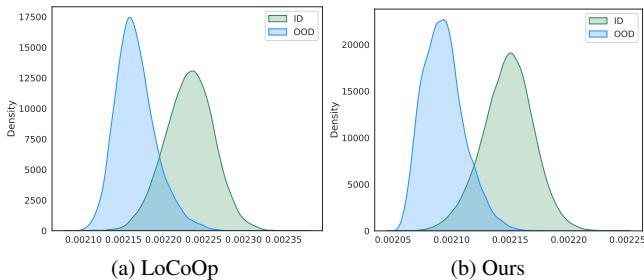
Figure 7 visualizes the separation between ID (green) and OOD (blue) scores.
- In (a) LoCoOp, there is significant overlap. The model is confused.
- In (b) Ours, the peaks are further apart. The model can clearly distinguish between an object and an anomaly.
5. Conclusion and Takeaways
The paper “Overcoming Shortcut Problem in VLM for Robust Out-of-Distribution Detection” highlights a critical flaw in modern AI: models are often right for the wrong reasons. By relying on background shortcuts, VLMs become fragile and unreliable in open-world settings.
The key takeaways from OSPCoOp are:
- Don’t trust the background: Coupling between foreground and background is the root of the shortcut problem.
- Create your own OOD data: By removing objects and inpainting backgrounds, we can generate powerful negative training examples.
- Guide the attention: Using masks to force the model to have high entropy (uncertainty) on background regions effectively breaks the shortcut dependency.
This work is a significant step toward making Vision-Language Models not just powerful, but robust and trustworthy. For students and researchers entering the field, it serves as a reminder: accuracy numbers on a test set don’t always tell the whole story. You have to ensure the model is actually looking at what you think it’s looking at.