](https://deep-paper.org/en/paper/file-2203/images/cover.png)
Beyond Human Poses: Generating 3D Creatures with Arbitrary Skeletons using SKDream
The field of generative AI has moved at a breakneck pace. We started with generating 2D images from text, moved to generating 3D assets, and are now pushing the boundaries of controllability. While text prompts like “a fierce dragon” are powerful, they leave a lot to chance. What if you want that dragon to be in a specific crouching pose? What if you want a tree with branches in exact locations?
In 2D image generation, we have tools like ControlNet that use “skeletons” (pose estimations) to guide the output. However, these have almost exclusively focused on human skeletons. If you want to control the pose of a dog, a spider, or a fantastical creature, you have been largely out of luck—until now.
In this post, we are doing a deep dive into SKDream, a new research paper from CVPR that introduces a framework for generating multi-view images and 3D models controlled by arbitrary skeletons. Whether it’s a biped, a quadruped, or a plant, SKDream allows users to define the structure via a skeleton and the appearance via text.
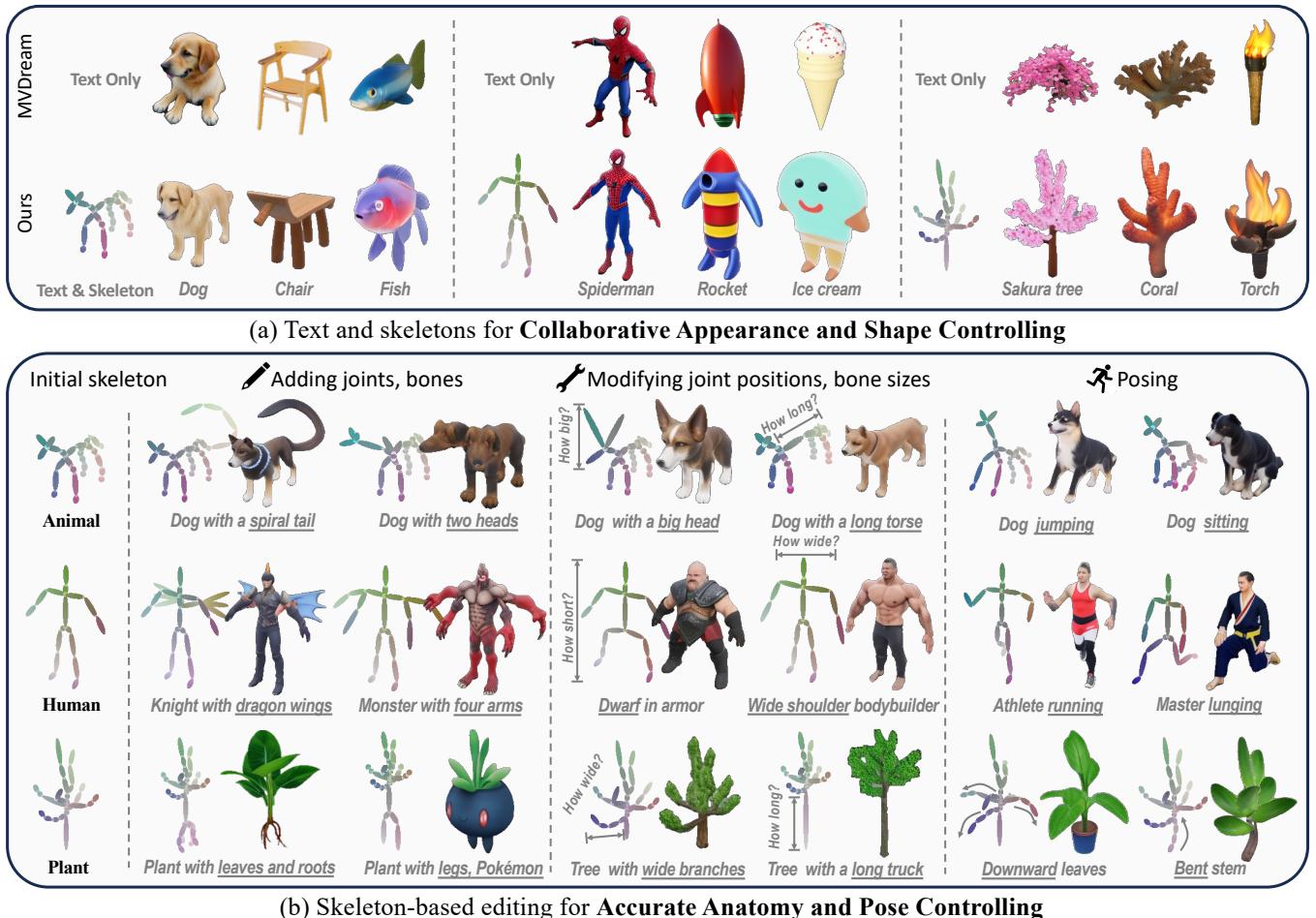
As shown in Figure 1, while standard text-to-3D models (like MVDream) generate high-quality objects, the user has no control over the pose. SKDream bridges this gap, allowing for precise manipulation of anatomy and pose—from a dog with a spiral tail to a knight with dragon wings.
The Core Problem: Why is this hard?
To understand why SKDream is a significant contribution, we first need to look at why this hasn’t been done before. There are two primary hurdles preventing us from using arbitrary skeletons for 3D generation:
- Data Scarcity: There are massive datasets for human poses (thanks to years of research in human pose estimation). There is no equivalent massive dataset connecting 3D meshes of random objects (chairs, fish, dragons) to semantic skeletons. You cannot train a model without data.
- Ambiguity in Representation: A human skeleton is standardized. We know which joint is the “left elbow.” But for a random structure, simple 2D lines are insufficient. A line on a 2D screen could represent a bone pointing toward the camera or away from it. This depth ambiguity confuses generative models.
The researchers behind SKDream tackled both of these problems head-on.
Part 1: Building the Data (Objaverse-SK)
Since no dataset existed, the authors had to build one. They utilized Objaverse, a massive library of 3D objects, but they needed to extract skeletons from these meshes automatically.
The Skeletonization Pipeline
Existing methods, such as RigNet, use deep learning to predict skeletons. However, RigNet is trained on specific data and often fails when presented with weird or complex geometries, often forcing symmetry where there shouldn’t be any.
Instead of relying on a pre-trained neural network for extraction, the authors designed a geometric pipeline focused on Curve Skeletons.
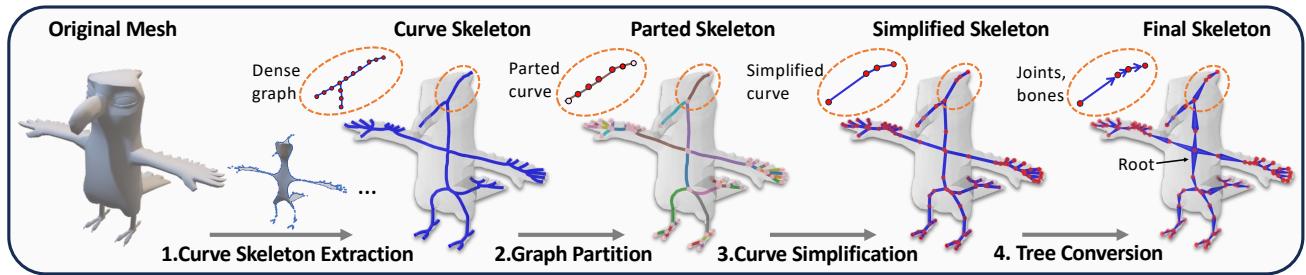
The process, illustrated in Figure 2, follows four steps:
- Curve Skeleton Extraction: They use an algorithm called Mean Curvature Flow (MCF) to contract the mesh down to its core curves. This is robust but results in a dense, messy graph.
- Graph Partitioning: The graph is analyzed to find intersection nodes (where branches meet) and is divided into parts.
- Curve Simplification: Complex curves are simplified into straight “bones” using the Douglas-Peucker algorithm.
- Tree Conversion: Finally, the graph is converted into a hierarchical tree structure (joints and bones) suitable for animation, selecting the root node based on centrality.
Quality Check: Ours vs. RigNet
How much better is this geometric approach compared to learning-based methods like RigNet?
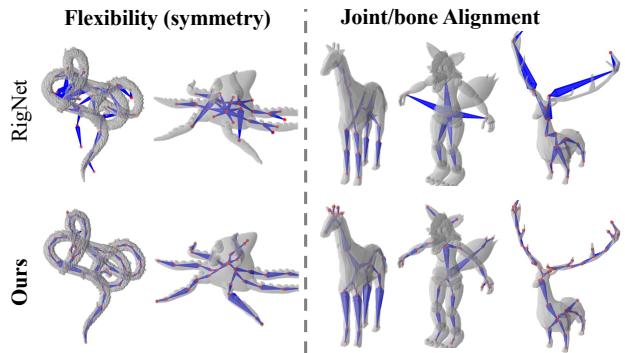
As seen in Figure 4, RigNet (top row) often struggles with alignment, producing skeletons that float outside the mesh or force a symmetric T-pose on a non-symmetric object (like the twisted snake). The SKDream pipeline (bottom row) faithfully follows the geometry of the object, whether it’s a snake or a quadruped.
This process resulted in Objaverse-SK, the first large-scale dataset containing 24,000 mesh-skeleton pairs, covering animals, humans, and plants.
Part 2: The Generation Pipeline
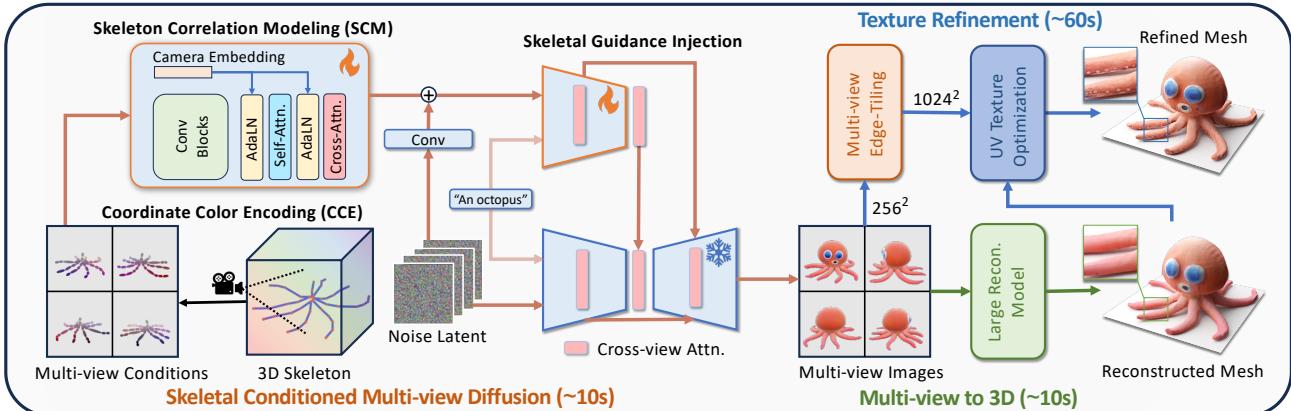
With the data problem solved, the authors moved to the model architecture. The goal is to take a Text Prompt and a 3D Skeleton and output a textured 3D Mesh.
This is a multi-stage process:
- Multi-view Generation: Generate consistent 2D images of the object from four different angles.
- 3D Reconstruction: Lift those images into a 3D model.
- Refinement: Polish the texture.
1. Solving Ambiguity with Coordinate Color Encoding (CCE)
The first challenge in the generation phase is how to feed the 3D skeleton into the image generator (a diffusion model). Standard approaches project the skeleton onto a 2D plane (like drawing a stick figure).
The problem? Loss of information. If you draw a stick figure, you can’t tell if the hand is reaching toward you or away from you. This is called depth ambiguity.
SKDream solves this using Coordinate Color Encoding (CCE). Instead of drawing black lines, they color the joints and bones based on their 3D coordinates \((x, y, z)\) normalized to RGB values. They also add the depth information into the alpha channel (CCE-D).
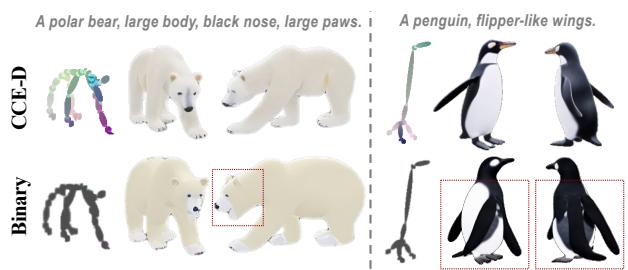
Figure 8 demonstrates why this matters.
- Bottom Row (Binary): With simple black-and-white lines, the model gets confused. It generates a polar bear head where the tail should be, or generates a penguin that doesn’t respect the orientation of the skeleton.
- Top Row (CCE-D): The color gradients tell the model exactly how the bones are oriented in 3D space. The resulting polar bear and penguin are correctly aligned and posed.
2. Injecting Conditions: The Skeletal Correlation Module (SCM)
The backbone of SKDream is a multi-view diffusion model (based on MVDream). To inject the skeletal information, standard ControlNet uses convolution layers. However, skeletons are “sparse”—they are thin lines in a mostly empty image. Convolutions often struggle to capture the global relationship between distant joints (e.g., understanding that the back left leg must coordinate with the front right leg).
The authors introduce the Skeletal Correlation Module (SCM) (shown in Figure 3). It replaces standard convolutions with:
- Self-Attention: To model anatomical correlations (how different parts of the skeleton relate within one view).
- Cross-Attention: To model cross-view correlations (ensuring the front view and side view understand they are looking at the same skeleton).
- Camera Embeddings: Fused via Adaptive Layer Normalization (AdaLN) to tell the model exactly which camera angle corresponds to the current skeleton projection.
This architectural change is not just theoretical; it drastically improves training speed.
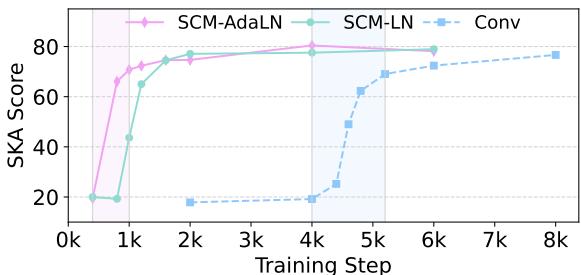
As shown in Figure 9, the SCM with AdaLN (pink line) converges \(5\times\) faster than standard convolution methods (blue line), reaching high alignment scores almost immediately.
Part 3: From Images to Refined 3D Assets
Once the diffusion model generates four consistent views of the object (aligned with the skeleton), the system needs to turn them into a 3D mesh.
Instant Reconstruction
The authors employ a Large Reconstruction Model (LRM), specifically InstantMesh, to pop the four images into a coarse 3D mesh. This takes about 10 seconds. While the shape is usually good, the texture can be blurry because the input images are only \(256 \times 256\) resolution.
Texture Refinement
To fix the blurriness, SKDream includes a refinement stage.
- They use an image upscaler (ControlNet-Tile) to boost the generated images to \(1024 \times 1024\).
- They project these high-res images back onto the 3D mesh’s texture map (UV space).
However, simply projecting images can leave gaps or seams in areas the cameras didn’t see perfectly. To solve this, they optimize the texture \(u\) using the following loss function:

Here, the first term ensures the texture matches the high-res images. The second term is a regularization term: it forces the texture to stay close to the original (coarse) reconstruction \(u_0\) in areas where there is no new information. This prevents artifacts in “unseen” regions.
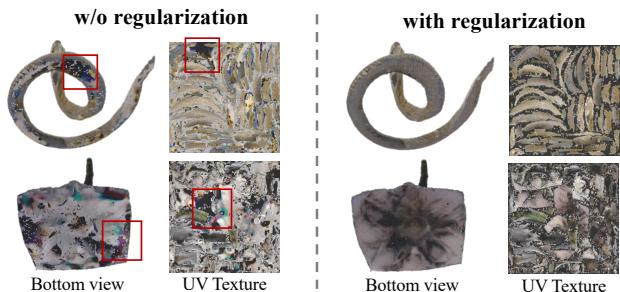
Figure 10 shows the impact of this regularization. Without it (left), you see noisy artifacts in the UV map and on the bottom of the object. With regularization (right), the unseen areas remain smooth and consistent.
The result is a significant leap in texture quality:
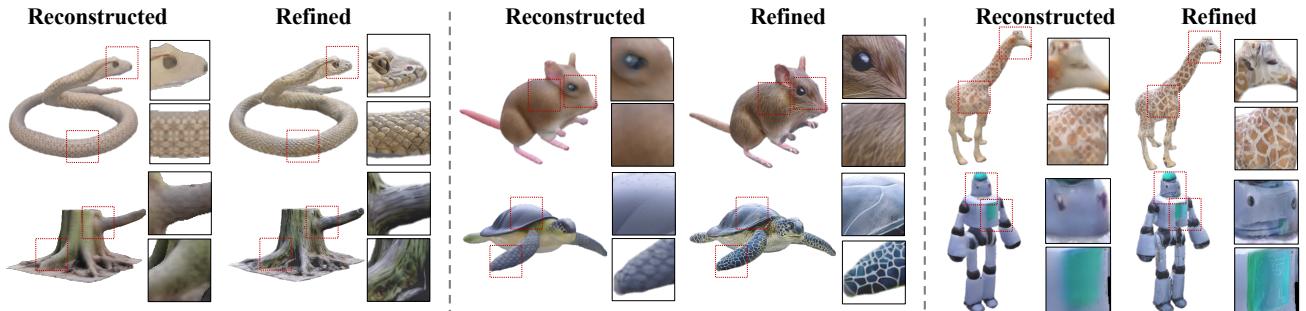
In Figure 6, notice how the snake scales, turtle shell patterns, and robot details become sharp and distinct after refinement.
Experiments and Evaluation
How does SKDream compare to other methods? Since no direct competitor for arbitrary skeletal generation existed, they compared against SDEdit (a standard image-to-image editing technique) and a variation using guidance.
Qualitative Comparison
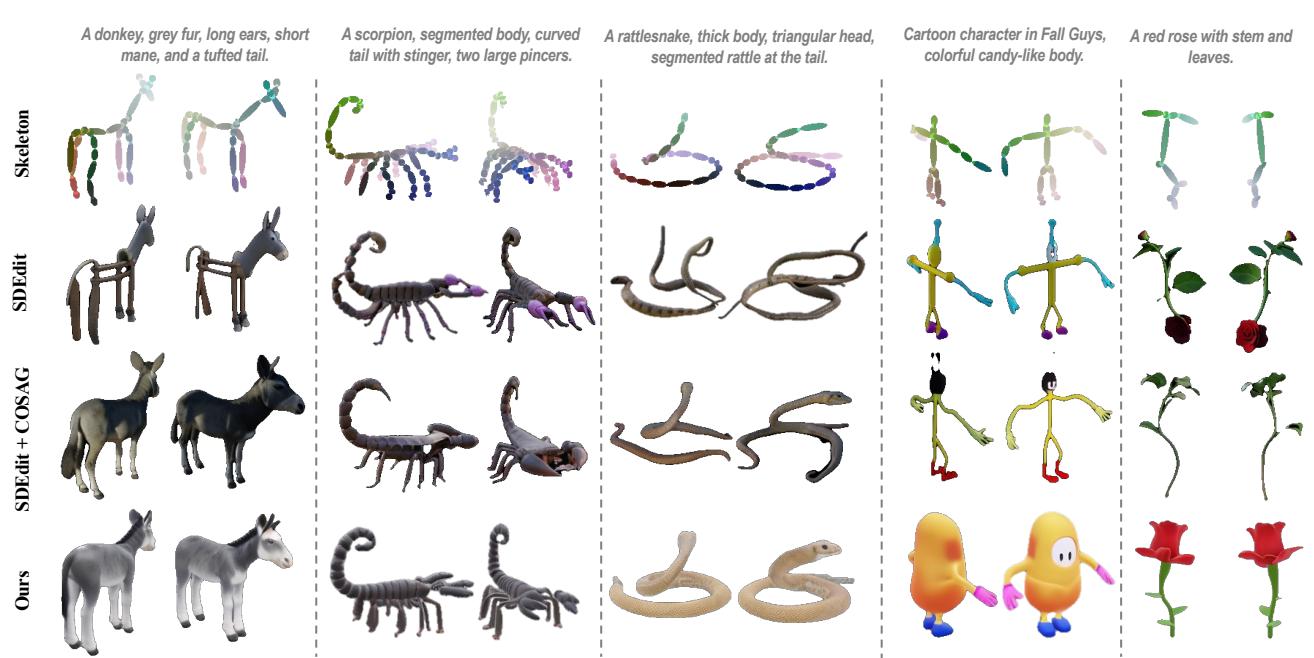
Figure 5 shows the difference clearly.
- SDEdit: While it roughly follows the shape, it often hallucinates incorrect anatomy (breaking the snake’s body) or textures (turning a donkey into wood).
- Ours (SKDream): The generated objects—from the scorpion to the rose—adhere strictly to the skeletal structure while maintaining high photorealism and textual alignment.
Quantitative Analysis
To measure success mathematically, the authors proposed a new metric: SKA (Skeleton Alignment Score). This uses a contrastive learning approach (similar to CLIP) to measure how well the generated image matches the input skeleton.

Looking at the data:

SKDream (“Ours-SCM”) significantly outperforms baseline methods across all categories (Animals, Humans, Plants). The alignment is particularly strong for Quadrupeds and Arthropods.
Generalization
A critical question for any AI model is: “Can it handle things it wasn’t trained on?” The authors tested SKDream on categories from ShapeNet that were excluded from training, such as airplanes, chairs, and guitars.
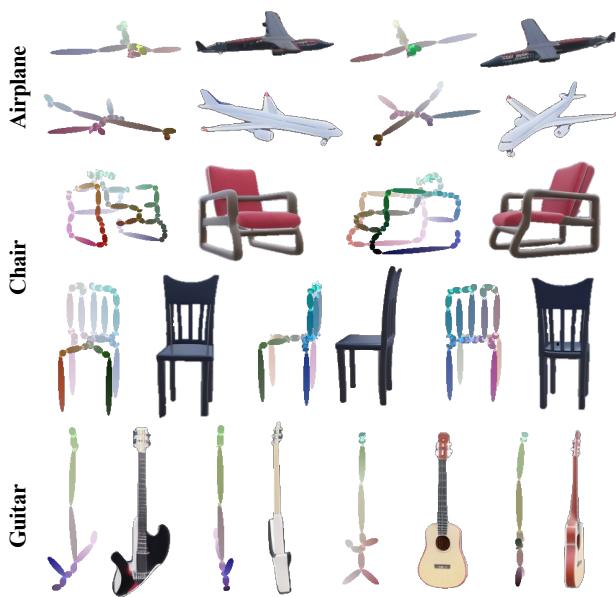
Figure 7 shows that the model generalizes surprisingly well. Even though it was primarily trained on creatures and plants, it can successfully skin an airplane skeleton or a guitar skeleton, proving that the Skeletal Correlation Module has learned a generalized understanding of structure, not just memorized specific animals.
Ablation Studies
Finally, the authors verified their design choices. Does the Coordinate Color Encoding (CCE) really matter? Does the SCM architecture really help?
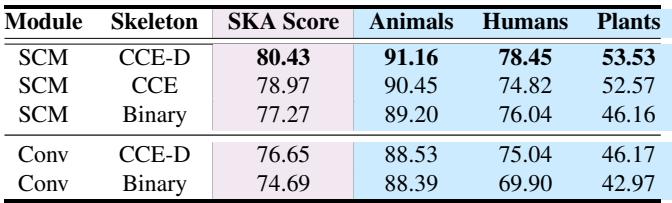
Table 3 confirms that:
- SCM is better than Conv: Using the Skeletal Correlation Module improves alignment over standard convolutions.
- CCE-D is better than Binary: Using color and depth encoding provides the highest alignment scores.
Conclusion and Implications
SKDream represents a significant step forward in controllable 3D generation. By moving beyond human-centric datasets and designing architectures specifically for sparse, arbitrary structures, the authors have created a tool that can generate and rig almost anything.
Key Takeaways:
- Data is King: Creating Objaverse-SK was essential. The robust geometric pipeline for skeleton extraction enabled the training of this model.
- Representation Matters: Encoding 3D coordinates into colors (CCE) solves the depth ambiguity problem inherent in 2D condition maps.
- Architecture for Structure: The SCM proves that for structural conditions like skeletons, attention mechanisms work better than simple convolutions.
This technology opens exciting possibilities for indie game developers, animators, and creators who need to populate virtual worlds with diverse, rigged 3D assets instantly. Instead of spending hours modeling and rigging a custom monster, a user can simply sketch a skeleton, type a prompt, and let SKDream do the rest.