](https://deep-paper.org/en/paper/file-2219/images/cover.png)
Introduction
Imagine you are trying to teach a robot how to cook by having it watch a video of a human chef. The robot has its own camera (first-person, or “egocentric” view), but it is also watching a surveillance camera in the corner of the kitchen (third-person, or “exocentric” view). The human picks up a blue cup. To imitate this, the robot needs to know that the blue shape in the corner camera corresponds to the same object as the blue shape in its own camera.
This sounds trivial for humans, but for computer vision models, it is an incredibly difficult geometric and semantic puzzle. The viewpoints are disjoint; the lighting is different; the object might look huge in one camera and tiny in the other.
Traditionally, solving this requires massive amounts of labeled data—thousands of images where a human has manually drawn circles around the “same” object in different views. But recently, researchers from the University of Texas at Austin and Stanford University introduced a method called Predictive Cycle Consistency (PCC).
Their approach allows AI to learn these associations entirely on its own (self-supervised), achieving results that beat even human-supervised models on challenging benchmarks.
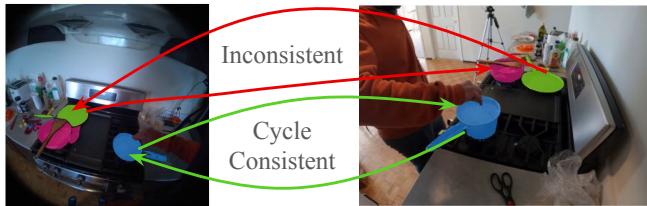
As illustrated in Figure 1, the goal is to bridge the gap between two radically different views—a dark, fisheye view and a bright, standard view—and successfully identify that the blue cup is the same object in both, despite the “inconsistent” spatial layout.
In this post, we will break down how PCC works, how it uses a clever “colorization” trick to find objects, and why it represents a major step forward for robotic imitation learning and video understanding.
The Problem: The Limits of Current Correspondence
Visual correspondence is the task of determining which parts of Image A relate to which parts of Image B. In the past, this was mostly done using Optical Flow or pixel-to-pixel tracking. These methods work great for high-frame-rate video where a car moves slightly to the left between Frame 1 and Frame 2.
However, these methods fall apart in two specific scenarios:
- Extreme View Changes: When Camera A and Camera B are looking at the scene from completely different angles (as seen in Figure 1).
- Temporal Discontinuities: When there is a large time gap between frames (e.g., matching a car at the start of a video to the same car 30 seconds later).
In these “discontinuous” settings, pixels don’t just shift; they disappear, warp, or change appearance entirely. To solve this, models need to understand objects, not just pixels.
State-of-the-art self-supervised methods usually rely on contrastive learning (matching feature embeddings). While effective, these methods often struggle with “distractors”—objects that look semantically similar (like two different pieces of paper) but are spatially distinct. The researchers needed a way to force the model to understand the specific geometry of a scene without being told the answer.
The Core Method: Predictive Cycle Consistency
The researchers propose a pipeline that bootstraps its own training data. The process relies on a clever pretext task: Conditional Grayscale Colorization.
1. The Pretext Task: “Paint the Scene”
To learn about the world, the model is given a simple game to play. It is shown:
- A Source Image (in full color).
- A Target Image (in black and white/grayscale).
The model’s job is to colorize the Target Image. To do this successfully, the model must look at the Source Image, identify the objects, figure out where those objects are located in the grayscale Target Image, and transfer the color information correctly.
If the model can paint the target correctly, it implicitly “knows” where the objects are.
2. Extracting Correspondence via Perturbation
How do we extract this “knowledge” from the colorization model? The authors use a technique rooted in causality: if I change the input, how does the output change?
Imagine the Source Image has a red apple. If the model correctly identifies the apple in the grayscale Target Image, then changing the apple’s color to blue in the Source Image should cause the model to paint a blue apple in the Target Image.
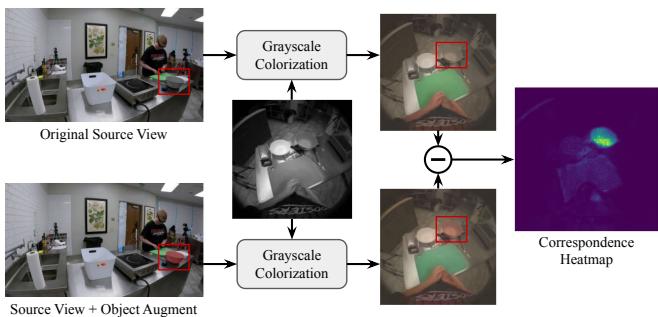
As shown in Figure 5, the process works like this:
- Take the original source image and run the colorization.
- Create an augmented source image where a specific object is artificially colored (perturbed).
- Run the colorization again.
- Subtract the two resulting images.
The difference between the two outputs reveals a “heatmap.” The areas that changed color in the output are the areas that correspond to the object we modified in the input.
The researchers formalize this heatmap generation mathematically. The correspondence heatmap \(\mathcal{H}\) is calculated by looking at the difference between the original output \(\mathbf{F}(\dots, \mathcal{I}_1)\) and the perturbed output \(\mathbf{F}(\dots, \mathcal{I}_1')\):

In simple terms, this equation calculates the normalized difference across all color channels. If a pixel in the target view changes significantly when we change the source object, that pixel is part of the corresponding object.
3. Cycle Consistency: The Two-Way Street
Generating a heatmap is good, but it can be noisy. To make the system robust, the authors apply Cycle Consistency.
Correspondence should be invertible. If “Object X” in the Ego-view corresponds to “Object Y” in the Exo-view, then “Object Y” should map back to “Object X.”
The pipeline uses the “Segment Anything Model” (SAM) to detect all potential objects in both images. Then, it runs the perturbation test in both directions:
- Forward (\(1 \to 2\)): Change Object X in View 1 \(\rightarrow\) See which object lights up in View 2.
- Backward (\(2 \to 1\)): Change the matched object in View 2 \(\rightarrow\) See if it lights up Object X in View 1.
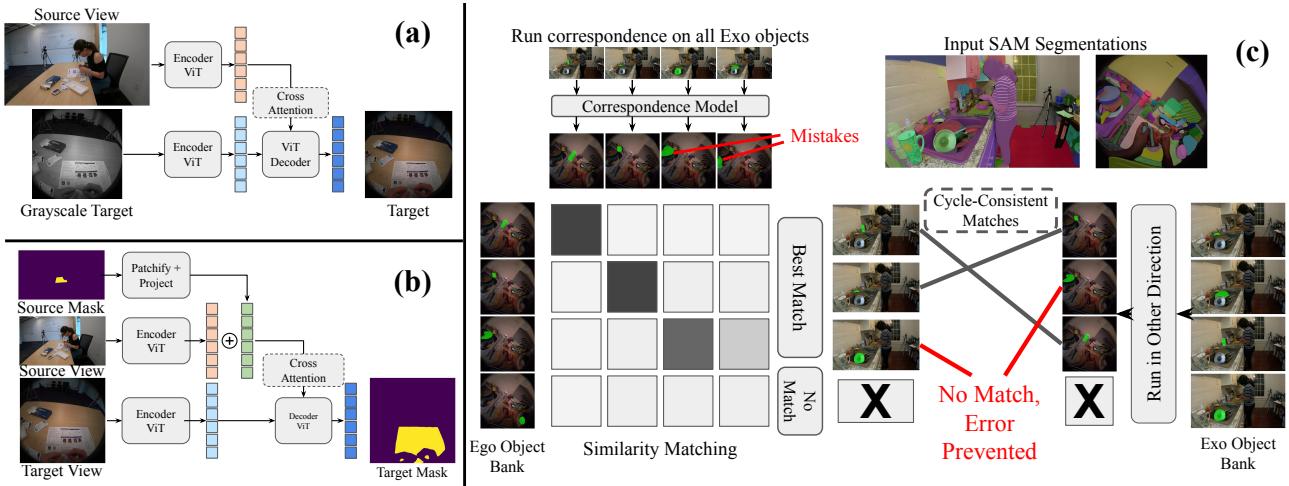
Figure 4(c) illustrates this loop. By enforcing that the match must work in both directions, the system filters out bad guesses and “hallucinations.” Only pairs that form a closed loop are kept as Pseudolabels.
4. Iterative Self-Improvement
The “colorization” model is just the starting point (Iteration 0). It provides the initial, rough set of matched objects.
Once the system has generated a dataset of these “pseudolabeled” object pairs, it trains a new, dedicated Correspondence Model. This new model isn’t trying to colorize images anymore; it is explicitly trained to take an object mask in one view and predict the mask in the other.
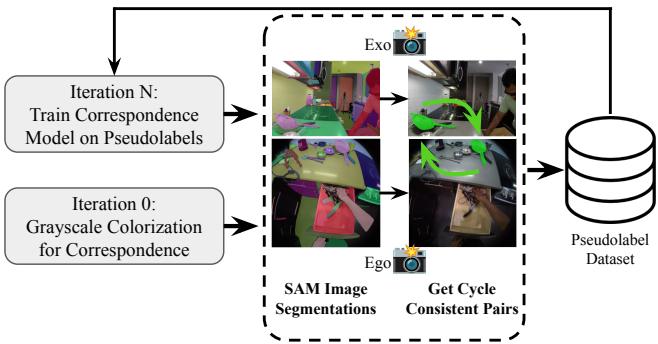
As shown in Figure 3, this creates a virtuous cycle:
- Use the current model to find high-confidence matches (Pseudolabels).
- Train a new, better model on those matches.
- Use the new model to find even more difficult matches.
The researchers found that running this loop for just 3 iterations saturated the model’s performance, leading to highly accurate correspondence.
Experiments and Results
To prove this works, the researchers tested PCC on the hardest available datasets for visual correspondence.
1. The EgoExo4D Challenge (Space)
EgoExo4D is a massive dataset containing synchronized video of skilled human activities (like cooking or repairing bikes) captured from head-mounted cameras (Ego) and third-person cameras (Exo).
The task is: Given a mask of an object in the Ego view, find it in the Exo view (and vice versa).
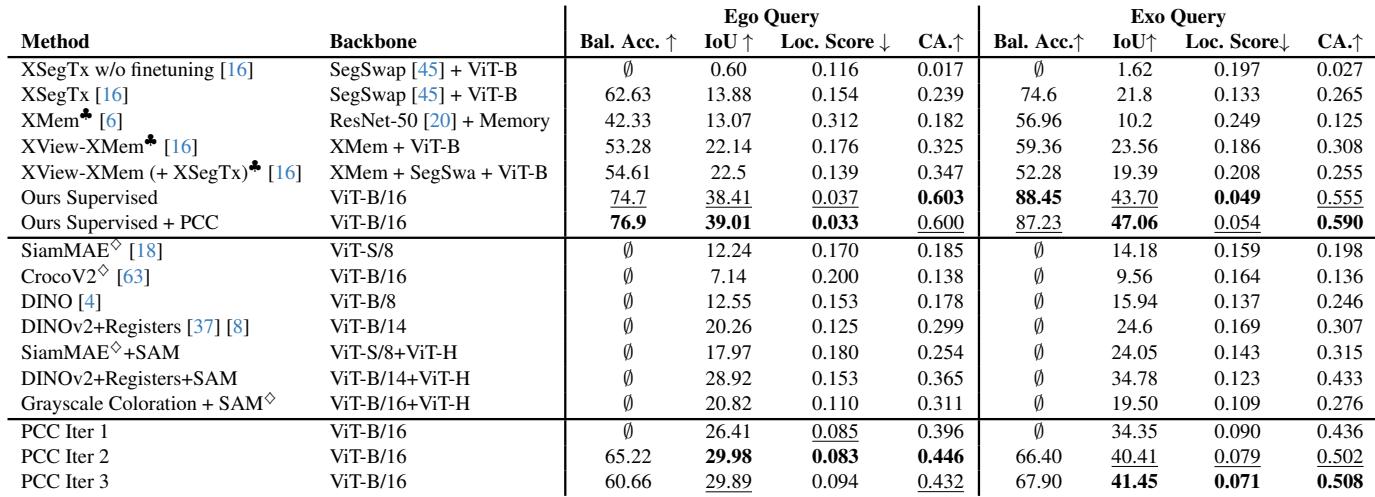
Table 1 highlights the breakthrough performance of PCC.
- Beating Supervised Models: “Ours Supervised + PCC” achieves higher IoU (Intersection over Union) than models trained purely on human-labeled data.
- Beating Self-Supervised SoTA: Compare PCC Iter 3 (bottom row) against SiamMAE and DINOv2. In the “Exo Query” task (finding an object in the ego-view given the exo-view), PCC achieves an IoU of 41.45, while the powerful DINOv2 (with SAM) only reaches 34.78.
The model is particularly good at “Location Score” (Loc. Score), which measures how close the predicted center of the object is to the real one. Lower is better, and PCC achieves 0.071 vs DINO’s 0.123.
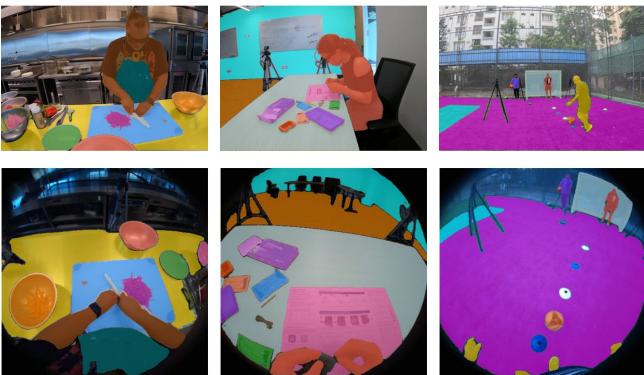
Figure 2 demonstrates the qualitative difficulty of these scenes. Look at the middle column: the model successfully distinguishes between different pieces of paper on a cluttered table. In the left column, it correctly identifies the cutting board and bowl despite the extreme angle change between the top (Exo) and bottom (Ego) views.
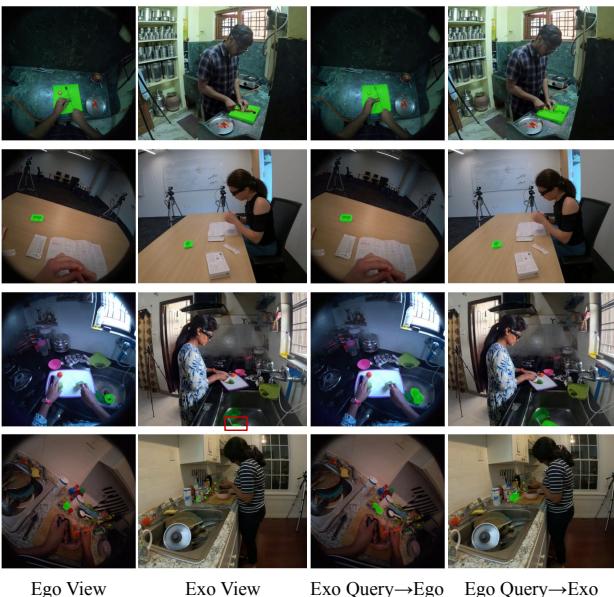
Figure 6 further shows the model’s robustness to occlusion. Even when hands are covering parts of the objects or when the lighting is dim, PCC maintains a lock on the correct items.
2. Tracking Across Time (DAVIS-17 & LVOS)
The researchers also applied PCC to video tracking. Standard video tracking works well between Frame 1 and Frame 2. But what if you jump from Frame 1 to Frame 20?
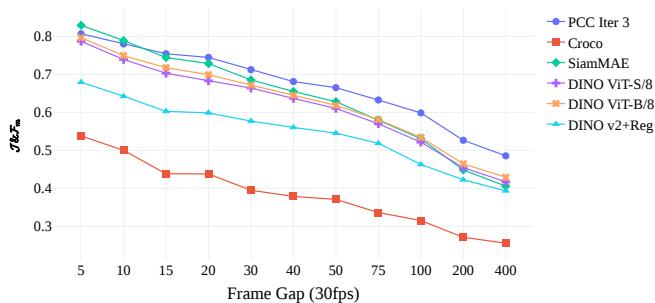
Figure 7 plots performance as the gap between frames increases.
- The x-axis represents the frame gap (up to 400 frames).
- The Blue Line (PCC Iter 3) remains much more stable than the competitors.
- Notice how SiamMAE (Green) and Croco (Red) drop off significantly as the gap widens.
This proves that PCC isn’t just relying on local motion cues; it has learned a semantic understanding of “object permanence.”
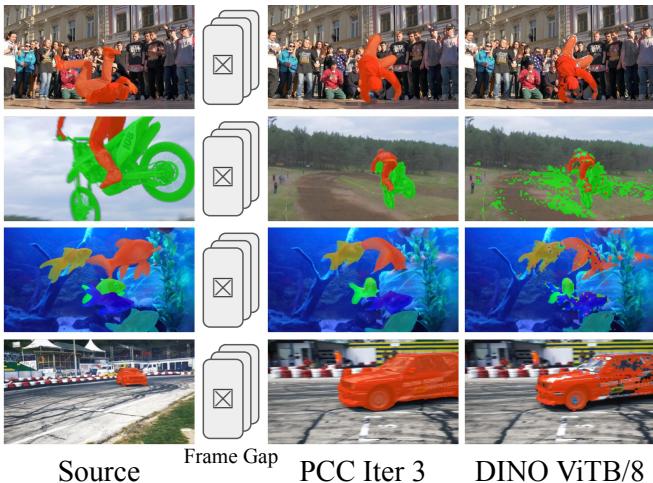
Figure 8 provides a visual comparison. In the bottom row (motorcycles), notice the “DINO ViTB/8” column. The representation has degraded, and the segmentation is messy. The “PCC Iter 3” column maintains a sharp, accurate mask of the motorcyclist even after a large time jump.
Why This Matters
The success of Predictive Cycle Consistency highlights a trend in modern AI: Constraints breed creativity. By constraining the model to be cycle-consistent (A \(\to\) B \(\to\) A must hold), the researchers forced the AI to learn robust, high-quality representations without needing a human to label a single pixel.
Key Takeaways
- Objects > Pixels: For difficult correspondence tasks involving large viewpoint or time changes, operating at the object level (using masks) is superior to pixel-level or patch-level matching.
- Generative Pretraining Works: Using a generative task (grayscale colorization) forces the model to learn spatial relationships that discriminative tasks might miss.
- Self-Training is Powerful: The ability to generate pseudolabels and iteratively improve allows the model to surpass the very baselines it started with.
Implications
This technology is a significant enabler for robot learning. If a robot can watch a YouTube video of a human fixing a sink (Exo view) and map those tools and actions to its own camera feed (Ego view), we are one step closer to general-purpose robots that can learn by watching. Furthermore, in Augmented Reality (AR), this allows for persistent object anchoring—keeping a virtual label attached to a mug even as you walk to the other side of the room.
PCC demonstrates that with the right pretext task and a rigorous consistency check, AI can make sense of a chaotic, disjointed world all on its own.