](https://deep-paper.org/en/paper/file-2242/images/cover.png)
Introduction
Imagine you are walking down a busy city street with your eyes closed. You hear a siren. To figure out where it’s coming from, you might instinctively turn your head or walk forward. As you move, the sound changes—if you rotate right and the sound stays to your left, you know exactly where it is relative to you. This dynamic relationship between movement (egomotion) and sound perception is fundamental to how humans navigate the world.
However, teaching Artificial Intelligence to replicate this skill—sound localization—is notoriously difficult. Standard approaches often rely on training agents in simulated, silent 3D rooms where acoustics are mathematically perfect but unrealistic. Real-world audio is messy; it bounces off walls, gets drowned out by wind, and mixes with background noise. Furthermore, gathering “ground truth” data for real-world video (labeling exactly where every sound is coming from in every frame) is prohibitively expensive and time-consuming.
In the paper “Supervising Sound Localization by In-the-wild Egomotion,” researchers from the University of Michigan, Tsinghua University, and the Shanghai Qi Zhi Institute propose a clever solution. They ask a simple question: Can we teach an AI to locate sounds just by watching “in-the-wild” videos of people walking around?
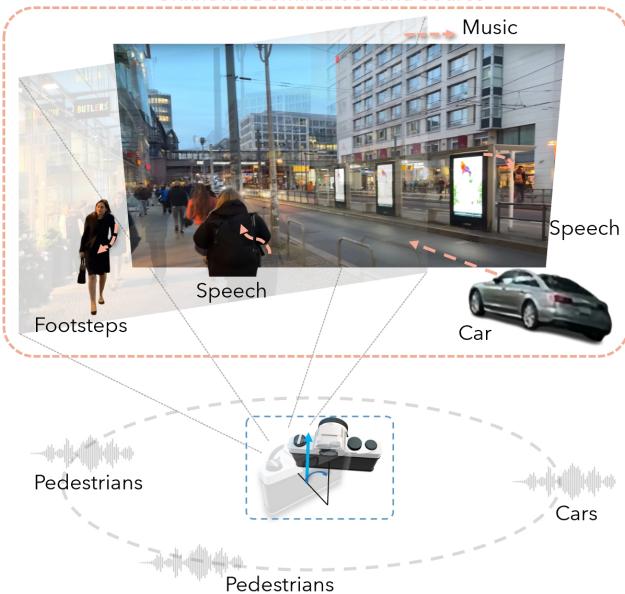
Their method uses the camera’s motion as a “free” supervisory signal. By analyzing how a camera moves (rotates and translates) in a video, the model learns to predict sound directions that are consistent with that motion. The result is a system that can learn from standard YouTube walking tours without any manual labeling, bridging the gap between simulated training and real-world application.
Background: The Challenge of “In-the-Wild” Audio
To understand why this research is significant, we first need to look at how machines typically learn to hear.
The Problem with Simulation
Historically, researchers have relied on simulators (like SoundSpaces) to generate training data. In a simulation, you can place a virtual agent in a virtual room, play a virtual sound, and tell the agent exactly where the sound is. This provides perfect labels. However, there is a massive “Sim2Real” gap. A simulated room doesn’t capture the acoustic complexity of a crowded subway station or a windy park. Models trained in simulation often fail when deployed in the real world.
The Problem with Real Data
The alternative is using real video. But here we face the “labeling bottleneck.” How do you generate millions of frames of video where a human has precisely marked the angle of every footstep, car honk, and bird chirp? It is nearly impossible.
The Solution: Weak Supervision
This paper introduces a weakly supervised learning framework. Instead of explicit labels (“The car is at 45 degrees”), the model uses constraints derived from visual data. It doesn’t need to know exactly where the sound is to start learning; it just needs to know how the sound’s position should change based on how the camera moved.
Core Method: Learning from Motion
The core innovation of this paper is treating egomotion (the motion of the camera/observer) as the teacher.
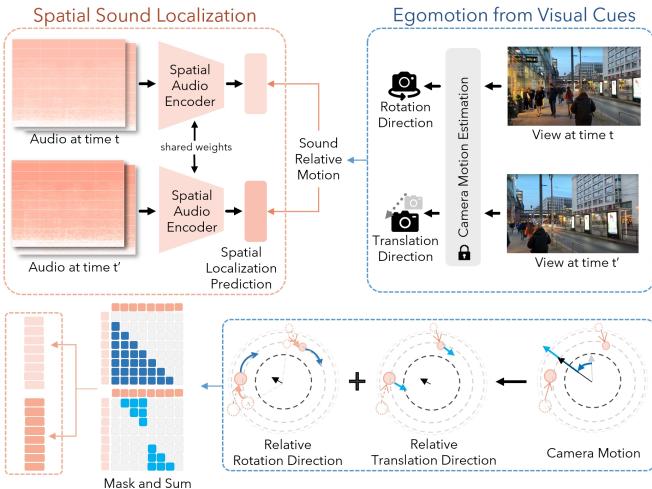
As illustrated in Figure 3 above, the pipeline consists of two parallel streams: an Audio Stream (which we want to train) and a Visual Stream (which acts as the supervisor).
1. The Visual Stream: Estimating Egomotion
First, the system analyzes the video frames to understand how the camera moved between two points in time, \(t\) and \(t'\). The researchers use off-the-shelf computer vision techniques (specifically SuperGlue for feature matching and Perspective Fields for calibration) to estimate two things:
- Rotation: Did the camera turn left or right?
- Translation: Did the camera move forward or backward?
Crucially, the vision part of this system is not being trained. It is a fixed, pre-existing tool used to generate labels for the audio model.
2. The Audio Stream: Predicting Azimuth
The model takes stereo audio clips (spectrograms) corresponding to time \(t\) and \(t'\). A Convolutional Neural Network (ResNet-18) processes these spectrograms and outputs a probability distribution over possible sound angles (azimuth). It breaks the 360-degree view into a grid of distinct angles (e.g., 32 bins).
3. The “Mask and Sum” Supervision
This is the mathematical heart of the paper. The model predicts sound angles for time \(t\) (\(f(s_1)\)) and time \(t'\) (\(f(s_2)\)). The system then checks: Are these two predictions consistent with the camera movement we saw?
Rotation Loss
If the vision system detects the camera rotating clockwise, a stationary sound source must appear to shift counter-clockwise relative to the camera.
The researchers formulate a loss function that penalizes the model if it predicts a shift in the “wrong” direction. They sum up the probabilities of all angle pairs that are compatible with the visual rotation.
\[ \mathcal { L } _ { \mathrm { r o t } } = L _ { \mathrm { c e } } \left( \sum _ { ( i , j ) \in R } f ( \mathbf { s } _ { 1 } ) _ { i } f ( \mathbf { s } _ { 2 } ) _ { j } , d _ { r } \right) , \]In this equation:
- \(f(s_1)_i\) and \(f(s_2)_j\) are the predicted probabilities of the sound being at angle \(i\) and \(j\) respectively.
- \(R\) is the set of all pairs \((i, j)\) that are consistent with the visual rotation direction \(d_r\).
- The loss forces the model to maximize the probability of these consistent pairs.
Translation Loss
Similarly, if the camera moves forward (translation), objects on the side should move toward the back of the visual field (parallax effect). The paper defines a translation loss:
\[ \mathcal { L } _ { \mathrm { t r a n s } } = L _ { \mathrm { c e } } \left( \sum _ { ( i , j ) \in T } f ( \mathbf { s } _ { 1 } ) _ { i } f ( \mathbf { s } _ { 2 } ) _ { j } , d _ { t } \right) , \]Here, \(T\) represents the set of angle pairs consistent with the camera’s forward or backward movement \(d_t\).
Binaural Cues (IID)
To stabilize training, the researchers also use a traditional physics-based cue: Interaural Intensity Difference (IID). Put simply, if a sound is louder in the left channel, it’s likely coming from the left.
\[ \mathcal { L } _ { \mathrm { b i n } } = L _ { \mathsf { c e } } \left( \sum _ { j \in B } f ( \mathbf { s } _ { i } ) _ { j } , b _ { t } \right) , \]This acts as a “sanity check” for the model, ensuring it respects basic acoustic physics while learning the more complex geometric relationships from motion.
The Combined Objective
The final training objective combines all three losses. The weights \(\lambda_1\) and \(\lambda_2\) allow the researchers to balance how much the model relies on rotation, translation, or raw intensity differences.
\[ \mathcal { L } = \lambda _ { 1 } L _ { \mathrm { r o t } } + ( 1 - \lambda _ { 1 } ) L _ { \mathrm { t r a n s } } + \lambda _ { 2 } L _ { \mathrm { b i n } } , \]By minimizing this combined loss, the neural network learns to localize sounds in a way that aligns with both the physics of stereo audio and the geometry of camera motion.
Experiments & Results
To test their method, the authors had to overcome a major hurdle: there were no existing large-scale datasets of “in-the-wild” stereo video with ground truth sound labels. So, they built one.
The StereoWalks Dataset
The researchers curated a dataset called StereoWalks, primarily sourced from YouTube walking tours. These videos are ideal because they feature continuous camera motion through diverse environments (cities, parks, markets) and are recorded with high-quality stereo microphones (often iPhones).
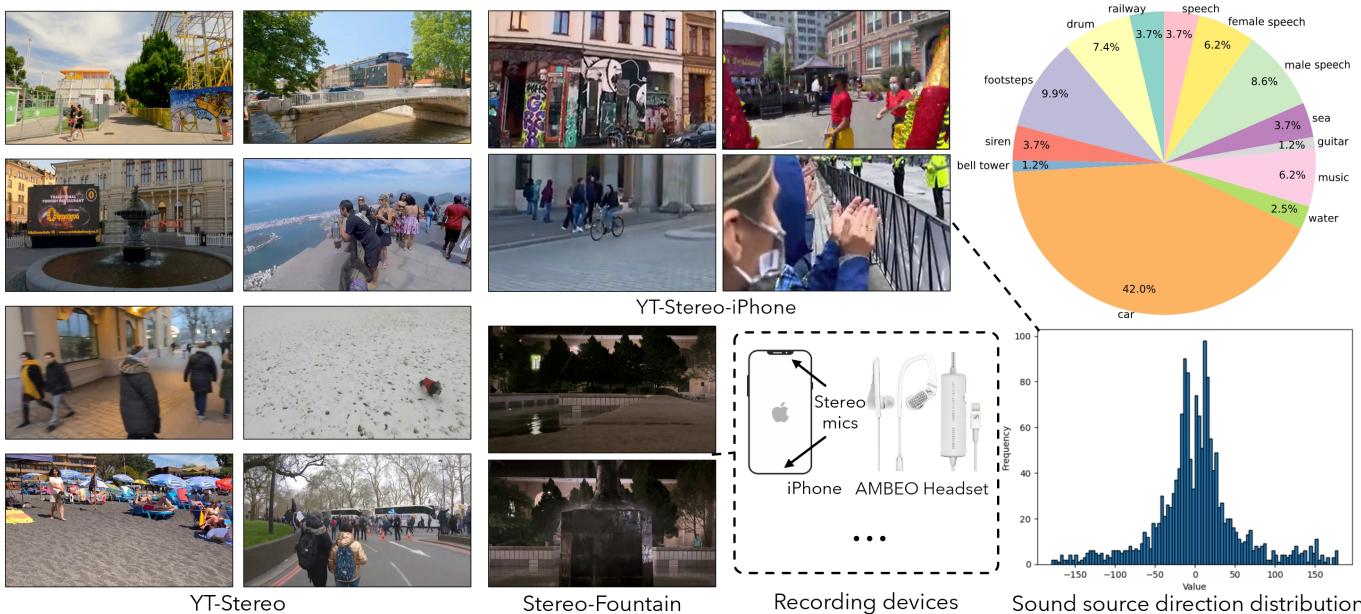
As shown in Figure 2, the dataset captures a wide variety of scenes. To evaluate performance, they collected two smaller, controlled subsets: Stereo-Fountain and Binaural-Fountain, where they could manually verify sound source locations.
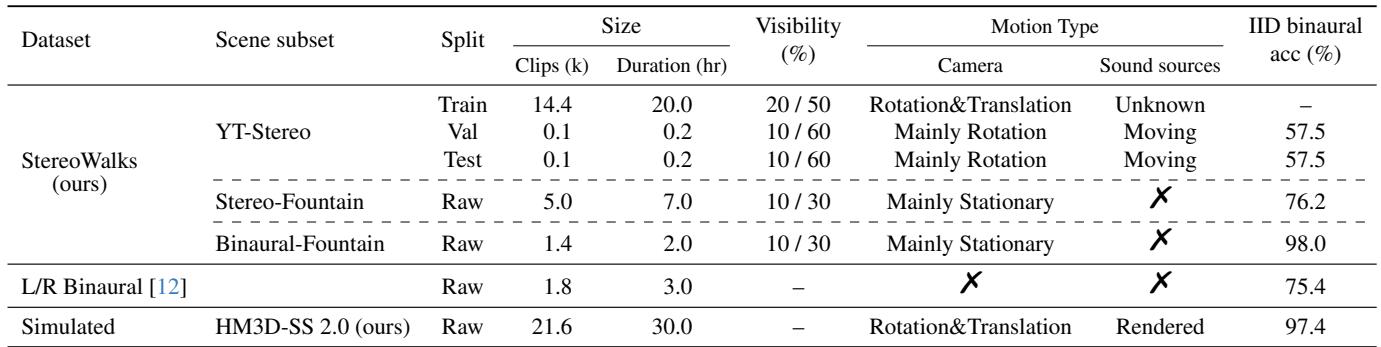
Table 1 highlights a key distinction: while simulated datasets offer perfect visibility and control, StereoWalks provides the noisy, unpredictable conditions necessary for robust real-world learning.
Outperforming Baselines
The researchers compared their method against several baselines, including models trained on simulated data (GTRot) and models using only IID cues.
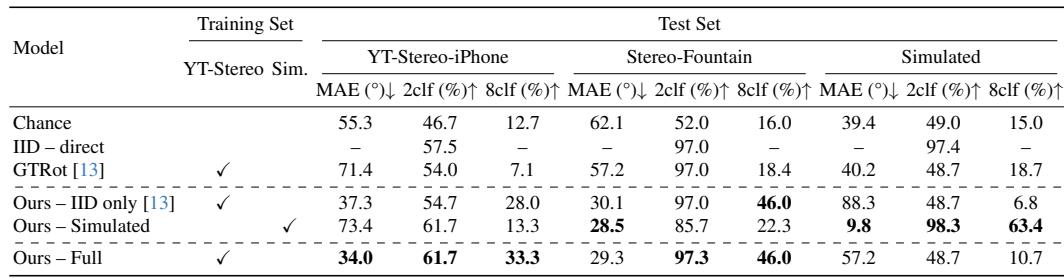
Table 2 reveals the main finding: Training on real data (Ours-Full) significantly outperforms training on simulated data when tested in the real world.
- The “Simulated” model struggles to generalize to the YT-Stereo dataset (MAE of \(73.4^{\circ}\)), likely due to the domain gap between synthetic rooms and city streets.
- The “Ours-Full” model achieves a much lower Mean Absolute Error (MAE) of \(34.0^{\circ}\) on the challenging YT-Stereo-iPhone set.
Visualizing the Success
The quantitative numbers are backed up by qualitative visualizations. In Figure 4 below, we can see the model’s predictions (peach lines) closely tracking the ground truth (orange dashed lines) for various sound sources like footsteps, speech, and music.
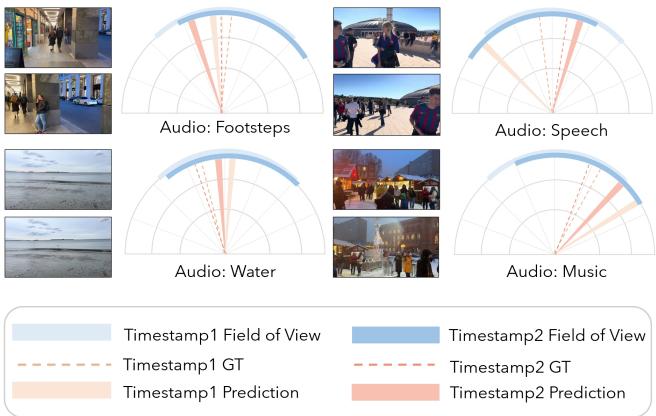
Notice how the model successfully tracks the sound source as it moves through the field of view. This confirms that the model isn’t just memorizing static cues; it understands the dynamic relationship between the observer and the sound.
Why Does It Work Better?
Real-world audio is messy. Sounds overlap, fade in and out, and move unpredictably. The authors hypothesized that their method is more robust to these conditions.

Table 4 confirms this hypothesis. In scenarios with overlapping and intermittent sounds (Settings 2 and 3), the egomotion-supervised model (“Ours-Full”) maintains accuracy much better than the simulation-trained baselines. The geometric constraints provided by camera motion seem to help the model disentangle complex auditory scenes.
The Role of Translation vs. Rotation
An interesting nuance of the research is the breakdown of motion types. Does the model learn more from the camera turning (rotation) or walking forward (translation)?
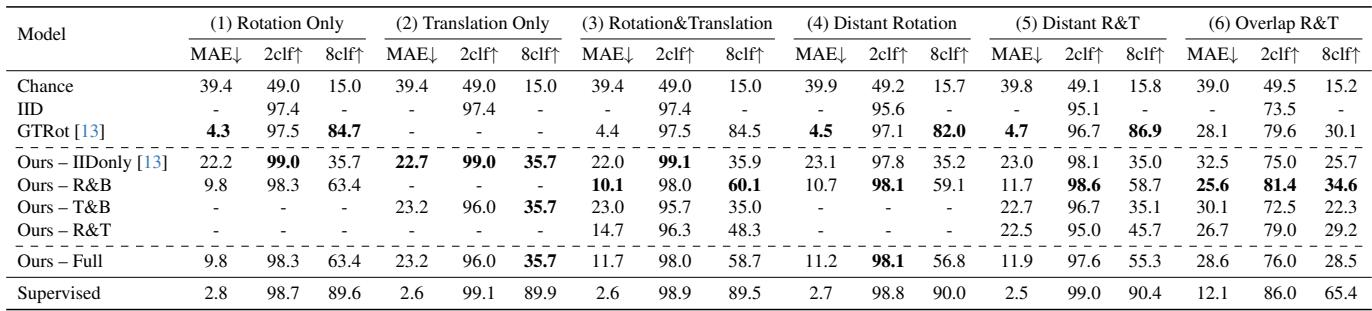
Table 5 suggests that rotation is generally the stronger signal. Because sound sources in walking tours are often distant, walking forward a few meters doesn’t change the sound’s angle much. However, rotating the camera changes the angle immediately and significantly. That said, including translation loss (“Ours-Full”) still provides the most robust performance across different scenarios.
Addressing Front-Back Confusion
A classic problem in stereo audio (two microphones) is distinguishing sounds in front of you from sounds behind you. Without the complex shape of the human ear (pinna) to filter sound, a stereo mic hears front and back almost identically.

Table 6 shows an interesting comparison between recording devices. The Binaural-Fountain dataset (recorded with in-ear microphones) allowed for much higher accuracy in Front/Back localization (69.3%) compared to the standard Stereo-Fountain (iPhone) dataset (51.0%). This highlights that while egomotion helps, hardware limitations of standard phones still pose a challenge for resolving front-back ambiguity.
Conclusion & Implications
This paper presents a significant step forward in audio-visual learning. By cleverly utilizing the geometric relationship between sight and sound, the authors created a system that learns to localize sound from ordinary, unlabeled videos.
Key Takeaways:
- Egomotion is a powerful teacher: We don’t always need human labels. The physics of how the world moves relative to us provides a rich supervisory signal.
- Real data beats simulation: For “in-the-wild” tasks, training on messy, real-world data (even with weak supervision) yields better results than training on pristine simulations.
- Geometry + Deep Learning: The success of this method comes from combining deep learning (ResNet) with classical computer vision geometry (Rotation/Translation matrices).
Future Potential: This technology opens the door to using the millions of hours of video available on platforms like YouTube to train sophisticated spatial audio models. In the future, this could improve hearing aids, allow robots to navigate toward sounds in disaster zones, or create more immersive augmented reality experiences where virtual sounds are perfectly anchored to the real world. By teaching machines to “hear” motion, we bring them one step closer to perceiving the world as we do.