](https://deep-paper.org/en/paper/file-2273/images/cover.png)
Introduction
Imagine your typical morning routine. You aren’t just a robot executing one program file named make_breakfast.exe. You turn on the stove to cook oatmeal, and while that simmers, you turn around to grind coffee beans. Maybe you pause to pack a lunch. You are interleaving steps from multiple different tasks into a single, continuous flow of activity.
For humans, this is second nature. For Artificial Intelligence, specifically Computer Vision systems, this is a nightmare.
Most current research in Temporal Action Segmentation (TAS)—the field responsible for teaching computers to recognize and break down video into distinct steps—focuses on “single-task” scenarios. Models are trained on videos where a person does one thing from start to finish. But the real world is messy, chaotic, and filled with multitasking.
In this post, we are diving deep into a CVPR paper titled “Understanding Multi-Task Activities from Single-Task Videos.” The researchers propose a fascinating framework that trains AI on simple, single-task videos but enables it to understand complex, multi-task scenarios.
The Problem: The Gap Between Training and Reality
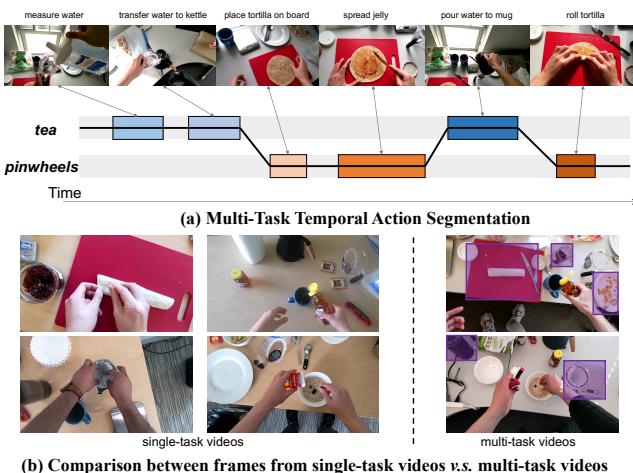
As illustrated in Figure 1 above, there is a fundamental disconnect between how we currently train AI and how we expect it to perform.
In Single-Task Videos (Figure 1b, left), the environment is clean. If the video is about making tea, you only see tea-making objects. The sequence is linear.
In Multi-Task Videos (Figure 1b, right), the environment is cluttered. You might see a jar of peanut butter (for a sandwich) sitting on the counter while the person is pouring water (for tea). Furthermore, the timeline (Figure 1a) is fragmented. The “Tea” task is interrupted by the “Pinwheels” task, then resumed.
The researchers identified two major hurdles:
- Contextual Bias: Existing models get confused when they see objects irrelevant to the current action (e.g., seeing a coffee grinder while making oatmeal).
- Data Scarcity: It is incredibly difficult and expensive to collect and annotate datasets that cover every possible combination of interleaved tasks.
The Solution: The MT-TAS Framework
To solve this, the authors introduce a framework for Multi-Task Temporal Action Segmentation (MT-TAS). The genius of this approach is that it only requires single-task videos for training. It synthetically generates multi-task data to prepare the model for the real world.
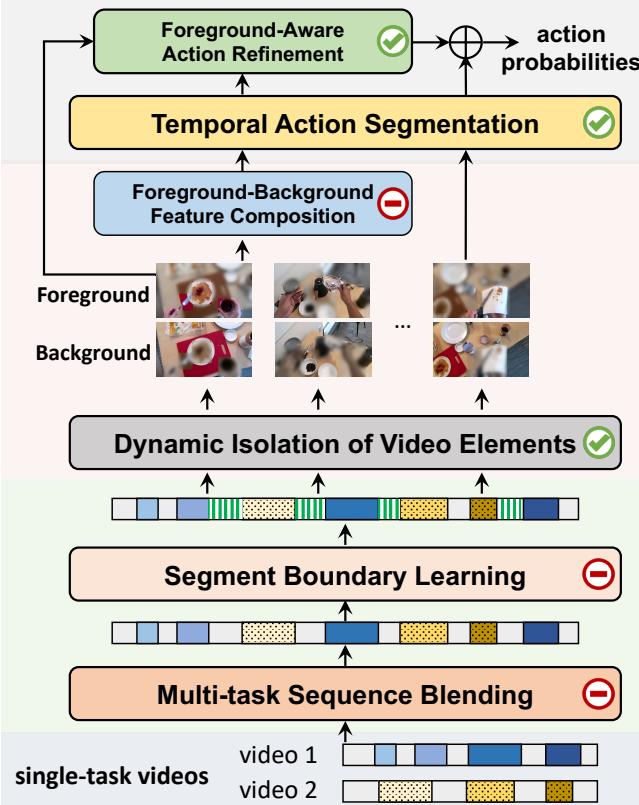
As shown in Figure 2, the framework is composed of four key modules designed to bridge the gap between single-task training and multi-task testing. Let’s break them down step-by-step.
1. Multi-Task Sequence Blending (MSB)
Since we don’t have labeled multi-task videos, we have to make them. However, we can’t just randomly stitch video clips together. It wouldn’t make sense to “pour water” and immediately “put on shoes” if those tasks don’t happen in the same room.
The researchers employ a Large Language Model (LLM) to act as the “brain” of the operation. They feed the LLM the current action and ask it a logic question: Is it plausible to switch tasks now, or should we continue the current task?
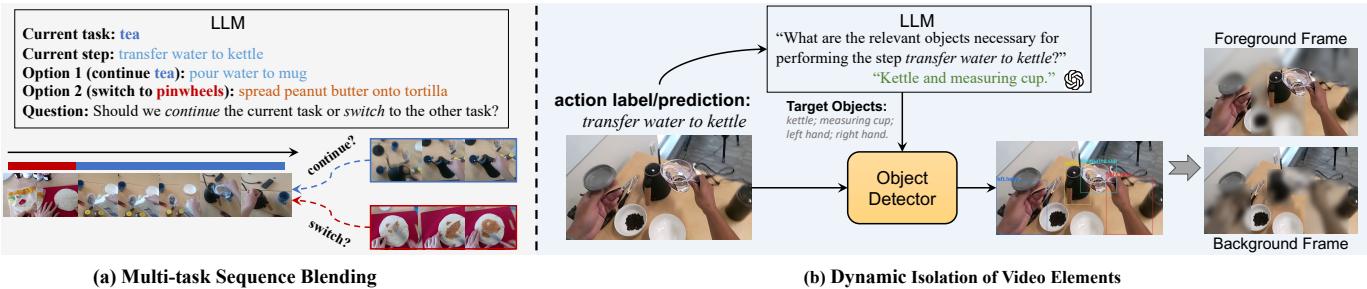
Look at Figure 3(a). If the current step is “turning on the kettle,” it makes sense to switch tasks because you have to wait for the water to boil. If the step is “scooping jelly,” you shouldn’t switch until you’ve spread it. By using an LLM to guide these transitions, the Multi-Task Sequence Blending (MSB) module creates synthetic training videos that follow human common sense.
2. Segment Boundary Learning (SBL)
When you stitch two different videos together, the transition is visually jarring. The lighting might change, or the camera angle might shift instantly. These “jump cuts” don’t happen in real continuous videos, and they can confuse the AI.
To fix this, the authors introduce Segment Boundary Learning (SBL). The goal is to smooth out the features at the points where tasks switch.
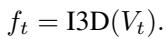
First, the model extracts features (\(f_t\)) from the video using a standard 3D Convolutional Neural Network (I3D):
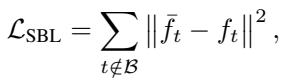
The SBL module then tries to reconstruct the feature at a specific frame (\(\bar{f}_t\)) using the frames surrounding it, excluding the immediate neighbors to avoid trivial copying:

The system is trained to minimize the difference between the reconstructed feature and the original feature for non-boundary frames. By learning to predict smooth transitions, the model can “hallucinate” smoother boundaries where the synthetic cuts occur.
3. Dynamic Isolation of Video Elements (DIVE)
This is perhaps the most visually intuitive part of the paper. In a multi-task scenario, your kitchen counter is messy. You have ingredients for Task A and Task B out at the same time. Single-task training videos are usually too tidy.
The Dynamic Isolation of Video Elements (DIVE) module creates “Frankenstein” frames to simulate this clutter.
- Identify Relevant Objects: The system asks an LLM: “What objects are needed for transferring water to kettle?” The LLM replies: “Kettle and measuring cup.” (See Figure 3(b)).
- Separate Foreground/Background: Using an open-vocabulary object detector (GroundingDINO), the system finds those specific objects and the user’s hands. This is the Foreground. Everything else is Background.
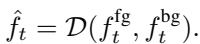
The system then extracts features for the foreground (\(f^{fg}\)) and background (\(f^{bg}\)) separately using Gaussian blurring masks (\(M\)):

Now comes the clever part: Foreground-Background Feature Composition (FBFC). To simulate a messy multi-task environment, the model takes the foreground of the current task and mixes it with the background of a completely different task video.

Here, \(\beta\) controls how much of the “foreign” background is mixed in. The decoder then reconstructs a new, synthetic feature that combines the correct action (foreground) with a complex, distractor-filled background (mixed background).
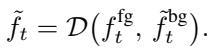
This forces the AI to learn that the “background noise” doesn’t matter—only the relevant objects do.
4. Foreground-Aware Action Refinement (FAAR)
All the previous steps happen during training. But what happens when the model is actually running on a test video?
The researchers introduce a two-stage process called Foreground-Aware Action Refinement (FAAR).
- Stage 1: The base model makes an initial prediction of what is happening (\(p_t\)).
- Stage 2: The model looks specifically at the foreground (the hands and relevant objects identified earlier) and makes a second prediction (\(p_t^{fg}\)).
The final prediction is a weighted average of the general view and the focused foreground view. This ensures that even if the background is confusing, the model stays focused on the active objects.
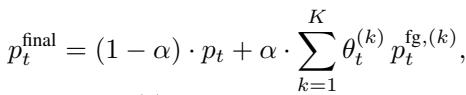
Here, the weights \(\theta\) ensure the model prioritizes the most likely actions.
Experimental Results
To test this framework, the authors couldn’t use existing datasets—they were all single-task! So, they collected a new dataset called MEKA (Multi-task Egocentric Kitchen Activities), consisting of 12 hours of footage where participants performed interleaved cooking recipes.
Offline Performance
“Offline” segmentation means the model can see the whole video at once (past and future frames) to make a decision.
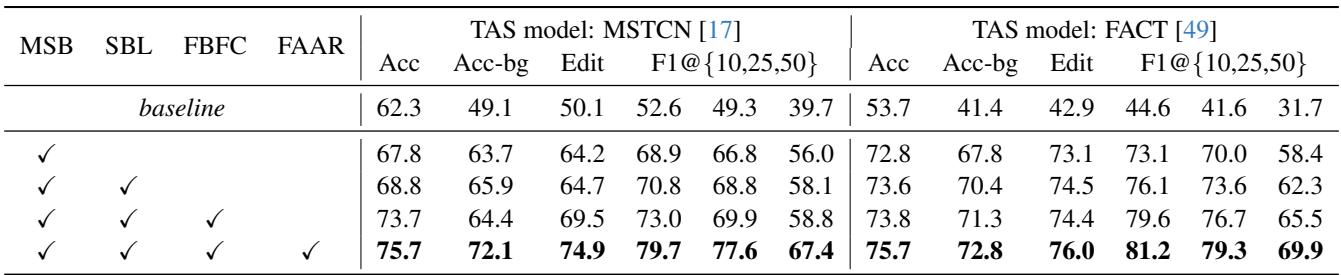
Table 1 shows the results.
- Baseline: Standard models (MSTCN and FACT) trained on single-task data perform poorly (approx. 49-62% accuracy).
- With MT-TAS: As the researchers added their modules (MSB, SBL, FBFC, FAAR), performance skyrocketed. The full framework achieved 75.7% accuracy with MSTCN and 77.6% with FACT. This proves that synthetic data blending and foreground focus significantly help the model generalize.
Online Performance
“Online” segmentation is harder because the model processes the video in real-time and can’t see the future.
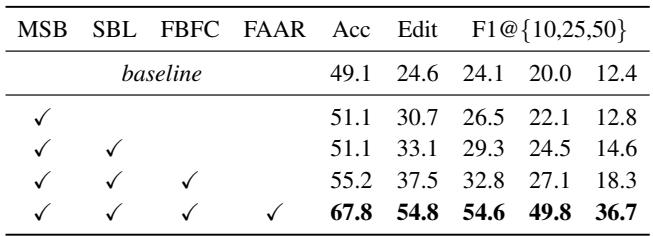
As shown in Table 2, the trend holds. The baseline model achieved only 49.1% accuracy. With the full MT-TAS framework, accuracy jumped to 67.8%. The FAAR module (Foreground-Aware Action Refinement) was particularly critical here, providing a massive boost by helping the model ignore irrelevant past context and focus on what the hands were doing right now.
Qualitative Analysis: Seeing the Blend
It helps to visualize what the FBFC module is actually doing to the data.
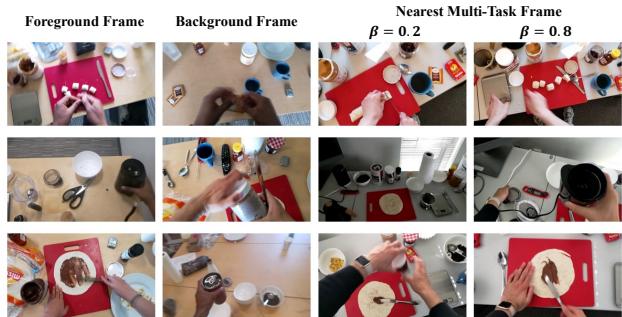
Figure 5 shows the synthetic blending in action.
- Left column: The foreground action (e.g., pouring syrup).
- Middle column: The background from a different task.
- Right columns: The synthetic frames created by mixing features.
- When \(\beta\) is low (0.2), the image looks more like the background.
- When \(\beta\) is high (0.8), the relevant objects (syrup bottle) become clear.
By training on these variations, the model learns to recognize “pouring syrup” regardless of whether there is a clean counter or a messy pile of dishes behind it.
Ablation Studies: Does Foreground Matter?
Finally, the researchers asked: Does focusing on the foreground actually help, or does it lose important context?
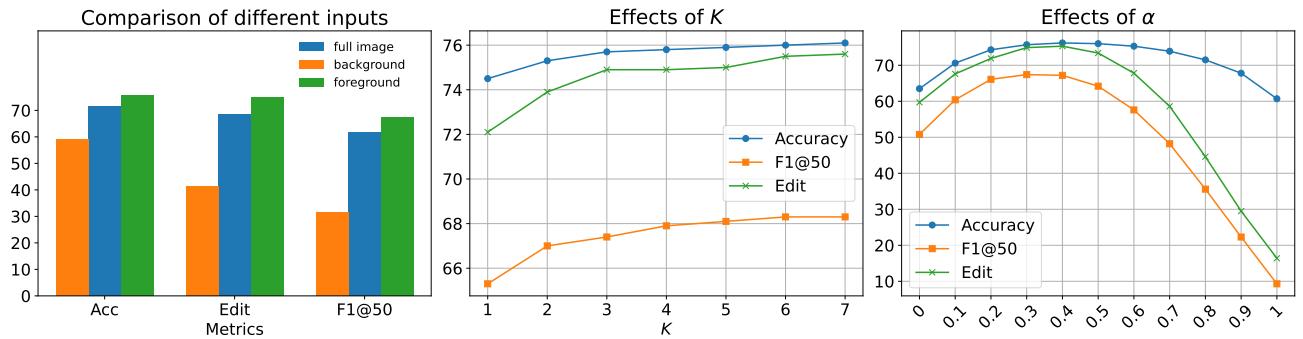
Figure 4(a) answers this clearly. Using “Full Image” features (Blue bar) gives decent results. Using “Background” only (Orange bar) destroys performance. But using “Foreground” features (Green bar) yields the highest accuracy. This confirms that in multi-tasking scenarios, the background is often just noise.
Conclusion
The MT-TAS framework represents a significant step forward in video understanding. It tackles the realistic problem of multi-tasking not by demanding expensive new datasets, but by smarter use of existing data.
By using LLMs to simulate logic, blending algorithms to simulate clutter, and object detection to focus attention, this approach successfully teaches AI to separate the signal from the noise.
Key Takeaways:
- Synthetic Data Works: You can train on simple data to solve complex problems if you synthesize the complexity intelligently.
- Context Management: In multi-tasking, knowing what to ignore (background clutter) is just as important as knowing what to track.
- LLMs in Vision: Large Language Models are proving to be excellent “directors” for computer vision tasks, providing the common sense needed to structure visual data.
As we move toward more advanced home robots and assistants, frameworks like MT-TAS will be essential for machines that can truly understand the chaotic, interleaved nature of human daily life.