](https://deep-paper.org/en/paper/file-2279/images/cover.png)
Introduction
Imagine a camera that works like the human eye. It doesn’t take snapshots frame-by-frame; instead, it only reacts when something changes. If you stare at a perfectly still wall, your optic nerve stops firing signals about the wall (though your eyes make tiny, imperceptible movements to prevent this blindness).
This is the principle behind Event Cameras (or Dynamic Vision Sensors). They are revolutionary pieces of technology that capture brightness changes asynchronously with microsecond precision. They excel at capturing high-speed motion—think catching a bullet in flight or a drone dodging obstacles—without the motion blur or low dynamic range of standard cameras.
However, event cameras have a massive “blind spot”: Static Scenes. If the camera is on a tripod and the scene isn’t moving, the sensor generates almost no data. In a video reconstruction, this results in a moving object floating in a void of gray nothingness. The background—the context—is lost.
For years, researchers have tried to fix this by forcing camera movement or using strobe lights. But what if the “noise” the camera generates when it’s idle isn’t actually noise?
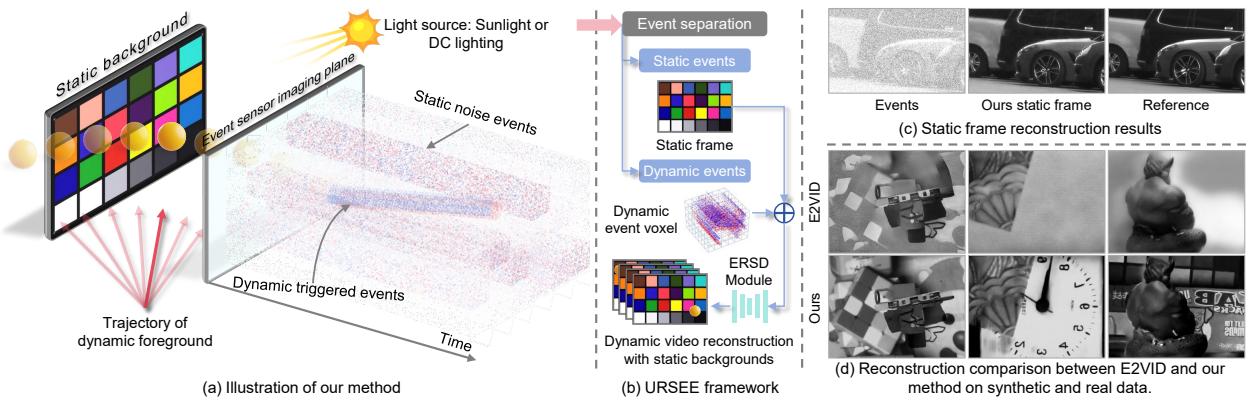
In this post, we dive into URSEE (Unified Reconstruction of Static and dynamic scEnes from Events). This paper introduces a novel framework that treats static “noise” as a signal, allowing for the reconstruction of high-fidelity video that includes both high-speed motion and detailed static backgrounds.
The Paradox of the Event Camera
To understand the breakthrough of URSEE, we must first understand the fundamental limitation it solves.
Standard cameras capture absolute intensity (brightness) at fixed intervals (e.g., 30 frames per second). Event cameras, however, report brightness changes. A pixel only “speaks” if the log intensity changes by a certain threshold.
- Dynamic Scene: An object moves. Pixels fire rapidly. We get a stream of data.
- Static Scene: Nothing moves. Pixels remain silent. We get silence.
Current state-of-the-art reconstruction networks, like E2VID, take these event streams and turn them into video. But because static backgrounds don’t generate events, E2VID cannot “see” the background. It creates a “ghostly” video where moving edges are visible, but the wall behind them is invisible.
The researchers behind URSEE asked a critical question: Is the camera truly silent in a static scene?
Part 1: The Physics of “Static” Events
Contrary to popular belief, event cameras do trigger events in static scenes. These are usually dismissed as “noise” or “leakage currents.” However, the authors of this paper discovered that this noise is not random; it is statistical.
They conducted a series of experiments using a DC light source (to prevent flickering) and a Macbeth ColorChecker (a standard calibration chart) to analyze how event cameras behave when staring at a still object.
The Intensity-Event Relationship
The results, shown in the figure below, reveal a distinct relationship between Ambient Brightness, Reflectance, and Event Count.
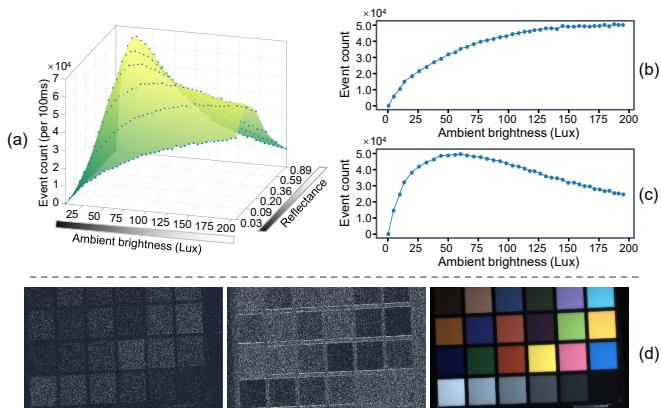
Look closely at the graphs in Figure 2:
- Low Reflectance (Darker objects): As brightness increases, the number of “noise” events increases (Graph b).
- High Reflectance (Brighter objects): There is an inflection point. The event count rises, hits a peak around 60-70 Lux, and then actually decreases (Graph c).
This implies that the “noise” carries information about the texture and brightness of the static scene. The event camera is essentially performing a stochastic (random) sampling of the static scene intensity over time. If we accumulate these events long enough, we should theoretically see the image.
Part 2: Reconstructing the Static Background
Knowing that static events contain data is step one. Turning that noisy data into a clean image is step two.
The Problem with Pixel-Wise Integration
The naive approach is Pixel-wise Integration: simply counting the events at every pixel over a few seconds and mapping that count to a brightness value.
This fails for two reasons:
- Noise Accumulation: The signal is weak, and random noise makes the image look like “salt and pepper” static.
- Event Saturation: Over a long exposure, pixels might hit a maximum limit, pushing values to 0 or 255 (pure black or pure white), destroying contrast.
The Solution: Convolutional Integration
The authors propose Convolutional Integration. Instead of treating each pixel as an island, they use a \(3 \times 3\) convolutional kernel (a mean filter) during the integration process.
This acts as a spatial smoother. It aggregates information from neighboring pixels, which drastically reduces the “salt and pepper” noise and prevents extreme value polarization (where pixels get stuck at max brightness).
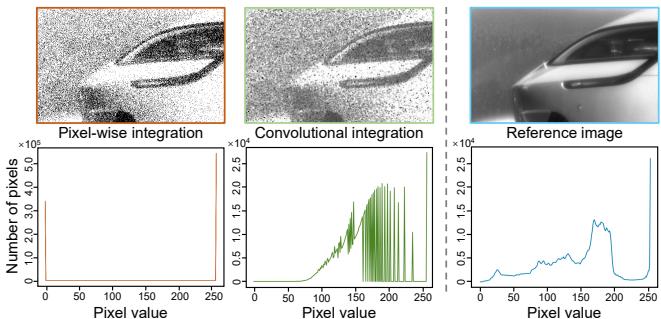
As visible in Figure 3, the difference is stark. The “Pixel-wise” car image is barely recognizable and grainy. The “Convolutional integration” image clearly shows the headlights and grille. The histogram (bottom) confirms that the convolutional method preserves a healthy distribution of mid-tone grays, whereas the pixel-wise method pushes everything to the dark left side.
The SRD Module (Denoising)
Even with convolutional integration, the image isn’t perfect. To bridge the gap to standard photography, the authors introduce the SRD Module (Static Reconstruction Denoising).
This is a neural network based on the U-Net architecture. It is trained to take the convolutional integration result and predict a clean, high-fidelity grayscale image. It uses channel attention mechanisms to understand global noise characteristics and filter them out.
Part 3: The URSEE Framework
Now we have a way to get a static background. But the goal is video. We need to combine this static background with the high-speed moving objects that event cameras are famous for.
This brings us to the URSEE Framework (Unified Reconstruction of Static and dynamic scEnes).
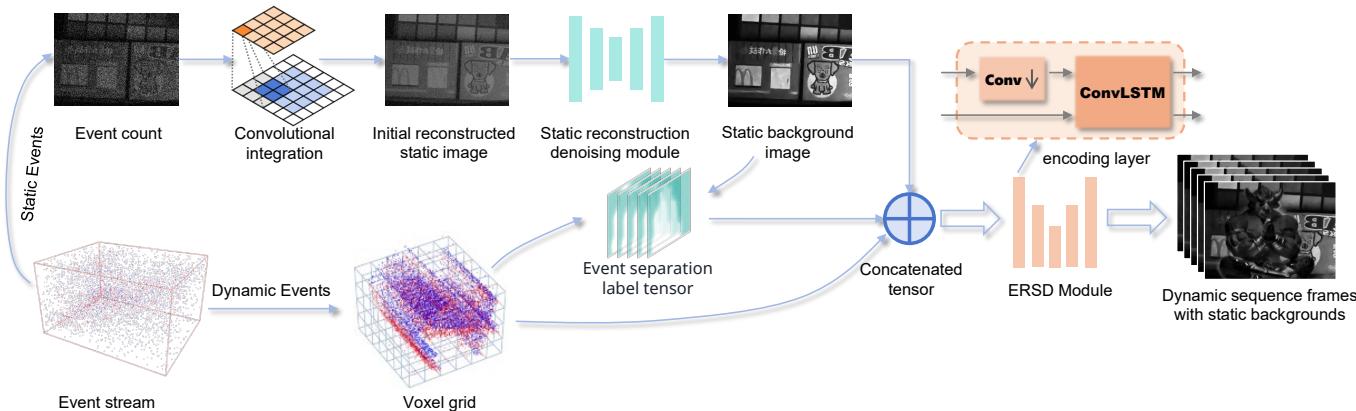
The pipeline, illustrated in Figure 4, operates in three distinct phases:
1. Event Separation
The raw data stream contains a mix of “static noise” (background) and “dynamic motion” (foreground). The system uses a spatiotemporal window (\(20 \times 20\) pixels, 10ms) to analyze the stream.
- If the event count in a window exceeds a threshold \(\rightarrow\) Dynamic Event (Object moving).
- If the count is low \(\rightarrow\) Static Event (Background noise).
2. Parallel Processing
The stream splits into two channels:
- Static Channel: The static events are processed via Convolutional Integration and the SRD Denoising Module (as explained above) to create a single, clean Static Background Frame.
- Dynamic Channel: The dynamic events are converted into Voxel Grids. A voxel grid is a 3D representation (width \(\times\) height \(\times\) time) that preserves the precise timing of the motion.
3. Fusion and the ERSD Module
This is the heart of the system. The framework concatenates three things into a massive tensor:
- The Clean Static Background.
- The Dynamic Voxel Grids.
- An Event Separation Label Tensor (a map telling the network which pixels are static and which are dynamic).
This fused tensor is fed into the ERSD Module (Event-based Reconstruction Network with Static and Dynamic Elements).
The ERSD is a Recurrent Neural Network using ConvLSTM (Convolutional Long Short-Term Memory) units. Why LSTM? Because video is temporal. The network needs to remember what happened in the previous frame to ensure motion is smooth and the background remains stable over time.
Experiments and Results
To train and test this system, the researchers couldn’t rely on existing datasets because those datasets mostly ignored static backgrounds. They created two new ones:
- E-Static: Real-world data captured with a hybrid setup (Event camera + Standard RGB camera) for ground truth.
- E-StaDyn: A synthetic dataset where they simulated events from 3D rendered scenes, allowing them to have perfect ground truth for complex motion.
Static Reconstruction Results
First, let’s look at how well URSEE recovers just the static images compared to other methods like E2VID or FireNet.
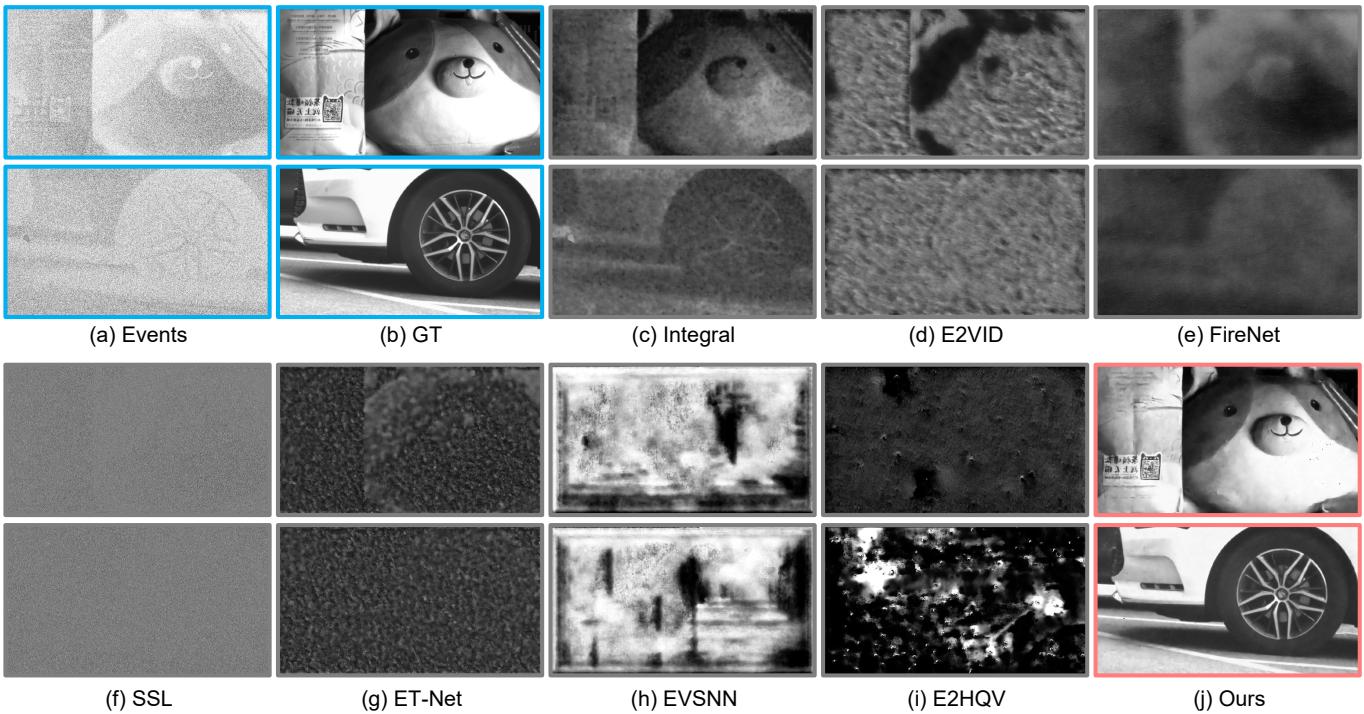
In Figure 5, the results are undeniable. Look at column (d) for E2VID—it is almost completely gray. Because E2VID relies on motion, it fails to see the static paintings or the shelf. Column (j), URSEE, recovers the text on the books, the texture of the paintings, and the sharp edges of the objects, almost matching the Ground Truth (b).
The quantitative data supports this visual check:

URSEE achieves a PSNR (Peak Signal-to-Noise Ratio) of 22.43, nearly double that of E2VID’s 9.35. In image reconstruction, a gap that large represents a fundamental shift in quality.
Dynamic Video Results
The ultimate test is video. Can URSEE keep that background stable while a robot arm or a pigeon moves in front of it?
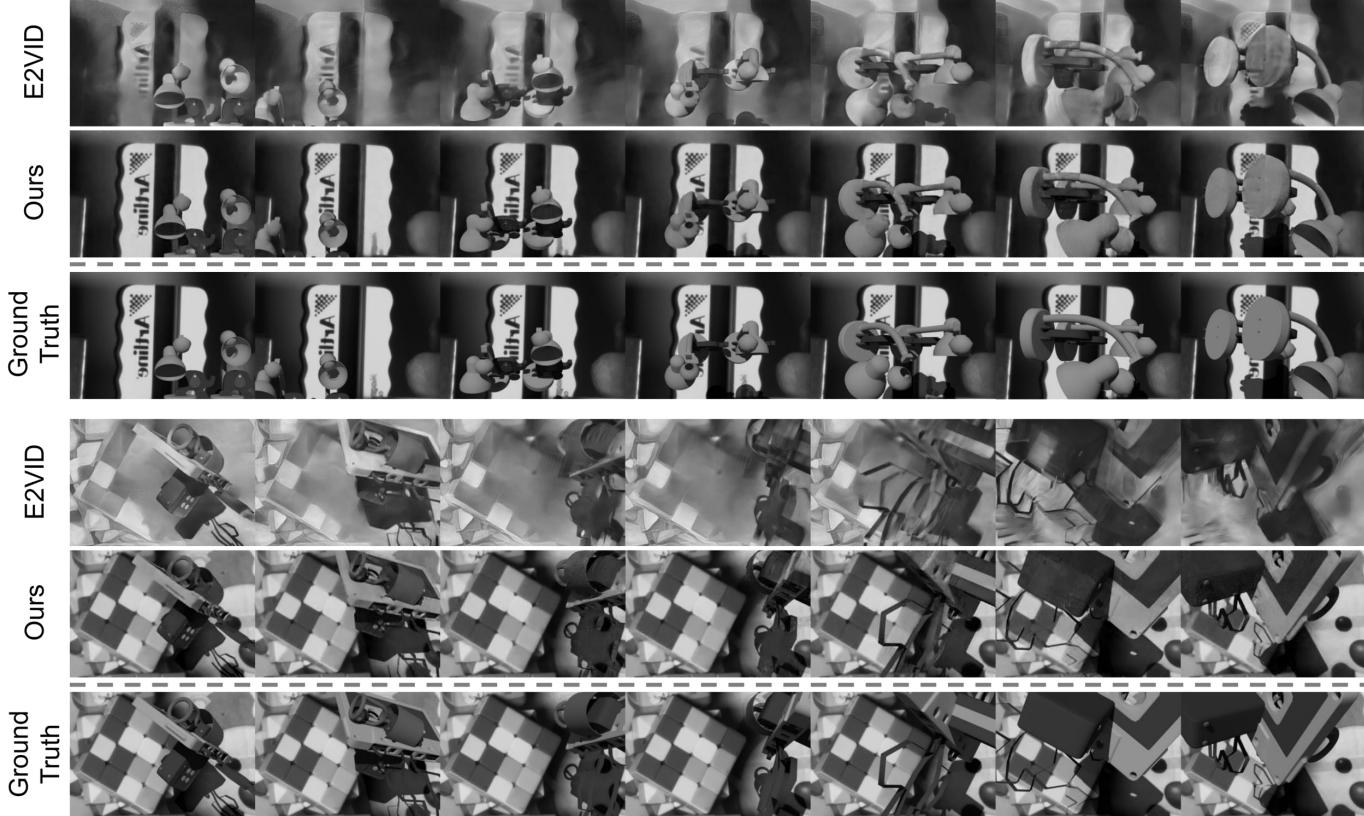
Figure 6 compares the methods on synthetic data.
- Top (E2VID): Notice the “ghosting.” In the top row, the logo on the wall appears and disappears. In the bottom row, the mechanical parts are blurry blobs. E2VID struggles because it only sees the background when the foreground object moves over it, triggering changes.
- Middle (URSEE): The background logo and the mechanical parts remain crisp and stable throughout the sequence. The motion of the foreground object is reconstructed with high fidelity.
This performance holds up in the real world as well.
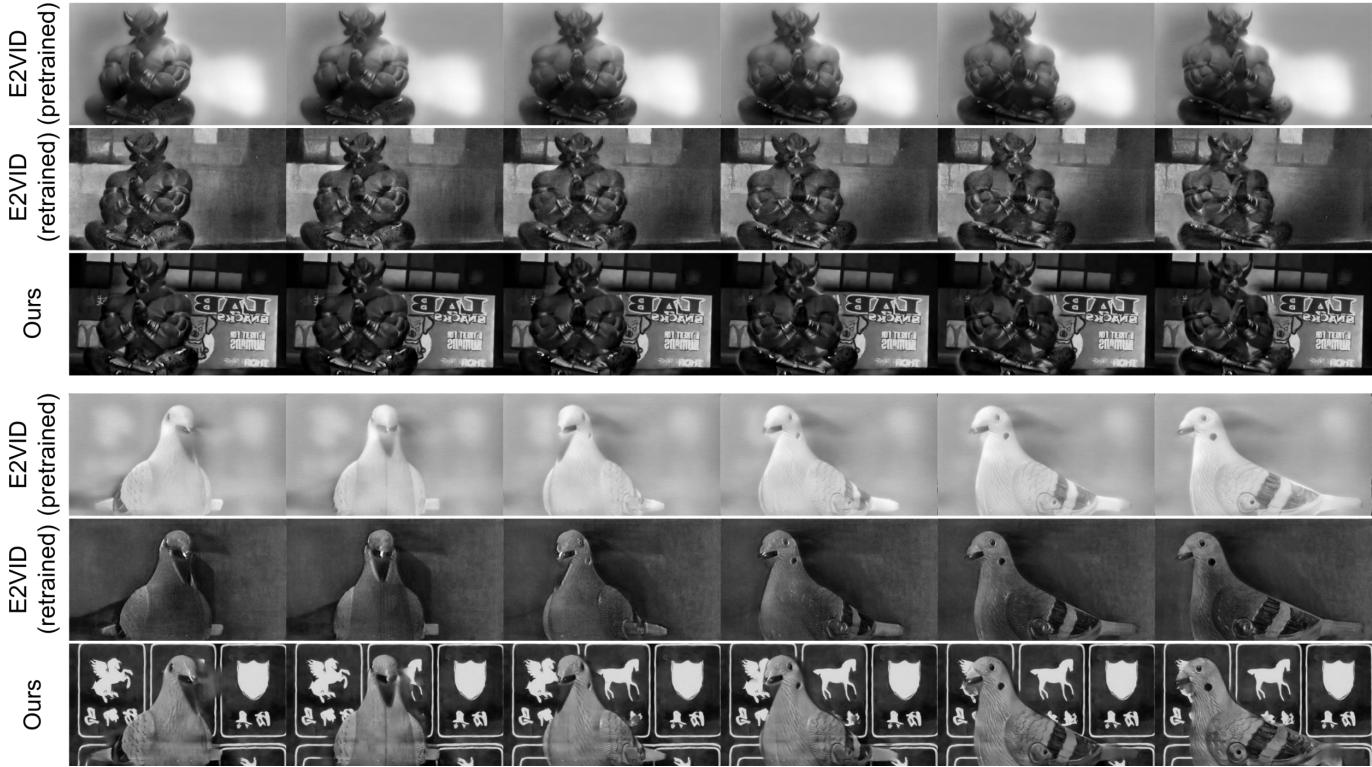
In Figure 7, look at the bottom row with the pigeon. In the E2VID versions (top and middle), the checkered background is a muddy gray mess. In the URSEE version (bottom), you can clearly see the grid pattern of the background while the white pigeon flaps its wings.
Conclusion and Implications
The URSEE framework represents a significant step forward for neuromorphic engineering. By refusing to treat static events as “useless noise,” the researchers have unlocked the ability for event cameras to function more like comprehensive vision sensors.
Key Takeaways:
- Noise is Data: Static scenes generate statistical event patterns that can be decoded into intensity images.
- Convolutional Integration: Simple spatial filtering is essential to prevent noise accumulation in static reconstruction.
- Unified Architecture: Successfully reconstructing video requires treating static and dynamic events separately before fusing them, rather than forcing a single network to do it all.
This technology has vast implications. It could allow autonomous vehicles to use power-efficient event cameras for everything—detecting a speeding car (dynamic) and reading the stop sign it ran (static)—without needing a secondary standard camera. It bridges the gap between the efficiency of biological vision and the clarity of digital photography.